Turning the tide with a massive rebound! What's next for Tesla?
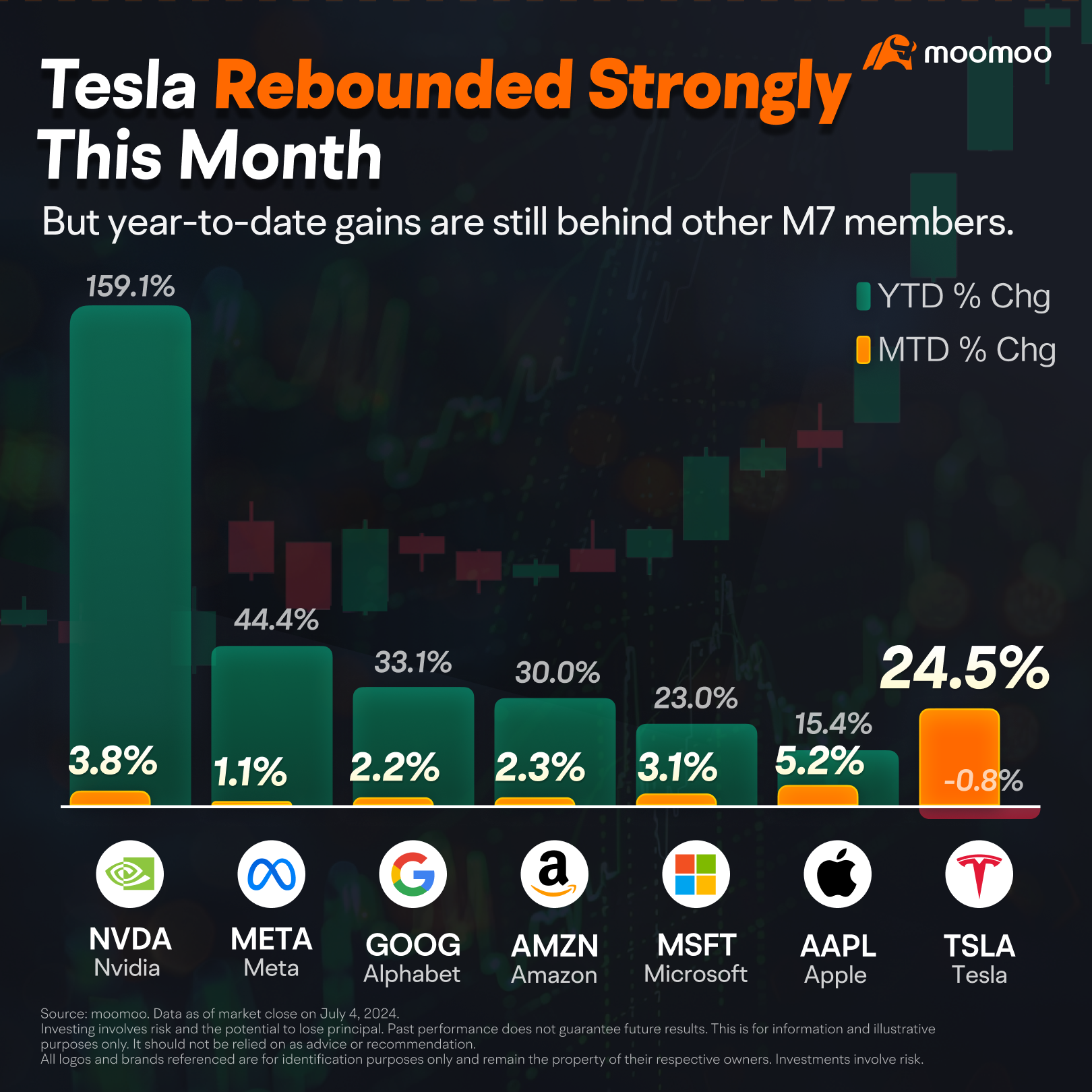
The Magnificent Seven (M7), a group of leading tech stocks, collectively spearheaded the U.S. stock market in 2023. However, as we move into 2024, their trajectories have noticeably diverged.
Nvidia ($NVIDIA(NVDA.US)$) continues to lead the pack, while the other giants also maintain impressive performances, with Apple ($Apple(AAPL.US)$) achieving the lowest increase but still surpassing 15%.
Tesla ($Tesla(TSLA.US)$), once the centerpiece of the market’s attention, has quietly relinquished its throne. Among the M7, which once shared the same prosperity, Tesla has spent most of this year lagging.
Since the beginning of the year, Tesla’s stock price plunged due to declining vehicle deliveries, underwhelming financial reports, and waves of layoffs, even experiencing a drawdown of over 40%.
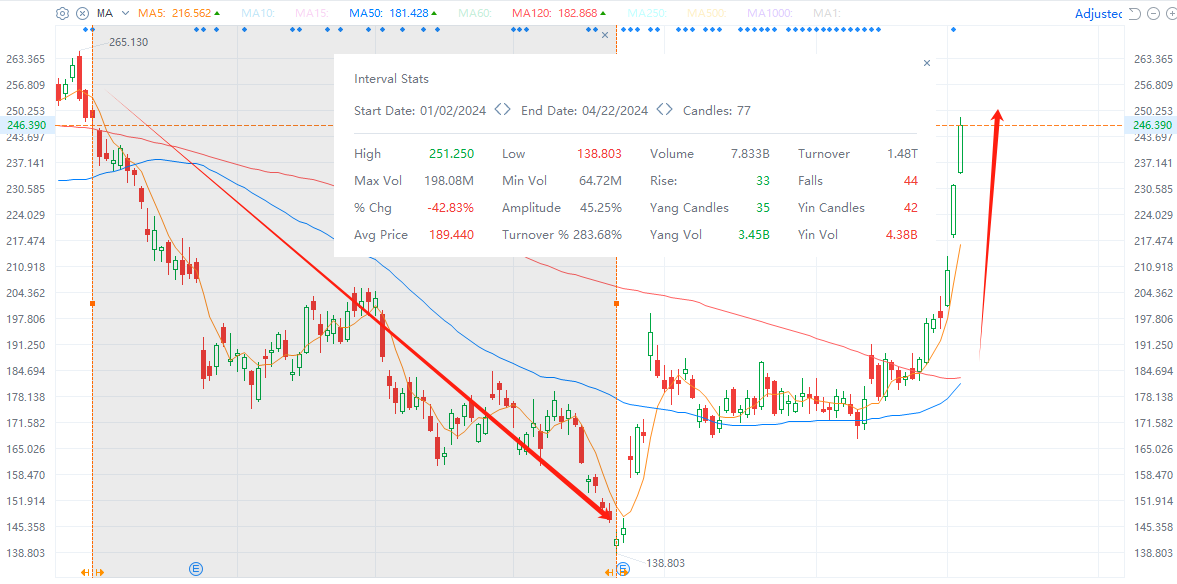
Source: moomoo. Data as of market close on July 4, 2024. Investing involves risk and the potential to lose principal. Past performance does not guarantee future results. This is for information and illustrative purposes only. It should not be relied on as advice or recommendation.
Following Elon Musk's visit to China at the end of April, Tesla successfully met the Chinese national automotive safety requirements, and the process of Full Self-Driving (FSD) entering the Chinese market accelerated.
This led to a rebound in stock prices, although performance remained lukewarm for some time. It wasn't until recently that Tesla experienced a strong surge, increasing nearly 25% within just a few trading days in July, pushing its year-to-date gains close to positive territory, making it the standout performer among the M7.
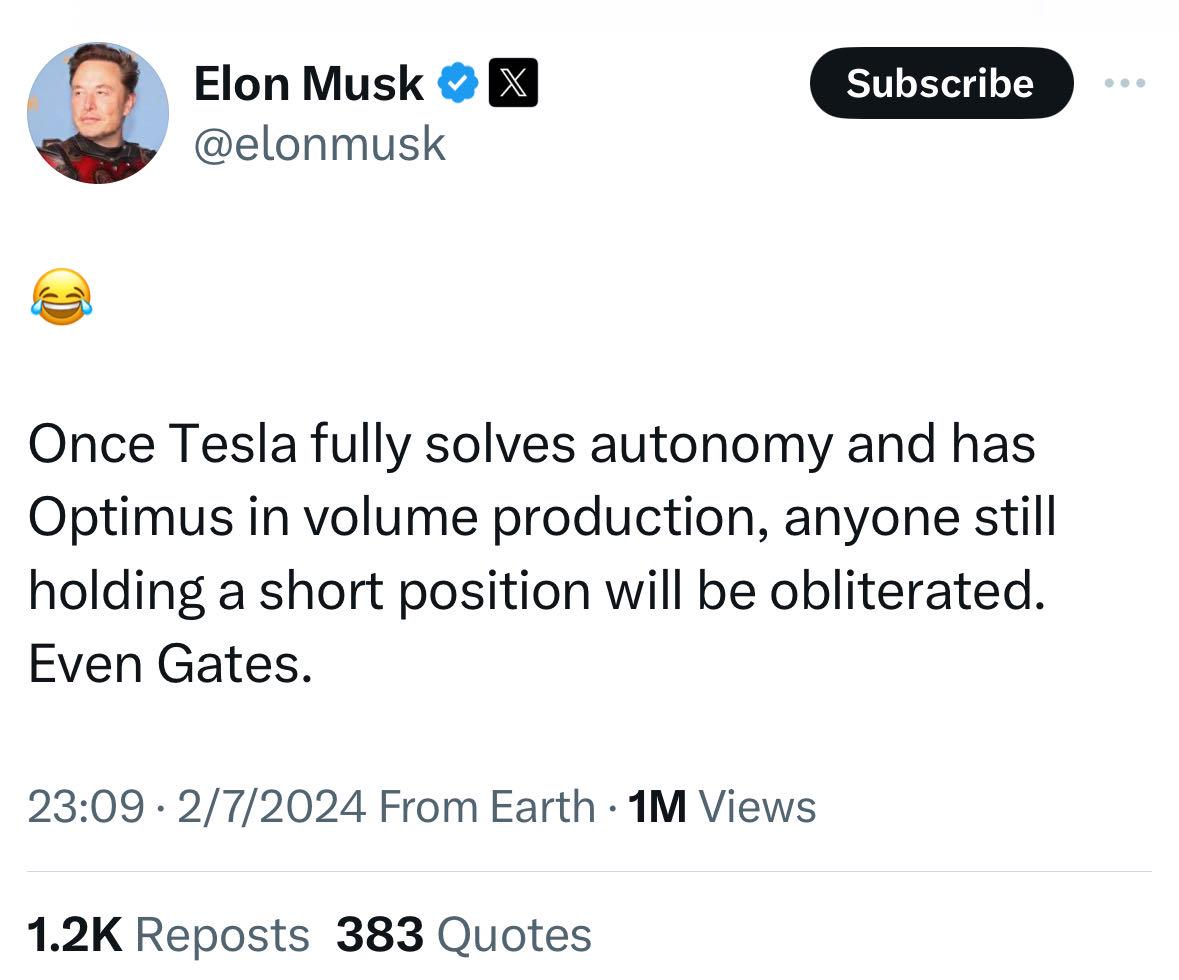
When asked about his views on Tesla short-sellers, Musk declared on X (formerly Twitter): “Once Tesla fully solves autonomy and has Optimus in volume production, anyone still holding a short position will be obliterated. Even Gates.”
Note: Optimus is a general-purpose robotic humanoid under development by Tesla.
So what factors have driven Tesla's surge recently?
Vehicle deliveries beat expectations
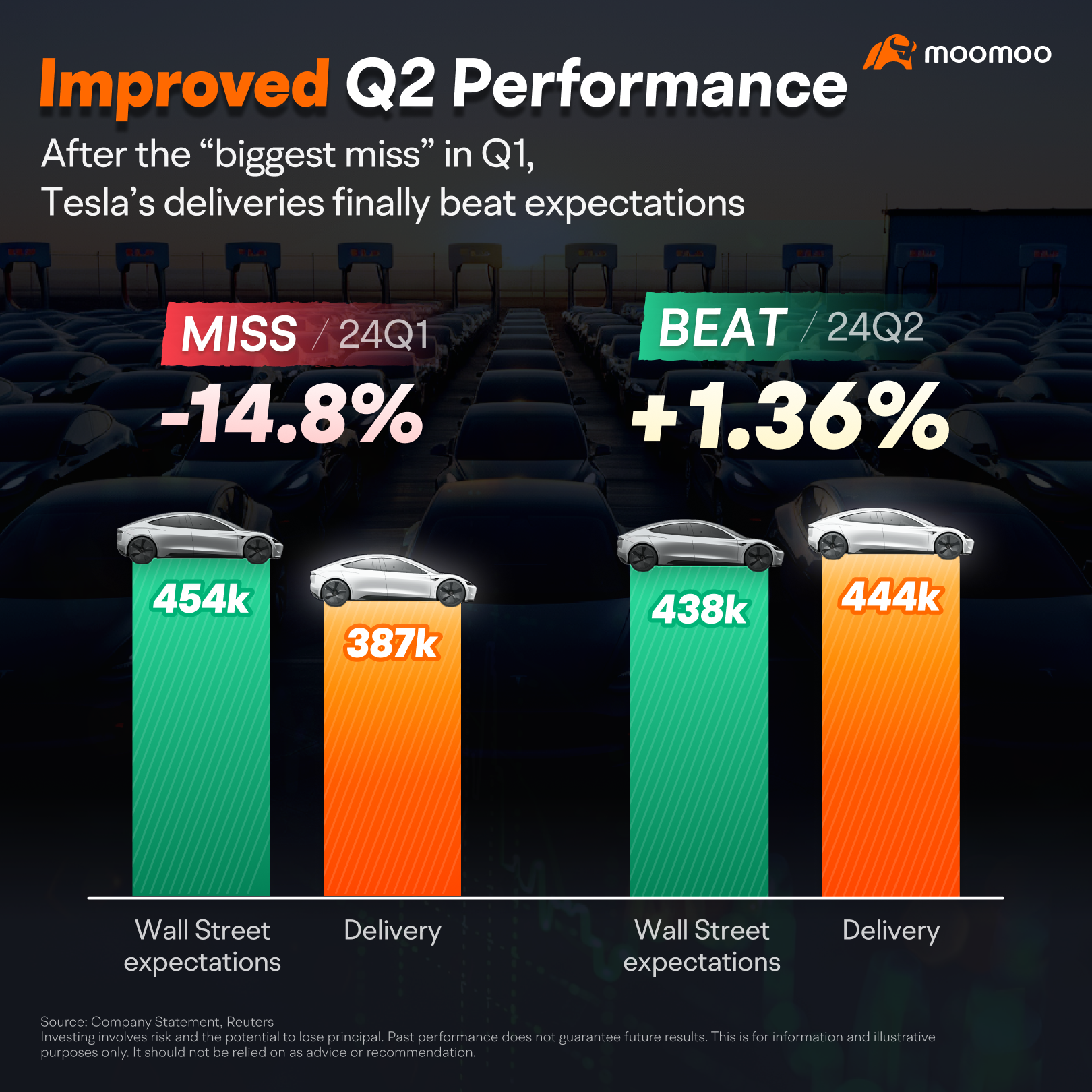
What ignited market enthusiasm was Tesla’s Q2 vehicle delivery data, released on July 2. In that quarter, Tesla delivered 443,956 vehicles, which fell 4.8% from last year but gained a quarter-over-quarter increase of 14.8%. And the market had expected around 438,000 deliveries.
The data only beat expectations slightly by about 6,000 vehicles or around 1.3%. Why did the stock surge over 10% that day?
Probably this was the first time Tesla's deliveries exceeded expectations after missing for three consecutive quarters. In the first quarter of 2024, the gap between Tesla’s actual deliveries and analyst expectations reached an unprecedented deviation of nearly 15%.
The release of Q2 data gave the market some relief. Although the year-over-year numbers still showed a decline, the better-than-expected deliveries indicated that Tesla remains resilient in the highly competitive electric vehicle market, and the deteriorating trend seen in Q1 had significantly eased.
Additionally, a detailed breakdown of the Q2 data reveals that June’s performance was better than that in April and May, especially in the European and North American markets.
Despite Tesla officially reporting delivery data every quarter and releasing it at the beginning of the following month, we can still use various methods to break down this data into higher frequency intervals.
Tesla’s main sales markets are Europe, North America, and China. In China, the China Automotive Technology and Research Center (CATARC) publishes monthly sales data for major automakers, including Tesla.
Some third-party market research firms also offer monthly sales data for the European and North American markets. Although these figures might slightly differ from Tesla’s official numbers, they still reflect the general trends.
The June data for the Chinese market was released on July 2 and did not exceed expectations. The previous two months also showed average performance in China. The data for April and May in the European and North American markets had already been released.
It is likely that the strong performance in June for Europe and North America, reflected in the overall quarterly data, has led to more optimistic expectations for Tesla’s future momentum.
Energy storage sector sees explosive growth
In addition to its automotive performance, Tesla's announcement showed significant progress in its energy storage business. In the second quarter of 2024, Tesla’s energy storage installations reached 9.4 GWh, representing a year-over-year increase of 157% and a quarter-over-quarter increase of approximately 132%.
This figure set a new historical record for single-quarter energy storage installations, driven primarily by Tesla’s expanded production capacity and the high demand in the energy storage industry.
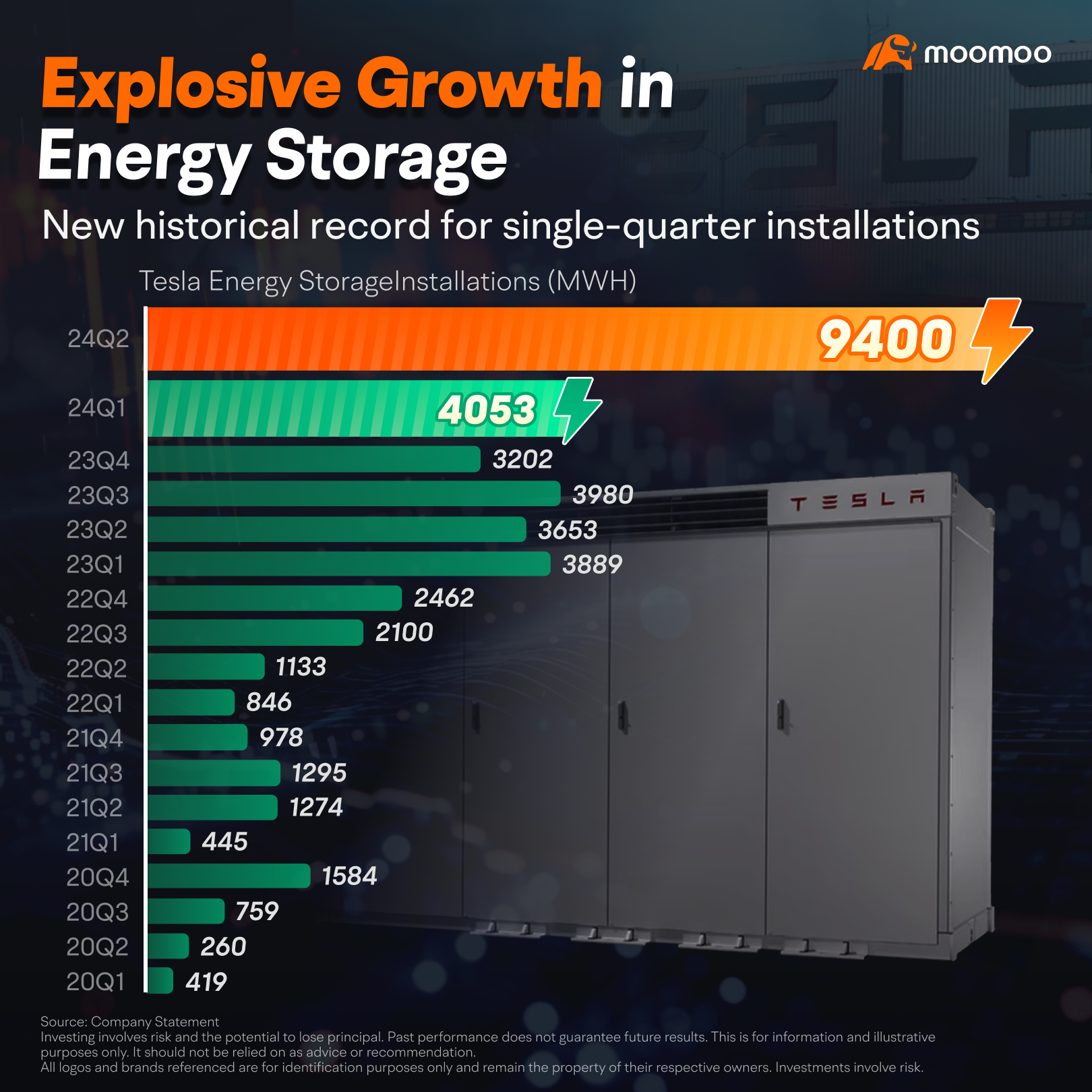
The energy storage business already showed positive signs in the first quarter, with a quarterly installation of 4.05 GWh, setting a former historical high. However, at the time, market attention was focused on disappointing vehicle deliveries, and the information did not make much of an impact.
Additionally, the scale of the energy storage business is still relatively small compared to the automotive sector. According to the latest Q1 2024 financial report, total revenue from the automotive was $17.38 billion, while the revenue from energy storage was $1.64 billion, less than one-tenth of the automotive sector.
In Q2, the energy storage business more than doubled its installation volume from the already record-setting Q1, representing explosive growth.
It is worth noting that although the scale is still smaller than the automotive business, the gross margin of the energy storage business is higher than that of the more fiercely competitive electric vehicle industry.
In Q1 2024, the gross margin for Tesla’s automotive sales was 15.56%, while the gross margin for the energy storage business was 24.65%, a difference of nearly 10%.
At the Q1 shareholder meeting, Elon Musk expressed optimism about the energy storage business, projecting an annual growth rate of 200% to 300%.
In May 2024, Tesla broke ground on its energy storage Gigafactory in Shanghai, with a production capacity nearing 40 GWh. The capacity is expected to achieve mass production by Q1 2025.
Five years ago, on January 7, 2019, Tesla began construction on its Shanghai Gigafactory, despite facing significant challenges. By the end of the year, the first batch of Model 3s from the Gigafactory was delivered. This milestone marked the beginning of a monumental market rally for Tesla as new vehicles continued to roll off the production line.
It is yet to be seen if the energy storage sector will follow a similar trajectory.
AI-Related Opportunities: Optimus and Robotaxi
Besides its revenue-generating automotive and energy storage businesses, Tesla is also investing in AI-related ventures such as the humanoid robot Optimus and autonomous driving-related Robotaxi, which provide growth potential for the future. "Tesla is the best-undervalued AI play right now," said Wall Street Analyst Keith Fitz-Gerald.
However, it’s important to note that these two business areas have yet to contribute to the company’s revenue and are still not yet close to practical implementation. Unlike Nvidia, which has seen its revenue and profits from AI chips reflected in its financial statements for some time, Tesla's AI ventures are still in the developmental phase.
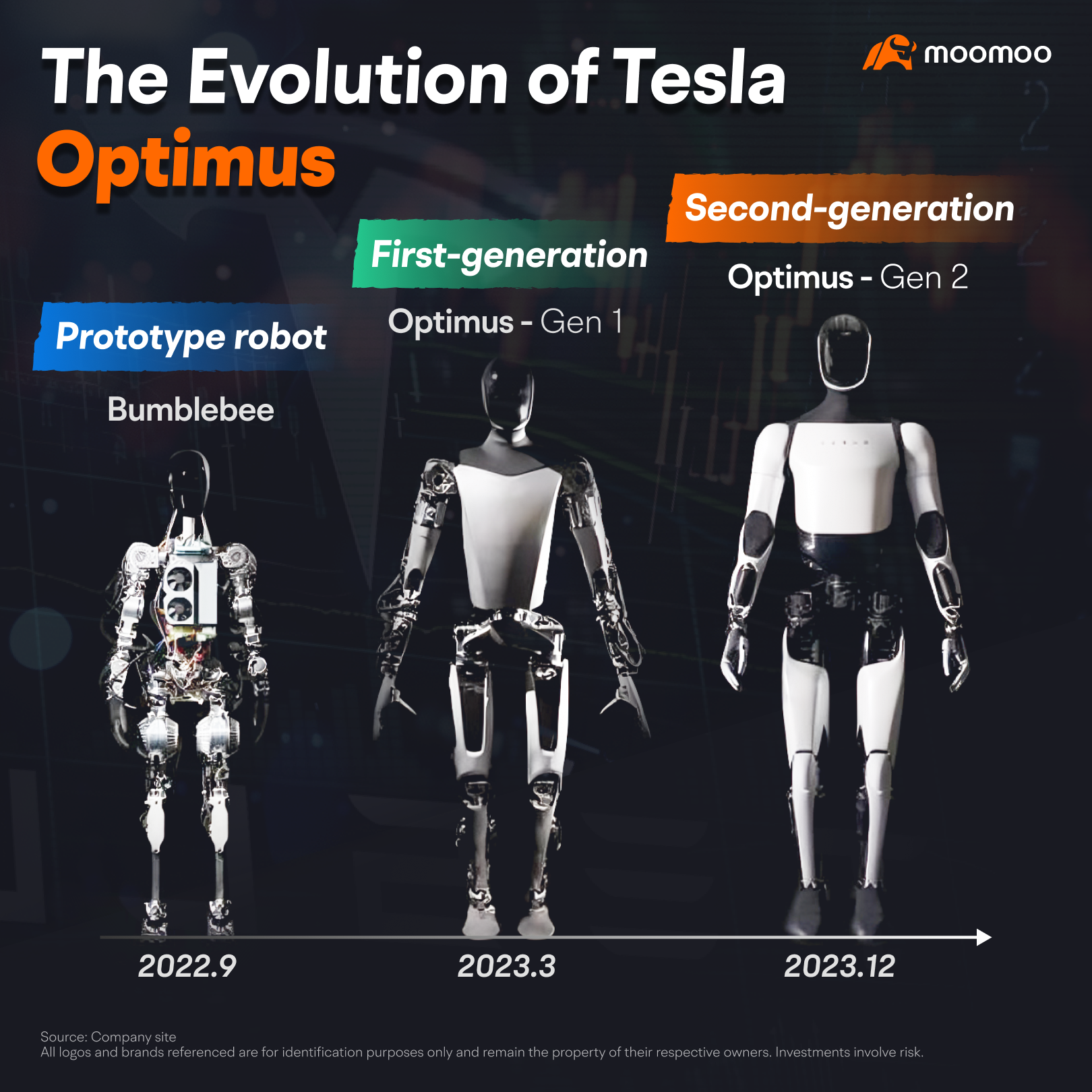
There have been some recent developments in these two areas. At the beginning of July, Tesla announced that the second-generation humanoid robot Optimus would debut at the 2024 World Artificial Intelligence Conference (WAIC) in Shanghai from July 4 to 7.However, this exhibition is a static display, with no movement or interaction with visitors.
Tesla first revealed its Optimus plans in August 2021. The prototype robot 'Bumblebee' was introduced in September 2022. In March 2023, the first-generation 'Optimus Gen 1' was launched, followed by the second-generation 'Optimus Gen 2' in December. Despite several iterations, Optimus is still in the lab research stage and is not generating sales yet.
On August 8, Tesla will host 'Robotaxi Day', where it will present the latest advancements in autonomous driving technology and unveil its long-anticipated driverless taxi.
This vehicle, controlled by AI and autonomous driving technology, does not require a driver and can autonomously transport passengers to their specified destinations.
The date for Robotaxi Day was set as early as April, and multiple videos of the Optimus Gen 2 have surfaced since its release at the end of 2023.
The recent stock surge is likely driven more by the current performance of Tesla's automotive and energy storage divisions.
Trading tips: Fibonacci Sequence
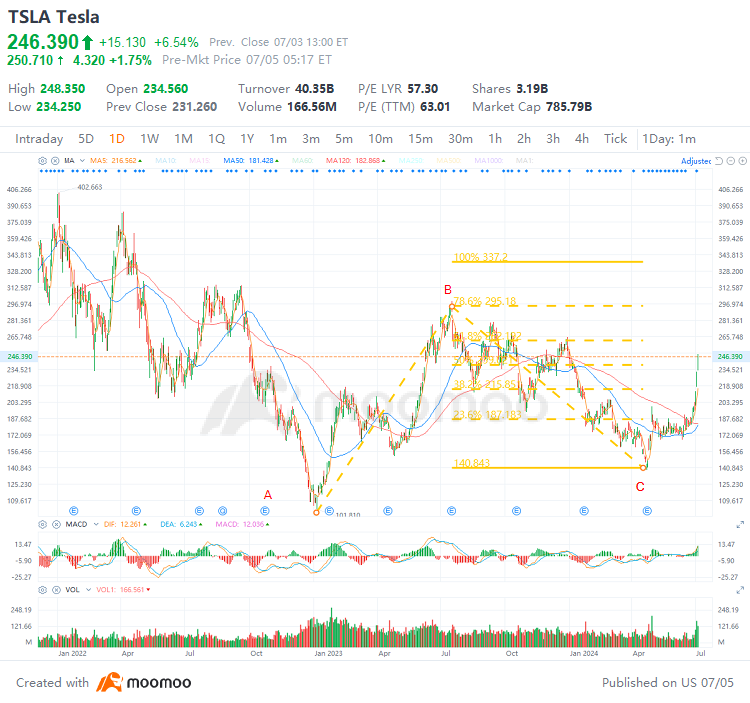
Let’s look at Tesla’s stock price movements using Fibonacci sequence analysis.
Returning to Tesla, we can use the 'Fibonacci Trend Extension' tool on moomoo. By connecting points A, B, and C on the chart, we can identify key ratio levels to determine rebound target prices.
Source: moomoo. Data as of market close on July 4, 2024. Investing involves risk and the potential to lose principal. Past performance does not guarantee future results. This is for information and illustrative purposes only. It should not be relied on as advice or recommendation.
The next level is 61.8%, corresponding to around $262. If this level is breached, the price might move to $295. Of course, using Fibonacci trend extension lines involves a high degree of subjectivity, and this analysis is provided for reference only.
Also, Tesla’s stock price often experiences significant volatility. Therefore, if you seek to trade the stock in the short term, setting stop-loss orders to manage risk is better. This way, you can control potential losses in case of a pullback.
Additional Disclosures: This content is also not a research report and is not intended to serve as the basis for any investment decision. The information contained in this article does not purport to be a complete description of the securities, markets, or developments referred to in this material. The information has been obtained from sources considered to be reliable, but we do not guarantee that the foregoing material is accurate or complete. Furthermore, there is no guarantee that any statements, opinions or forecasts provided herein will prove to be correct.
This presentation is for informational and educational use only and is not a recommendation or endorsement of any particular investment or investment strategy. Investment information provided in this content is general in nature, strictly for illustrative purposes, and may not be appropriate for all investors. Read more