Economy Boosts Market Sentiment as US Stocks Hit Continuous New Highs (0122-0126)
Weekly Overview of Global Markets
Market Review and Outlook
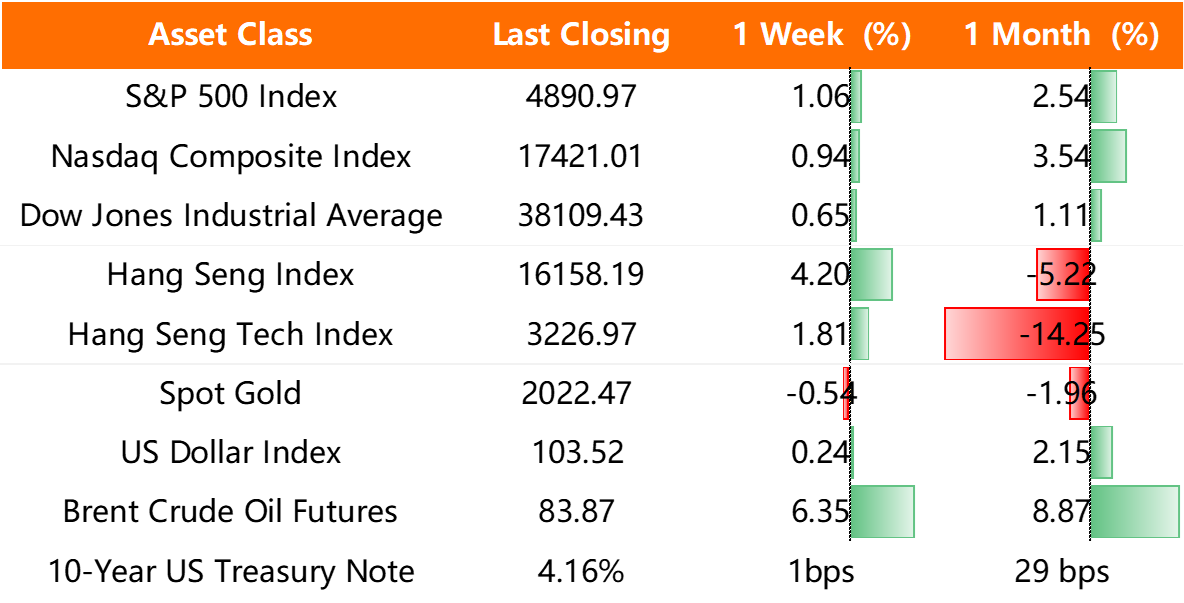
Weekly performance of major asset classes: US equities> US dollar> crude oil> US bonds> gold > Hong Kong stocks
Stocks: The GDP report released on Thursday provided the most obvious boost to the US stock market.
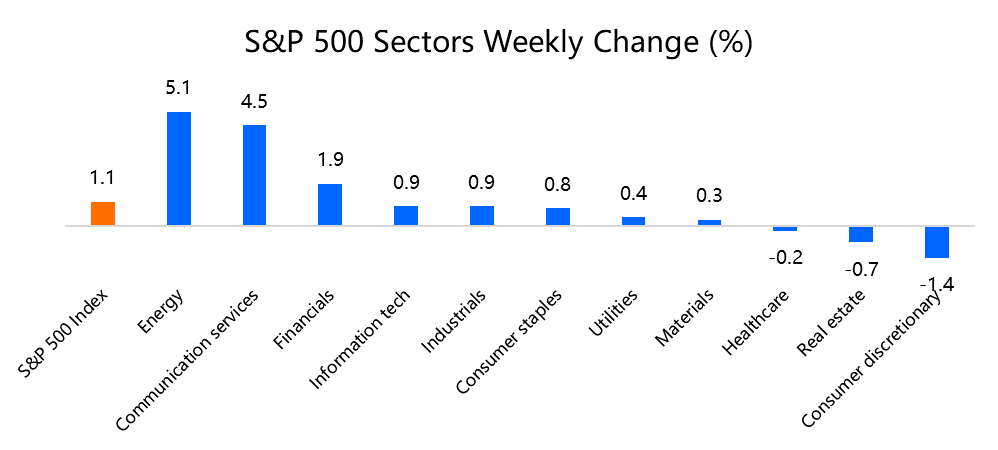
With the economy performing well, combined with lower interest rates and growing interest in AI, the S&P 500 index hit yet another high for the fifth straight day. The Nasdaq also saw gains for the sixth consecutive trading day. Interestingly, the majority of S&P constituent companies that have released their earnings reports have exceeded Wall Street's expectations, with 82% of these companies delivering better-than-anticipated results. However, this was not the case for Tesla, which saw its stock price plummet by 12.13% on Thursday, marking its worst single-day performance since September 2020 and dragging down the Nasdaq.
This week, investors will be keeping a close eye on tech giants Apple, Microsoft, Amazon, Alphabet, and Meta Platforms as they release their earnings reports. Market anticipation is high, as analysts are keen to see if Microsoft and Amazon's cloud services are showing growth, how Meta and Alphabet are performing in terms of advertising growth, and if Apple can continue its impressive growth.
Bonds: The situation in the US bond market is starting to deteriorate again. Last week's 5-year US bond auction was not successful, with the bid rate being 2 basis points higher than the expected issuance rate, indicating weak demand for bonds with this maturity. As a result, the yield on 30-year Treasury bonds rose to its highest level this year. Despite this, Morgan Stanley and JPMorgan Chase believe this is a good time to invest in US bonds given the recent economic growth.
US Dollar: The US dollar strengthened last week after the European Central Bank maintained its interest rates at the historic high of 4%. In contrast, the US economy appears to be experiencing a soft landing, which is contributing to the strengthening of the dollar.
Crude oil: US oil prices have risen above $77, driven by China's stimulus measures, winter weather, and economic growth. Energy stocks are expected to benefit from these developments, with analysts predicting further rises in the price of crude oil.
Note: The weekly performance of major asset classes is ranked based on the weekly change in the asset class as shown in the table above, with ">" indicating the ranking from highest to lowest. US bonds are ranked based on the change in futures prices. Past returns do not guarantee future returns.
Data source: Bloomberg.
Weekly Hot Topic
Market sentiment shifts as probability of March rate cut decreases
Investor sentiment has undergone a significant change in the past couple of weeks, with the probability of a rate cut in March dropping below 50%. It may be possible that the shift in market sentiment is largely due to investors acknowledging the strength of the US economy, and the market appears to be gradually adjusting to this expectation. Furthermore, it seems that the market is no longer as concerned about robust economic data, and instead, data that surpasses expectations may be contributing to the market's upward momentum. This was evident following the release of highly anticipated gross domestic product (GDP) and inflation data last week, which saw the stock market reach new highs.
GDP report concludes outstanding economic growth performance
The Q4 GDP report revealed that the US economy grew by 3.3% after seasonal and inflation adjustments, lower than the 4.9% growth in the third quarter but higher than the expected 2% by economists surveyed by the Wall Street Journal.
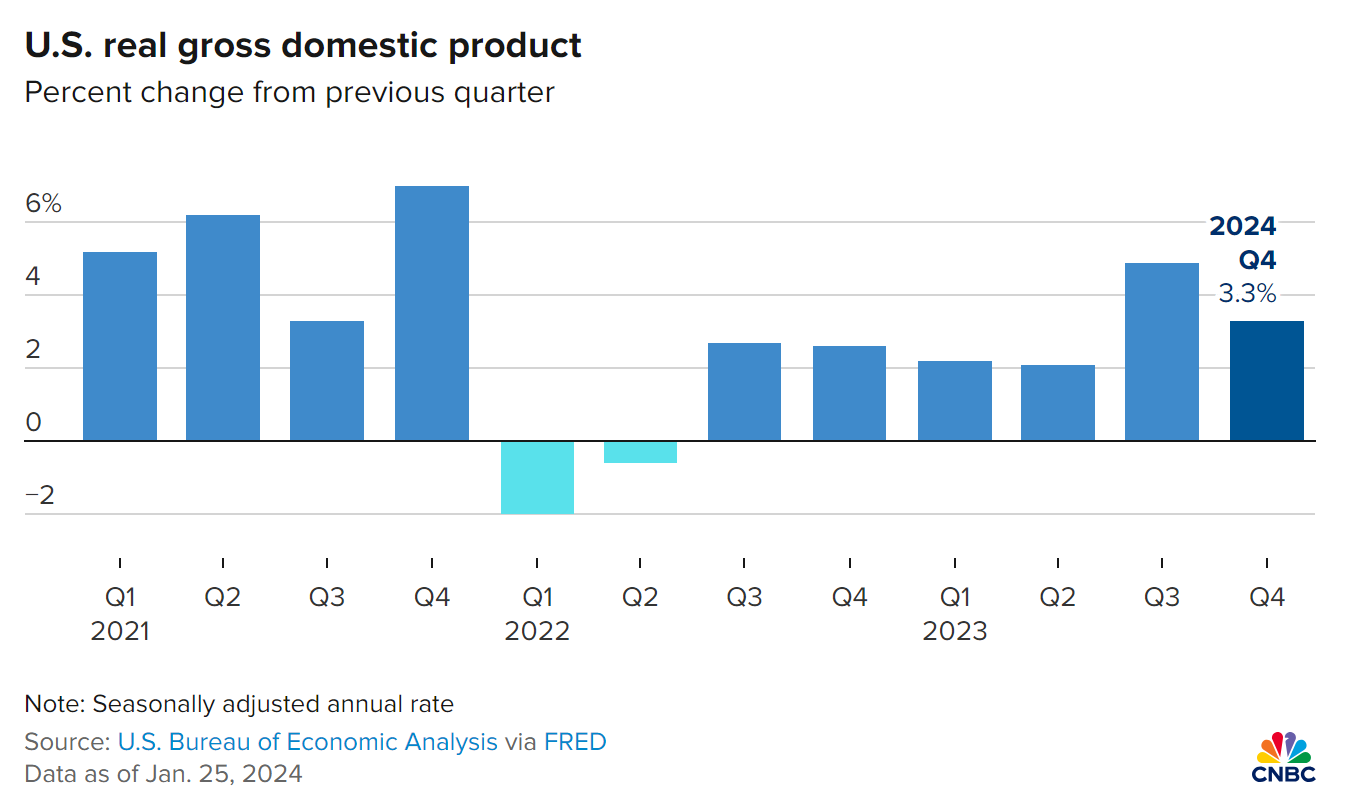
Despite concerns over high interest rates and prices, consumers still seem willing to spend freely. This can be attributed to strong consumer spending, employment, and government spending, resulting in an annual rate of 2.5% increase in GDP last year, which surpassed Wall Street's expectations at the beginning of the year and was better than the 1.9% increase in 2022.
However, it is worth noting that GDP is a lagging indicator and has limited predictive capabilities for the economic outlook. Regarding the interest rate cut issue that people are most concerned about, Olusola Oyeniran, Fitch Ratings' US regional economic director, said that the economic growth momentum entering 2024 still looks very good, and if the data continues to rise, the Fed may not be in a hurry to cut interest rates.
The US economy in 2024 may still face challenges, such as the reduction in savings and the increase in the burden of high-interest debt, which may impact consumer spending. Additionally, the lag effect of monetary policy may take up to two years to manifest, which could potentially lead to a future economic slowdown.
Inflation continues to steadily decline
Some progress was made in the annual inflation data released with the GDP report. Core PCE (personal consumption expenditures) inflation data, often considered one of the Fed's preferred inflation measures, steadily decreased in December. In fact, core PCE inflation is now 2.9% year-over-year, below last month's 3.2%, and below 3.0% for the first time since 2021.
After the strong data was announced, the market cheered, and the US stock market once again moved towards new historical highs, which shows that investors are optimistic about the US economy's future.
Important Events Outlook for This Week
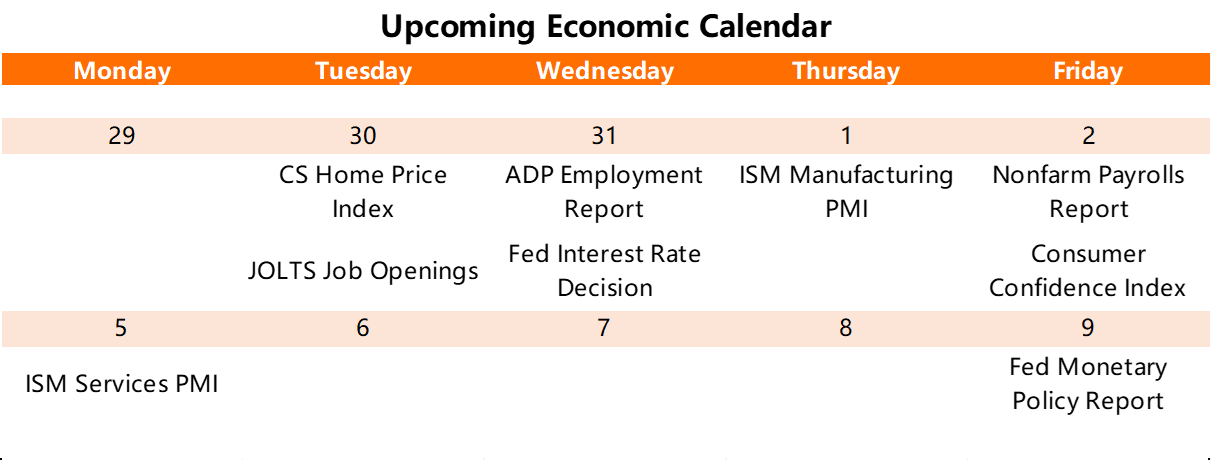
Note: The Upcoming Economic Calendar is selected from moomoo Financial Calendar.
FOMC Meeting
The first FOMC meeting of the year is scheduled for January 30-31, 2024. While most agree that the Fed won't change interest rates next week, it remains the most important event on the calendar.
The unexpected drop in inflation by the end of 2023 or the end of the Fed's rate-hiking cycle is a key driving force, which has intensified speculation about future rate cuts.
Currently, inflation in the United States continues to decline, while employment and economic growth maintain strong momentum. The financial condition index is currently at the most relaxed level since the current rate-hiking cycle. Strong data has repeatedly delayed the urgency of interest rate cuts. From the perspective of Fed officials, the January FOMC meeting doesn't require an immediate change in policy rates and may even temper overly optimistic expectations. The market speculates that Chairman Powell may make cautious or even more hawkish comments in his post-meeting statement and press conference.
However, it's worth noting that two weeks ago, preliminary data released by the Fed showed that an increase in interest payments led to a record loss of billions of dollars for the Fed last year. Discussions about when to slow down the balance sheet have recently increased in the market. It's generally believed that the Fed has started paying attention to the immense impact of high interest rates on the financial market, so it will begin discussing slowing down the balance sheet at this month's policy meeting. The market speculates that the Fed may restart quantitative easing policies early. JPMorgan predicts that the Fed will propose a timetable of slow down tapering at a late January meeting, with consensus reached in March and implemented in April, according to a report.
Manufacturing PMI and Non-Farm Employment Report
The ISM Manufacturing PMI and non-farm employment report are set to be released next week after the FOMC meeting, and they could impact expectations for the March meeting. It might take quite a weak set of numbers to convince traders that a cut could arrive as early as March. IN all likelihood, the report will smash another set of okay or better numbers. As we’d really need to see unemployment rise sharply and NFP print negative jobs before we could expect the Fed to simply flick the policy switch.
The S&P global flash manufacturing PMI survey estimated the industry to have expanded in January. And it could carry more weight if long-standing ISM manufacturing survey followed suit. The ISM appears to have troughed in June yet remains firmly in contraction levels at 47.4, but if it were to contract at a much slower pace of surprise with an expansion (above 50) then it could spur another round of short-covering for the US dollar.
This presentation is for informational and educational use only and is not a recommendation or endorsement of any particular investment or investment strategy. Investment information provided in this content is general in nature, strictly for illustrative purposes, and may not be appropriate for all investors. Read more