[November.2024]Strong revenue growth, record profits, and increased buybacks: How to interpret Meitu
Among China's technology giants with market capitalizations exceeding $100 billion, Tencent has one of the most stable stock prices, while Meituan may experience the most volatility.
Meituan's stock once peaked at HK$460, with a market value nearing HK$ 3 trillion, only to plummet to HK$ 61 earlier this year—a decline of over 85%. However, since February, as the sentiment for Chinese stocks has improved, Meituan's share price has rebounded significantly, briefly surpassing HK$ 200.
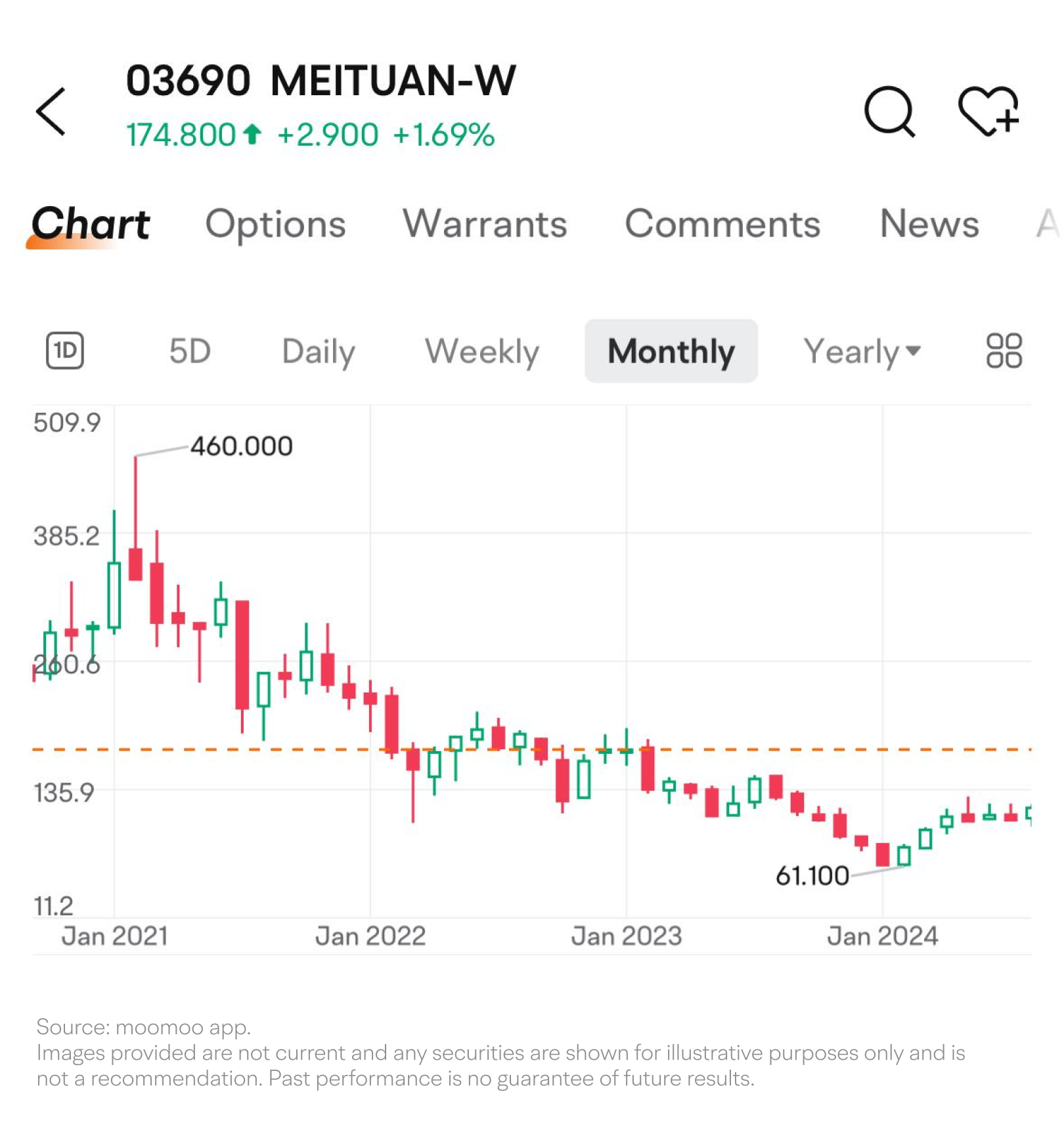
This price volatility is linked to the company's performance. Meituan had been in a prolonged period of losses, making its valuation highly sensitive to market sentiment, resulting in sharp fluctuations in its stock price. Now that Meituan is stabilizing its profitability, its stock price may become more closely linked to its financial performance.
On November 29, Meituan will release its latest earnings report. Each earnings release may signal a potential investment opportunity, but before diving in, investors need to understand how to interpret their financial statements.
Meituan’s Key areas to focus on include its user base, growth drivers, profitability, and stock repurchase plans.
1. Core business: Local commerce
Meituan's business is primarily segmented into core local commerce and innovative initiatives. The core local commerce segment, which includes food delivery, on-demand services, and travel, serves as the foundation of the company, contributing significantly to both revenue and profit.
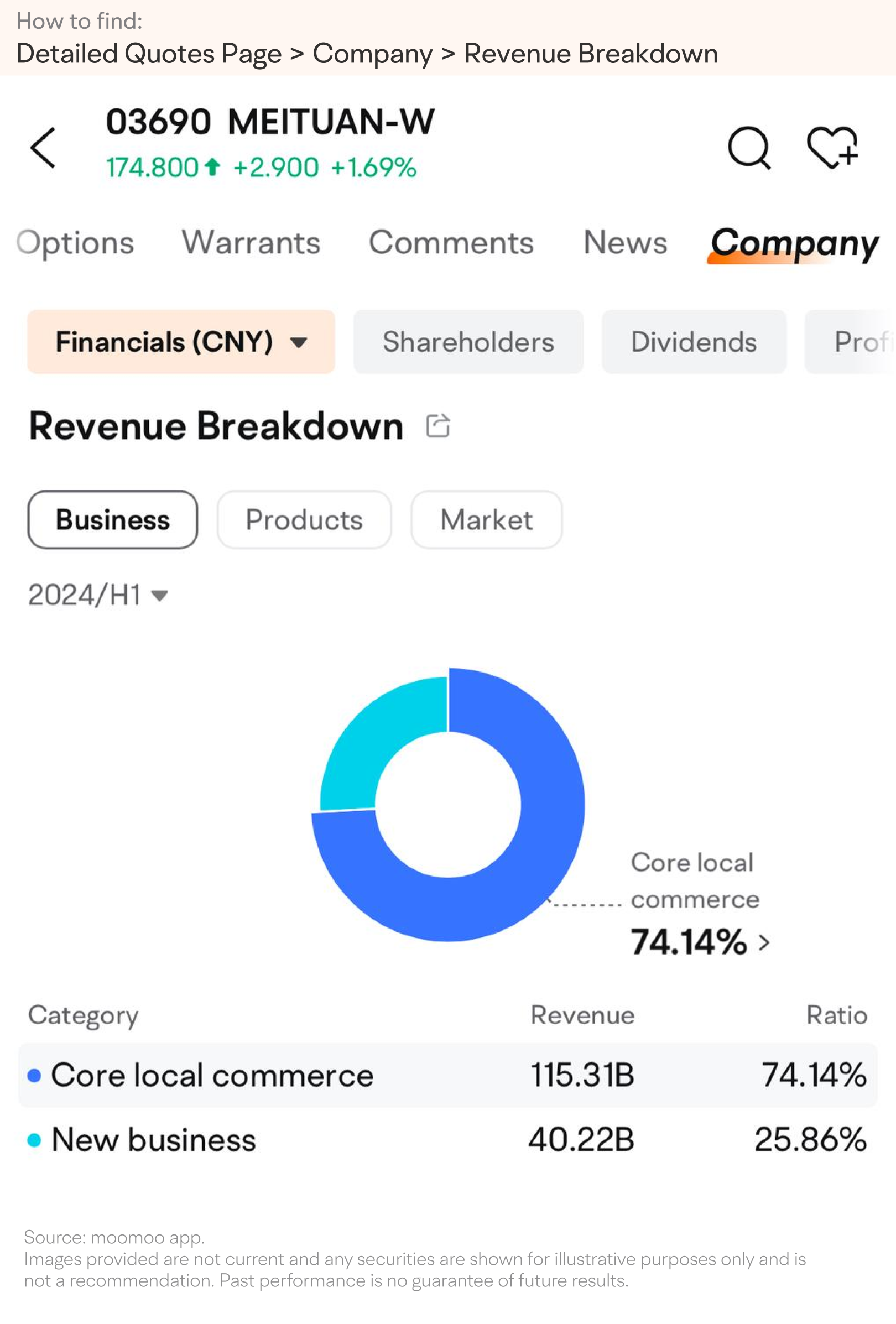
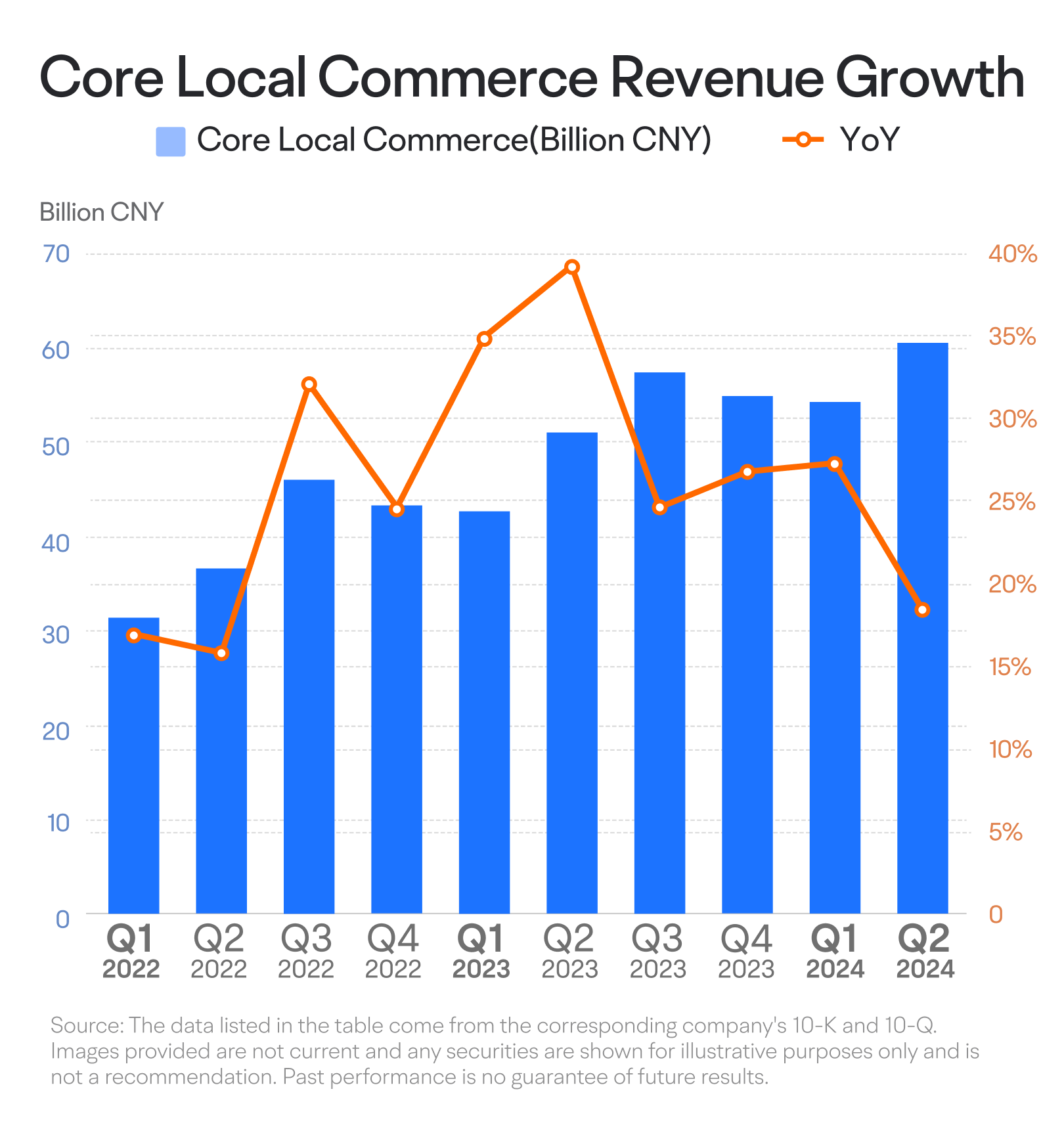
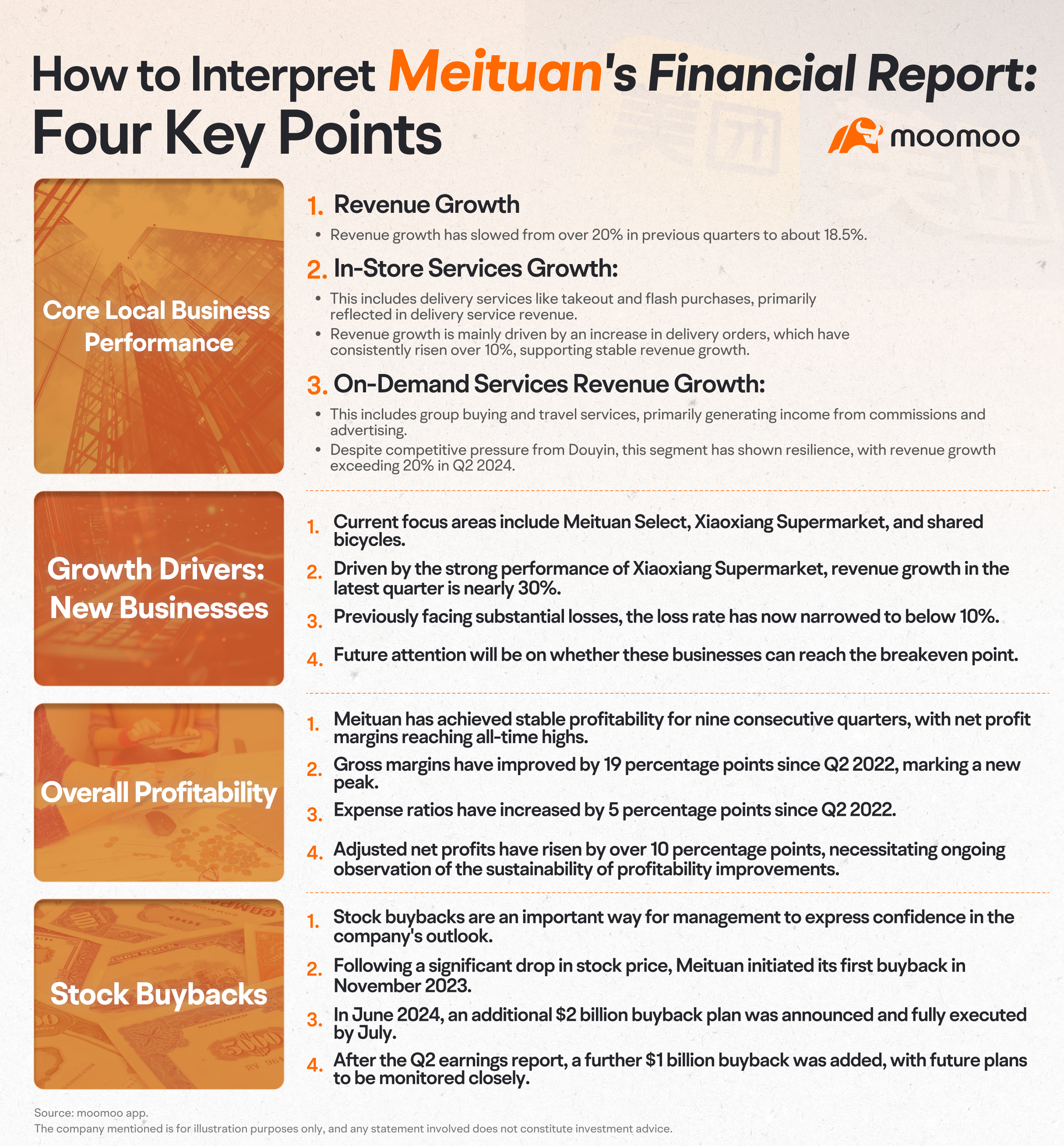
In Q2 2024, revenue for the core local commerce segment was approximately RMB 60.68 billion, accounting for nearly 75% of total revenue, with an 18.5% year-on-year growth rate—still robust, though slower than prior quarters where growth exceeded 20%.
This segment consists of two main areas:
On-Demand Services: Mainly food delivery and flash purchases, generating revenue through delivery fees.
In-Store Services: This includes group buying and travel, monetized through commissions and online marketing services.
The volume of delivery orders and average order value influence revenue from on-demand services. Since Q2 2022, average order value has fluctuated but stabilized, while delivery order volume has consistently grown over 10% year-on-year for eight consecutive quarters, driving revenue growth.
Despite facing competition from Douyin’s group-buying services, Meituan’s in-store business has shown resilience, with revenue from commissions and online marketing services increasing by approximately 20% year-on-year in Q2 2024.
Meituan achieved an operating profit of around RMB 15.2 billion in Q2 2024, setting a new record, with an operating profit margin of approximately 25%.
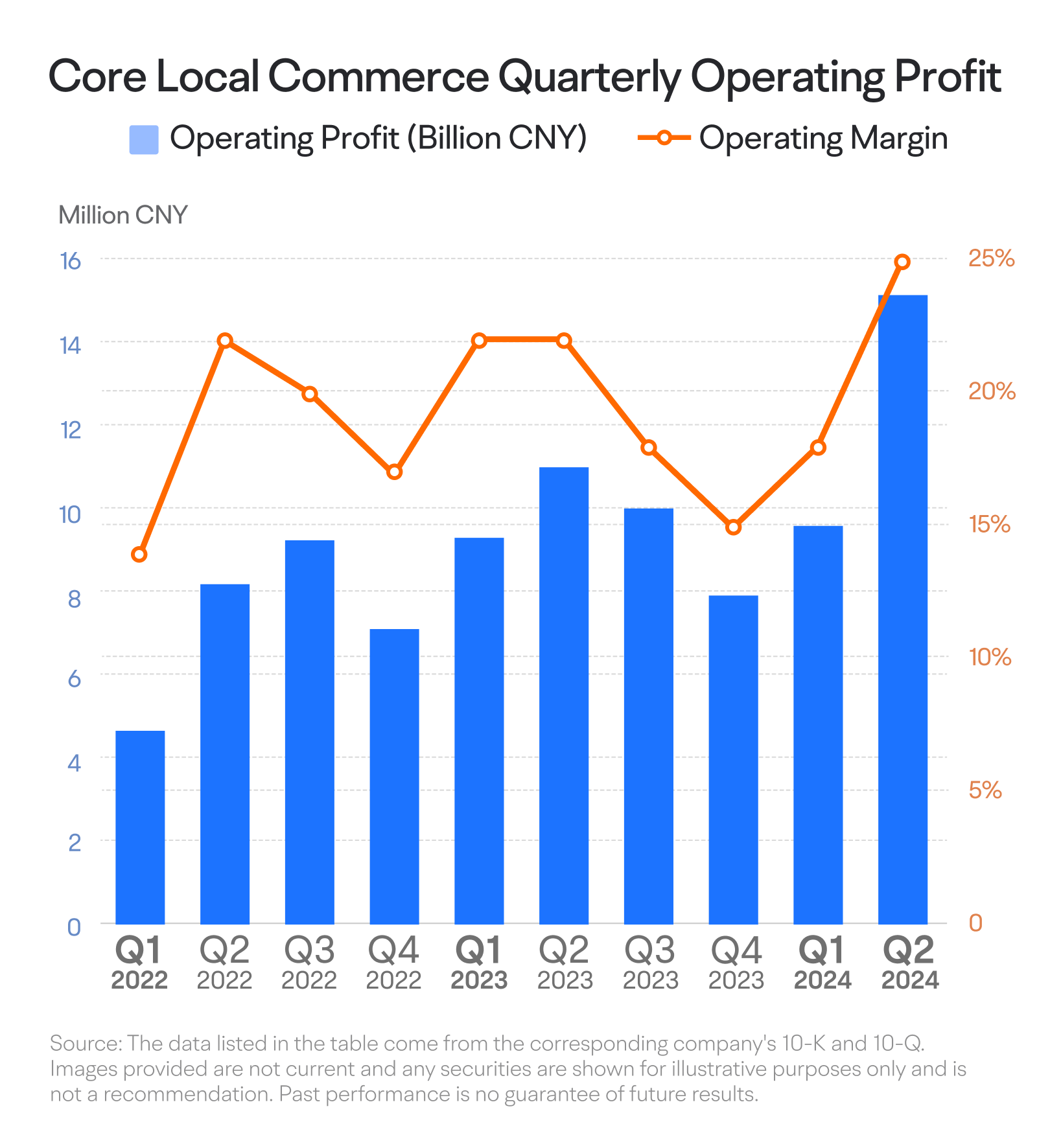
Most of this profit stems from its asset-light in-store business, which has benefited from reduced competitive pressure. Both Meituan and Douyin are now focusing on enhancing monetization rather than solely competing for market share. An easing of competitive pressure may benefit Meituan's revenue growth and profit margins in its core local commerce business.
In upcoming earnings reports, it may be important to monitor whether Meituan can sustain its revenue growth and continue improving its operating profit margin within the core local commerce segment.
2. Growth drivers: New business ventures
While Meituan's core local commerce serves as its foundation, its innovative ventures represent potential growth opportunities. Previously recognized for boundaryless expansion, Meituan has recently focused on key projects, including Meituan Select, Xiao Xiang Supermarket, and bike-sharing services.
Revenue from these new businesses has consistently grown over 10% each quarter. After a dip in Q2 2023, robust growth from Xiao Xiang Supermarket pushed revenue growth back to about 30% by Q2 2024.
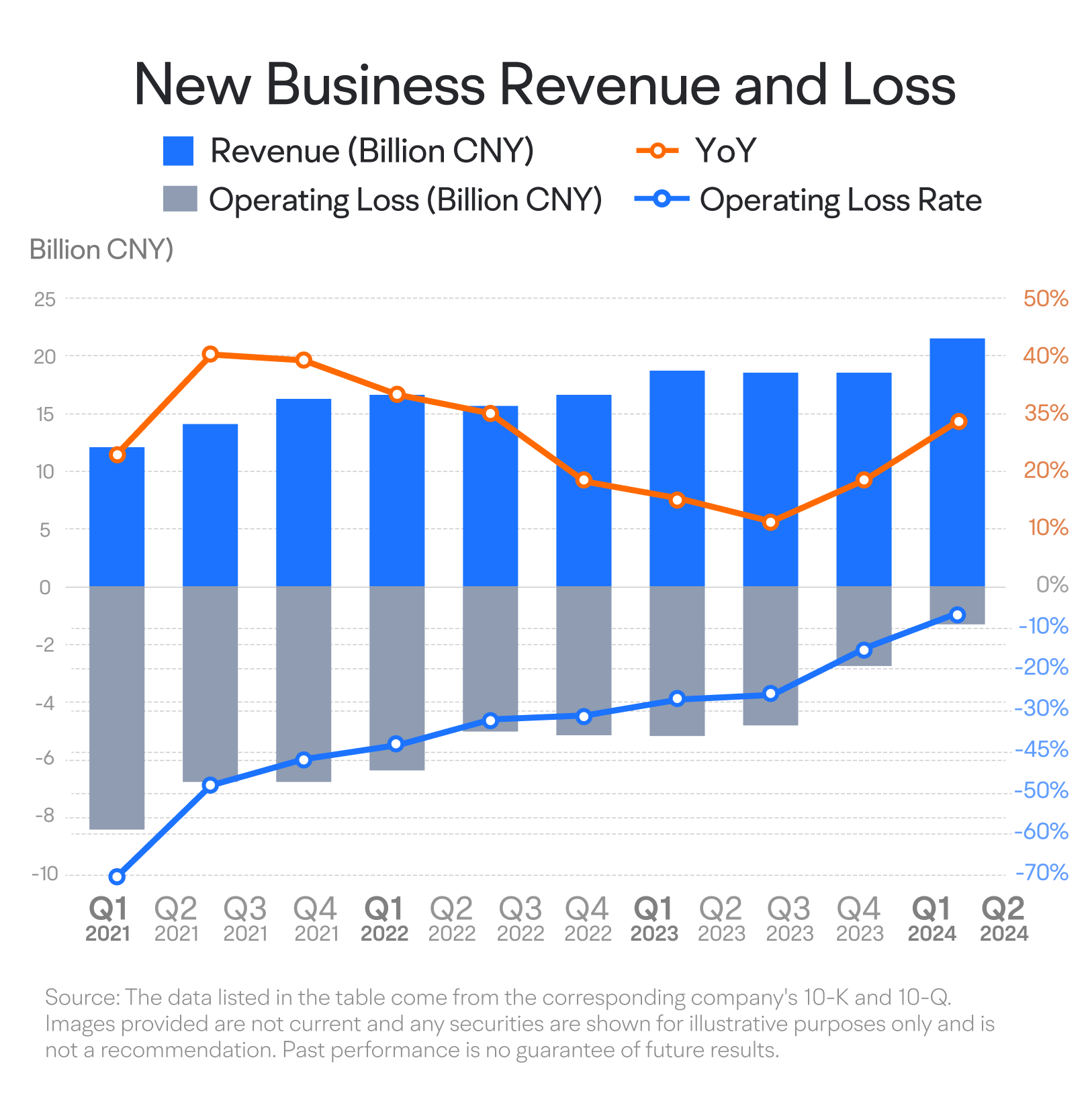
Investors are also noting a significant reduction in losses from these ventures. Historically a drag on profits, with quarterly losses reaching 10 billion RMB, losses have narrowed to approximately 1.3 billion RMB in Q2 2024, bringing the loss rate down to 6.1%—the first time it has fallen below 10%.
As we look ahead to future earnings reports, it may be important to see if Meituan's new businesses can sustain their growth, drive overall revenue increases, and continue reducing losses toward breakeven.
3. Overall profitability
Three years ago, Meituan was a company that consistently posted losses, even occasionally reporting a profit in a quarter only to quickly revert to losses. However, since Q2 2022, Meituan has achieved nine consecutive quarters of profitability. Although quarterly net profits have fluctuated, the overall trend has been upward, with adjusted net profit reaching a record high of 13.61 billion RMB in Q2 2024.
Typically, improved profitability for a company is reflected in two main areas: an increase in gross margin and a reduction in expense ratio. Meituan has made progress in both areas.
In terms of gross margin, Meituan has shown a clear upward trend since Q2 2022, with year-on-year improvements each quarter. By Q2 2024, the gross margin reached approximately 41.2%, marking a historic high and an increase of 19 percentage points since Q2 2022.
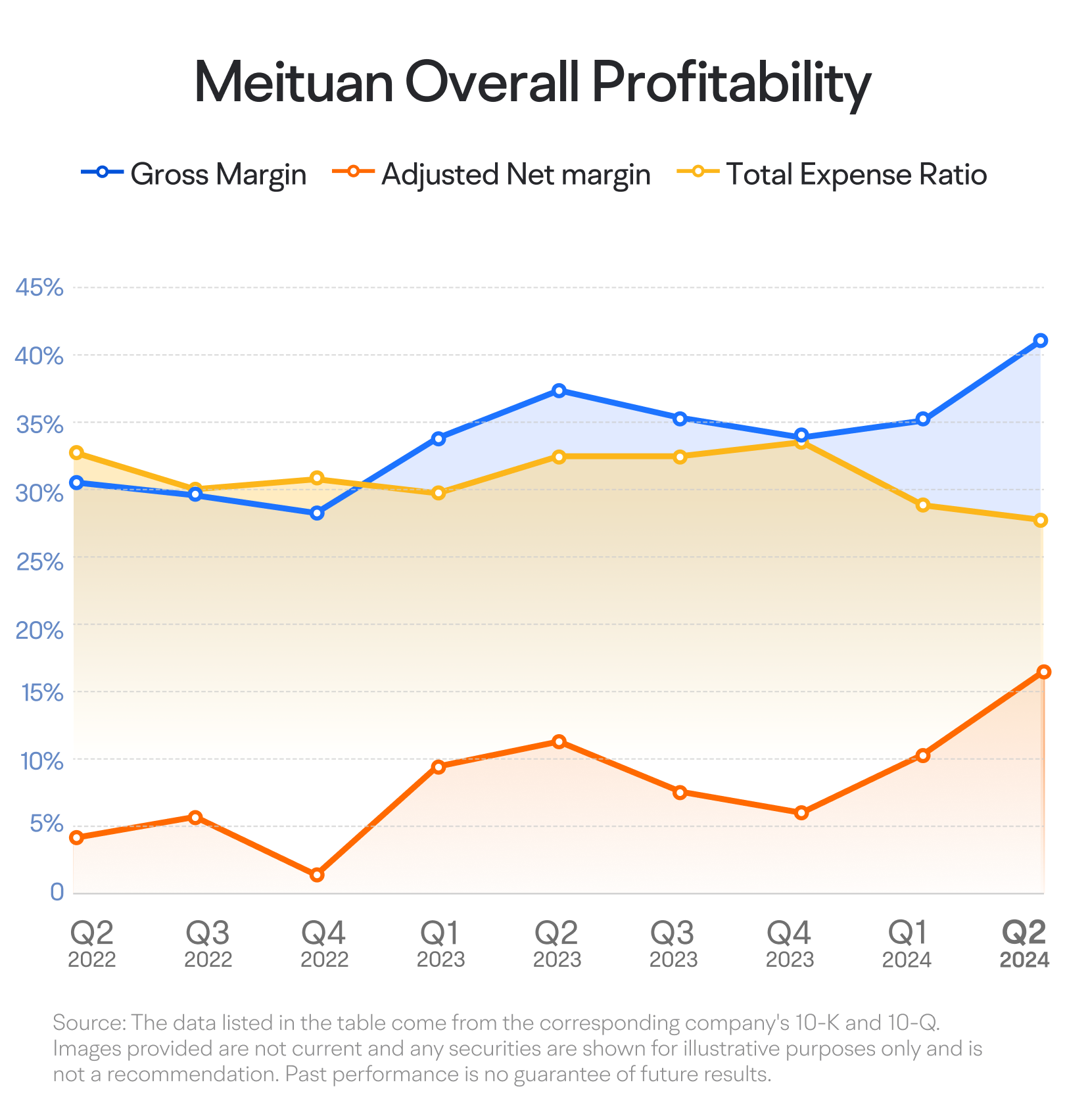
Meituan has also seen a decline in its sales, administrative, and research and development expense ratios, contributing to a significant reduction in overall expenses. Since Q2 2022, the total expense ratio has improved in most quarters, reaching a historic low of approximately 27.8% in Q2 2024.
With rising gross margins and falling expense ratios, Meituan's profitability has surged. The adjusted net profit margin climbed from 4.2% in Q2 2022 to 16.5% in Q2 2024, a record high.
Looking ahead, it may be important to see if Meituan can maintain its upward momentum in gross margins and continue optimizing its expense ratios to further enhance profitability.
4. Stock buybacks
Over the past two years, Meituan has maintained solid revenue growth. Its core local commerce unit delivers consistent profits, and new businesses turn losses into gains, driving overall profitability to record highs. However, this positive performance contrasts sharply with its stock price, which plummeted from a historic high of HK$460 to just over HK$60.
When stock prices decline, management may consider buybacks if they believe the stock is undervalued. A buyback is also a strong signal of confidence in the company’s future. For buybacks to be feasible, sufficient cash reserves are necessary, and Meituan’s cash holdings have exceeded 100 billion RMB, allowing for large-scale repurchases.
When Meituan's stock first fell below HK$100 in late November of last year, the company announced its first-ever buyback plan worth $1 billion, which was first executed in January. By June, Meituan announced an additional $2 billion buyback plan.
In terms of execution, Meituan moved quickly, completing the initial $1 billion buyback within five months, and swiftly utilizing the additional $2 billion plan between June and July. The total buyback amount has now reached HK$23.3 billion.
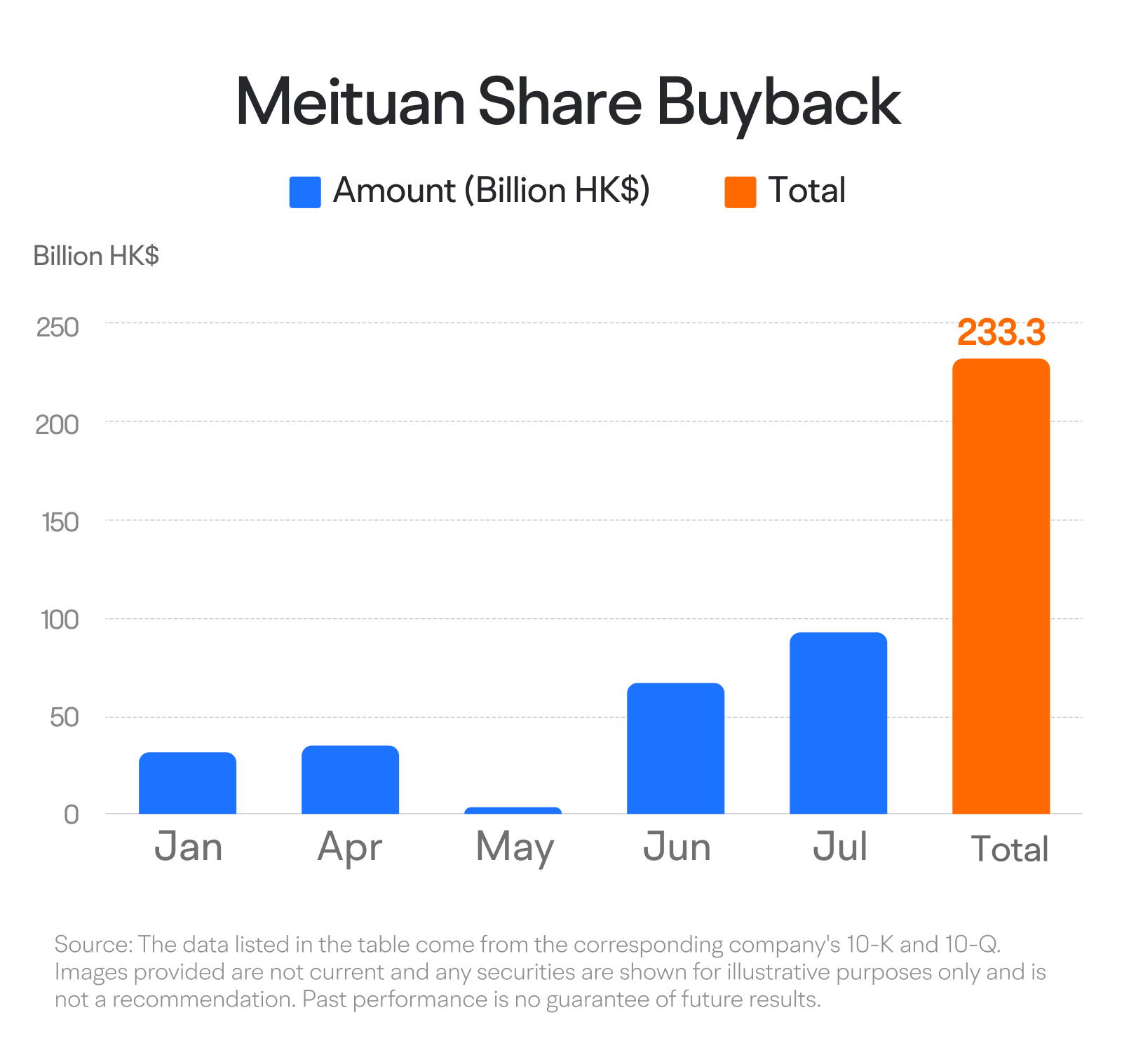
Meituan's buyback program is far from over. By the end of August, following its Q2 earnings report, the company announced an additional $1 billion buyback plan, reinforcing its commitment.
Since January, Meituan's stock price has surged from just over HK$60 to over HK$200, more than doubling. While this rebound is partly due to the overall rally in Chinese stocks, Meituan's aggressive buyback actions likely contributed significantly to its status as a leading performer.
In upcoming earnings reports, it may be important to track the progress of Meituan's buyback efforts and whether management will continue to increase their buyback commitments.
This presentation is for informational and educational use only and is not a recommendation or endorsement of any particular investment or investment strategy. Investment information provided in this content is general in nature, strictly for illustrative purposes, and may not be appropriate for all investors. Read more