What if a recession comes? Understanding strategies
Is winter coming?
On August 2, significantly worse-than-expected non-farm payroll data triggered market turmoil. Expectations for the U.S. economy swiftly shifted from a soft landing to a recession. The market fear gauge, VIX, soared, spreading risk aversion from U.S. equities to global markets.
If a recession hits, how should you respond? This article outlines potential strategies during a recession.
Cash reserves
Though painful, recessions are an inevitable part of the economic cycle. According to Charles Schwab, the U.S. has experienced 12 recessions since 1948, averaging one every six years.
Recessions typically coincide with bear markets, and market downturns often precede the onset of a recession. While a recession lasts only 11 months on average, it usually takes more than two years for markets to rebound to their pre-bear market peaks.
In such times, increasing cash reserves becomes crucial. Holding sufficient cash during market volatility can help avoid forced selling during downturns and provide capital to seize opportunities when markets stabilize.
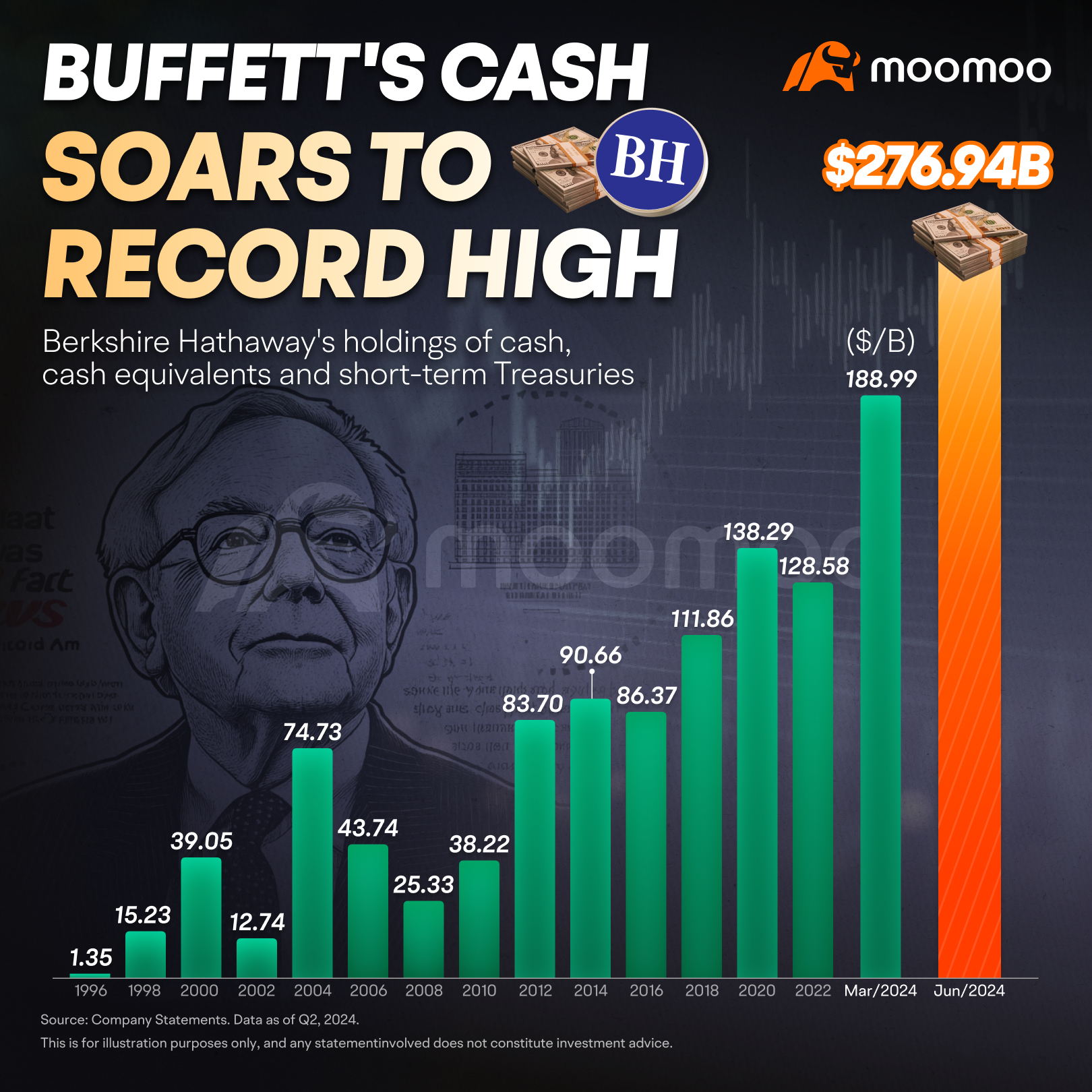
Berkshire Hathaway, the leading investment institution under Warren Buffett, disclosed its latest filings on August 3. In Q2 2024, it accumulated a record $277 billion in cash reserves, following several quarters of new highs.
This explosive growth in cash reserves was mainly due to significant reductions in Apple stock holdings.
While the rationale behind these moves wasn't explained, the market speculates that the "Oracle of Omaha" might be betting on an impending U.S. recession, waiting for cheaper entry points.
Bonds
During the 2008 financial crisis and the 2020 COVID-19 shock, the Federal Reserve slashed policy rates to zero to counteract economic downturns.
When policy rates begin to shift, U.S. Treasury yields typically decline, driving up bond prices.
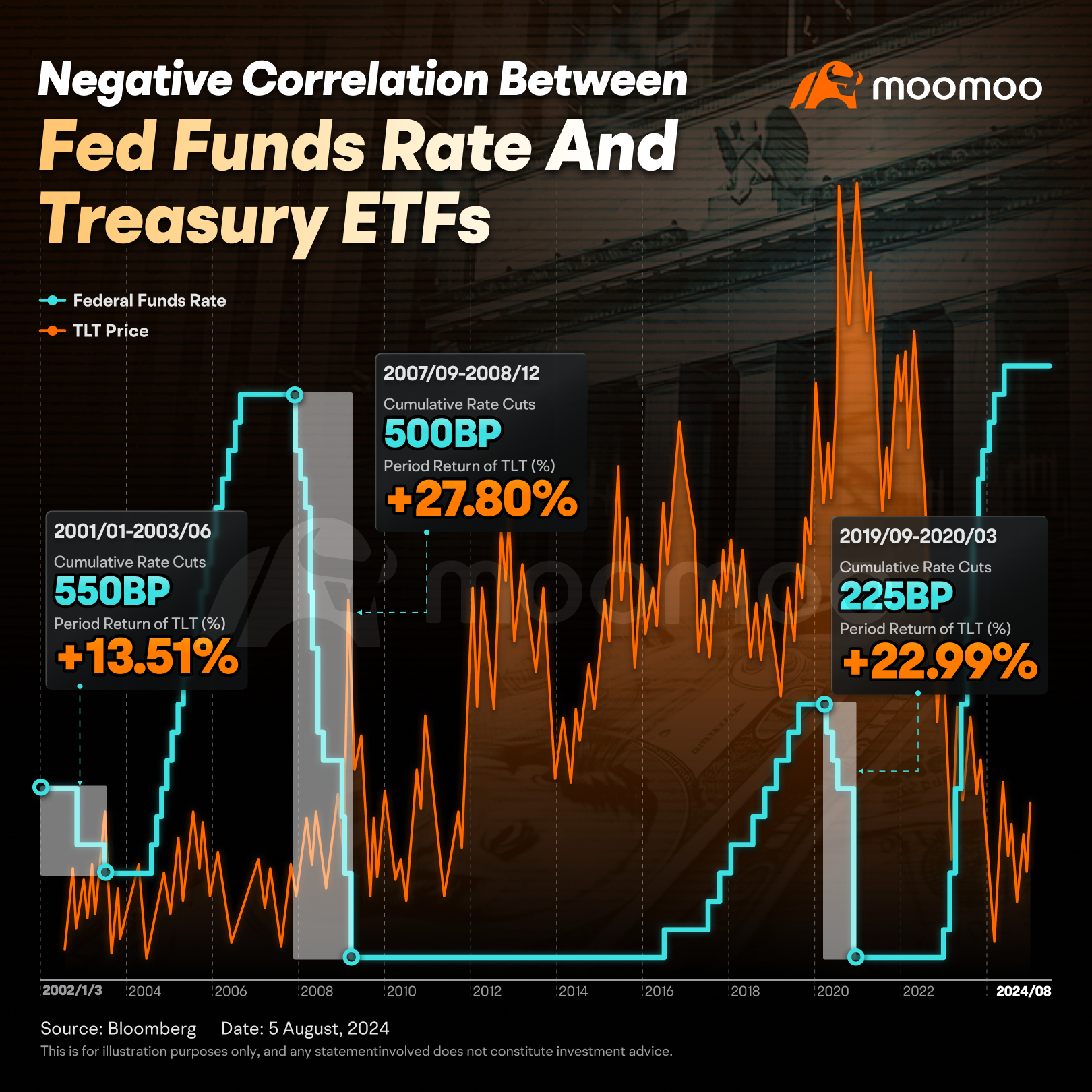
MorningStar analyzed eight typical recession periods since 1929. It shows that while stocks generally underperform during recessions, T-bonds consistently achieve positive growth during all economic downturns.
U.S. Treasuries come with different maturities. Longer-duration Treasuries are usually more sensitive to interest rate changes and show greater price volatility. During a looming recession and rising rate cut expectations, the prices of longer-duration Treasuries typically increase more than shorter-term bonds.
ETFs provide an easier way to gain exposure to these bonds.
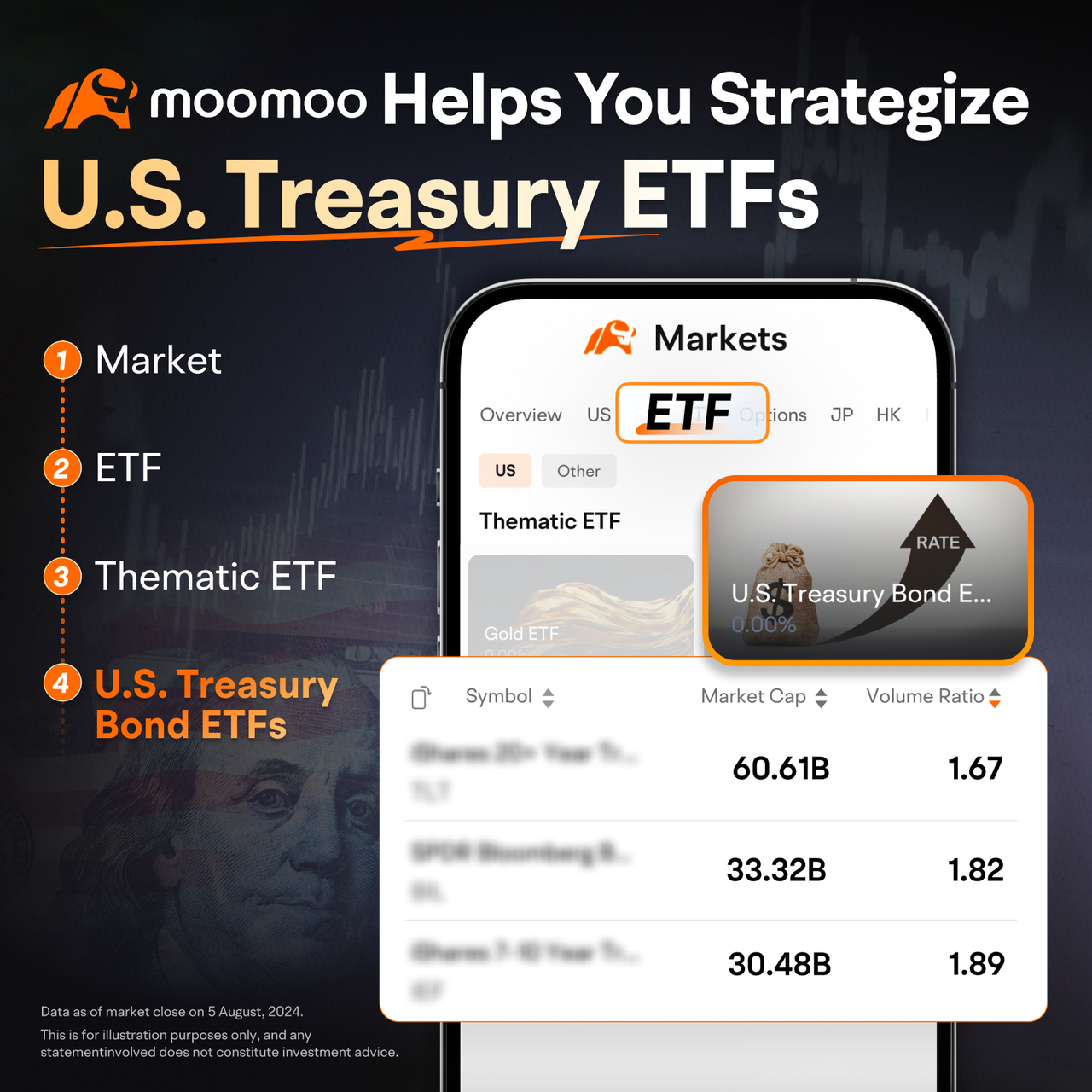
On moomoo, you can go to Markets > ETFs > Thematic ETFs > U.S. Treasury Bond ETFs to find these products.
Currently, the largest ETF tracking U.S. Treasuries is the 20+ Year Treasury Bond ETF (TLT), which has the longest duration.
Inverse ETFs
During market downturns, inverse ETFs can be used for hedging.
However, they are complex financial instruments that use sophisticated strategies involving derivatives like futures and swaps to achieve negative index correlation. These high-risk assets may not be suitable for most investors.
Proshares, a primary issuer of inverse ETFs, explains how they work. Conventional index funds are designed to match the performance of an underlying index over any period. Most inverse ETFs, however, are designed to meet an investment objective, or multiple, for a single day only.
Inverse funds rebalance their exposure to their underlying benchmarks each day by trimming or adding to their positions.
Holding inverse ETFs for more than one day can result in deviations from the fund's original goal over time. Market fluctuations can erode inverse ETFs, particularly when volatility is high.
The greater the multiple or more volatile a fund’s benchmark, the more pronounced the effects may be.
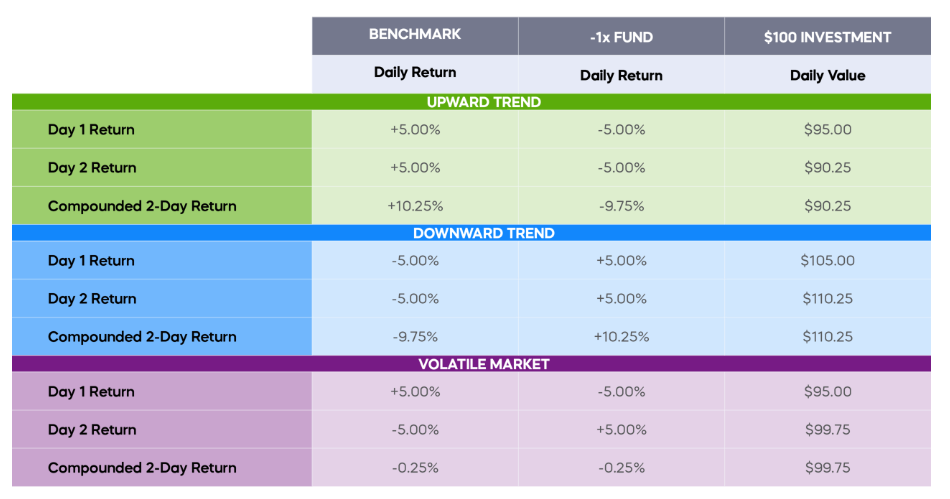
Assuming the market fluctuates by 5% daily over two days.
A -1x fund would return -9.75% when the benchmark is up 5%, and 10.25% when the benchmark is down 5% over two consecutive days. In a volatile market where the benchmark dropped 0.25% over two days, the fund also went down 0.25% and wouldn't act as an effective hedge.
Inverse ETFs also have higher fees. For instance, the expense ratio for the QQQ $Invesco QQQ Trust (QQQ.US)$ , which tracks the Nasdaq-100 index, is 0.2%, while the fee rates for the 1x inverse PSQ $ProShares Short QQQ (PSQ.US)$ and the 3x inverse SQQQ $ProShares UltraPro Short QQQ ETF (SQQQ.US)$ are both 0.95%.
Prospective investors should understand these products' objectives and methods.
Defensive sectors
During recessions, some sectors remain resilient, such as consumer staples, healthcare, and utilities, as consumers find it hard to cut back on these essentials.
In contrast, sectors like real estate, information technology, and energy, which are more sensitive to demand fluctuations, could suffer more.
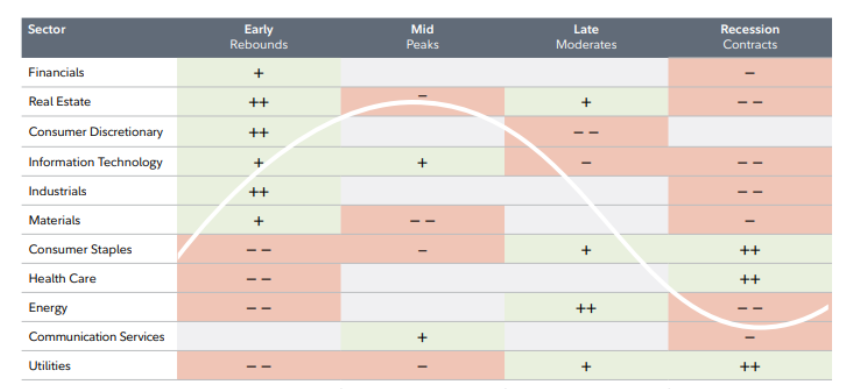
Source: Fidelity. This is for information and illustrative purposes only. It should not be relied on as advice or recommendation.
Things to consider
Recent market expectations have swung widely. The worse-than-expected July non-farm payroll data seemed to plunge the U.S. into recession overnight.
But as the new week began, a better-than-expected non-manufacturing PMI revived hopes for a soft landing.
The poor employment data was partly impacted by hurricanes. While the labor market is cooling, it isn't as severe as it appears. The recession trade is gaining popularity, but it might not materialize.
Although there are no FOMC meetings in August, the Federal Reserve will host its annual Jackson Hole symposium from August 22-24. Fed Chair Jerome Powell will deliver a speech on the economic outlook and monetary policy, providing investors with clearer insights into the U.S. economy.
Additional Disclosures: This content is also not a research report and is not intended to serve as the basis for any investment decision. The information contained in this article does not purport to be a complete description of the securities, markets, or developments referred to in this material. The information has been obtained from sources considered to be reliable, but we do not guarantee that the foregoing material is accurate or complete. Furthermore, there is no guarantee that any statements, opinions or forecasts provided herein will prove to be correct.
This presentation is for informational and educational use only and is not a recommendation or endorsement of any particular investment or investment strategy. Investment information provided in this content is general in nature, strictly for illustrative purposes, and may not be appropriate for all investors. Read more