Trump is back in the White House! Is this the moment for the energy sector?
The results of the U.S. presidential election show that Donald Trump has been re-elected as President of America. Trump's energy policies are well-known: he opposes the adoption of renewable energy, supports the extraction of fossil fuels, and has explicitly stated in his campaign that he will once again withdraw from the Paris Climate Agreement. During his campaign, Trump frequently chanted “Drill, Baby, Drill.”
Due to his clear policy stance, the energy sector has always been considered a crucial component of the "Trump trade."
However, investors might overlook that during Trump's previous term, the energy sector was the worst performer among the 11 sectors of the S&P 500, declining nearly 40%.
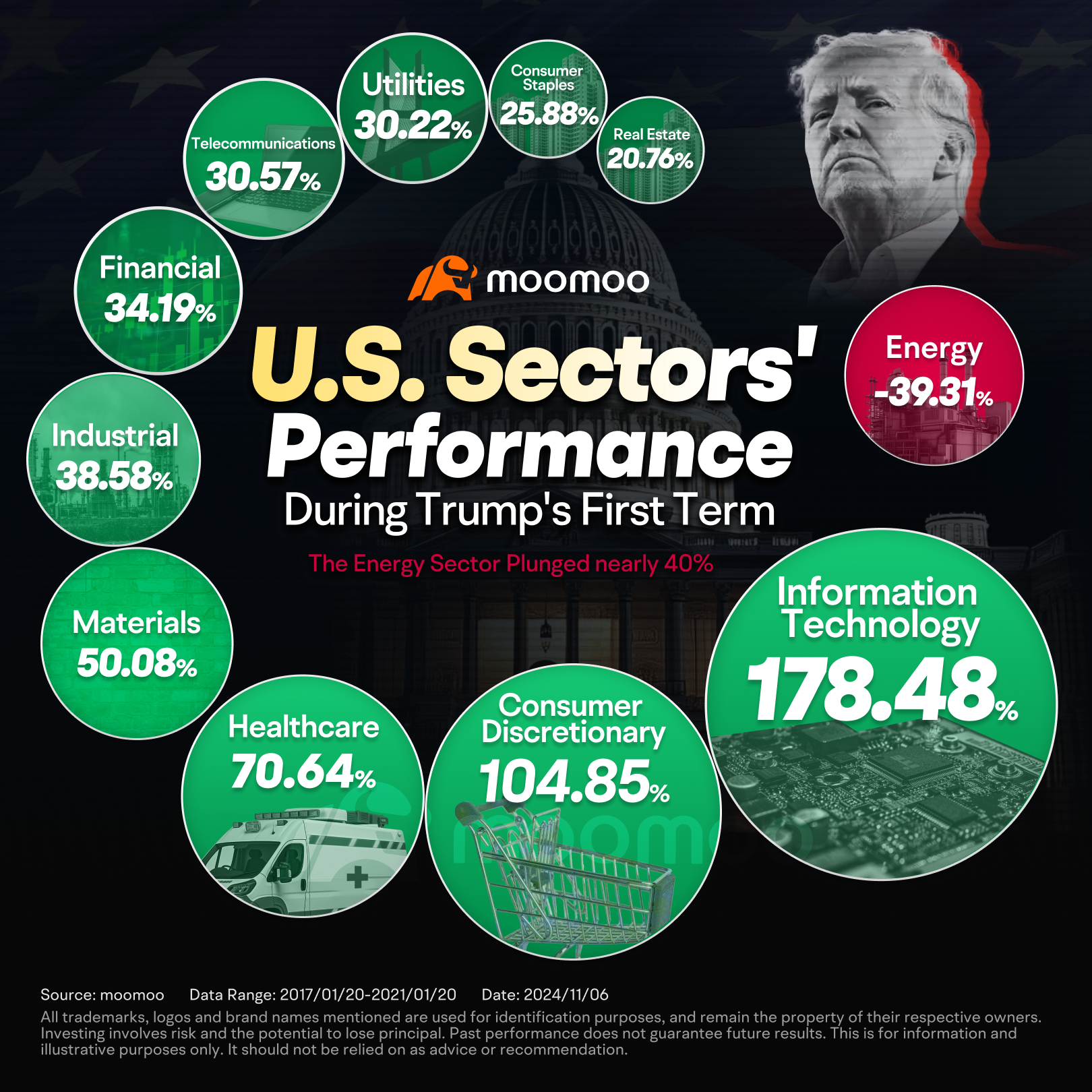
During Trump's first term, he backed the energy industry with supportive policies. So why did the sector underperform? What can we expect as he begins his second term? This week's Opportunity Mining will explore these questions.
Volume up ≠ Stock gain
The energy sector's poor performance during Trump's first term can largely be attributed to the pandemic.
Global travel restrictions led to a crash in transportation and industrial activities, causing a sharp decline in energy demand.
In April 2020, the industry saw unprecedented negative oil prices, resulting in substantial losses for related companies.
However, without the pandemic's impact, the energy sector still underperformed. As of early January 2020, before the oil price collapse, the energy sector had declined by 6.85% since Trump took office.
Upon assuming office in 2017, Trump implemented a series of policies favorable to the industry. He rolled back environmental regulations (such as methane emission standards) and accelerated the approval process for industry projects, leading to significant growth in U.S. oil production.
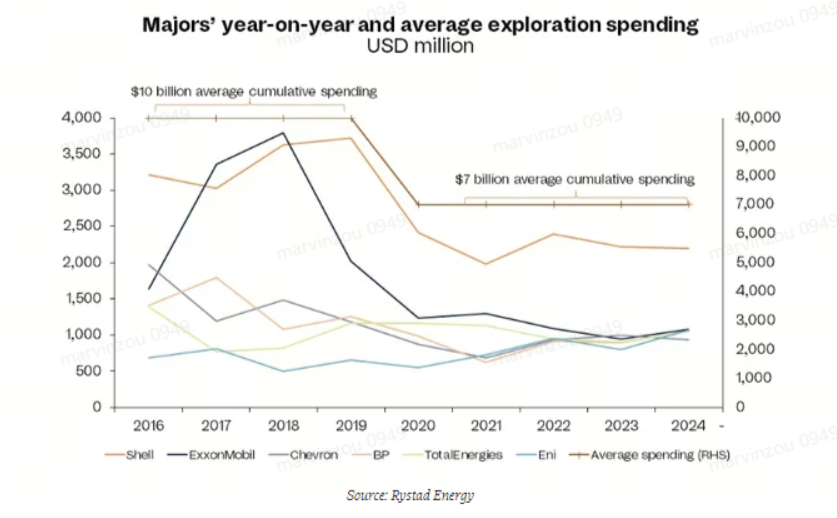
According to Rystad Energy, major industry players like $Exxon Mobil (XOM.US)$, $Chevron (CVX.US)$ , and $Shell (SHEL.US)$ had an average annual capital expenditure of $10 billion between 2016 and 2019.
This is for information and illustrative purposes only. It should not be relied on as advice or recommendation.
During Trump's first term, U.S. shale oil production surged, and in 2018, the country surpassed Saudi Arabia to become the largest oil producer. However, with increased production came intensified competition among oil companies, resulting in a noticeable adjustment in oil prices starting from the fourth quarter of 2018, which affected the sector's performance.
A favorable policy environment does not guarantee success for the industry. S&P Global notes that commodity prices and Wall Street, rather than the president, are the true determinants of the industry's fate.
Under Democratic leadership, traditionally at odds with the industry, high inflation and geopolitical tensions have provided a tailwind for the energy sector, leading to a multi-year bull market alongside soaring prices.
Industry giants have reduced capital expenditures from $10 billion to around $7 billion, significantly improving the sector's condition.
According to Morningstar, energy stocks delivered a 75% excess return relative to the broader market during Biden's presidency (up to Q3 2024), far outperforming during Trump's tenure.
Analysts at Bank of America believe that the price spikes we've seen in the past will be tempered, and there are some downside risks. They also noted that hedge funds chose to sell oil producers after the election results, in contrast to their previous aggressive buying behavior.
Focus on "Shovel Stocks"?
The concept of "shovel stocks" originates from the California Gold Rush, where merchants selling shovels and other tools often profited more consistently than prospectors. In the era of AI, companies like $NVIDIA (NVDA.US)$, with its powerful GPUs, have become market leaders.
In the energy sector, "shovel stocks" refer to companies providing equipment, services, and technical support for resource extraction and production.
These companies do not directly produce oil, but their business is closely tied to producers' capital expenditures. If oil drilling activities see a significant uptick during Trump's second term, oilfield service companies may also benefit.
The oilfield services industry is led by the 'Big Three' companies—$Schlumberger (SLB.US)$, $Halliburton (HAL.US)$, and $Baker Hughes (BKR.US)$—all of which are publicly traded in U.S. markets.
With a history that stretches back to the early 20th century, these firms engage in exploration, operations, and equipment services worldwide. According to Yakov & Partners, the Big Three command a combined 56% market share in North America, with Halliburton holding the largest portion at 25%.
However, the future capital expenditure plans of producers remain a key area to monitor.
Zacks Investment Research notes that after a cyclical trough in the 2020s, upstream companies have been cautious with capital spending, prioritizing shareholder returns over increasing production. This trend is likely to persist.
The Financial Times also reports that investors, tired of years of debt-driven drilling booms, are unlikely to alter their current capital discipline.
What to watch in energy investments?
As previously discussed in our section on the lithium industry, cyclical stocks have unique characteristics compared to other sectors. Instead of solely concentrating on current financial performance, investors should take a broader look at industry trends and supply-demand dynamics.
Energy is a cyclical industry, and unlike lithium resources, it is also significantly affected by geopolitical factors, like the influence of OPEC.
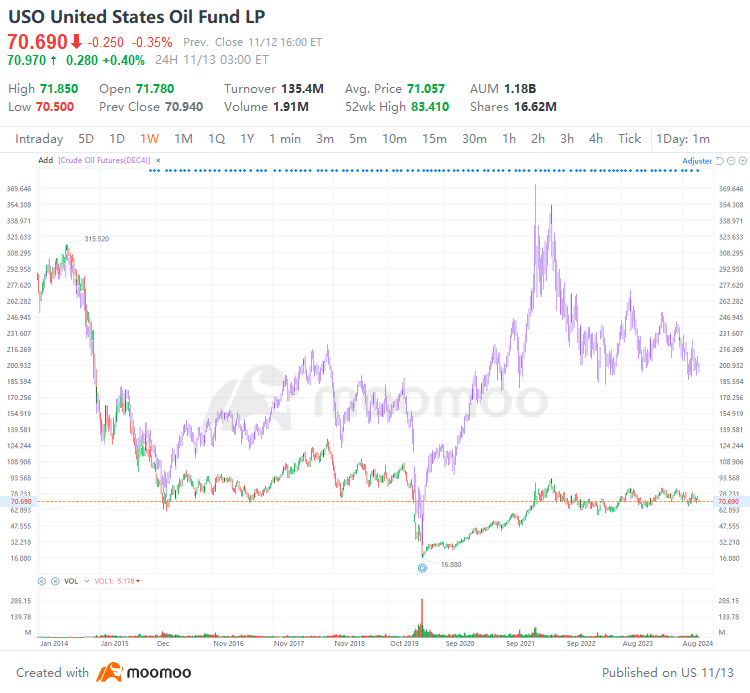
If you've invested in oil ETFs, you might notice a peculiar phenomenon: unlike gold ETFs, oil ETFs often show discrepancies with futures prices, underperforming the spot price over the long term.
Past performance does not guarantee future results. This is for information and illustrative purposes only. It should not be relied on as advice or recommendation.
Gold, as a precious metal, has high unit value and is easy to store and manage, so most gold ETFs hold physical gold with minimal tracking error.
In contrast, crude oil is a bulk commodity, and related ETFs operate by holding futures contracts. For example, the largest oil ETF, $United States Oil Fund LP (USO.US)$ , holds near-month WTI crude oil futures contracts and rolls them over to next month's contracts as they near expiration, a process known as "rollover."
When the price of longer-dated contracts is higher than near-term contracts, USO must buy the longer-dated contracts at a premium, incurring a rolling loss. In such cases, even if spot prices remain unchanged or rise, the ETF's net asset value may still suffer.
Conversely, if longer-dated prices are lower than near-term, the ETF may benefit from the roll.
Holding physical crude oil incurs storage costs, which are reflected in the forward contract prices, typically resulting in a positive spread (longer-term prices above near-term). This means that over the long term, oil ETFs may not track futures prices closely.
Additional Disclosures: This content is also not a research report and is not intended to serve as the basis for any investment decision. The information contained in this article does not purport to be a complete description of the securities, markets, or developments referred to in this material. The information has been obtained from sources considered to be reliable, but we do not guarantee that the foregoing material is accurate or complete. Furthermore, there is no guarantee that any statements, opinions or forecasts provided herein will prove to be correct.
This presentation is for informational and educational use only and is not a recommendation or endorsement of any particular investment or investment strategy. Investment information provided in this content is general in nature, strictly for illustrative purposes, and may not be appropriate for all investors. Read more