The Details Behind ServiceNow's 37x Stock Surge in 11 Years
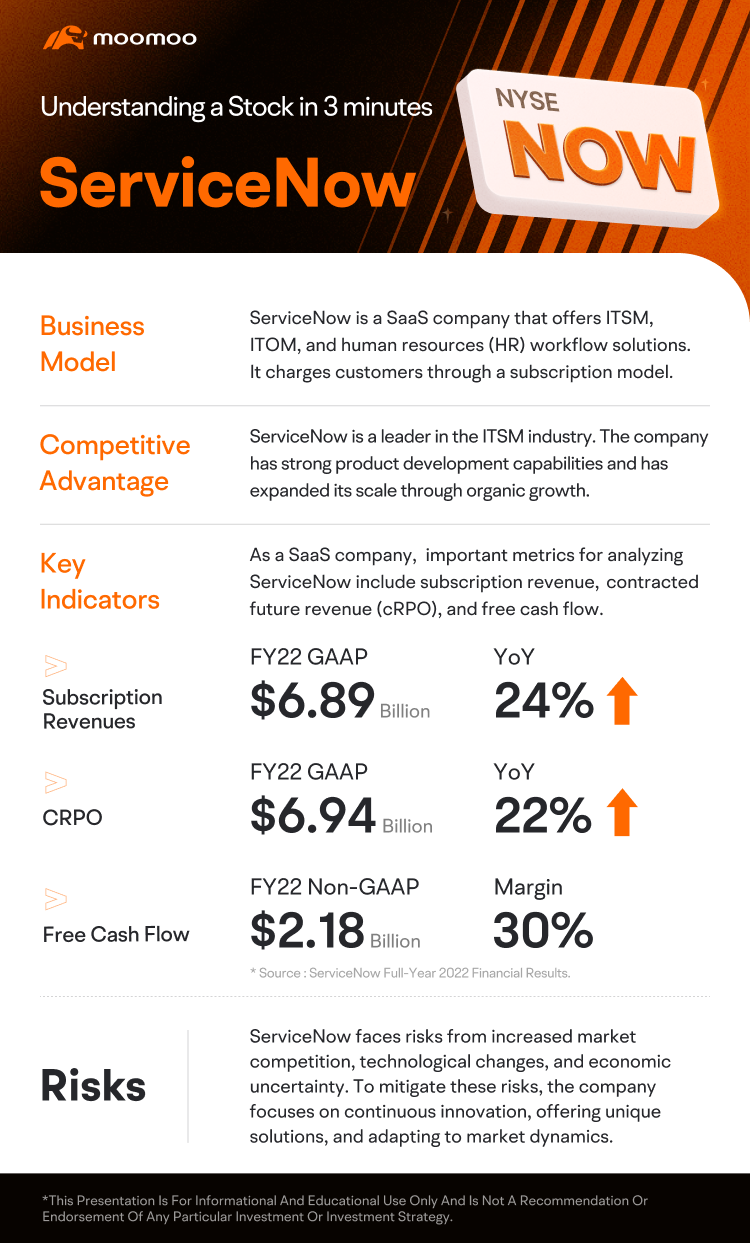
In the US stock market, there is a company that has caught investors' attention.
Despite being listed for only 11 years, its market value has grown 37 times, exceeding US$100 billion.
Moreover, it has maintained a revenue of US$7.2 billion in the fiscal year 2022, growing at a rate of 23%.
According to the company's projections, they believe their annual subscription revenue will reach US$10 billion by 2024 and US$15 billion by 2026.
The name of this company is ServiceNow (NYSE: NOW), a market leader in IT service management (ITSM), IT operations management (ITOM), and digital workflow.
In this article, we will explore what drives ServiceNow's ongoing rapid growth in the industry.
Table of Contents:
ServiceNow's Success Story: Choosing the Right Path
ServiceNow's Growth Strategy: Focusing on Organic Expansion
Behind the Stock Price: AI as a Potential New Growth Driver
Future Opportunities and Risks
ServiceNow's Success Story: Choosing the Right Path
ServiceNow was founded in 2003 with a focus on ITSM (IT Service Management) in the SaaS (Software as a Service) industry.
It helps businesses plan, operate, and maintain their IT systems, which are critical to their operations.
At its inception, the ITSM market was highly competitive, with established giants such as IBM, Oracle, HP, and BMC as competitors. However, ServiceNow set itself apart from the rest by becoming the first ITSM cloud service provider.
Around 2010, with the rapid growth of the internet and the increasing demand for cloud computing solutions, ServiceNow experienced a surge in demand.
Capitalizing on its early advantage and expertise in SaaS ITSM, ServiceNow quickly emerged as an industry leader and went public.
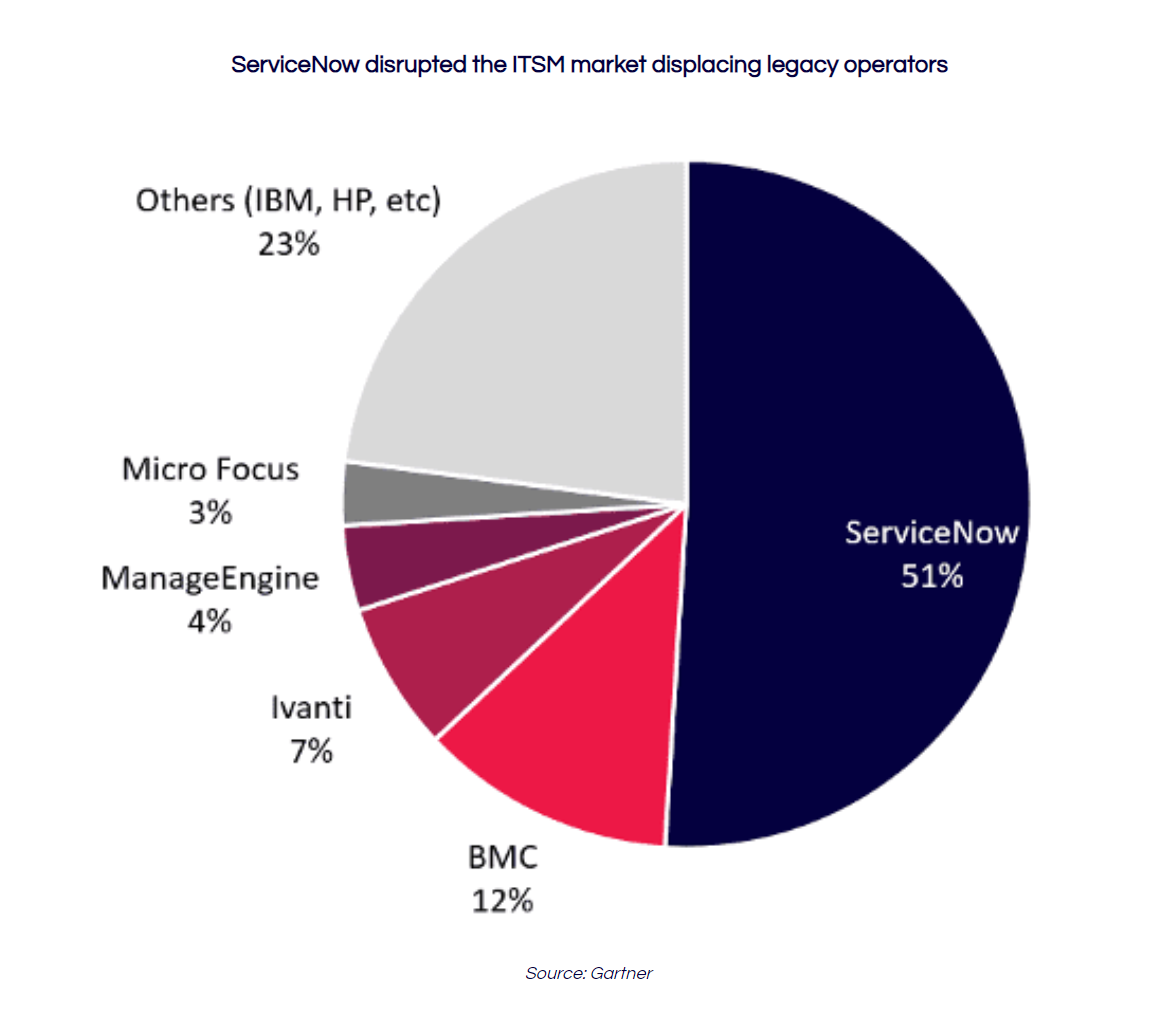
In 2019, ServiceNow established its dominance in the ITSM market with an impressive 51% market share. By the end of 2022, the company's revenue soared to US$7.2 billion, solidifying its position as one of the most successful companies in the SaaS industry.
Source: Montaka Global Investments
ServiceNow's Growth Strategy: Focusing on Organic Expansion
ServiceNow stands out from other SaaS companies by adopting a different growth strategy.
In general, there are two common approaches to growth in the SaaS industry: organic and inorganic. Organic growth involves expanding through internal product development, while inorganic growth entails growing through acquisitions.
For example, leading SaaS company Salesforce has achieved significant growth through large-scale acquisitions such as Slack (US$27.7 billion), Tableau Software Inc. (US$15.3 billion), and MuleSoft Inc. (US$6.5 billion).
In contrast, ServiceNow prioritizes organic growth, supplemented by forming partnerships and making small-scale acquisitions to expand its company size.
This unique strategy sets ServiceNow apart from other SaaS giants and creates a strong product development capability that serves as a potential competitive advantage.
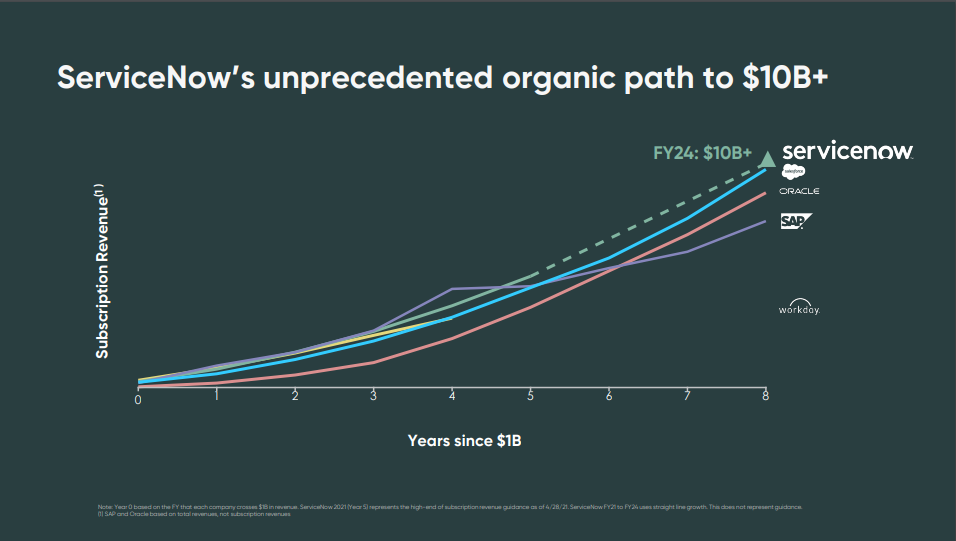
ServiceNow aims to be the first company to reach US$10 billion in subscription revenue through organic growth, outpacing established SaaS giants like Salesforce, Oracle, and SAP in terms of speed.
Source: ServiceNow Financial Analyst Day 2021
Behind the Stock Price: AI as a Potential New Growth Driver
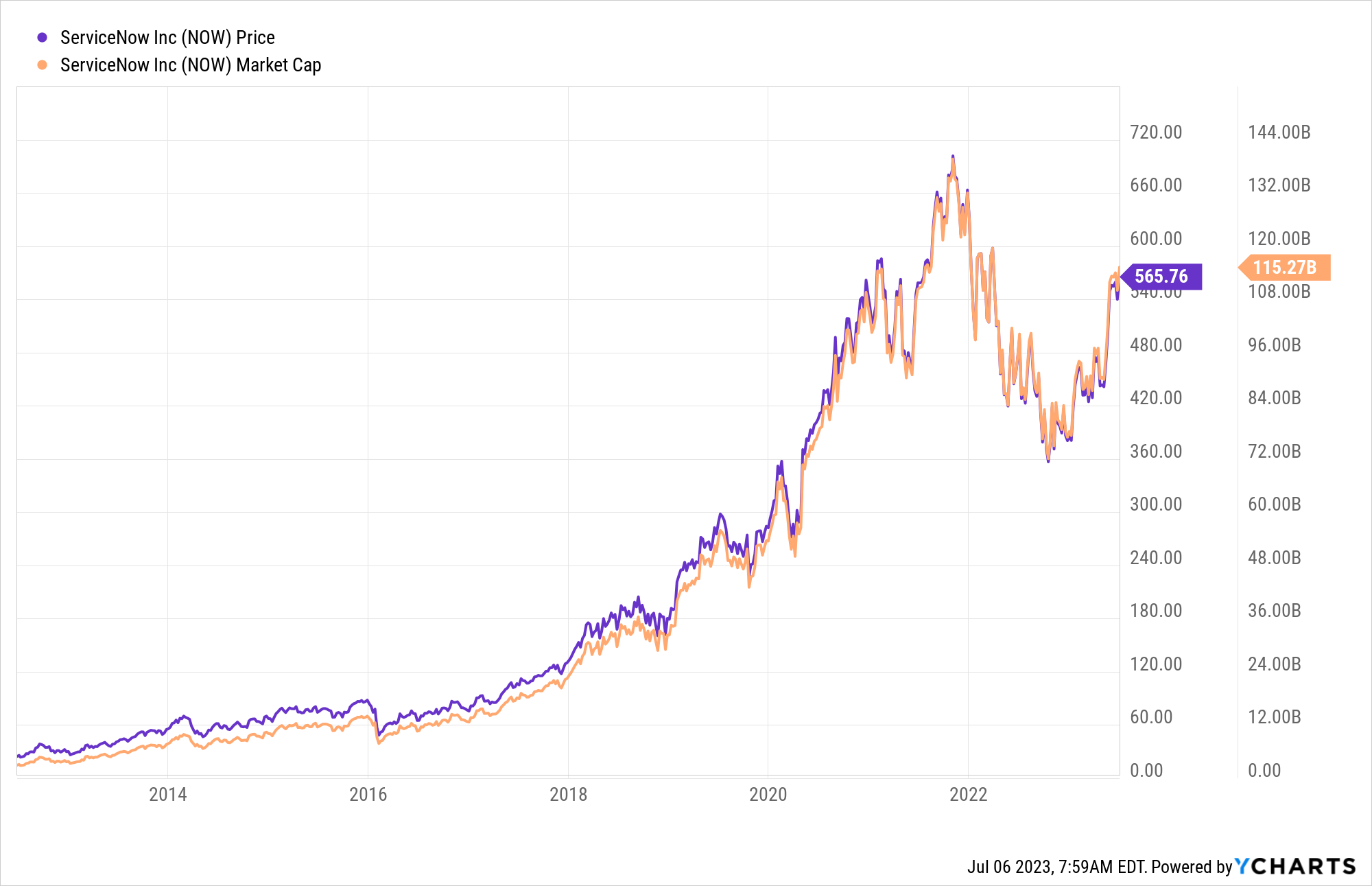
ServiceNow's continuous development has been driven by several CEOs, and its stock price growth can be divided into three distinct stages:
Stage 1 (2012-2017): Establishing ITSM Leadership
Under the leadership of CEO Frank Slootman, ServiceNow established itself as a top ITSM provider. Its stock price rose from US$24.6 at its IPO in June 2012 to US$86 by February 2017.
2. Stage 2 (2017-2019): Expanding into New Areas
In 2017, John Donahoe took over as CEO, succeeding Frank Slootman. Donahoe recognized the need for ServiceNow to expand beyond IT departments, prompting the company to diversify into areas such as customer service, human resources, and more. During Donahoe's tenure as CEO, the company's stock price increased by an impressive 161%.
3. Stage 3 (2019-present): Empowering Business with AI
In 2019, Bill McDermott became ServiceNow's CEO, bringing extensive experience from his time at SAP SE. Under McDermott's leadership, ServiceNow focused on enterprise transformation. At the 2023 Investor Day, the company emphasized the role of generative AI in empowering its workflow business.
*Past performance is no guarantee of future results.
Future Opportunities and Risks
Future Opportunities: ServiceNow is already a massive company with a market capitalization of over US$100 billion and annual revenue of over US$7 billion. However, according to company management, there is still significant growth potential for the company. With its expansion into IT, customer service, human resources, and other areas, ServiceNow estimates that the potential market size in these segments could reach US$220 billion by the 2025 fiscal year, according to the company's financial analyst day report in 2023.
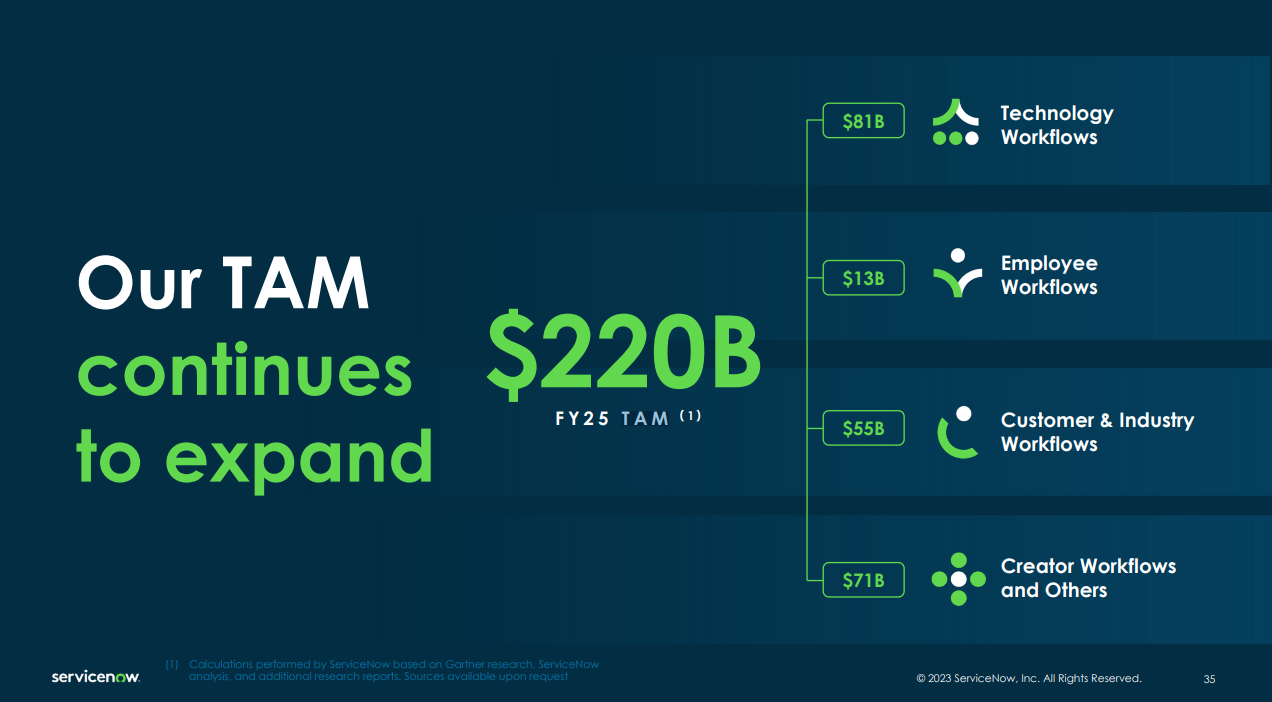
Source: ServiceNow Financial Analyst Day 2023. Total addressable market (TAM), also called total available market, is a term that is typically used to reference the revenue opportunity available for a product or service.
Potential Risks: ServiceNow's valuation is relatively high. Data from Simply Wall Street as of July 6, 2023, shows that ServiceNow's price-to-sales (PS) ratio is 15 times, surpassing the industry average of 8.8 times. Moreover, as a growth stock, it tends to attract investors during bullish markets but can suffer larger declines compared to other stocks during bearish market conditions.
Summary
This week, we explored ServiceNow, a stock in the SaaS industry with a focus on IT service management (ITSM). Here are the key takeaways:
ServiceNow's success can be attributed to its early emphasis on becoming a leading provider of cloud-based ITSM solutions.
The company's growth strategy involves expanding organically, establishing partnerships, and making small-scale acquisitions.
ServiceNow's stock price growth can be categorized into three stages: solidifying its position in ITSM, expanding into new business areas, and leveraging AI to enhance operations.
The company may have growth potential in its market, but its stock valuation is currently higher than the industry average.
Additional disclosures: This content is also not a research report and is not intended to serve as the basis for any investment decision. The information contained in this article does not purport to be a complete description of the securities, markets, or developments referred to in this material. The information has been obtained from sources considered to be reliable, but we do not guarantee that the foregoing material is accurate or complete. Furthermore, there is no guarantee that any statements, opinions or forecasts provided herein will prove to be correct.
This presentation is for informational and educational use only and is not a recommendation or endorsement of any particular investment or investment strategy. Investment information provided in this content is general in nature, strictly for illustrative purposes, and may not be appropriate for all investors. Read more