Cryptocurrency strong rebound! What's next for Coinbase?
Hello everyone, in this week’s Opportunity Mining, we will take a look at one of the major exchanges in the cryptocurrency field: $Coinbase (COIN.US)$ .
Coinbase's stock price is closely tied to the performance of cryptocurrencies, especially bitcoin.
In 2024, bitcoin hit an all-time high of nearly $74,000 per coin in March, causing a surge in the company's stock. However, by August, fears of an economic recession led to a cryptocurrency sell-off, with bitcoin dropping below $50,000 and pulling Coinbase down with it.
Bitcoin's price rise usually attracts more investors and traders, increasing trading volume. Exchanges profit from transaction fees, so higher trading volume boosts revenue and profitability. This correlation explains the link between the company's stock price and cryptocurrency prices.
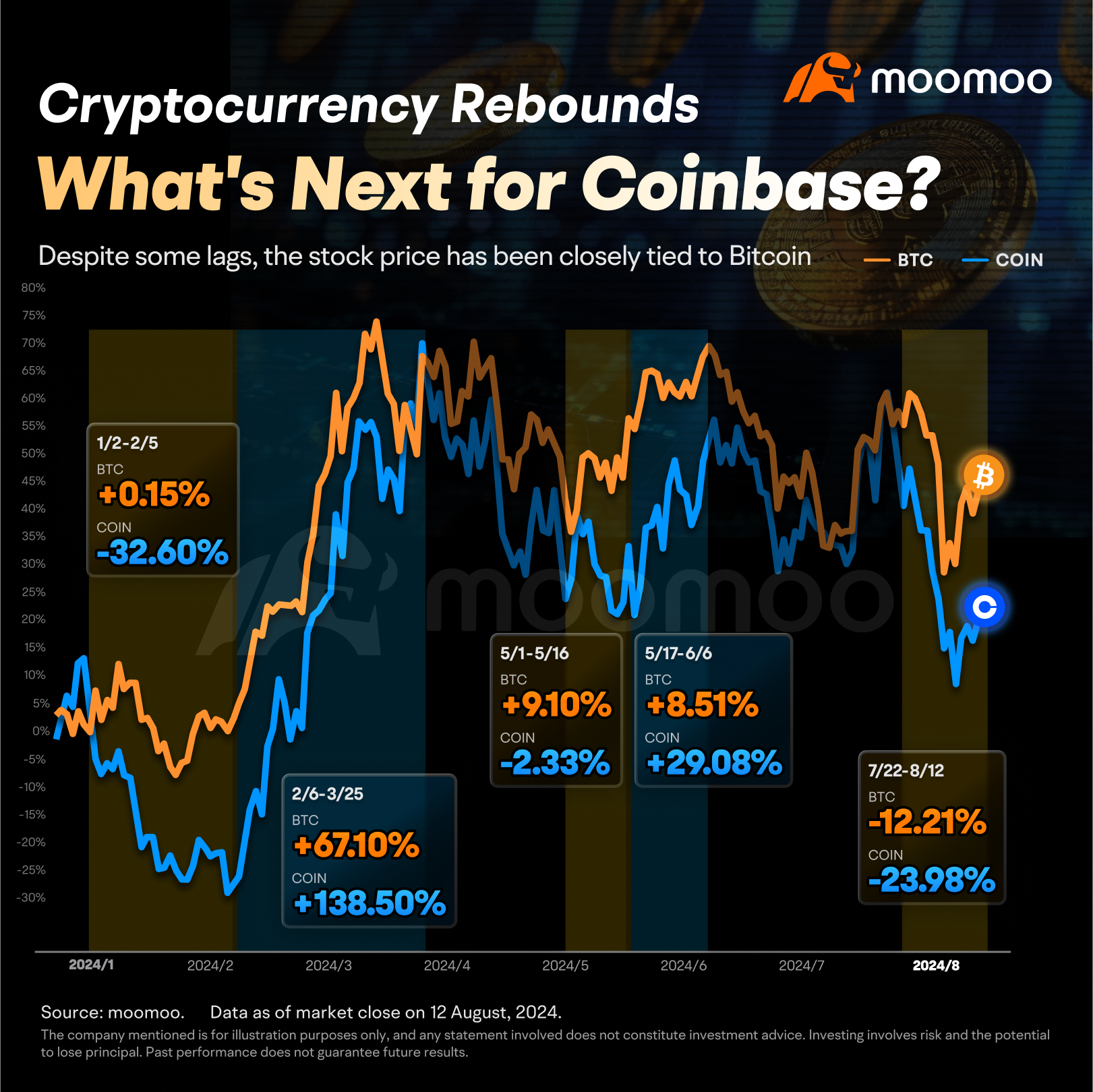
It's important to note that Coinbase and bitcoin haven't always moved in sync; sometimes there's a lag. Earlier this year and in May, the company's stock price lagged behind relative to Bitcoin's gains but eventually caught up.
With new macroeconomic data emerging, recession worries have eased. On August 8, bitcoin surged over 11%, reclaiming the $60,000 mark.
What are the main businesses of Coinbase? And how does the newly approved cryptocurrency ETF, greenlit at the beginning of the year, impact the exchange's existing business? This article will address these questions.
Performance stabilizing
Coinbase, founded in 2012, went public on the U.S. stock exchange in 2021, becoming the world's first publicly listed cryptocurrency exchange.
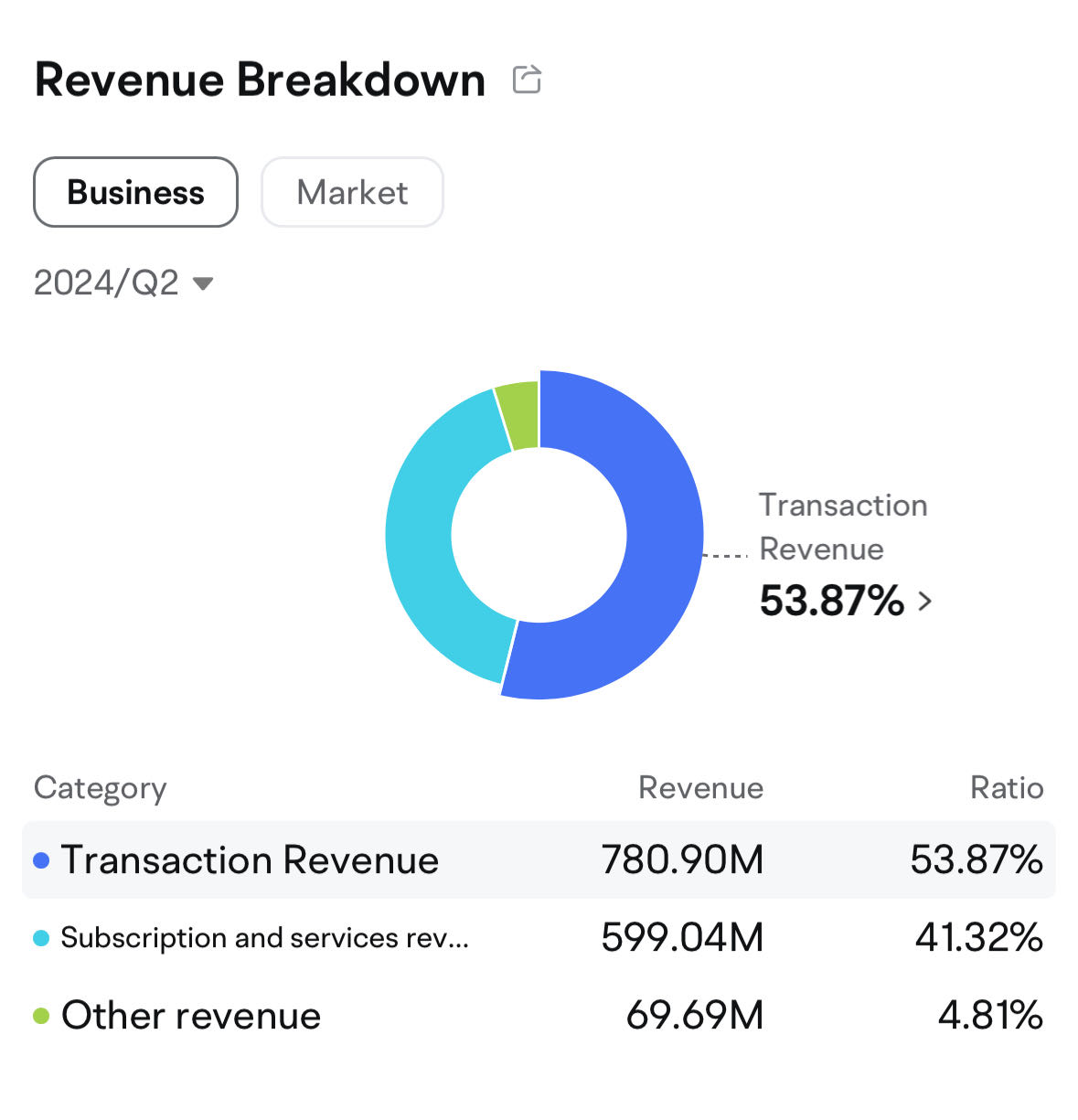
The company’s business comprises three segments: transaction revenue, subscription and services, and other. Transaction revenue is the largest.
Transaction revenue refers to fees collected from users conducting cryptocurrency transactions on the platform based on the transaction amount.
Subscription and services include income from stablecoins (like USD-pegged USDC/USDT), staking revenue from cryptocurrencies, and revenue from custodial assets.
Source: moomoo.
Investing involves risk and the potential to lose principal. Past performance does not guarantee future results.
On August 1, Coinbase released its second-quarter earnings. Q2 revenue was $1.45 billion; adjusted EBITDA was $596 million, marking the sixth consecutive quarter of positive adjusted EBITDA.
Both revenue and profit saw significant year-over-year growth but a quarter-over-quarter decline. It was primarily due to cryptocurrencies transitioning from a surge in Q1 to a more volatile state.
Zacks Investment Research noted that Coinbase is increasing its market share in the U.S. spot and derivatives markets, expanding its product portfolio, and penetrating the international market. Growth in stablecoins should also fuel the top line of this company.
The report noted that strengthening banking connections, securing new licenses, and expanding customized product offerings are helping Coinbase reach new heights.
Also, ARK Investments under CEO Cathie Wood significantly increased their holdings in Coinbase during the market downturn.
Transaction documents reveal that multiple ARK ETFs purchased over 90,000 shares of Coinbase on August 5, valued at $17.8 million. The next day, ARK acquired nearly 20,000 more shares for $3.9 million.
The average cost was about $191 per share. Based on the closing price on August 12, this trade is slightly profitable.
Impact of ETFs
Retail trading, or trading by individual investors, constitutes the major part of transaction revenue for Coinbase. This segment is crucial for the company's overall performance.
Q2 retail trading revenue was $665 million, accounting for over 85% of total transaction revenue, and nearly half of the total revenue.
In January, the U.S. Securities and Exchange Commission (SEC) approved the listing and trade of a series of spot Bitcoin ETFs. It sparked concerns about Coinbase.
With investors able to obtain cryptocurrencies through various means, exchanges could potentially lose market share.
Some analysts believed that new cryptocurrency investors could opt for ETFs rather than using Coinbase, thereby reducing the demand for the company's services.
Additionally, the lower fees of newly issued ETFs might force Coinbase into a price war, leading to reduced transaction fees and impacting its earnings.
However, the market’s concerns have not thus materialized. On one hand, the new ETFs also require custodial services from exchanges. Among the first 11 bitcoin ETFs approved by the SEC, eight chose to partner with Coinbase. In Q1 of this year, the company’s custodial assets grew by 69% quarter-over-quarter, partly driven by ETF fund inflows.
On the other hand, the company’s transaction fees have not been impacted by the ETFs. The surge in cryptocurrency prices ignited investor enthusiasm, making fees a secondary concern.
Morningstar noted concerns about Coinbase's high fees compared to its peers, but there are no signs of immediate pressure. The company's market share remains strong, and average pricing has increased in recent quarters. Price compression is not an immediate concern, as there is no catalyst driving prices lower.
Technical analysis
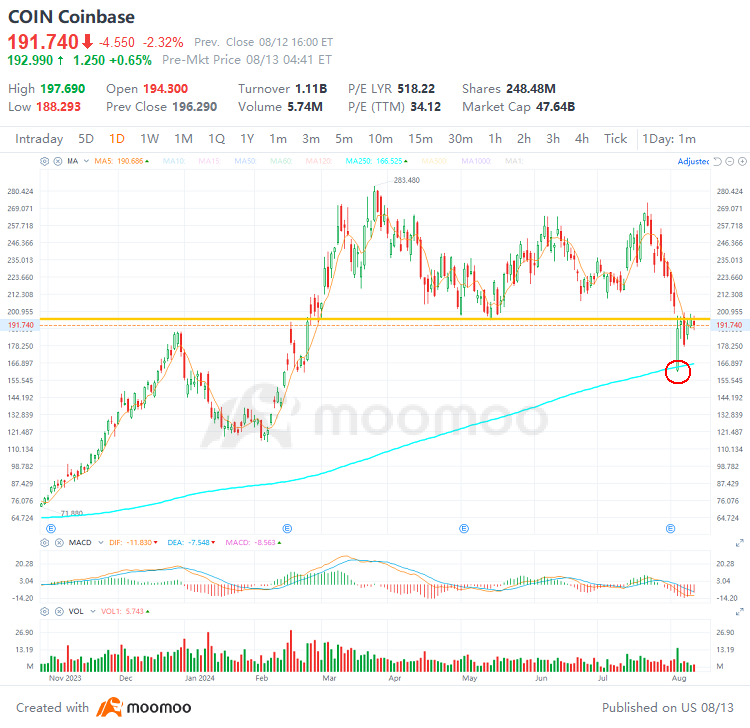
On August 5, amid recession fears, Coinbase's stock price briefly dipped below the 250-day moving average bull-bear dividing line on the daily chart.
However, it quickly rebounded above the dividing line as market concerns eased, and the trend did not show a clear deterioration.
With the recent price pullback, the previous low created in May has turned from a potential support level to a potential resistance level.
If the price rebounds to around $200, some bulls might consider closing their positions. Therefore, it should be considered whether this level can be effectively broken.
Source: moomoo.
Data as of market close on August 12, 2024. The company mentioned is for illustration purposes only, and any statement involved does not constitute investment advice.
Related risks
Market Volatility: The proportion of non-transactional income for Coinbase has significantly increased, lessening the impact of cryptocurrency price fluctuations.
However, its stock performance remains closely tied to the volatile cryptocurrency markets, making the company susceptible to extreme events.
Regulatory Risk: In January 2023, Coinbase settled with U.S. regulators for $100 million over anti-money laundering allegations, including a $50 million fine and $50 million to enhance its compliance system.
The SEC’s lawsuit against the company is ongoing. However, compared to peers like Binance, Coinbase has faced relatively less regulatory impact.
Technical Risk: Cryptocurrency exchanges are frequent targets for hackers. Technical failures or security vulnerabilities could cause platform outages or trading disruptions, impacting the company’s performance.
Additional Disclosures: This content is also not a research report and is not intended to serve as the basis for any investment decision. The information contained in this article does not purport to be a complete description of the securities, markets, or developments referred to in this material. The information has been obtained from sources considered to be reliable, but we do not guarantee that the foregoing material is accurate or complete. Furthermore, there is no guarantee that any statements, opinions or forecasts provided herein will prove to be correct.
Cryptocurrency ETFs are speculative and involve a high degree of risk. An investor may lose all or substantially all of an investment in the Fund. Cryptocurrency has historically exhibited high price volatility relative to more traditional asset classes, which may be due to speculation regarding potential future appreciation in value among other factors. The performance of these ETFs should follow cryptocurrency prices closely, minus fees and the fund’s trading costs. Before investing in an ETF, you should read both its summary prospectus and its full prospectus, which provide detailed information on the ETF’s investment objective, principal investment strategies, risks, costs, and historical performance (if any). You can find prospectuses on the websites of the financial firms that sponsor a particular ETF, as well as through your broker.
This presentation is for informational and educational use only and is not a recommendation or endorsement of any particular investment or investment strategy. Investment information provided in this content is general in nature, strictly for illustrative purposes, and may not be appropriate for all investors. Read more