What to know about investing in Real Estate Investment Trusts (REITs)
What are REITs?
REITs, or Real Estate Investment Trusts, are pooled collections of assets that own, finance, or operate income-generating real estate and issue dividends to their investors. Some of them can be traded publicly on a stock exchange, but others cannot.
REITs originated in the US. In 1960, the US Congress passed the Internal Revenue Code, proposing a partial tax exemption for dividends from REITs that meet the requirements, thus laying the foundation for REITs' tax benefits. The first REIT was created in the US in1961. After 60 years of development, the US has now become the largest and most mature REITs market in the world.
According to NAREIT (National Association of Real Estate Investment Trusts), REITs allow anyone to invest in portfolios of real estate by purchasing an individual stock, a mutual fund, or an exchange-traded fund (ETF). The stockholders of a REIT can earn a proportion of the income produced without having to buy, manage or finance a property. Approximately 145 million Americans live in households invested in REITs via their 401(k), IRAs, pension plans, and other investment funds.
In total, gross assets owned by REITs of all types across the US add up to more than $3.5 trillion, with public REITs holding approximately $2.5 trillion in assets, representing more than 500,000 properties. The equity market capitalization of US-listed REITs registered over $1.35 trillion.
How do REITs make money?
REITs invest in many different types of real estate properties, including offices, apartment buildings, warehouses, retail centers, medical facilities, data centers, cell towers, infrastructure, and hotels. Most REITs focus on a particular type, but some hold multiple types of properties in their portfolios.
Most REITs operate along a straightforward business model: By leasing space and collecting rents, the company generates income and then pays out to shareholders in the form of dividends.
The main source of income of REITs is stable rents so that they can distribute most of their incomes (usually 90% of revenue) to investors as dividends, and this partly explains why the dividend payout rate of REITs is higher than stocks. Investors can also buy multiple REITs to reduce risks.
Historically, REITs have delivered competitive returns based on high, steady dividend income and long-term capital appreciation. Since they are not highly correlated with other assets, REITs can also help diversify your portfolio to lower risks and increase returns.
Investing in REITs involves risks
First, non-traded REITs cannot be traded on a securities exchange, so they are considered illiquid assets.
Second, investors usually do not have thorough knowledge about non-traded REITs because information about their underlying assets is not fully disclosed.
Third, the performance of publicly-traded REITs, generally considered safer than non-traded REITs, is subject to interest rate fluctuations. Demand for REITs may decline during interest rate hikes.
Finally, Tax rises and misjudgment of underlying assets can also affect REITs ' performance. Changes in these influencing factors may explain why REITs' performance differs.
Inflation and Interest Rates - How do REITS fare?
US stocks have suffered from a sharp drop since the beginning of 2022, with Nasdaq Composite Index tumbling by over 33%(as of July 22, 2022) . The market believes Federal Reserve's interest hike expectations and the high inflation are the leading causes of the battering stock market.
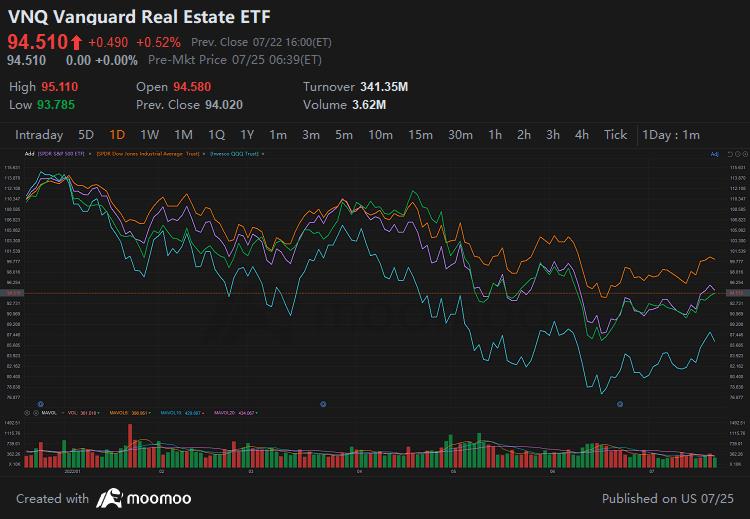
ETF-Vanguard (VNQ) vs. the 3 major US stock indexes (since 2022)
As shown in the chart above, VNQ (green line) has outperformed the overall market so far this year, with VNQ significantly beating the S&P 500 (SPY), Nasdaq (QQQ), and Dow Jones Industrial Average (DIA) in April, when the market was most concerned about inflation. Until now, the VNQ has only underperformed the DIA and still outperformed the QQQ.
In addition, REITs tend to lock in mortgage rates for as long as possible when interest rates are low so that they can withstand periods of higher interest rates.
In other words, when interest rates rise, the negative impact on most REITs is limited, while the positive effect of increasing rents is maximized.
It is clear from the following chart that REITs have historically outperformed equities (SPY) during most periods of interest rate hikes.
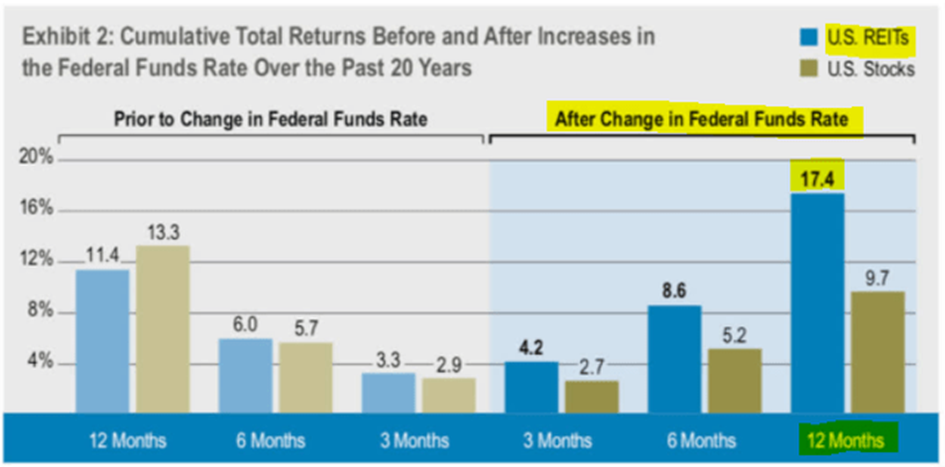
Source: Cohen & Steers
Three reasons why REITs may perform better during inflation:
1. Rapid price increases drive up construction costs. So properties' market value will also go up due to their higher replacement values.
2. Higher construction costs can also drive up rents.
3. Higher inflation may lead to higher wages, which translates into higher incomes. Therefore, tenants in all types of real estate are more capable of paying higher rents.
Of course, excessive inflation may erode the real purchasing power of consumers, which in turn limits rent growth. This is why moderate inflation is the ideal environment for maximizing returns from real estate.
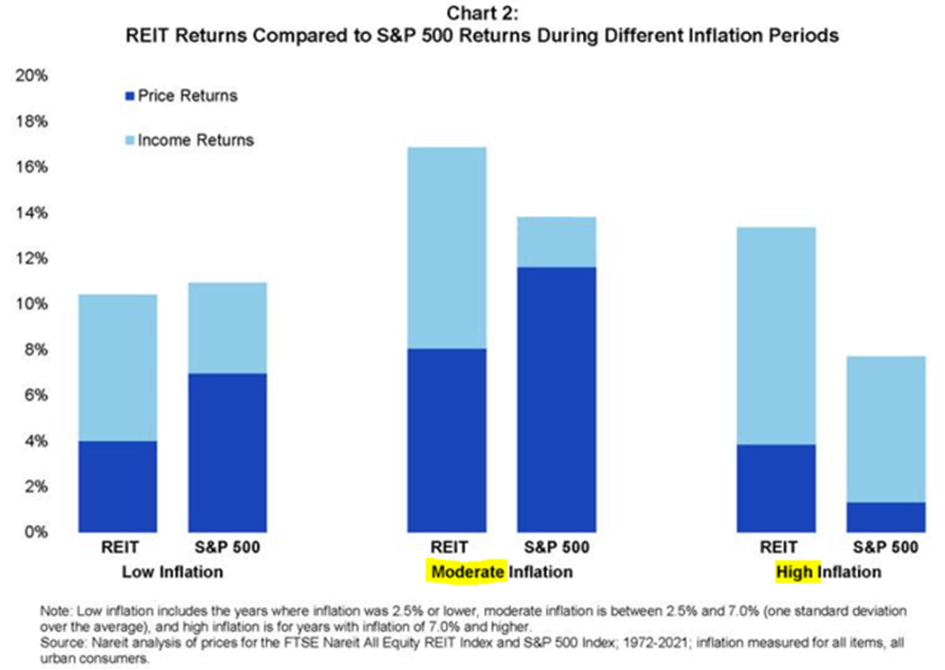
REITs outperform when inflation is high
Source: NAREIT
Three REITs worth watching
According to SeekingAlpha's strategy report, analysts have selected the following three REITs which are worth investing in.
1. $Essential Properties Realty Trust Inc(EPRT.US)$
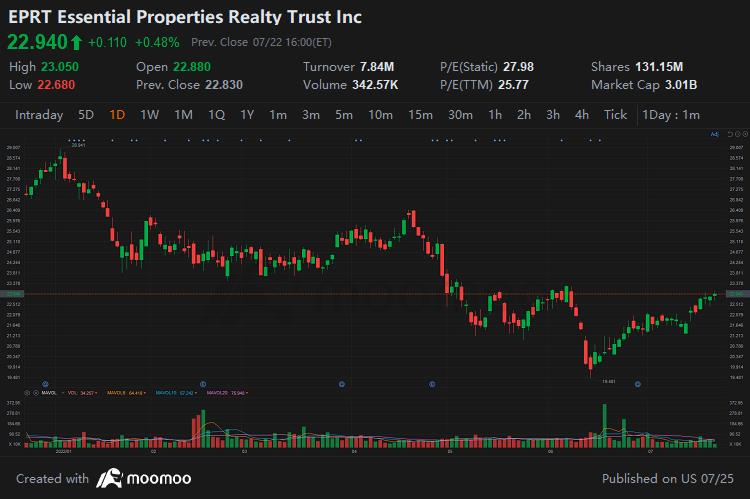
Essential Properties Realty Trust is a company that acquires, owns, and manages single-tenant properties that are net leased to middle-market companies operating in service-oriented or experience-based businesses. In addition to the rent, the net lease requires the tenant to pay some or all of the taxes, fees, and maintenance costs associated with the property; EPRT charges a rental mailing fee. Some of the well-known brands in EPRT's portfolio include restaurant chains such as Taco Bell, McDonald's, and Arby's, as well as companies such as Marriott, Circle K, and Cinemark.
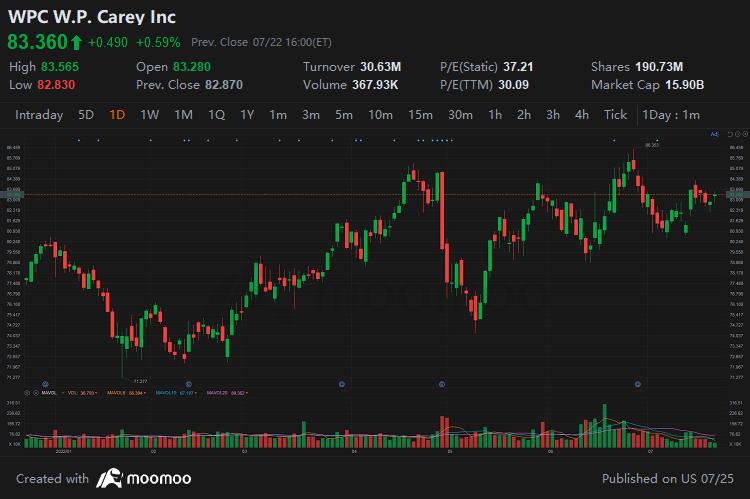
WP Carey Inc. is highly regarded and is expected to be among Seeking Alpha's largest net lease REITs, investing in high-quality single-tenant industrial, warehouse, office, retail, and self-storage properties. WPC's properties include 1,336 net leases (Jul 2022) with an annual rental income of approximately $1.2 billion, 352 tenants, 98.5% occupancy, and 99% rent escalation. With nearly half of its rental income coming from the industrial and logistics sectors, WPC benefits from the supply chain headwinds that other sectors are experiencing. As a result, SeekingAlphpa believes it is a lower-risk investment relative to other industries.
3. $Life Storage, Inc.(LSI.US)$
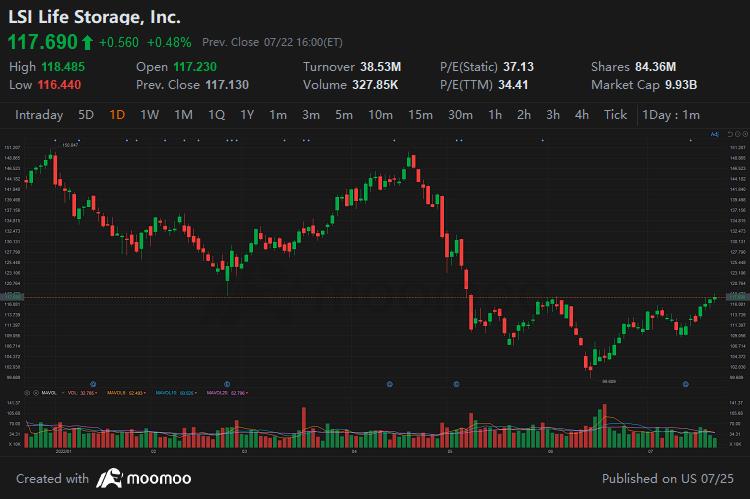
Life Storage, Inc. is a real estate investment trust engaged in the acquisition, ownership, and management of self-storage properties. It provides commercial, vehicle, and wine storage services. With lower capital and operating expenses, Self-storage enjoys progressive cash flow and strong operating margins.
The company has more than 1,000 locations in the United States and Canada. The rapid growth of e-commerce is driving demand for warehouses as well as servers for product storage in the technology industry. Supply chain and labor shortages have led to high occupancy and rental rates for warehouse properties, which gives Life Storage a growth advantage over many other REITs.
In addition, some Wall Street analysts also recommend $Brixmor Property Group Inc(BRX.US)$ and $VICI Properties(VICI.US)$. (Should You Be Impressed By Brixmor Property Group Inc.'s (NYSE: BRX) ROE? July 13, 2022)(Wall Street Analyst Resumed VICI Properties Inc. [VICI]. What else is Wall St. saying July 27, 2022)
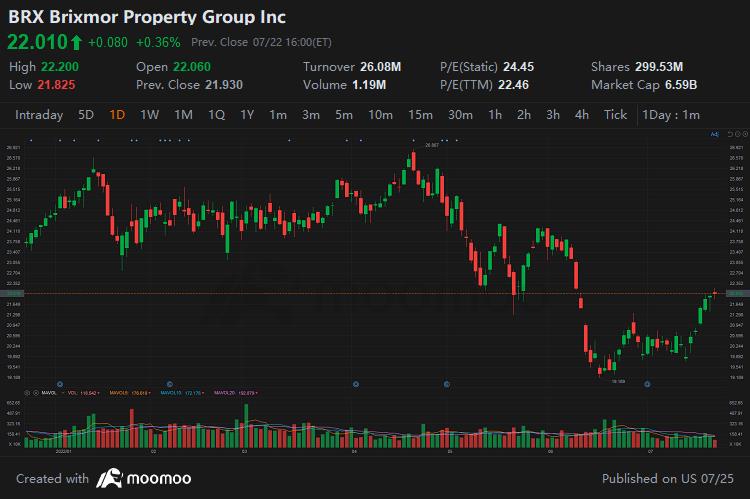
BRX is one of the largest open-air shopping center REITs in the US. Approximately 70% of the company's properties are leased by $The Kroger(KR.US)$, Publix, $KONINKLIJKE AHOLD DELHAIZE NV SPON ADR EACH REP 1 ORD SHS (ADRNY.US)$(e.g., Food Lion, Giant, Stop & Shop) and $Albertsons Companies(ACI.US)$ and other US-based grocery stores for rent.
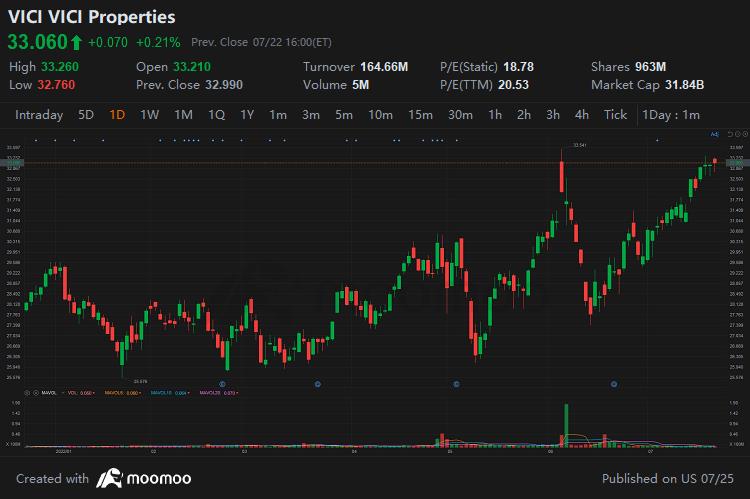
VICI is a leader in gaming REITs, with iconic Las Vegas resorts such as Caesars Palace and The Venetian under its belt, following the company's successful acquisition of MGM Development Properties $MGM Growth Properties LLC.
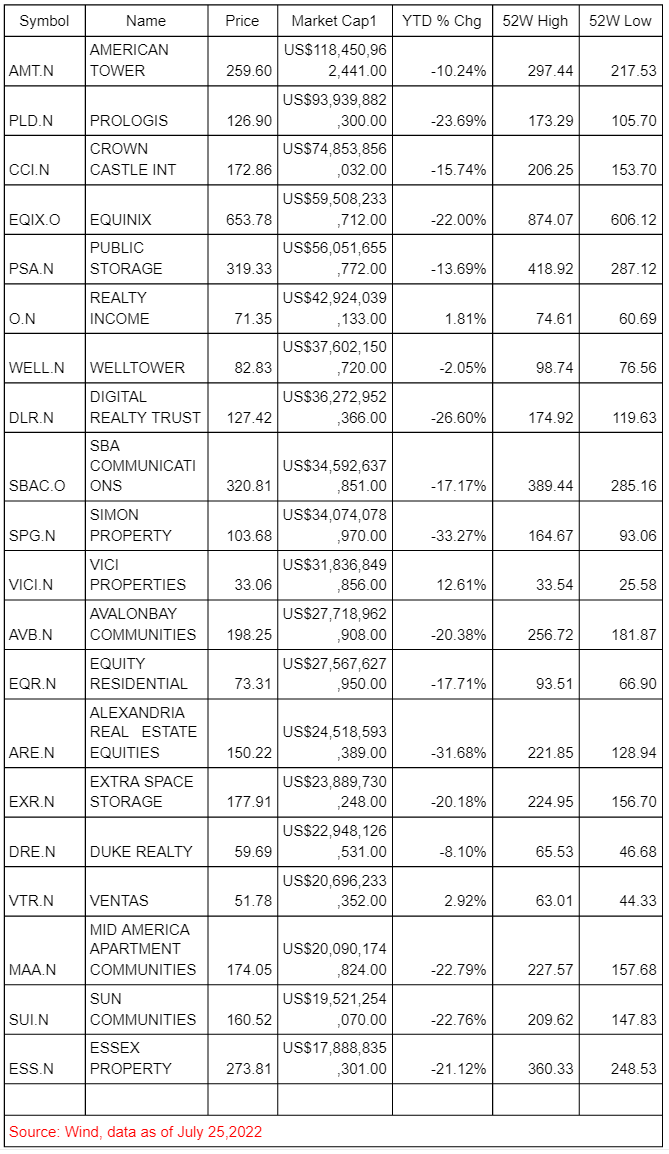
20 Largest Market Cap REITs in the US
Moomoo is a professional trading app offered by Moomoo Technologies Inc. In the U.S., investment products and services on Moomoo are offered by Moomoo Financial Inc., Member FINRA/SIPC.
Any illustrations, scenarios, or specific securities referenced herein are strictly for illustrative purposes. Past investment performance does not guarantee future results. Investing involves risk and the potential to lose principal.
Investing involves risk and the potential to lose principal. Risks of the REITs are similar to those associated with direct ownership of real estate, such as changes in real estate values and property taxes, interest rates, cash flow of underlying real estate assets, supply and demand, and the management skill and creditworthiness of the issuer.
Diversification is an investment strategy that can help manage risk within your portfolio, but it does not guarantee profits or protect against loss in declining markets.
This presentation is for informational and educational use only and is not a recommendation or endorsement of any particular investment or investment strategy. Investment information provided in this content is general in nature, strictly for illustrative purposes, and may not be appropriate for all investors. Read more