Berkshire bites into Domino's! What lies ahead?
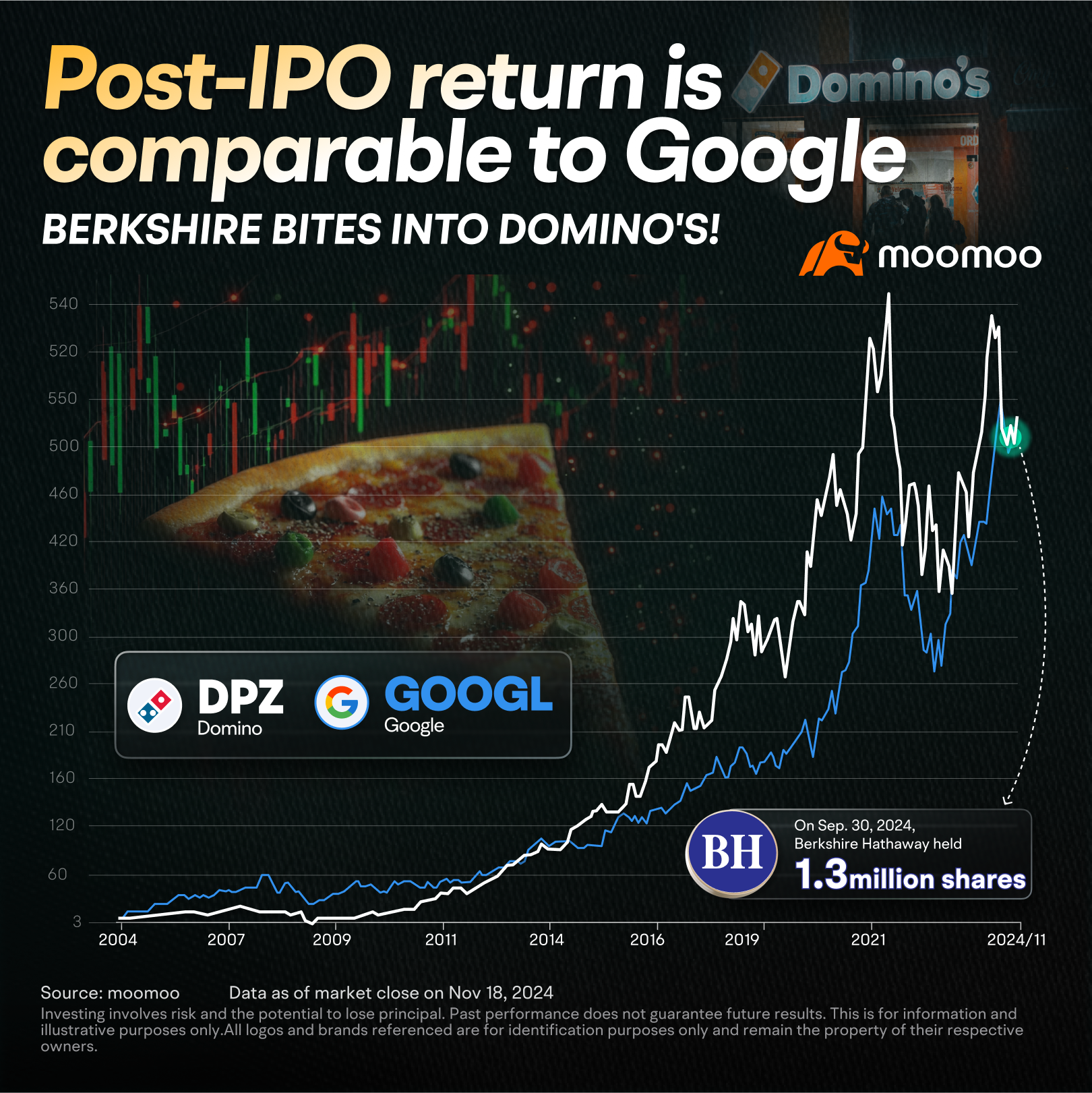
In November, $Berkshire Hathaway-A (BRK.A.US)$ , led by Warren Buffett, unveiled its third-quarter holdings.
According to the company's 13F filing, $Domino's Pizza (DPZ.US)$ emerged as a significant new addition for the quarter. Berkshire holds 1.3 million shares of Domino's, valued at approximately $550 million.
With numerous outlets worldwide, Domino's Pizza is a well-known brand in the fast-food industry. The company went public in 2004 and has achieved remarkable historical performance. $Alphabet-A (GOOGL.US)$ also went public in the same year, and the total returns of the two were indistinguishable.
However, in 2024, its stock underperformed the market, especially after experiencing a nearly 25% drop post-second quarter. As of the market close on November 18, Domino's market capitalization remained around $15 billion.
How is Domino's doing operationally? What could have led Berkshire to take a stake in the company? And is it a smart move to follow in the footsteps of the investment guru?
Let's delve into this week's Opportunity Mining.
A slowdown in sales growth
In July, Domino's released its second-quarter report, which met expectations but provided pessimistic guidance. Management predicted a slowdown in same-store sales and decided to pause its goal of adding 1,100 global stores by 2028. Domino's stock plummeted nearly 15% on that day.
In the third quarter, Domino's revenue faced continued pressure. The Q3 report revealed international same-store sales growth of 0.8%, falling short of the 2.9% consensus estimate, while U.S. same-store sales grew by 3%, slightly below the expected 3.6%.
Management lowered the annual sales growth target from 7% to 6%. For the decade preceding 2023, Domino's consistently achieved above 10% growth annually.
This slowdown is mainly attributed to ongoing high inflation, which has changed consumer habits. According to a Lending Tree survey this year, 78% of respondents view fast food as now being a "luxury."
Driven by rising supply chain costs, menu prices surged, leading more consumers to opt for home-cooked meals. Carnegie Investment noted that fast-food prices are no longer attractive, causing consumers to turn to chain supermarkets and grocery stores.
During the third-quarter earnings call, Domino's management acknowledged the pressure on consumer spending and adopted a more aggressive pricing strategy.
They ramped up promotions and discounts and updated their loyalty program to offer more frequent rewards at lower prices. Domino's also began collaborating with Uber Eats to expand its delivery channel sales.
Why did BRK buy Domino's?
Despite facing growth challenges due to the macroeconomic environment, Domino's performance remains relatively strong compared to many peers in the fast-food industry.
According to Barron's, large chains like $McDonald's (MCD.US)$ and $Starbucks (SBUX.US)$ reported sluggish sales, with many restaurants forced to join price wars to win back diners. Many peers have seen negative same-store sales growth, whereas Domino's has slowed and is still in expansion.
In a November note, investment bank Oppenheimer named Domino's one of the top picks in the restaurant sector.
Analysts believe the company could achieve strong market share growth by 2025, with current industry conditions favoring Domino's to outpace competitors. By increasing promotions and expanding delivery partnerships, sales are expected to return to a growth trajectory.
MorningStar describes Domino's as a wide-moat company with great capital allocators at the helm. With superior same-store growth above peers and a rapid international strategy in the past, it has delivered considerable returns to investors.
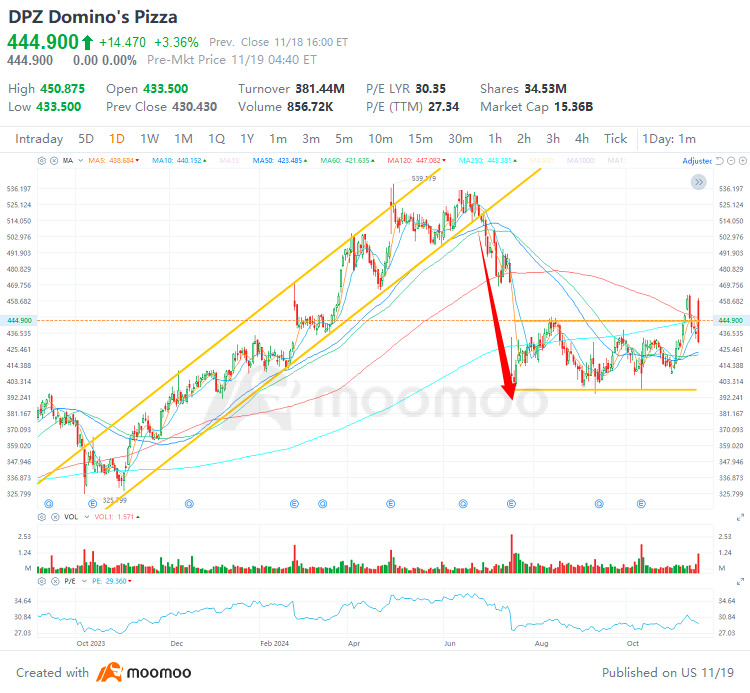
From a technical perspective, Domino's stock was in an upward channel from October last year until the second quarter of this year, nearing its historical high.
However, it has seen a noticeable pullback, trading in a horizontal range in recent months. Investors could watch whether the stock can effectively break above the $445 level, the upper bound of the current range, which could potentially set the stage for further development.
Source: moomoo. Data as of market close on Nov 18, 2024. The company mentioned is for illustration purposes only, and any statement involved does not constitute investment advice.Investing involves risk and the potential to lose principal. Past performance does not guarantee future results.
Is piggyback investing wise?
Following the release of Berkshire's holdings, headlines often highlight new additions like "Buffett Buys XXX Stock," but this isn't accurate.
Berkshire Hathaway has two investment portfolio managers, Ted Weschler and Todd Combs, who typically handle smaller positions under $1 billion, rather than Warren Buffett himself.
The recent 13F filing shows that Berkshire's new investment in $Ulta Beauty (ULTA.US)$ , made in Q2, was mostly sold off by Q3—similar situations have occurred in the past.
Given Buffett's reputation for long-term value investing, this raises questions among investors. The under $300 million position in ULTA is more likely attributed to Weschler or Combs.
Buffett has long stated he doesn't interfere with these two managers' decisions. "I would probably not know they were even buying it until, maybe, a month after they started."
Some investors mimic 13F holdings to build their portfolios, but this piggyback investment strategy carries certain risks.
Firstly, 13F filings have a time lag; for example, we only see Berkshire's holdings at the end of the third quarter in November. During this period, the portfolio may have changed.
Additionally, 13F filings only disclose long positions, not shorts, options, or other derivatives. Large investment firms have different risk tolerance and investment objectives compared to individual investors.
The CFA Institute tracked the performance of "piggyback portfolios" over ten years, finding these portfolios had higher volatility than the broader market and did not consistently deliver significant outperformance.
Warren Buffett has publicly stated that investors shouldn't rely on Berkshire's investment choices or mimic other high-profile financiers to get rich.
"l wouldn't ever urge them to do anything based on what we do. lf they want to do what Berkshire does then they should buy Berkshire", said the "Oracle of Omaha" in 2016.
Additional Disclosures: This content is also not a research report and is not intended to serve as the basis for any investment decision. The information contained in this article does not purport to be a complete description of the securities, markets, or developments referred to in this material. The information has been obtained from sources considered to be reliable, but we do not guarantee that the foregoing material is accurate or complete. Furthermore, there is no guarantee that any statements, opinions or forecasts provided herein will prove to be correct.
This presentation is for informational and educational use only and is not a recommendation or endorsement of any particular investment or investment strategy. Investment information provided in this content is general in nature, strictly for illustrative purposes, and may not be appropriate for all investors. Read more