Four things to consider in 2024
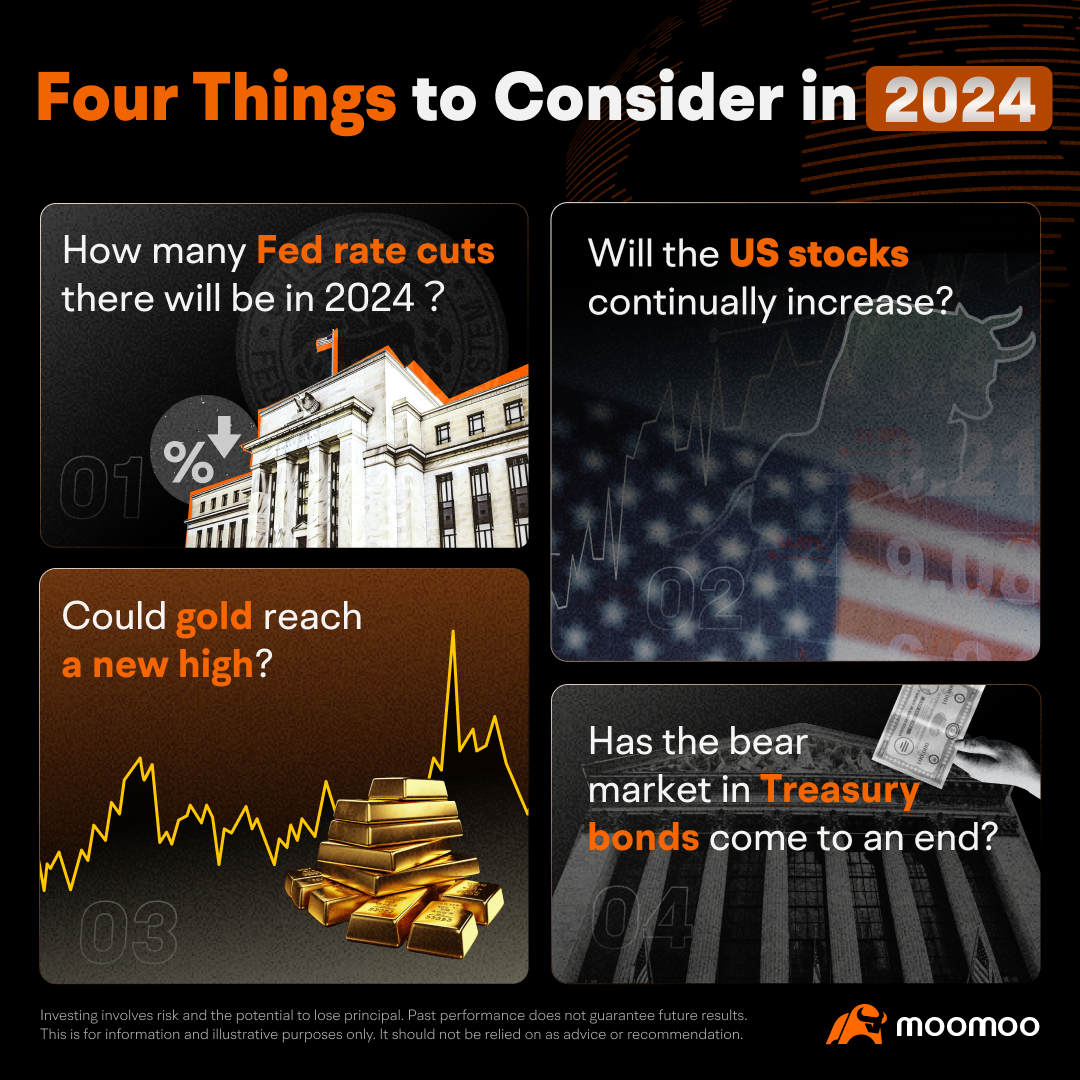
In 2023, the Federal Reserve raised interest rates four times throughout the year to manage inflation. Initially, experts were concerned that these increases might result in an economic downturn for the United States.
However, an unforeseen development occurred. ChatGPT, a generative artificial intelligence, provided a significant boost to industries such as semiconductors, cloud computing, and software.
Surprisingly, the U.S. economy showed strong resilience, with economic growth exceeding expectations by 2 percentage points, according to Fortune.
Buoyed by a robust economy, the US stock market made a strong recovery from its 2022 slump, with all three major indexes posting impressive performances.
Not just equities, gold has shined as well, with spot prices soaring to a record peak of $2,150 in December 2023, according to data from Trading Economics.
Conversely, US bonds have faced headwinds, grappling with the impact of climbing interest rates over the past two years. The yield on the 10-year U.S. Treasury bond yield notably rose from 1.5% in 2021 to nearly 5.0% in October 2023, according to data from Ycharts
Looking ahead, there's keen anticipation about the outcomes for the next year, particularly regarding the Fed's decision on rate cuts and the potential implications for stocks, bonds, and gold.
US Fed interest rate decision
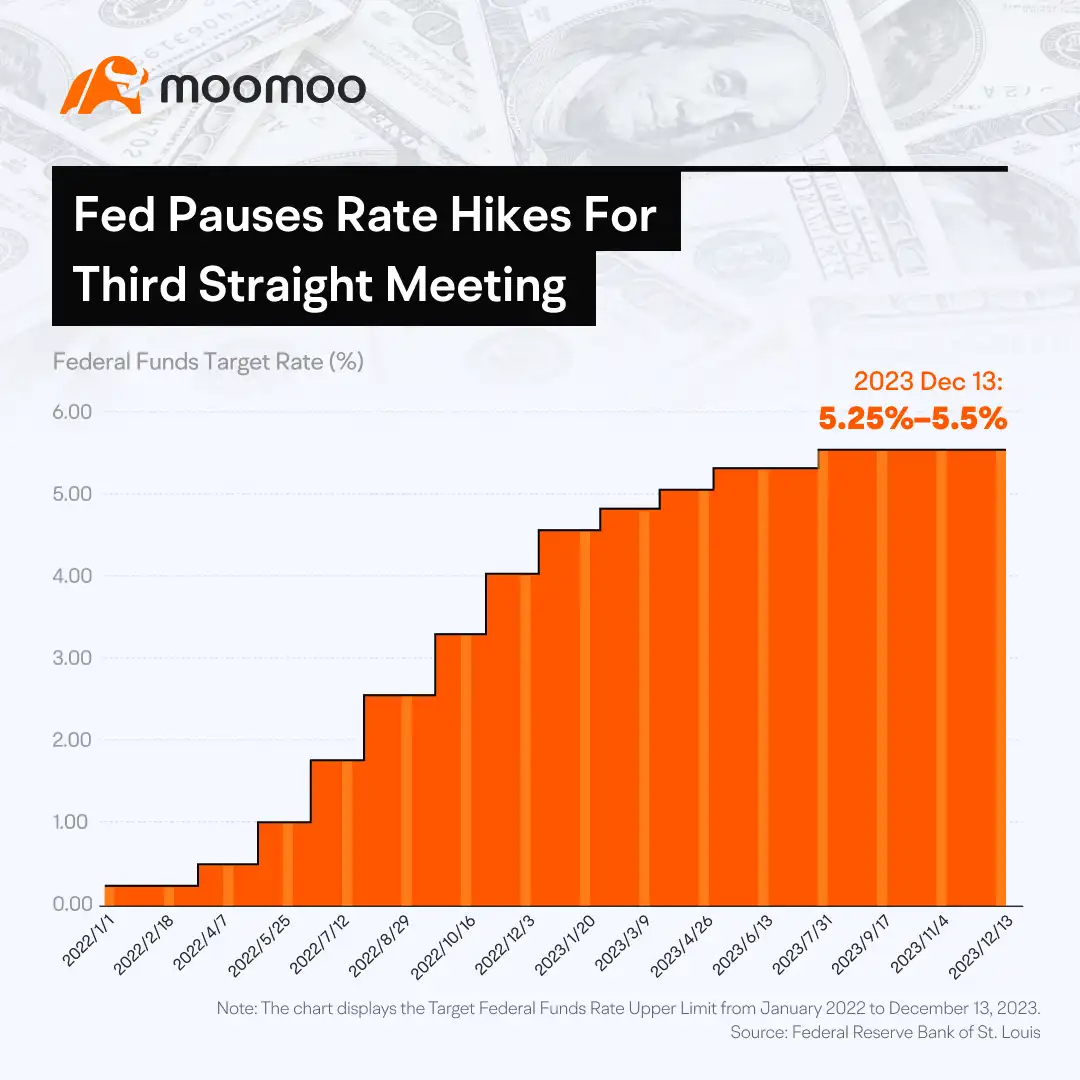
Beginning in March 2022, the Federal Reserve embarked on a series of interest rate hikes aimed at tempering escalating inflation.
After 11 consecutive raises, U.S. interest rates have moved up from near zero to the current range of 5.25%-5.50%, according to the Federal Reserve Bank of St. Louis.
*Images provided are not current and any securities are shown for illustrative purposes only and is not a recommendation.
Simultaneously, the inflation level in the U.S. has indeed fallen as expected. According to Trading Economics, the latest Consumer Price Index (CPI) data for November 2023 shows a CPI of 3.1%, marking the lowest level in five months.
This is a significant drop from the 6.5% level at the beginning of the year and is now very close to the Federal Reserve's target of 2%.
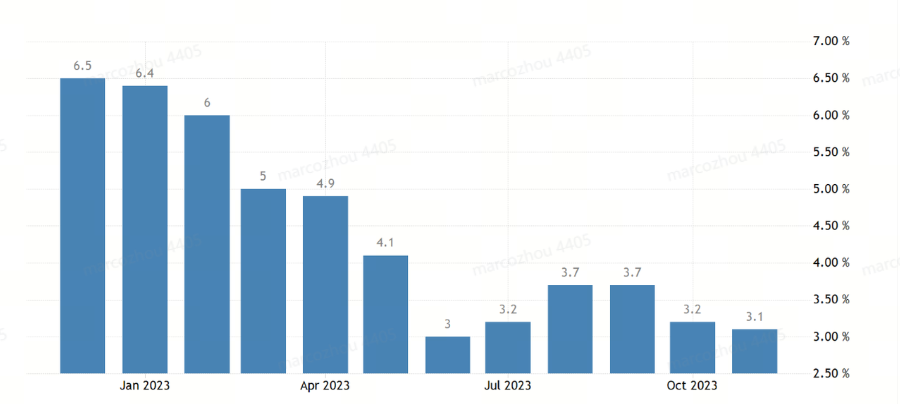
Source: Trading economics. The Y-axis is the annual core consumer price inflation rate in the United States, which excludes volatile items such as food and energy.
*Images provided are not current and any securities are shown for illustrative purposes only and is not a recommendation.
The December 2023 Federal Reserve Meeting signaled an end to the rate-hike cycle, with the primary focus shifting to the extent of rate cuts for 2024. The Fed's dot plot forecasts at least three cuts.
However, the markets are pricing in a more aggressive scenario; the CME FedWatch Tool indicates a 62% probability of rates dropping to 3.50%-4.00% by year-end, suggesting around six to seven cuts, assuming 25 basis points per cut.
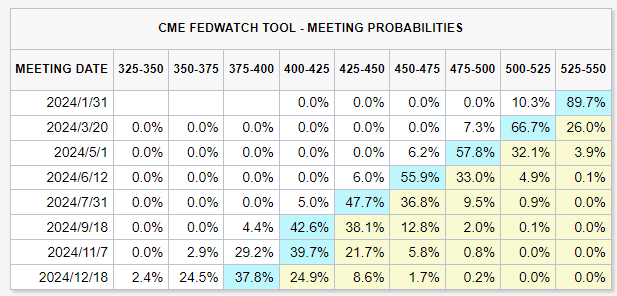
Source: The CME FedWatch Tool. Data as of December 18, 2023. The X-axis is the fed fund rate (in bps)
*Images provided are not current and any securities are shown for illustrative purposes only and is not a recommendation.
Generally, a reduction in the Fed's interest rates has a considerable effect on the capital market, with stocks, bonds, and gold all being highly responsive to shifts in interest rates.
US stock market
According to Investopedia, changes in interest rates affect the theoretical value of companies and their shares.
A share's fair value is determined by discounting its projected future cash flows to the present using the investor's required rate of return.
If interest rates decrease while everything else remains constant, share values may expected to increase. This is why the market generally reacts positively when the U.S. The Federal Reserve announces a rate cut.
Value stocks or growth stocks?
Typically, growth stocks feel a more pronounced impact from interest rate cuts, as early-stage companies often depend on outside financing and may not have substantial cash reserves.
During a period of persistent interest rate increases, the cost of borrowing can become prohibitively expensive, making it tougher for these companies to secure the funds they need. Lacking sufficient financial backing, their swift growth can be hindered, or they might even encounter financial difficulties.
Yet, with the current cycle of interest rate hikes nearing its end, the outlook for such companies is likely to get better, potentially marking a pivotal moment for growth in their performance.
Small-cap or large-cap?
Additionally, the impact of interest rate cuts on small-cap stocks may be greater than that on large-cap stocks.
This is because smaller companies often rely more heavily on short-term debt, and a rate cut would significantly alleviate their burden.
Furthermore, some analysts suggest that small-cap stocks may currently be more attractive than large-cap stocks for two potential reasons:
First, from a valuation perspective, smaller companies look more attractive. So far this year, the large-cap stocks have been dominated by the so-called the "Magnificent Seven", a nickname often given to the seven most significant and influential tech companies, while the small-cap market has been mediocre. The value ratio of US small caps relative to large caps is near its lowest level in history, according to LSEG Datastream.
Second, there's optimism around the earnings potential of smaller-cap stocks. According to LSEG, the Russell 2000 index, which tracks smaller companies, is projected to see a robust 30% increase in earnings next year, recovering from an 11.5% decline in 2023.
It's crucial to bear in mind that small-cap stocks tend to be more vulnerable to economic cycles than large-cap stocks. A significant economic slowdown could severely impact the operational capabilities of small-cap companies.
US bonds
The Fed's ongoing interest rate hikes have a direct impact on US bonds, and the cessation of such rate hikes may benefit bondholders most directly.
This is because bond prices and market interest rates are inversely related, meaning that bond prices will rise if bond yields decrease.
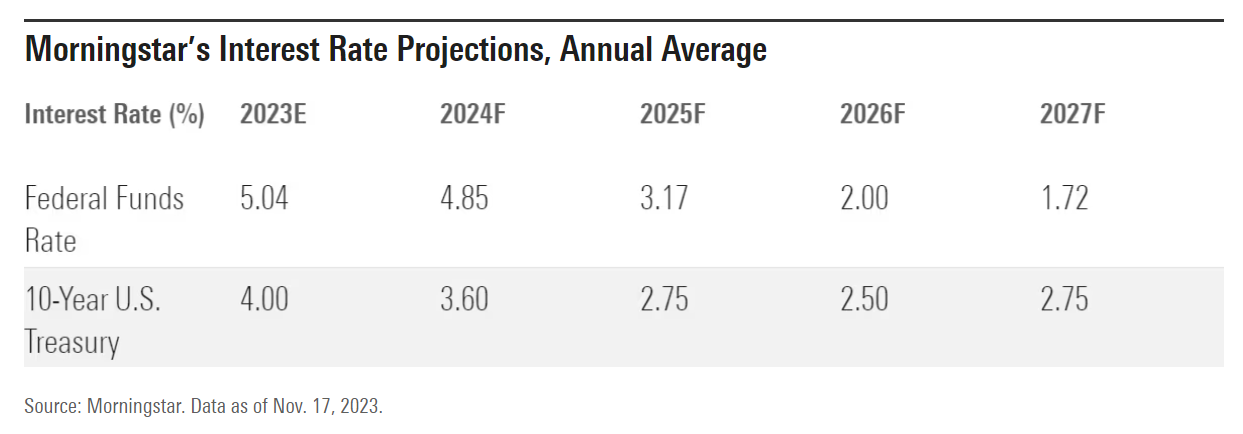
Analysts at Morningstar predict the Fed will begin cutting rates in 2024, with a projected decline to 1.72% by 2027.
The Fed's rate pass-through to Treasury rates is not linear. For instance, Morningstar predicts that the 10-year Treasury yield will decrease to 3.6% in 2024 and further drop to 2.75% in 2027. It can be observed that the decline in Treasury rates is less than the potential rate cut by the Fed.
*Images provided are not current and any securities are shown for illustrative purposes only and is not a recommendation.
In December's Fed meeting, officials hinted at the possibility of three interest rate cuts in 2024. Currently, the 10-year Treasury yield has fallen below 4% (as of December 15, 2023), but is still about 40 basis points higher than Morningstar's forecast of 3.6% in 2024.
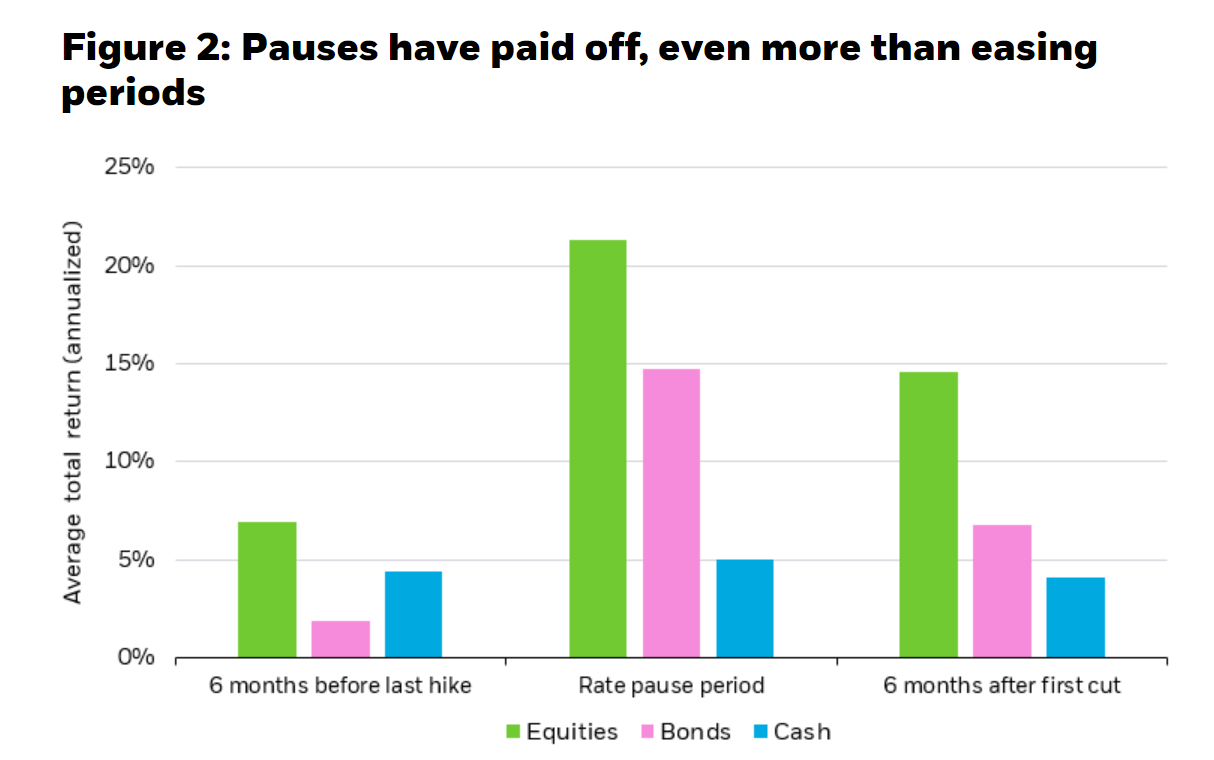
In addition, according to the senior iShares strategist Kristy Akullian, pauses between the last rate hike of a cycle and the first rate cut tend to be favorable for bonds. By the time the central bank begins to cut rates, it will be too late for investors to take full advantage of opportunities in fixed income.
Source: iShares, 2024 Year Ahead Outlook.
*Images provided are not current and any securities are shown for illustrative purposes only and is not a recommendation.
Gold
The price of gold is influenced by interest rates as well.
If the Fed continues to raise interest rates, it will lead to a significant inflow of US dollar funds, causing a surge in the dollar index.
Conversely, if the Fed starts to lower interest rates, it will result in a potential outflow of US dollar funds, driving down the dollar index.
Since gold is priced in US dollars, its price may rise as the value of the US dollar declines.
Interest rates are just one of many elements affecting gold prices. There are other significant factors at play, such as Safe Haven Demand, which rises with changes in the global economic climate, and the broader commodity demand influenced by general market trends.
As a result, compared to U.S. bonds, gold is subject to a wider array of influences, making its future price movements more intricate and harder to predict.
Potential risks
Overall, the Fed's rate cut has a positive impact on US stocks, bonds, and gold, but it doesn't mean that the prices of these assets will perform well in 2024. There are also many potential risks:
The interest rate is just one of many factors that impact various assets. For instance, when valuing stocks using the discounted cash flow valuation model, future cash flow also plays a crucial role in determining their value. If the US economy weakens, it will lead to a decline in the company's future cash flow and subsequently decrease its overall value.
As mentioned above, the market is already very optimistic about the Fed's rate cut next year. According to the CME FedWatch Tool, the market now expects the probability of 6-7 rate cuts next year to reach 62%. If the Fed cuts rates less than expected, it may cause asset prices to decline.
Lastly, the market may have already factored in the Fed's positive outlook on interest rate reductions into current asset prices. Therefore, if upcoming rate cuts by the Fed merely meet or fall short of expectations, they could also trigger a drop in asset prices.
Above is some sharing of the outlook for 2024, hoping to help investors make future investment plans. It is crucial for investors to thoroughly assess their financial situation and risk tolerance in order to customize an investment strategy that suits their needs.
This presentation is for informational and educational use only and is not a recommendation or endorsement of any particular investment or investment strategy. Investment information provided in this content is general in nature, strictly for illustrative purposes, and may not be appropriate for all investors. Read more