Cracking the Code: Analyzing Google, One of the Top Five Global Tech Giants
Google has formed a large and relatively stable product ecosystem network, making it one of the top global tech giants. It is the world's largest search engine with over 4.3 billion users. Additionally, its brand names Android and Chrome have respectively dominated the smartphone operating system and browser markets.
Despite its soaring stock price, many investors still shy away from investing in Google because they struggle to understand its complex business model. In this article, we will explore Google, a subsidiary of Alphabet.
Background of Google: Four CEOs
Investing in Google can be challenging partly due to its complex business composition, which is partly attributed to the company's management history. Since its inception by Larry Page and Sergey Brin on September 4, 1998, Google has had four different CEOs:
From 1998-2001, Larry Page served as CEO but was asked to step down due to investor doubts about his age and experience limitations.
From 2001-2011, Eric Schmidt, former CEO of Sun and Novell, served as Google CEO, when Google transformed from a search engine company to a technology giant.
From 2011-2015, Larry Page resumed his position as CEO, exploring new innovative businesses such as cloud services, biotechnology, smart homes, capital investment, broadband services, and autonomous driving.
From 2015 to the present, Sundar Pichai has served as CEO, responsible for core products such as Android and Chrome browsers.
Google's Market Capitalization Growth: Expansion of Business
Over the past 20 years, Google has transformed from a company with a narrow search engine focus to a global leader in a variety of industries, including search and mobile ecosystems.
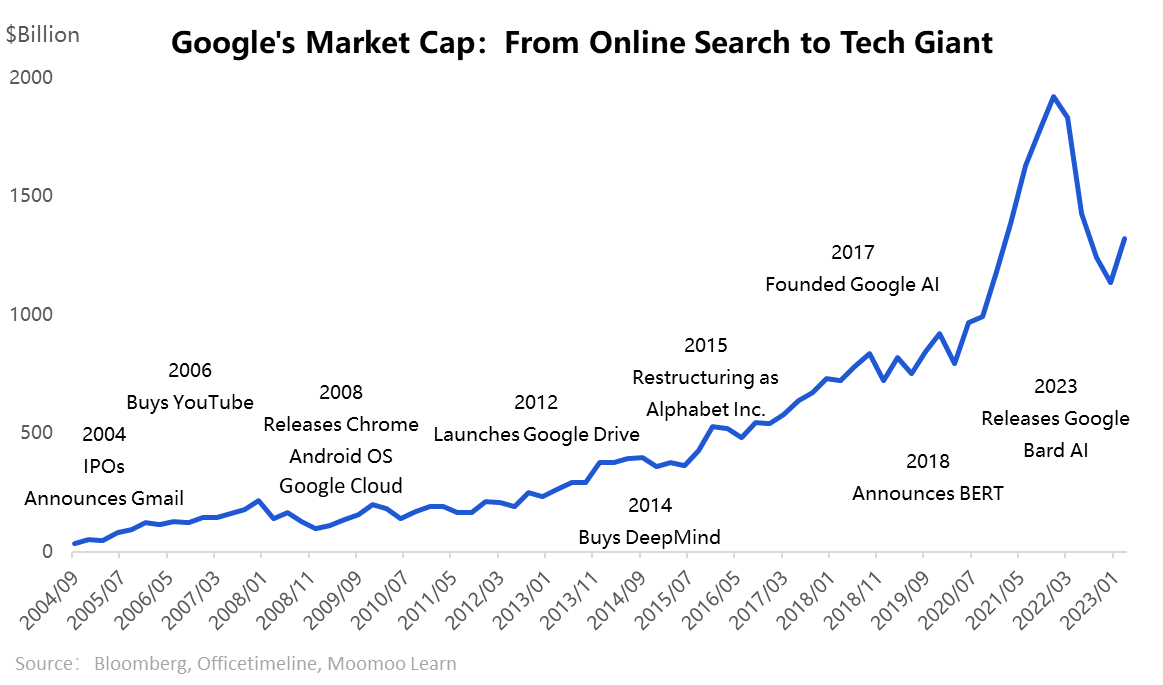
From 1996 to 2004, Google's primary source of income was search engine advertising revenue.
After going public in 2004, Google obtained a significant portion of its revenue from advertising. However, it recognized the need to diversify beyond search engines to maintain growth. To achieve this goal, Google acquired numerous startups during that time, including Android in 2005, which expanded its mobile ecosystem business, and YouTube in 2006, which expanded its video advertising business. As of 2023, Google has acquired 256 companies. Notably, between 2010 and 2011, on average, Google acquired more than one company per week.
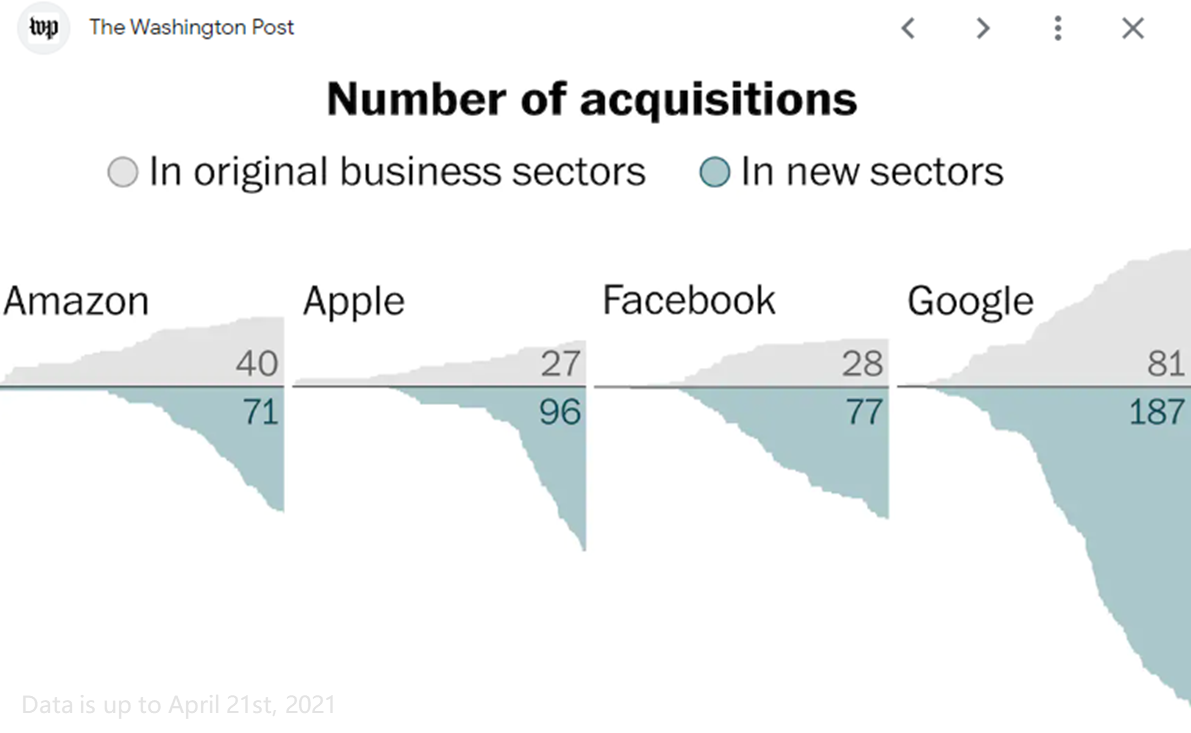
From 2008 to 2015, Google began exploring various innovative products, such as developing autonomous driving technology, Google Glass, and establishing the biotech company Calico.
From 2015 until now, Google's online advertising business and other businesses have gradually matured, leading it to explore new ventures in AI and cloud computing. In 2014, Google acquired DeepMind, and in 2016, it integrated Google Cloud, which has contributed to higher revenue year over year.
Google's Monetization: Looking for New Growth Points
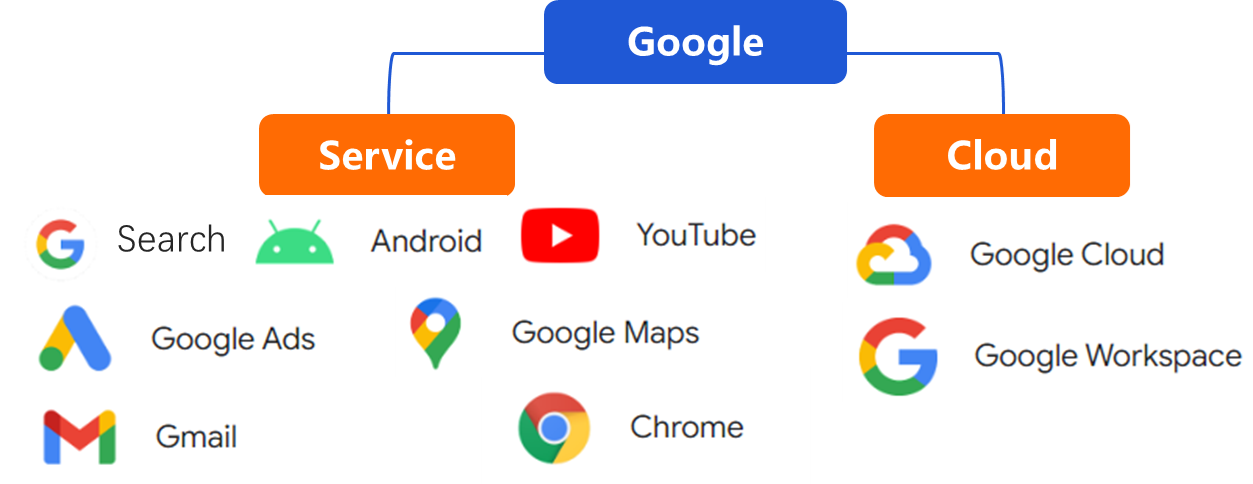
According to Google's annual report, the company's business can be divided into two categories: Google Services and Google Cloud.
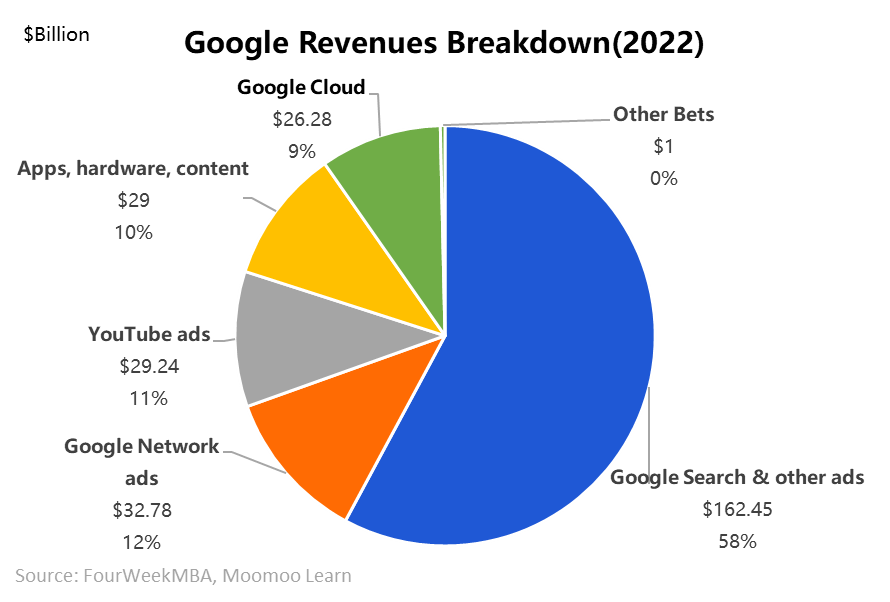
Google's search engine serves as the backbone of its revenue, accounting for 58% of the total, according to the 2022 financial report. The search engine generates most of its revenue through advertising. Google processes over 99,000 searches per second, equivalent to 8.5 billion searches per day. Advertisers pay Google based on the number of clicks their ads receive. Advertising revenue, including other businesses such as YouTube and Network, accounts for 81% of Google's overall revenue, making it the company's primary source of profit.
Despite Google's dominant position in the search engine market and its advertising business having low operating expenses, some investors may still question whether investing in Google is wise.
Why? That's because the advertising revenue is generally considered not stable. This type of profit is highly sensitive to macroeconomic conditions. During an economic slowdown, companies tend to reduce their advertising spending. For example, when the global economy experienced a downturn in 2022, Google's net profit was down to $59.97 billion, a YoY decline of 21.1%.
Furthermore, some of Google's businesses have already matured, for example, YouTube. As the world's largest video search and sharing platform, with 2.56 billion monthly active users covering 36% of the world, YouTube's user growth rate has slowed down. At the same time, it faces stiff competition from short video platforms, causing a significant decline in advertising revenue.
Nevertheless, Google has some new growth points, lying in its cloud and AI technologies.
From 2018 to 2022, Google's revenue from its search and other businesses decreased, while its revenue from cloud services steadily increased. Google Cloud now accounts for around 70% of the global cloud service market, along with Amazon Web Services and Microsoft Azure. In 2022, Google Cloud generated $26.28 billion in revenue, representing 9.3% of total revenue, a 36.8% YoY increase.
Google's AI technology is also well-established and has accumulated extensive experience, making it a dominant player in the current AI wave. In 2016, Google's AI model AlphaGo made its debut. Many people still remember the game between AlphaGo and the world's top Go players, which was a significant milestone for AI technology. It demonstrated the power of AI to people around the world and became an important symbol for the new peak of AI technology, further promoting the third wave of AI development.

To summarize, Google's business has transformed from a narrow advertising-based business to a broader range of businesses, including Google Cloud. Going forward, the company aims to use "AI + cloud computing" as its new growth point, which could drive its long-term success.
Google's Moat: Always Staying Ahead of the Curve
Google has built a strong moat in the competitive technology market by leveraging its unique advantages. First, Google has access to an unparalleled amount of data due to its vast user base and numerous products and services. This allows Google to develop insights and capabilities that are difficult for others to emulate, creating a significant barrier to entry. Second, Google boasts one of the highest cash reserves among global public companies, providing the company with the financial flexibility to invest in new businesses and technologies. Third, innovation has always been at the core of the company, helping it find new monetization methods and driving its growth and success in the tech industry.
While advertising will remain Google's main source of revenue in the future, the company is constantly searching for new ways to generate income. An example of this is YouTube Shorts, a short video-centric platform that aims to attract creators from other platforms and promote short-video e-commerce.
While Google will maintain its lead in the search engine field for the foreseeable future, some predict that AI, likely the latest fad ChatGPT, may replace traditional search engines. As a result, Google's business model needs to evolve, incorporating large language models into its search engine. Bing has already started integrating GPT models, transforming search engines in the process. Google is also exploring its own AI models, but there are numerous challenges to overcome in combining AI with search engines.
These factors have formed Google's unique moat - one that is adaptable to the times and is constantly innovating to keep up with the changing technology landscape.
Future Opportunities and Risks
The reason for Google's underperformance in 2022, as stated by The Times, was due to advertisers cutting spending for an economic downturn. According to Barron's, Google's stock dropped 34% in 2022 as revenue growth slowed and investors worried about weaker search-advertising trends.
In the long term, CB Insights' analyst believes Google's growth points are expected to come from innovation in online search, cloud computing, online video, and autonomous driving.
According to FourWeekMBA, Google's main source of revenue still remains to be advertising, however, it is important to notice how other areas of the company are growing pretty quickly. For instance, the other part of the business focuses on App purchases through the Google Play store, the Google Cloud offering, and the Hardware product. This shows how Google is investing in other areas that might well represent its main way of monetizing in the years to come. Another critical aspect to look at is Google’s “other bets” a set of risky, yet visionary attempts of Google to shape the future of humanity via technology.
Additional disclosures: This content is also not a research report and is not intended to serve as the basis for any investment decision. The information contained in this article does not purport to be a complete description of the securities, markets, or developments referred to in this material. The information has been obtained from sources considered to be reliable, but we do not guarantee that the foregoing material is accurate or complete. Furthermore, there is no guarantee that any statements, opinions or forecasts provided herein will prove to be correct.
This presentation is for informational and educational use only and is not a recommendation or endorsement of any particular investment or investment strategy. Investment information provided in this content is general in nature, strictly for illustrative purposes, and may not be appropriate for all investors. Read more