Is the bottom of the lithium industry in sight?
In early October, global mining leader $Rio Tinto (RIO.US)$ announced plans to acquire lithium producer $Arcadium Lithium (ALTM.US)$ for $6.7 billion in cash at a premium. The deal has received unanimous approval from both companies' boards and is expected to close by mid-2025 if successfully executed.
Rio Tinto noted that the recent drop in lithium prices makes this countercyclical acquisition a promising long-term opportunity. The company is optimistic about lithium's outlook, projecting over 10% compound annual growth in demand through 2040, which will likely result in a supply deficit.
Following the announcement, Arcadium's stock surged, nearing Rio Tinto's offer price of $5.85 per share by October 14. Other companies in the industry also saw rebounds.
Lithium, an essential material for electric vehicles, is widely regarded as the "white oil" of the new era.
Since the end of 2020, a mismatch between strong demand and limited supply caused lithium prices to soar, at one point up more than tenfold from its low.
However, with a significant release in supply, lithium prices have been declining steadily since early 2023. According to Benchmark Minerals, by October 2024, the global weighted average price had fallen back to around $10,000 per ton.
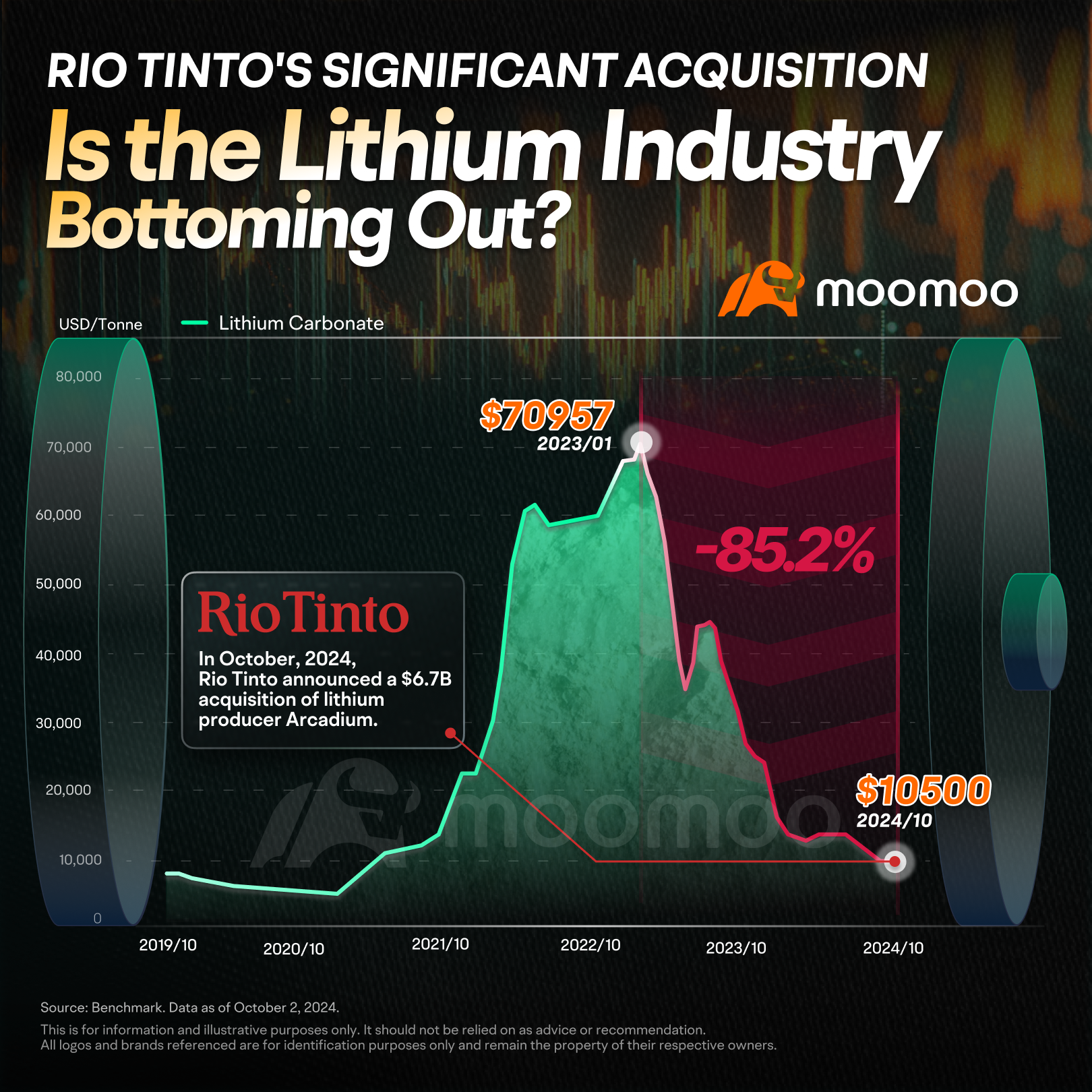
The lithium industry saw substantial consolidation and clearance during the previous cycle's bottom.
In 2020, Australian lithium miner Altura was acquired by $Pilbara Minerals Ltd (PLS.AU)$, and Chinese lithium company $TIANQI LITHIUM (09696.HK)$ sold part of its stake in Australia's Greenbushes mine to $IGO Ltd (IGO.AU)$ under debt pressure.
With the industry at a low point, could Rio Tinto's acquisition signal another turnaround?
Inventory levels remain high, but capacity is starting to clear
Many producers have opted to cut or suspend capacity under operational pressure in a sluggish market. In July, $Albemarle (ALB.US)$, the world’s largest lithium producer, announced plans to reduce lithium production and pause capacity expansion in Australia.
Albemarle said it would conduct scrutiny of cost and operational structure, including halting new production lines and maintaining existing ones. Previously, smaller, higher-cost miners such as $Core Lithium Ltd (CXO.AU)$ had already reduced output.
In September, lithium-ion battery giant $Contemporary Amperex Technology (300750.SZ)$ also halted production at a major mine in China. UBS analysts noted that after lithium prices faced ongoing downward pressure, they observed a supply response from marginal cost producers, alleviating market fears of oversupply.
Morningstar believes that the equilibrium level for lithium is around $20,000 per ton, which serves as a mid-term price benchmark. With supply and demand returning to balance, lithium prices are expected to rebound significantly in the coming years.
However, there are differing opinions. In a report released earlier this month, Goldman Sachs suggested that the recent rebound was more sentiment-driven, with no significant improvement in fundamentals.
Despite efforts by some producers, the global lithium market is anticipated to remain in surplus. China's lithium chemical inventory, being the largest demand contributor, is still high, and several large-scale projects are continuing to bring new capacity online.
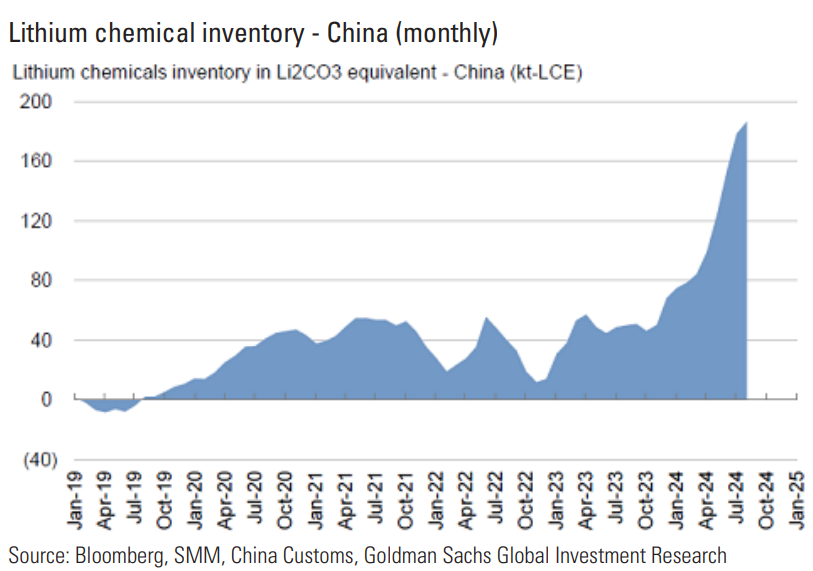
This is for information and illustrative purposes only. It should not be relied on as advice or recommendation.
Goldman Sachs indicated that the global lithium cost curve is concentrated between $9,000 and $10,000 per ton, and current prices remain above $10,000.
This indicates that high-cost marginal producers, despite making only modest profits, are still profitable enough to keep supplying the market. The institution forecasts that lithium prices will remain weak at least until the end of 2025.
Lithium investments overview
The world's lithium resources are primarily located in Australia and South America, in the form of spodumene and brine, respectively. Top industry players have established presences in these regions.
If the acquisition materializes, according to Benchmark, Rio Tinto will become the world's third-largest lithium producer. Albemarle and SQM will remain in the top two positions.
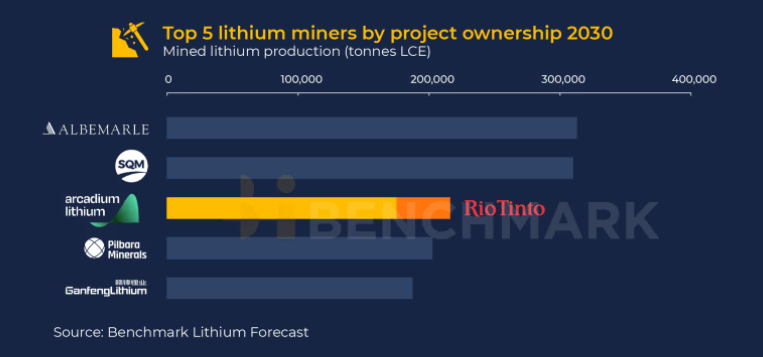
This is for information and illustrative purposes only. It should not be relied on as advice or recommendation.
Albemarle ($Albemarle (ALB.US)$):
Albemarle has invested broadly in global lithium resources, with projects not only in major regions like Australia and South America but also in the United States.
Its lithium processing capacity is more widely distributed, with refineries in China producing battery-grade lithium chemicals.
In Q2 2024, revenue from lithium resources accounted for about 60% of total revenue. The remaining revenue came from specialty chemicals (bromine products used in flame retardants, etc.) and catalysts, which are less volatile compared to lithium resources.
Albemarle's total revenue was $1.43 billion, down 40% year-over-year, with adjusted EBITDA plummeting 75% to $386 million, largely due to falling lithium prices in the second quarter.
The company noted that despite a nearly 40% year-over-year increase in lithium sales volume, the sharp price decline led to a more than 50% drop in lithium segment revenue, significantly impacting profitability.
Sociedad Química y Minera de Chile ($Sociedad Quimica Y Minera De Chile (SQM.US)$):
The company's main production area is the Atacama salt flat (Salar de Atacama) in Chile, which currently holds the highest lithium concentration and the largest resource among explored salt flats worldwide, also rich in potassium.
Leveraging the salt flat resources, SQM has developed lithium and potassium fertilizer businesses, along with iodine and derivative products primarily sourced from iodine deposits in northern Chile.
In recent years, SQM has expanded beyond Chile, acquiring lithium mines in Australia and refineries in China.
SQM's performance also faces pressure. In Q2 2024, the company reported total revenue of $1.29 billion, down 37% year-over-year, with adjusted EBITDA dropping 53% to $413 million.
Due to the distribution of lithium resources, many local lithium producers are not listed in U.S. Exchanges. Some companies mentioned above, such as Pilbara, IGO, and Core Lithium, are traded only in Australia.
If you lack access to local markets but want exposure to relevant companies, industry-related ETFs might be an option.
According to the ETF Database, there are ETFs targeting global lithium companies in the U.S. market, these products invest in targets listed on U.S. exchanges as well as companies listed in Australia and China.
The cyclical allure
As a key battery metal, lithium's demand is significantly driven by downstream markets, exhibiting cyclical characteristics.
Demand signals amplify throughout the supply chain, from vehicles to midstream (battery and battery materials) and further to resources.
This is known as the "Bullwhip Effect," where minor changes in downstream demand can cause significant fluctuations upstream. The dramatic rise and fall of lithium prices vividly illustrate this phenomenon.

Source: Bloomberg. This is for information and illustrative purposes only. It should not be relied on as advice or recommendation.
Renowned investor Peter Lynch has offered valuable insights on investing in cyclical stocks.
Cyclical stock investors could easily fall into value traps: For most stocks, a low price-to-earnings (P/E) ratio often suggests undervaluation, while a high P/E ratio indicates potential overheating.
However, for cyclical stocks, the valuation ratios often behave contrary to expectations, with P/E ratios typically lower at price peaks and higher during price lows.
For example, during SQM's rally in 2021-22, its P/E ratio showed a downward trend. If you were enticed by the single-digit valuation at the end of 2022 and invested, you would have faced a prolonged bear market. After a long decline, SQM's P/E ratio reached 400+ times by the close of trading on October 14.
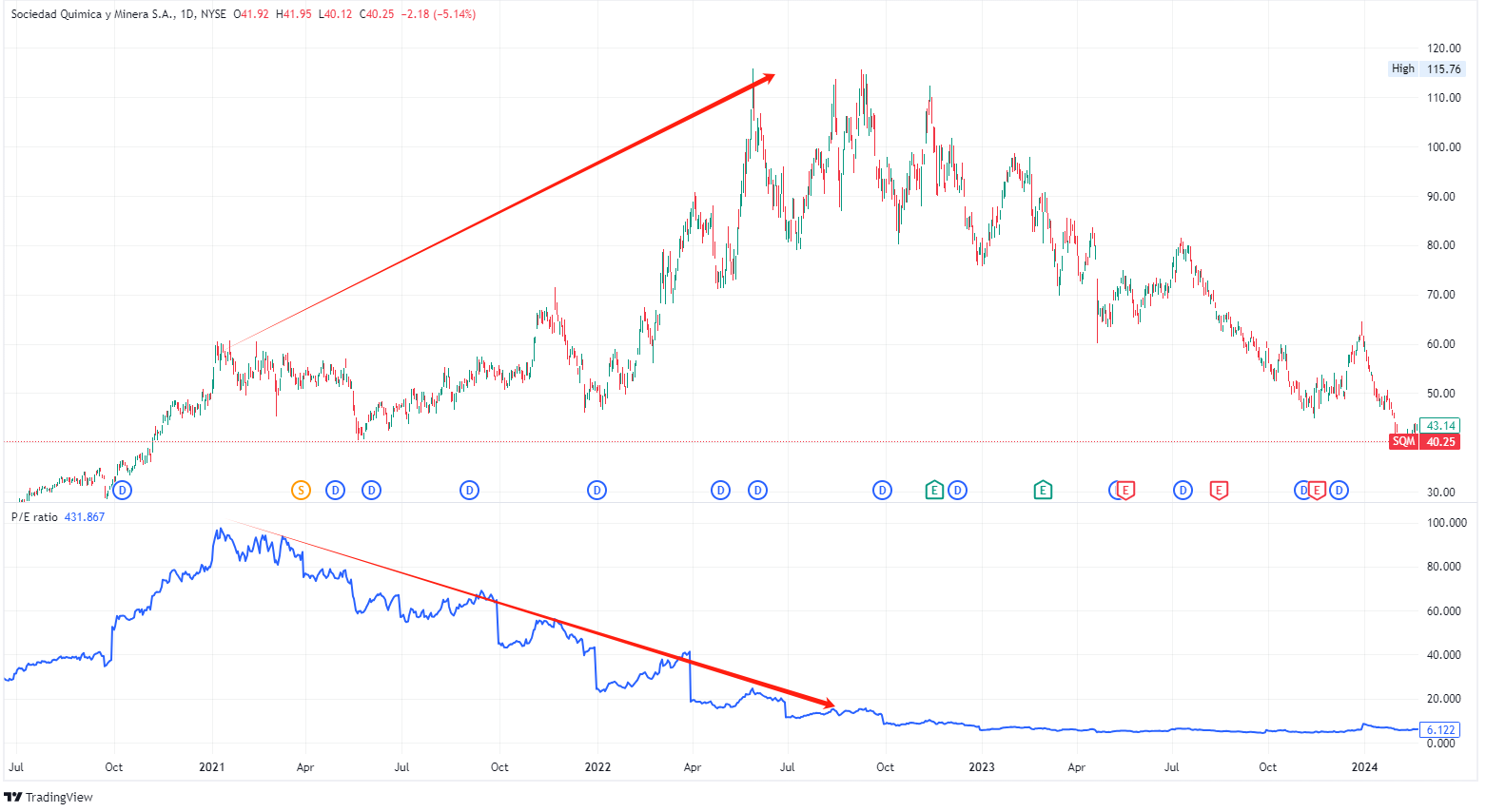
The company mentioned is for illustration purposes only, and any statement involved does not constitute investment advice. Past performance is no guarantee of future results.
Why does this happen? When the industry is at the bottom, product prices are low and profits are thin, causing the denominator of the P/E ratio (market capitalization/net profit) to shrink. Even if the market cap isn't high, the P/E ratio can still rise significantly. Conversely, when the industry is at a peak, profits usually surge, causing the P/E ratio to drop.
Instead of solely concentrating on current financial performance, investors should take a broader look at industry trends and supply-demand dynamics. Peter Lynch also noted that, compared to other types of investments, cyclical stocks require you to gain a particular edge to succeed, such as working in the industry you are investing in.
Additional Disclosures: This content is also not a research report and is not intended to serve as the basis for any investment decision. The information contained in this article does not purport to be a complete description of the securities, markets, or developments referred to in this material. The information has been obtained from sources considered to be reliable, but we do not guarantee that the foregoing material is accurate or complete. Furthermore, there is no guarantee that any statements, opinions or forecasts provided herein will prove to be correct.
This presentation is for informational and educational use only and is not a recommendation or endorsement of any particular investment or investment strategy. Investment information provided in this content is general in nature, strictly for illustrative purposes, and may not be appropriate for all investors. Read more