Rate cut boots on the ground. What's ahead for AI?
In the September meeting, the Federal Reserve lowered the benchmark interest rate by 50 basis points, initiating a rate-cutting cycle. A rate-cutting cycle refers to a series of consecutive reductions in interest rates, the decision to lower rates in September was seen as the first step in this process, as it signaled a shift in monetary policy direction to address economic challenges.
With the rate cut materializing, the market shifted to "Risk On" mode. Both the Dow Jones and S&P 500 indices reached historical highs, while the NASDAQ is just a step away from its previous peak.
In 2024, technology stocks especially artificial intelligence (AI), have dominated the market.
As expectations for rate cuts linger, the market began to focus on value stocks and small-cap stocks.
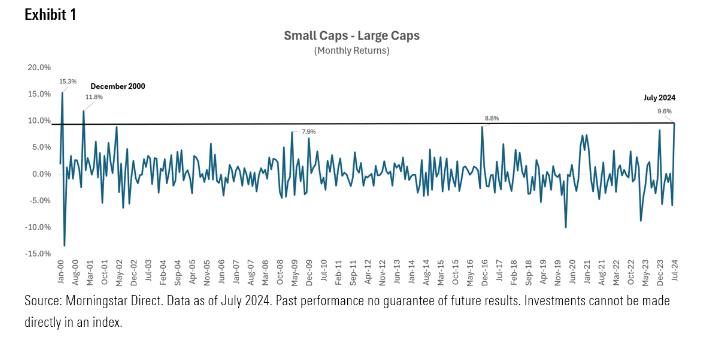
This July, small-cap stocks experienced their best single-month performance in 20 years, and value stocks outperformed tech stocks in the third quarter, sparking speculation about a style shift.
Investing involves risk and the potential to lose principal. Past performance does not guarantee future results. This is for information and illustrative purposes only. It should not be relied on as advice or recommendation.
However, since the Fed's announcement on September 18, tech stocks have again led the market over several trading days.
Is the outlook for AI overestimated? What impacts will the rate cuts bring? This week's Opportunity Mining will attempt to answer these questions.
Is there an AI bubble?

According to a report published in September by Goldman Sachs, despite the AI hype, the industry has not entered bubble territory. And they said that these companies are likely to continue driving returns for investors.
When comparing the current leading companies to those from historical bubble periods, there is no clear overvaluation.
For instance, during the 2000 Tech bubble, the average forward PE of major companies reached 52, while the current Magnificent Seven is at around 24. The analysts also found that today's leading companies have stronger profitability and more robust balance sheets, compared to previous bubble periods.
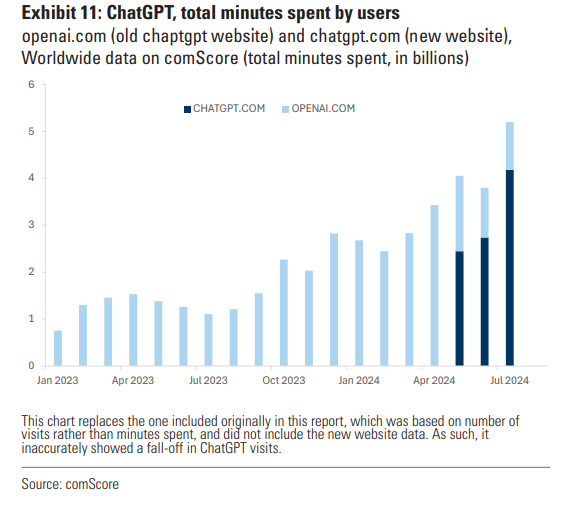
As a groundbreaking product of the AI era, ChatGPT continues to evolve. In September, OpenAI released the GPT-o1 model, significantly enhancing its expression and reasoning capabilities to better simulate human thought processes.
Its usage time has continued to grow, surpassing 5 billion minutes by July. It is worth noting that due to domain switching, initial data showed a downward trend, which at one point raised concerns in the market.
This is for illustration purposes only, and any statement involved does not constitute investment advice.
Goldman Sachs analyst believes AI is entering a deep 'build' cycle, which will drive capital expenditure across the industry. Compared to 2023, AI capital expenditure in 2024 saw a big tick-up and still appears to be on an upward trajectory. In the long term, investments in technology have begun to pay off, but patience is still needed.
Impact of rate cuts
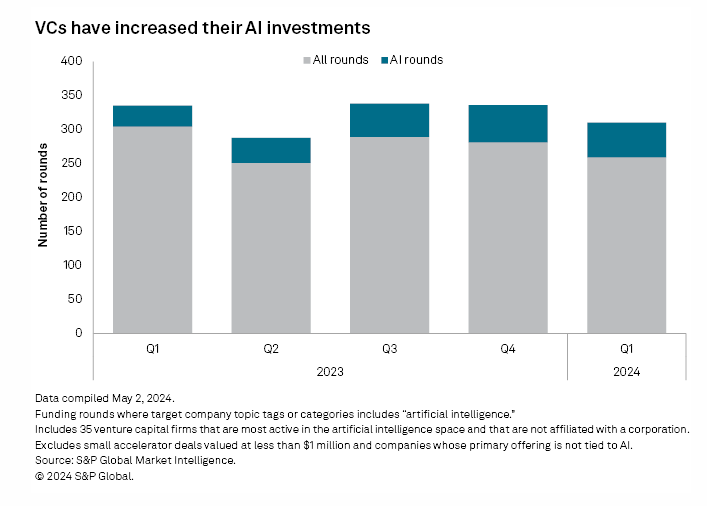
High interest rates led to a drop in overall mergers, acquisitions, and financing. However, the AI sector has grown against the trend.
According to S&P Global, in the first quarter of this year, major venture capital firms conducted 51 rounds of financing in the AI field, an increase of over 60% compared to the same period in 2023.
This is for information and illustrative purposes only. It should not be relied on as advice or recommendation.
Theoretically, all companies seeking financing will benefit from rate cuts. From crucial hardware like GPUs to software models, large tech companies and small businesses are investing substantial resources to compete, and rate cuts will likely accelerate this process.
Dan Ives from Wedbush indicates that the rate cut shows the "green light is back on" for tech stocks, which are expected to perform until the end of this year and potentially into 2025. With a 50 basis points cut, the probability of a soft economic landing increases, catalyzing further growth in the tech sector.
However, the benefits may not be evenly distributed.
According to Motley Fool, large tech companies are willing to aggressively increase R&D investment even with higher interest rates. As interest rates decline and capital costs decrease, this investment will become more aggressive, potentially concentrating competitive advantages further among tech giants. Smaller companies may struggle to invest enough to maintain long-term competitiveness.
Investment in AI
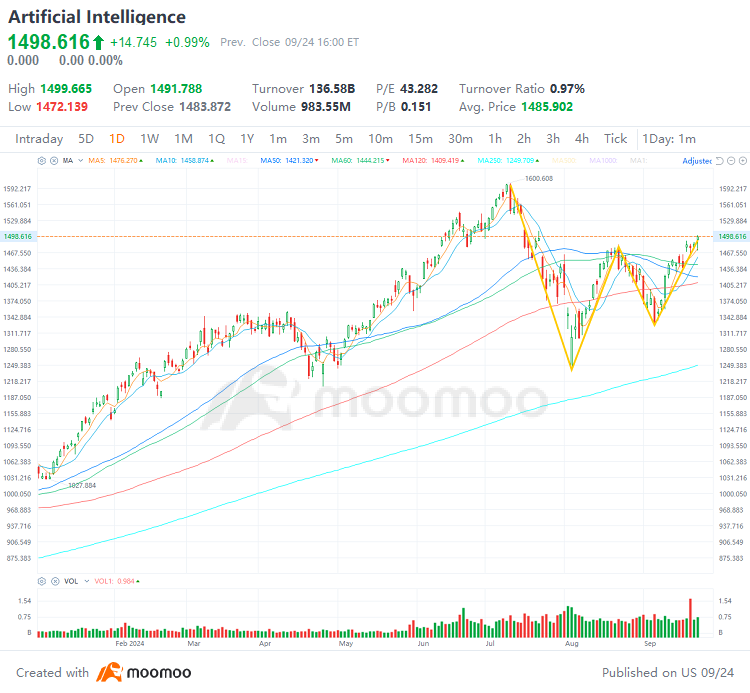
For those looking to invest in AI-related companies, moomoo has compiled an AI sector ( $Artificial Intelligence (BK2136)$ ) under the Investment Themes section. This sector includes major companies like $NVIDIA (NVDA.US)$ and $Broadcom (AVGO.US)$, as well as emerging companies like $Palantir (PLTR.US)$.
From a technical analysis perspective, the sector has recently formed a double bottom (W-bottom) pattern, indicating a potential end to the downtrend.
The sector is currently at the neckline after the previous rebound. Investors should watch if prices can break through this level effectively, as this might suggest further upward movement. If the neckline is broken, it could become a potential support level.
Source: moomoo. Data as of market close on September 24, 2024. This is for illustration purposes only, and any statement involved does not constitute investment advice.
Overall, considering AI-related ETFs could be one of an option. Prospective investors should understand the investment objectives and operational mechanisms of these products before making decisions.
Related risks
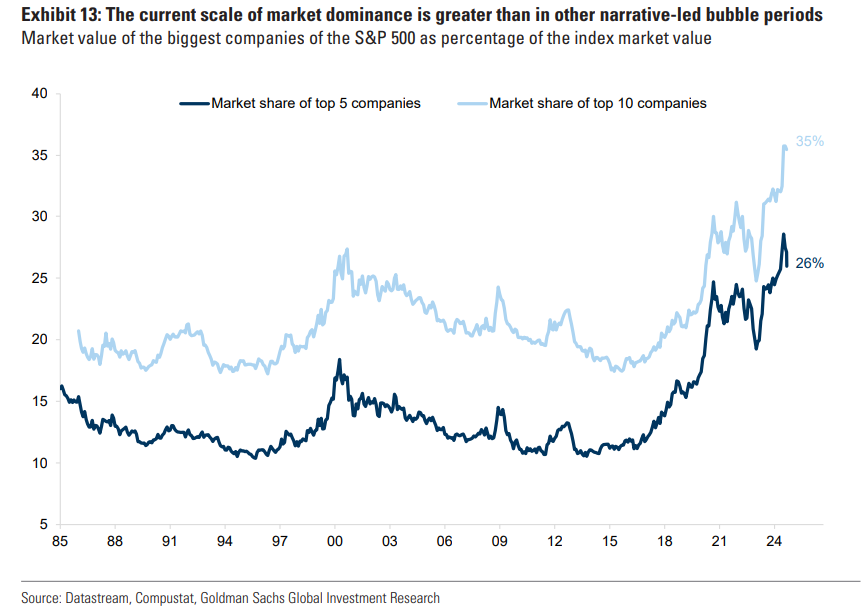
Market Concentration: According to Goldman Sachs, the top ten companies by market cap now account for the highest share of total market value in decades, exceeding one-third of the S&P 500 index, with the top five companies accounting for 26% of the index. This surpasses historical bubble periods.
Over time, market concentration has generally increased, possibly due to the high investment required to drive technological advancements, particularly in computing power and R&D spending. The investment scale needed for industry expansion precludes some smaller competitors.
Investing involves risk and the potential to lose principal. Past performance does not guarantee future results. This is for information and illustrative purposes only. It should not be relied on as advice or recommendation.
Technological Risks: Despite rapid development, the industry is still on the cusp of large-scale applications, facing potential technical challenges during implementation. Breakthroughs and improvements could alter the existing industry landscape, intensifying market competition.
Economic Environment: If the U.S. economy doesn't achieve a soft landing and instead falls into a recession, tech stocks are usually hit hard.
Additional Disclosures: This content is also not a research report and is not intended to serve as the basis for any investment decision. The information contained in this article does not purport to be a complete description of the securities, markets, or developments referred to in this material. The information has been obtained from sources considered to be reliable, but we do not guarantee that the foregoing material is accurate or complete. Furthermore, there is no guarantee that any statements, opinions or forecasts provided herein will prove to be correct.
This presentation is for informational and educational use only and is not a recommendation or endorsement of any particular investment or investment strategy. Investment information provided in this content is general in nature, strictly for illustrative purposes, and may not be appropriate for all investors. Read more