A tale of two chip giants: Is investing in the semiconductor sector still wise?
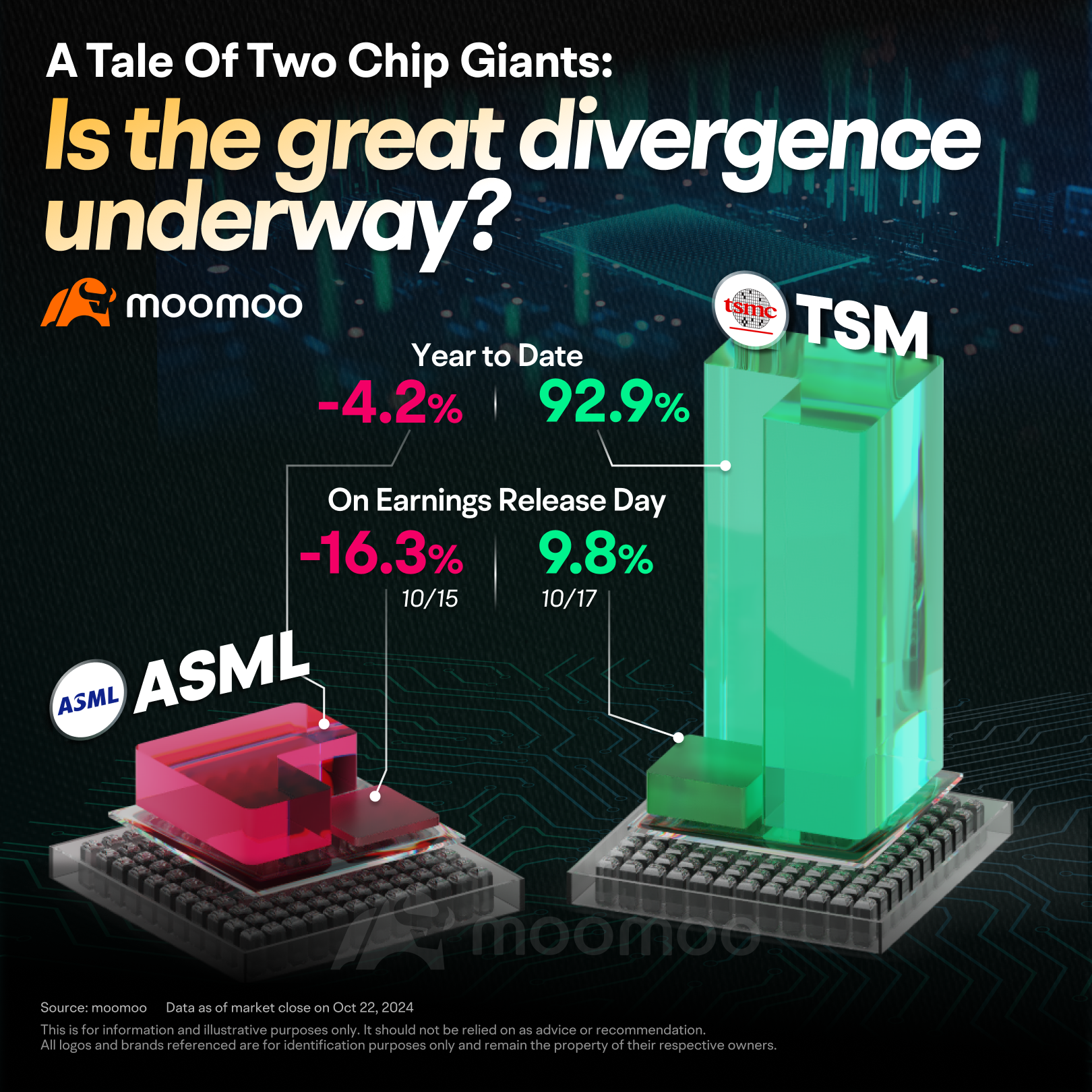
Last week, two semiconductor giants, $ASML Holding (ASML.US)$ and $Taiwan Semiconductor (TSM.US)$, released their third-quarter earnings, showcasing different trajectories.
On October 15, ASML shares plummeted after the earnings report, dragging the semiconductor sector into a significant downturn. However, just two days later, TSMC reported robust earnings, reaching an all-time high and successfully joining the trillion-dollar club.
ASML is the world's largest producer of lithography machines, providing essential equipment for chip manufacturing, while TSMC is the largest semiconductor foundry, focusing on advanced process technology for chip production.
Both companies hold dominant positions in their respective fields, so what lies behind their divergent performances? Can chip stocks maintain their momentum as the AI wave continues to advance?
Season of light or darkness
ASML's third-quarter performance appeared strong, with revenue, net profit, and gross margin all exceeding Wall Street expectations. However, the company's order backlog showed a noticeable decline.
The order backlog for the quarter dropped significantly to €2.63 billion, far below the market expectation of €5.39 billion. Additionally, ASML lowered its guidance, projecting 2025 net sales between €30-35 billion, down from €30-40 billion, and adjusted its gross margin forecast to 51%-53% from 54%-56%.
Consequently, ASML's stock fell sharply, closing down over 16% on the earnings release day and continuing to trade at low levels in the following days.
In contrast, TSMC exceeded both earnings and guidance expectations. The company projected fourth-quarter sales of $26.1 to $26.9 billion, compared to the market estimate of $24.9 billion, and a gross margin of 57%-59%, versus the market estimate of 54.7%.
Capital expenditures for 2024 are expected to be slightly over $30 billion, with further expansion planned for 2025. This helped alleviate market concerns about the semiconductor sector, allowing TSMC to reach a new high.
The contrasting performances may be attributed to their varying exposures to the artificial intelligence sector.
ASML's management noted that the demand for AI-related chips remains strong, but other semiconductor market segments are weaker, impacting the company's performance.
In comparison, over half of TSMC's revenue comes from high-performance computing (HPC), including core AI chips like GPUs for $NVIDIA (NVDA.US)$. The smartphone business, accounting for more than a third of the revenue, also saw growth driven by new Apple product launches.
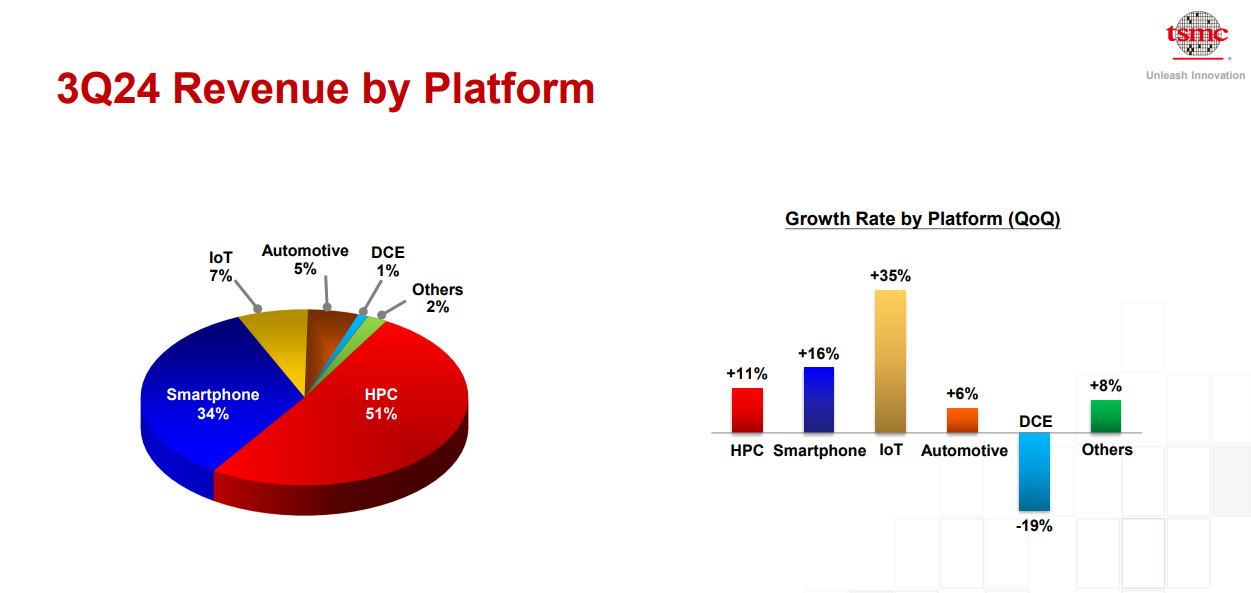
Source: TSMC. Past performance does not guarantee future results. This is for information and illustrative purposes only. It should not be relied on as advice or recommendation.
Morningstar noted that chip manufacturers like $Intel (INTC.US)$ and Samsung have not fully capitalized on the AI wave, facing technical inefficiencies and delayed capacity expansions, which affected ASML's orders. TSMC, as the preferred foundry for AI chips and the only company capable of meeting the demand for cutting-edge chips, remains undervalued despite its impressive performance.
Is the era of "rising tide lifts all boats" over?
Since ChatGPT's debut on November 30, 2022, the AI wave has propelled the semiconductor industry into a remarkable rally. The $PHLX Semiconductor Index (.SOX.US)$ has almost doubled since ChatGPT's release, with peak gains exceeding 120% as of the market close on October 22.
However, many companies have fallen behind during this surge. Besides ASML and Intel, once high-flying $Super Micro Computer (SMCI.US)$ has also seen significant pullbacks.
Last week, while NVIDIA and TSMC hit new highs, the Philadelphia Semiconductor Index declined by 2.6%.
Statements from ASML's management and the industry's divergent performance might be a reminder to investors: nearly two years into the AI wave, demand remains robust, but not every company can equally benefit.
According to Bloomberg, the gap is widening between companies riding on AI opportunities and those that are not. From the latest earnings season, this gap could soon expand from "gulf" to "abyss". Gabelli analysts suggest that if AI continues to drive chip demand, this divergence could persist until at least 2025.
UBS believes the demand for AI chips remains strong, urging investors to closely monitor future demand guidance during earnings seasons.
UBS analysts highlight $NVIDIA (NVDA.US)$ as the primary beneficiary, with its new Blackwell chips in full production and strong customer demand. Other companies expected to benefit from the AI wave include $Taiwan Semiconductor (TSM.US)$ , $Broadcom (AVGO.US)$, $Arm Holdings (ARM.US)$, $Micron Technology (MU.US)$, and $Advanced Micro Devices (AMD.US)$.
The internal divergence within the industry requires more from investors; broad investments across the entire sector may no longer guarantee easy gains and could even result in pitfalls like those faced by ASML.
Moomoo provides a breakdown of main business operations to help you better understand a company's activities. Navigate to: Stock Quotes Page > Company > Revenue Breakdown.
The "Company" section also offers more fundamental information, including performance forecasts, analyst ratings, valuation analysis, and financial statements.
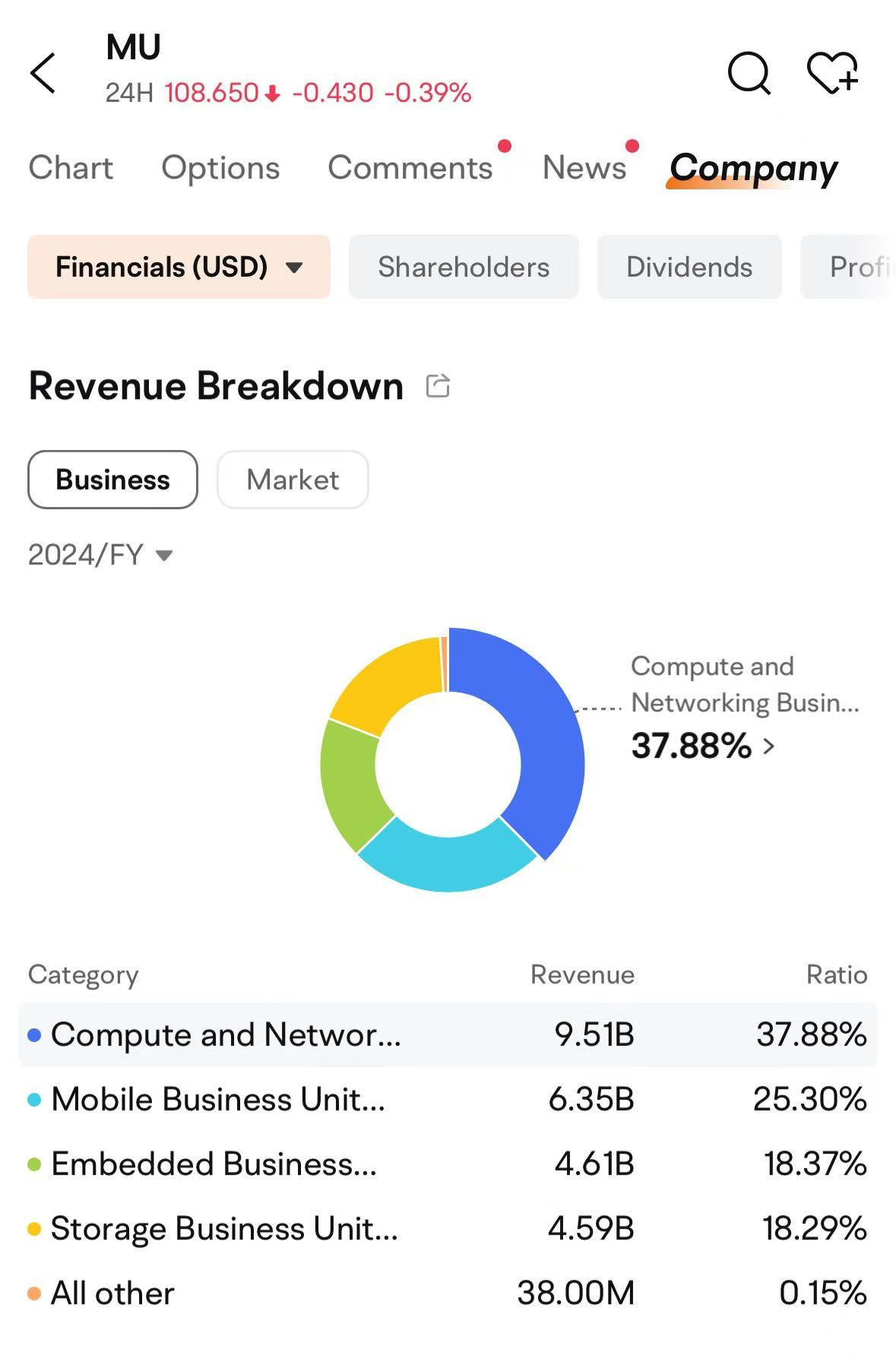
Source: moomoo. The company mentioned is for illustration purposes only, and any statement involved does not constitute investment advice. Past performance does not guarantee future results.
Industry leader NVIDIA's fiscal year does not align with the calendar year, and its latest quarterly earnings (Q3 FY25) will be released on November 20. However, you could gauge the industry's pulse through other companies' performances.
AMD, in the same sector as NVIDIA, will release its earnings next week. As major AI chip customers, tech giants like $Microsoft (MSFT.US)$ and $Alphabet-C (GOOG.US)$ will also report earnings next week, with future capital expenditure plans worth watching.
Related risks
AI development falling short of expectations: Currently, AI is a major driver for the semiconductor industry. If AI applications do not meet expectations, it could severely impact industry demands.
Intensifying competition: The semiconductor industry is highly competitive and marked by rapid technological advancements. Companies need continuous investment to maintain a competitive edge; otherwise, they risk falling behind or being eliminated from the market.
Macroeconomic changes: Following the 50 basis point rate cut by the Federal Reserve in September, U.S. economic data has consistently exceeded expectations, leading markets to price in a "No Landing" scenario. Recently, the yield on the 10-year U.S. Treasury has surged to 4.2%. If this trend continues, it could suppress risk assets.
Additional Disclosures: This content is also not a research report and is not intended to serve as the basis for any investment decision. The information contained in this article does not purport to be a complete description of the securities, markets, or developments referred to in this material. The information has been obtained from sources considered to be reliable, but we do not guarantee that the foregoing material is accurate or complete. Furthermore, there is no guarantee that any statements, opinions or forecasts provided herein will prove to be correct.
This presentation is for informational and educational use only and is not a recommendation or endorsement of any particular investment or investment strategy. Investment information provided in this content is general in nature, strictly for illustrative purposes, and may not be appropriate for all investors. It is provided without respect to individual investors’ financial sophistication, financial situation, investment objectives, investing time horizon, or risk tolerance. You should consider the appropriateness of this information having regard to your relevant personal circumstances before making any investment decisions. Past investment performance does not indicate or guarantee future success. Returns will vary, and all investments carry risks, including loss of principal. Moomoo makes no representation or warranty as to its adequacy, completeness, accuracy or timeline for any particular purpose of the above content.
This presentation is for informational and educational use only and is not a recommendation or endorsement of any particular investment or investment strategy. Investment information provided in this content is general in nature, strictly for illustrative purposes, and may not be appropriate for all investors. Read more