A complete guide to Santa Claus rally
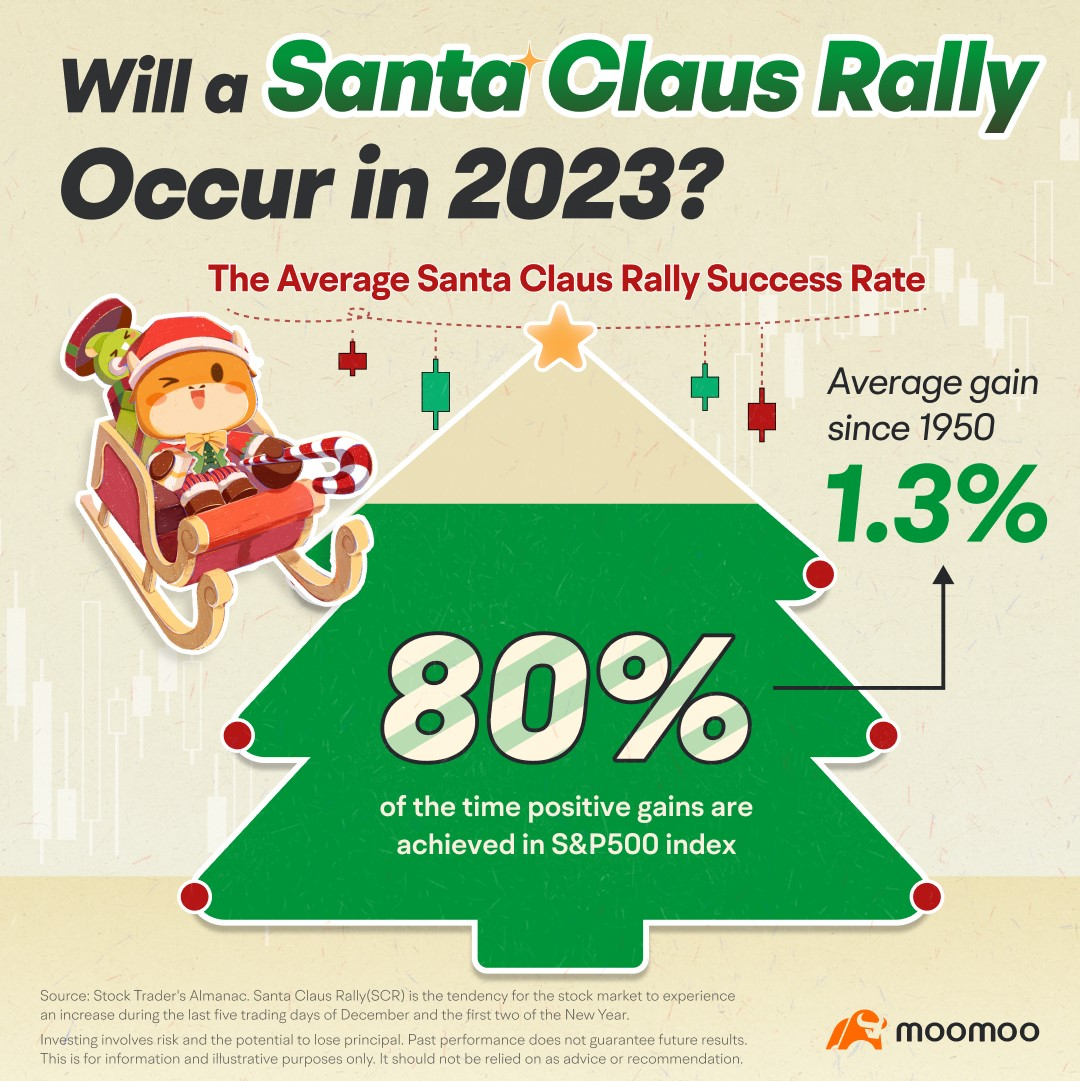
Santa Claus Rally(SCR) is the tendency for the stock market to experience an increase during the last five trading days of December and the first two of the New Year. 80% is calculated based on the number of positive gains achieved in the S&P500 index during the SCR period from 1950 to 2022. The average annual gain of 1.3% is calculated only based on the positive gains of the SP&500 index during the SCR period from 1950 to 2022.
During Christmas time, people eagerly anticipate the arrival of Santa Claus and the gifts he brings.
In the capital market, there is a similar excitement known as the Santa Claus rally - where the stock market tends to increase during the holiday season.
In this article, we'll explore the Santa Claus Rally's origins, what might cause it, and its history.
What is the Santa Claus rally?
The Santa Claus rally is a well-known example of seasonal effects in the U.S. stock market, where there's a tendency for the market to increase during the last five trading days of December and the first two trading days of the New Year.
This idea was first suggested by Yale Hirsch in 1972, the founder of the Stock Trader’s Almanac.
Looking at data from 1950 to 2022, the Stock Trader's Almanac found that the S&P 500 index (a benchmark stock market index) went up 58 out of 73 times during this period, which translates to an approximately 80% success rate. On average, the S&P 500 index increased by 1.3% during the Santa Claus rally.
Moreover, the Santa Claus rally can also be used as an early indicator of what may happen in the new year.
Hirsch believes that three indicators can be used to assess the potential stock market's performance for the next year: the Santa Claus rally, the performance of the first five trading days of the new year, and the January Barometer (which evaluates the market performance in the first month of the year).
So, if all three of these things look good, he thinks there's a pretty good chance the stock market will have a good year ahead.
Cause of the Santa Claus rally
When it comes to why the Santa Claus rally happens, opinions vary in the market, and there isn't a single explanation that everyone agrees on.
However, according to a summary by CFI, some of the most commonly cited reasons include:
Absence of institutional investors
Institutional investors and traders typically take a break in the last week of December, leaving the market more likely to be dominated by retail investors, who tend to be bullish and can drive gains.
Tax-loss harvesting
Tax-loss harvesting is a potential cause of the Santa Claus rally. In the United States, capital gains on the stock market will be taxed, while capital losses can be used as deductions on the investor’s tax return.
As a result, many investors sell underperforming investments at the year-end to offset their taxable gains — a strategy known as "tax-loss harvesting."
According to CFI, they think a slowdown in tax-loss harvesting, which has a deadline of December 31, is a potential cause for the Santa Claus Rally
January effect
Investors' expectations of the January Effect might also contribute to the Santa Claus rally.
The January Effect refers to the tendency for the stock market to rise in January each year.
This is also a phenomenon created when investors sell losers in December for tax-loss harvesting, only to re-buy new positions in January.
This may lead to an upward movement in the stock market in January.
Holiday mood
The festive atmosphere during Christmas and New Year's can create a positive mood. This positive sentiment might inspire investors to approach the New Year with hope and optimism, prompting them to invest in the stock market.
Extra money
During Christmas, people often receive various gifts, including year-end bonuses. These additional funds provide investors with extra money that they may choose to invest in the stock market.
However, factors like lack of investable funds due to holiday spending, lower trading volumes, geopolitical events, economic data, and other factors may cause the Santa Claus rally to not occur.
Trends in recent years
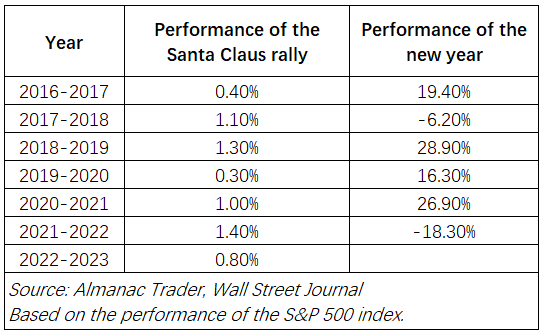
According to Almanac Trader and Wall Street Journal, the U.S. stock market has experienced a Santa Claus rally for the past seven years.
From 2016 to 2022, the S&P 500 recorded gains of 0.4%, 1.1%, 1.3%, 0.3%, 1.0%, 1.4%, and 0.8%, respectively, during the Santa Claus period.
Even in 2022, when the U.S. stock market experienced a bear market, the Santa Claus rally still happened.
Although historical data suggests that the Santa Claus rally tends to bring more positive returns than negative ones, predicting its future occurrence remains uncertain.
Remember, past performance doesn't guarantee future results.
The following table compares the performance of the S&P500 index during the Santa Claus rally and the corresponding full year over the past seven years:
Will a Santa Claus rally occur in 2023?
As the year comes to a close, investors are eagerly anticipating the potential occurrence of a Santa Claus rally.
In November, stocks posted an impressive monthly gain, with the S&P 500 rising over 8%.
However, fund managers at Real Investment Advice suggest the possibility of a stock market correction preceding the Santa Claus rally.
This is primarily due to the need for mutual funds to distribute their capital gains, dividends, and interest income for the year. While these distributions kick off in late November, a substantial number occur in the initial two weeks of December.
Nonetheless, fund managers think a pullback in the stock market in the first two weeks could increase the odds of a Santa Claus rally.
Certainly, no one can guarantee the consistent occurrence of the Santa Claus rally; it's a matter of probability.
It's important to recognize that while historical patterns can be useful in predicting future trends, each year stands as an independent event influenced by various factors, making outcomes unpredictable.
As such, investors or traders looking to participate in a potential Santa Claus rally might consider creating a personalized trading plan and implementing risk management strategies, such as pre-setting position sizes and stop-loss plans.
Bottom line
The Santa Claus rally refers to the last five trading days of December and the first two trading days of the following year, during which the US stock market generally experiences gain.
Commonly cited reasons for the Santa Claus rally include the absence of institutional investors, the January effect, and additional available funds.
Over the past seven years, Almanac Trader reports a consistent occurrence of the Santa Claus rally in the US stock market.
There is no guarantee that the Santa Claus rally will occur, so if investors or traders wish to participate in it, they should develop an effective trading plan and risk management strategy.
This presentation is for informational and educational use only and is not a recommendation or endorsement of any particular investment or investment strategy. Investment information provided in this content is general in nature, strictly for illustrative purposes, and may not be appropriate for all investors. Read more