NVIDIA joins the Dow: Will its market cap hold onto the top spot?
On November 1st, S&P Dow Jones Indices announced that NVIDIA ( $NVIDIA (NVDA.US)$ ) would be added to the Dow Jones Industrial Average ( $Dow Jones Industrial Average (.DJI.US)$ ). It will be effective before the market opens on November 8th, replacing Intel ( $Intel (INTC.US)$ ), which has been a member for 25 years.
Intel's stock price plummeted over 50% year-to-date, making it the worst performer among the index constituents. Its market capitalization fell below $100 billion for the first time in 30 years and was expected to mark its first annual loss since 1986.
NVIDIA has emerged as a cornerstone of the global semiconductor industry, thanks to its GPUs driving AI computing power. The stock has skyrocketed nearly 200% this year, pushing its market cap past $3 trillion. This shift highlights the industry's changing fortunes, where one company's rise often comes at another's expense.
On November 5, Nvidia rose nearly 3% to close with a market cap of $3.43 trillion and became the world's largest company again, as it had been since June.
According to Fortune magazine, the broader market's fate increasingly hinges on this AI leader, making NVIDIA one of the most watched stocks. NVIDIA contributed to over a third of the S&P 500's gains at one point this year.
What impact will NVIDIA's inclusion in the Dow have on the market, and can the company sustain its robust performance?
Impact of joining the Dow
The Dow Jones Index, the oldest of the three major U.S. stock indices, was established in 1896 and has a 128-year history.
Unlike other stock indices, the Dow uses a price-weighted method rather than market capitalization, meaning higher-priced stocks have a greater influence on the index. It includes only 30 stocks.
NVIDIA conducted a 1-for-10 stock split in June, reducing its stock price to one-tenth of its original price. Based on current prices, NVIDIA is expected to hold approximately a 2% weight in the Dow after its inclusion.
Previously, other tech giants like Microsoft ( $Microsoft (MSFT.US)$ ), Apple ( $Apple (AAPL.US)$ ), and Amazon ( $Amazon (AMZN.US)$ ) had already joined the index.
Due to its unique construction, the performance of these tech giants has a limited impact on the Dow, which still primarily reflects the performance of traditional sectors like finance, industry, and consumer goods. Currently, the top weight in the Dow is held by insurance giant UnitedHealth ( $UnitedHealth (UNH.US)$ ), followed by Goldman Sachs ( $Goldman Sachs (GS.US)$ ).
Looking back at the data of tech giants joining the Dow, they have performed well. However, it's important to note that a company's long-term performance relies more on its operational capabilities.
Given the small number of companies in the Dow, those that remain in the index exhibit a certain "survivor bias," generally performing well over the long term. Well-known companies previously removed from the Dow, such as Cisco ( $Cisco (CSCO.US)$ ) and HP ( $HP Inc (HPQ.US)$ ), have faced tough times.
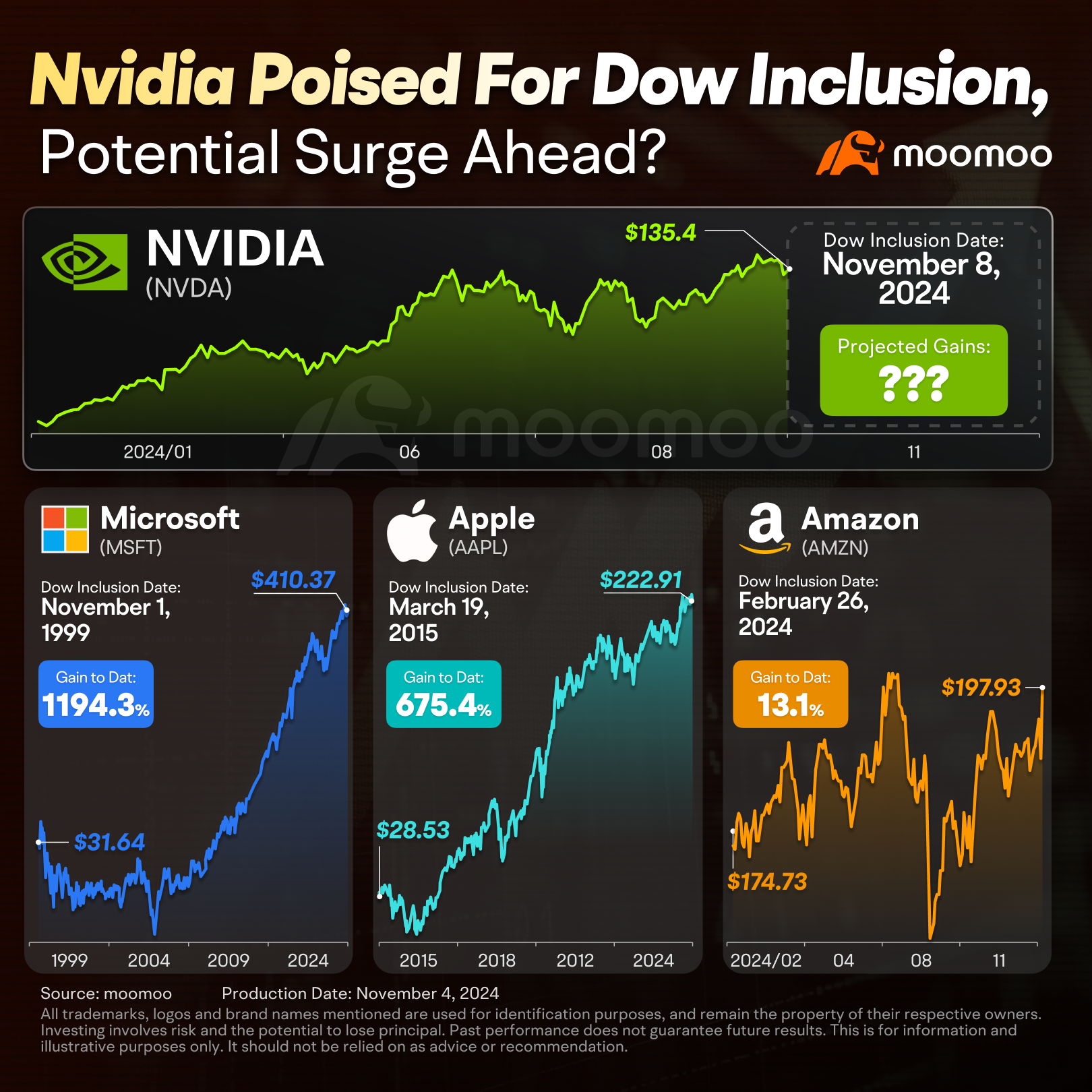
For NVIDIA, joining the Dow will indeed bring some passive fund inflows. However, due to its relatively low weight in the Dow and its massive market cap exceeding $3 trillion, the company's future trajectory hinges more on whether it can maintain its position amid the AI wave.
"Generational opportunity"
In October, Bank of America analysts raised NVIDIA's target price to $190, corresponding to a market cap exceeding $4.6 trillion. The institution noted a "generational opportunity" for NVIDIA, with its core data center business facing a market worth up to $400 billion. NVIDIA's free cash flow could exceed $200 billion within the next two years, reaching levels comparable to Apple.
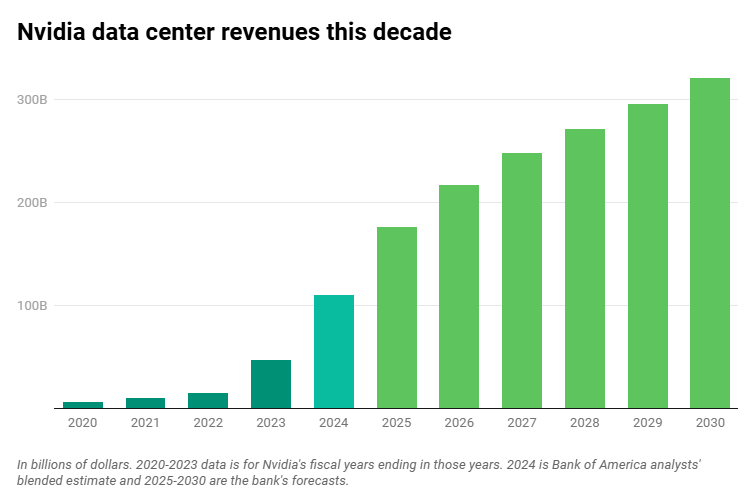
Bank of America believes NVIDIA's valuation remains attractive despite the significant rally. Its 25-year PEG ratio (price-to-earnings growth) is 0.6x, well below the 1.9x average of other major tech stocks.
Several cloud computing giants reported earnings and indicated continued investment in AI hardware, keeping downstream demand for NVIDIA strong.
According to Raymond James, the combined capital expenditure of major companies - Amazon ( $Amazon (AMZN.US)$ ), Microsoft ( $Microsoft (MSFT.US)$ ), Meta ( $Meta Platforms (META.US)$ ), and Google ( $Alphabet-C (GOOG.US)$ ) - increased by 11% quarter-over-quarter in the third quarter, a 59% surge year-over-year.
Raymond analyst suggests that while concerns about AI monetization are growing, fierce competition among hyper-scale enterprises will lead to exponential growth in computing intensity, driving further infrastructure investment in AI. With its dominance in the GPU sector, NVIDIA stands to benefit significantly from this trend.
Dominating the landscape
In 2023, NVIDIA captured 92% of the GPU market share. However, there are ongoing discussions about potential challengers catching up and threatening NVIDIA's dominance.
Advanced Micro Devices ( $Advanced Micro Devices (AMD.US)$ ) is seen as the most likely challenger, but its progress has been slow.
On October 29th, AMD reported its third-quarter earnings, followed by a more than 10% drop. Despite a significant increase in data center revenue to $3.5 billion, it barely surpassed one-tenth of NVIDIA's previous quarter revenue. AMD's latest products still lag a generation behind NVIDIA's, and the company's fourth-quarter guidance fell short of market expectations.
Intel's progress is even further behind. On October 31st, the company disclosed its third-quarter earnings, during which management admitted that its Gaudi AI chip development was behind schedule, failing to meet its previous annual revenue target of $500 million.
Bernstein analysts saw that as a sign that Intel's AI strategy "has essentially failed."
In contrast, demand for NVIDIA's products remains robust. NVIDIA CEO Jensen Huang stated that there is significant market demand for the new Blackwell series chips. "Everybody wants to have the most, and everybody wants to be first."
NVIDIA's supplier SK Hynix reported that NVIDIA requested to advance high-bandwidth memory supply by six months.
MarketWatch commented that despite NVIDIA ending its five-week winning streak in late October, the company still had a pretty good week, based on its peers and downstream disclosures.
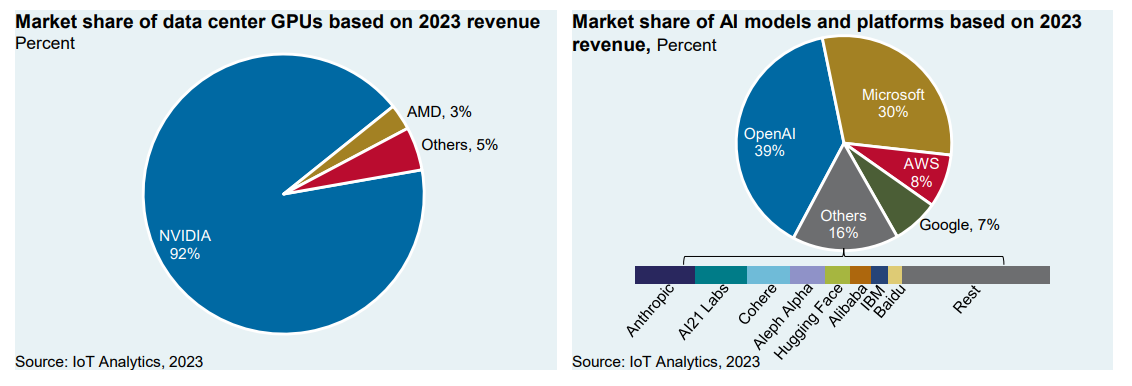
JPMorgan noted that despite facing competition, NVIDIA is expected to maintain over 90% of the AI chip market share over the next two years. However, for investors, the more important issue might not be the economic benefits of selling GPUs but whether downstream AI infrastructure users can generate sufficient returns from AI infrastructure investments.
For adequate returns on AI infrastructure to materialize, within the next 12-18 months, we will need to see a greater shift toward "inference" tasks (AI used to run production models for corporate customers) rather than GPU capacity primarily being used to train foundational models and chatbots.
Data shows that in 2023, OpenAI (developer of ChatGPT) accounted for nearly 40% of the downstream market share, and there is a need for more diversified downstream AI applications in the future.
How to invest in NVIDIA?
If you're optimistic about NVIDIA's prospects, the simplest way is to buy the stock directly.
Due to its high profile, the market also offers leveraged ETFs tracking NVIDIA's stock performance, in long/short directions and with different leverage multiples.
The largest is the 2x long NVIDIA ETF ( $GraniteShares 2x Long NVDA Daily ETF (NVDL.US)$ ), with assets exceeding $5 billion. However, leveraged ETFs only track daily performance, which can result in loss in a volatile market. It's important to understand such products' investment objectives and mechanics.
Additionally, NVIDIA is set to release its latest quarterly earnings on November 20th. Besides monitoring NVIDIA's performance by that time, you could also make some pre-earnings option strategies.
For example, NVIDIA's volatility surged before the August 28th release of its fiscal Q2 earnings. After the earnings were announced, volatility quickly decreased, a phenomenon known as the "IV Crush."
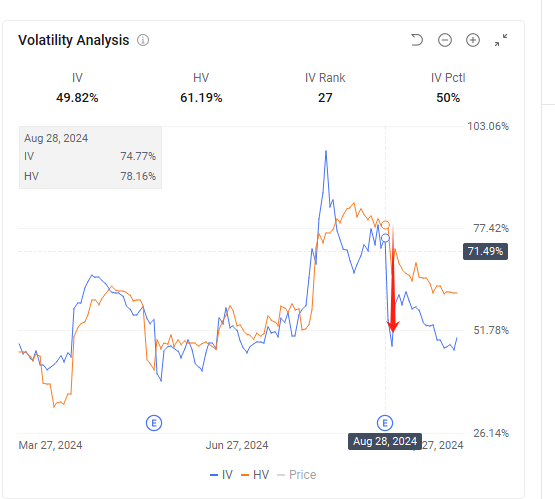
Implied volatility values, IV Rankings, and IV Percentiles are theoretical estimates, and the actual market conditions may not always align with the theoretical information shown. Investors should exercise caution and use multiple sources of information when making investment decisions.
No guarantee or assurance using any tools or data provided on the moomoo app will result in investment success or reduce investment risk.
In a risk-neutral situation, the lower the implied volatility of the target asset, the less premium one has to pay, theoretically benefiting the option buyer.
If you believe volatility will rise before the earnings report is released but are not sure whether it will go up or down, you can construct a long straddle or long strangle when volatility is low. Alternatively, you can take advantage of the IV Crush by selling straddles or strangles when volatility is high before earnings.
Related risks
Technology Change: Despite rapid development, the industry is still on the verge of large-scale applications, and may face further technological challenges during implementation. Additionally, breakthroughs and improvements could alter the existing industry landscape, intensifying market competition.
Supply Chain Risks: Chip manufacturing relies on a complex global supply chain. If there are upstream material shortages or geopolitical shifts, it could affect NVIDIA's production capacity and costs.
Macro Environment: Recent continued rises in U.S. Treasury yields could pressure risk assets if they remain at high levels.
Additional Disclosures: This content is also not a research report and is not intended to serve as the basis for any investment decision. The information contained in this article does not purport to be a complete description of the securities, markets, or developments referred to in this material. The information has been obtained from sources considered to be reliable, but we do not guarantee that the foregoing material is accurate or complete. Furthermore, there is no guarantee that any statements, opinions or forecasts provided herein will prove to be correct.
Options trading involves substantial risks and may not be suitable for all investors. Losses could potentially exceed your initial investment. Please also consider our US Options Product Disclosure Statement (PDS), US Options Target Market Determination (TMD) and OCC's Characteristics and Risks of Standardized Options available on the website before trading options.
This presentation is for informational and educational use only and is not a recommendation or endorsement of any particular investment or investment strategy. Investment information provided in this content is general in nature, strictly for illustrative purposes, and may not be appropriate for all investors. Read more