

Moomoo Insights
Jul 16 15:38
TSMC Earnings: AI Demand Is Stronger Than the Chip Selloff Suggests
Moomoo Insights
Sep 30 05:04
Live Take | Anthropic’s $518B Compute Bet: Who Wins From the AI Buildout?
In options trading, sell to open is an order that involves selling or shorting an option to start a new transaction. It's also known as "going short" or selling short." Some investors can use this strategy when they think the price of the underlying asset will decrease and hope to profit from it.
Keep in mind that options trading involves significant risks, especially selling short strategies, and it is not suitable for everyone. This strategy has the potential for unlimited losses and is only appropriate for traders with high risk tolerance and experience.
Both call and put options can be used with "sell to open" orders. For a call, a sell to open involves selling (writing) a new options contract to open a transaction. The investor may expect the options price to decline in the future and then hope to buy it back at a lower price to potentially secure a profit. Selling to open can also allow an investor to collect a premium by selling to another investor.
For a sell to open put, an investor may have a neutral to bullish view, and would be willing to take the assignment risk of the the option being exercised by the buyer should the stock drop below the strike price. In exchange, the investor receives a premium and if the put option expires worthless, the investor keeps it as a potential profit.
However, selling a naked, or unhedged, option can expose the seller to unlimited risk. For example, if the underlying market rises quickly, the seller of a short call position could experience rapid losses.
With sell to open, there are three possible outcomes: the option may expire, be exercised, or the investor (seller) may purchase it (buy to close) to close the trade.
An investor sells to open a $100 strike call option expiring in three months for $5. The underlying asset (a stock) shares are trading at $95 in the market. Here's three potential situations describing a buy-to-close of an initial sell-to-open call option trade.
Two months have passed and the underlying shares have fallen to $90. The call option contract has fallen to $2 per contract, from $5. An investor wants to realize these gains, so they buy to close the short options position at $2, taking a $3 profit or $300 for the trade ($3 X 100 shares = $300).
Two months have passed and the shares have increased to $100. The call option has stayed at $5 and investor decides to close the position at $5 to breakeven. The investor sold the call for $5 and closed the transaction for $5 ($5 - $5) = $0.
After two months, the underlying stock increases from $95 to $105; the call option’s value rose to $7. An investor can buy to close the short call position for $7; this will result in a loss of $2 on the trade ($5 - $7) or -$200 (-$2 X 100).
A sell-to-open order is an options order type where an investor sells (or writes) a new options contract with the expectation that the option will decrease in value. This strategy can be employed for both call and put options. An investor can sell to open a call when they expect the value of the underlying asset to decrease (bearish sentiment) and for put options, an investor sells to open a put when they expect the value of the underlying asset to increase (bullish sentiment).

Many savvy investors turn to selling options to earn premiums, but without precise calculations, it can feel like high-risk gambling. A tool that can quickly filter for lucrative and suitable contracts is essential for locking in steady returns and profiting scientifically. Moomoo’s Options Seller Dashboard is a powerful strategy screener that identifies Cash-Secured Put and Covered Call opportunities across the market. It allows you to apply custom filters based on your risk appetite, such as selecting an ETF, setting an IV Rank below 30% to control risk, and sorting by a high probability of profit. This helps you move away from selling blindly. Moomoo can help you discover high-quality selling opportunities while clearly managing the risk and reward of every premium earned. Register for a free account to use the Options Seller Dashboard and start profiting more scientifically.
Employing selling to open option orders can be a strategic move in options trading, but it comes with advantages and disadvantages.
Time decay (theta) works to an investor's advantage as option sellers can keep the premium if the option expires worthless.
Can benefit from lower implied volatility
Receives premium upfront, providing the potential for an income stream
A naked call sale can potentially result in unlimited losses if assigned as the seller is obligated to purchase the stock at the market price if the stock price rises significantly and sell it at the strike price; this can be much higher than the strike price.
Rising volatility can be challenging for options sellers as it equates to greater unpredictability and risk.
Brokerage firms often impose higher margin requirements on sell-to-open positions due to the associated risks. This can limit the trader’s ability to potentially leverage their portfolio.
Sell to close refers to selling an option to close a position that was initially purchased in order to open the transaction. This effectively allows the trader to exit their position on that option. The outcome of a sell-to-close transaction can vary. For a sell to close call it might result in a potential profit if the option's value has increased, but it could also lead to no gain or even a loss if the option's value has decreased compared to its purchase price.
Keep in mind the below example is for a sell to close for a call. Investors can also do a sell to close for puts. This can be done if the investor has a slightly bearish sentiment on the underlying stock and is interested in this strategy.
Let’s review three sell-to-close situations for a call transaction. A trader holds a $100 strike call option expiring in three months; they purchased the options contract for $5 when underlying shares traded at $95.
Two months have passed and the underlying shares have increased to $110. The call option has increased to $12, up from $5 per contract. The trader wants to lock in the gains and decides to sell to close the long option position. They execute the order at $12, securing a $7 profit ($12 - $5 = $7) or $700 ($7 X 100).
Two months have again passed and the stock has increased to $100. The call option remained at $5 and the investor decides to close their position at $5 to breakeven. This means they bought the call at $5 and sell to close it at $5 for a $0 profit ($5 – $5).
The option may be losing value after two months and an investor decides it may be a good idea to implement a sell-to-close order. Let's assume the shares have increased to $96 from $95 and the call option’s value may have declined to $2.
To sell to close the long call position at $2, this can result in a $3 loss on the trade. If the investor bought the call at $5 and closed the transaction at $2, this results in a $3 loss or -$3 x 100 = -$300.
Many investors buy calls thinking "as long as it rises, I'll profit," only to see returns fall short of expectations. This often happens because the break-even point wasn't calculated before placing the order, allowing high premium costs to erode gains. Moomoo’s Options Analysis feature brings clarity to every trade by instantly calculating the break-even point, maximum potential loss, maximum potential profit, and theoretical probability of profit. By clicking any contract in the options chain, you can see exactly where you start making money. If the break-even point is too far from the current price, you can adjust your strategy for better capital efficiency. Moomoo helps you settle every account. Register today for a free account to use our Options Analysis features and trade with a clear understanding of your bottom line.
Selling to close has both pros and cons. Understanding these can be helpful when investors are trading options.
Avoids additional commissions vs. selling shares in the open market after exercising an ITM call option
Can potentially help limit losses by closing out options before they expire and decrease further in value.
Potential commission from the options sale
May incur an opportunity cost as there's potential to miss further gains in the underlying asset if it moves favorably after the sell
Market timing is important when attempting to maximize potential profits so investors need to keep an eye on the trades
While they sound very similiar, there is a difference between sell-to open and sell-to-close orders. A sell-to-open order is when an investors sell (or writes), a new options contract. This action creates an obligation for the seller, depending on whether it's a call or put option. A sell-to-close order is used to sell an existing options contract that an investor already holds. Both calls and puts can be subject to sell-to-open vs sell-to-close orders.
Once an investor understands these key order types, the first hurdle is finding a platform that supports options on the stocks they follow. To execute strategies efficiently, traders need a platform with robust capabilities. Moomoo offers extensive stock options trading, allowing users to trade a wide range of U.S. equity options with transparent pricing and real-time data. The platform provides intuitive tools for analyzing options chains, monitoring volatility, and executing strategies with features like customizable alerts and risk management controls. This ensures a streamlined experience for both novice and experienced options traders. If you are looking for a dedicated environment to trade stock options, sign up for a free account now to explore Moomoo’s powerful features.
Moomoo provides a user-friendly options trading platform. Here's a step-by-step guide to get you started:
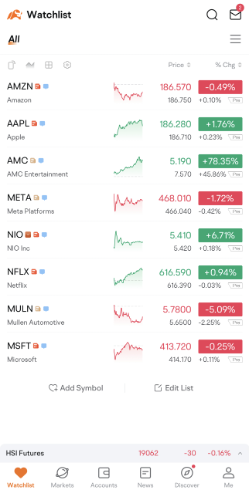
Step 1: Navigate to your Watchlist, then select a stock's "Detailed Quotes" page.
Images provided are not current and any securities are shown for illustrative purposes only and is not a recommendation.
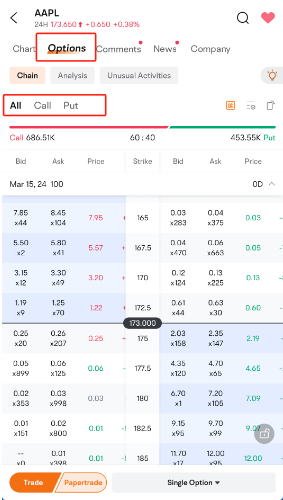
Step 2: Navigate to Options> Chain located at the top of the page.
Step 3: By default, all options with a specific expiration date are shown. For selective viewing of calls or puts, simply tap "Call/Put."
Images provided are not current and any securities are shown for illustrative purposes only and is not a recommendation.
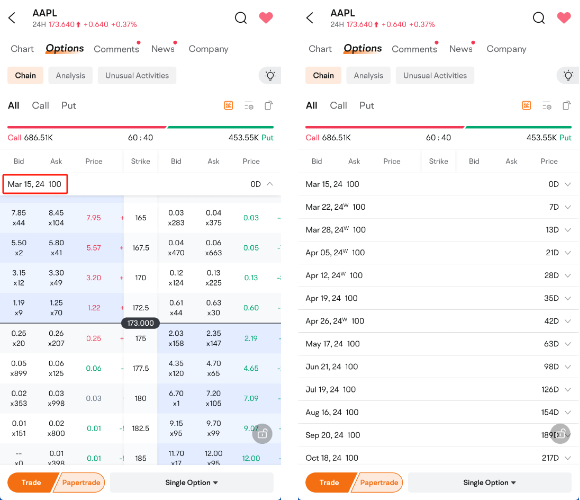
Step 4: Adjust the expiration date by choosing your preferred date from the menu.
Images provided are not current and any securities are shown for illustrative purposes only and is not a recommendation.
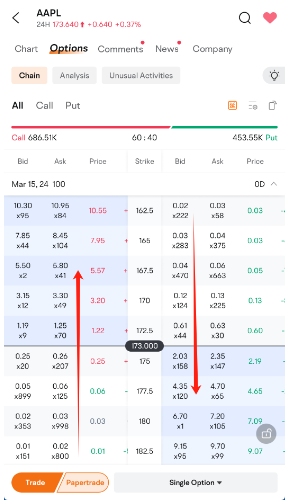
Step 5: Easily distinguish between options: white denotes out-of-the-money, and blue indicates in-the-money. Swipe horizontally to access additional option details.
Images provided are not current and any securities are shown for illustrative purposes only and is not a recommendation.
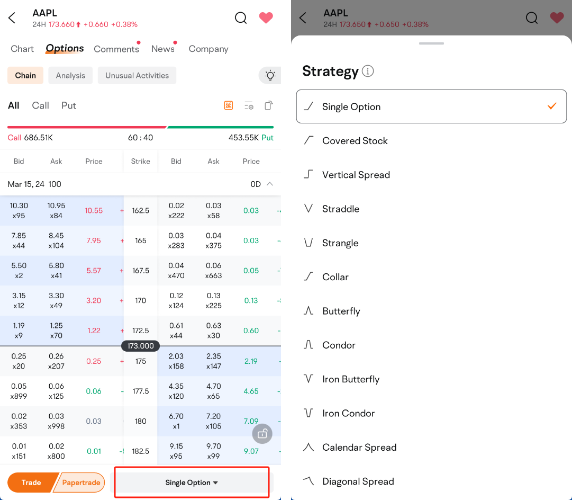
Step 6: Explore various trading strategies at the screen's bottom, offering flexibility for your investment approach.
Images provided are not current and any securities are shown for illustrative purposes only and is not a recommendation.
Buy to open signifies that an investor is initiating a long position by purchasing an option, with an expectation of potentially profiting from an increase in the option's value. Sell to open entails selling an option to establish a short position. The investors receives a premium and anticipates that the option will depreciate or expire worthless.
An investor can close a short option position (sell-to-open) by buying-to-close prior to expiration. Keep in mind that options may expire worthless, so an investor also could do nothing, avoid possible commissions and realize a profit based on the premium received when selling the option. However, by leaving an option open, there's risk the option price could move unfavorably before expiration or possible assignment risk at expiration.
In this strategy, here's a few ways it may be beneficial:
Earn premium income: Collect the option premium paid by the buyer. If the price of the underlying stock is above the strike price at expiration, the put option expires worthless, allowing you to keep the entire premium as profit.
Take advantage of time decay: Options usually decrease in value as they approach their expiration date (time decay). By selling put options, you can potentially benefit from this time decay as the option's value usually erodes over time.
This presentation is for informational and educational use only and is not a recommendation or endorsement of any particular investment or investment strategy. Investment information provided in this content is general in nature, strictly for illustrative purposes, and may not be appropriate for all investors. Read more
Recommend
Moomoo Offers Extended Trading Hours for Options Trading on Oct 19
At-the-Money (ATM) - How It Works in Options Trading
Out-of-the-Money in Options Trading - How It Works & Examples

Covered Call: A Comprehensive Guide to Options Trading
Strangle Options Strategy - A Helpful Guide for Traders
Straddle vs. Strangle: Understanding the Key Differences
Triple Witching: Understanding Its Impact on the Stock Market
Underlying Asset: Definition, Types and Examples
What Are Option Premiums
Covered Calls and Covered Puts - Strategies for Options Trading
Expiration Date in Options Trading
Options Break-Even Point: Definition, Formula, and Examples
Credit Spread: Definition, Examples & How to Calculate
Bull Put Spread: Definitions, How It Works & Examples
How to Manage Your Risk in Options Trading
How to Pick the 'Right' Strike Price
Options Wheel Strategy Explained: Definition and How to Trade
Long Collar Options Strategy: Definition, How It Works & Examples
Long Call Options Strategy: Definition, Potential Benefits, and Risks
Exercise of Options: When and How to Exercise Options
Time Value: Definition, Calculation, Importance in Options Trading
Short Call Options Strategy: Guide & Examples
What Are Bitcoin ETF Options: Investment Insights & Strategies
Hedge with Options: Protect Your Portfolio in 2026
Options Chains: Definition, How to Read and Analyze Them
Options Profit Calculation: Overview, Formula & Examples
What is Theta in Options Trading: Overview and Strategies
Debit Spread: Definition, Types & Examples
Butterfly Spread: Definition and Application in Options Trading
What Is an Options Screener and How to Use?
Unusual Options Activity: Insights and Strategies for Traders
Protective Put Strategy: Definition, How It Works & Examples
What Are Stock Options: Types, How They Work and Examples
Weekly vs. Monthly Options: Choosing the Right Expiration Date
How to Practice Options Trading with Demo Trading Account
Sell to Open vs Sell to Close: Understanding the Difference
Long Put: Definition, Examples and How to Trade
Iron Condor: Understanding This Options Trading Strategy
Diagonal Spread: Definition, Types & How to Use
Implied Volatility (IV) Rank & Percentile in Options Trading
Trading Earnings with Options
Iron Butterfly: Mastering the Options Trading Strategy
Interest Rate Options: Definition & How They Work
Options Buy to Open vs Buy to Close: What's the difference?
Vertical Spread: Definition, Types, & Examples
Bear Put Spread: An Options Trading Strategy Explained
What is a Dividend Reinvestment Plan (DRIP)?
Put/Call Ratio (PCR): Definition & How to Use
How Are Options Priced? | Calculation and Examples
Naked Calls Options Strategy: Definition & How It Works
Options Vs. Futures: Understanding Their Key Differences
Extrinsic Value: Definition, Calculation, and Trading Strategies
Intrinsic Value: How It Works And How To Calculate It
Bull Call Spread - Examples and Applications in Options Trading
Index Options: Definitions, Strategies and Risks
Short Put Options: Strategies and Risks Explained
Quadruple Witching: How It Can Affect the Stock Market
What Are Options? Everything You Need to Know before Trading
Four Option Trading Strategies for Beginners
10 Options Strategies to Enhance Your Trading Portfolio
American Options vs. European Options
In-The-Money (ITM): Call and Put Options Examples
What is a Calendar Spread?
Open Interest: What it means for traders and investors
Options vs Stocks: Choosing the Right Investment Strategy
Options Strike Prices Explained: A Complete Guide for Beginners
Call vs Put Options: Your Essential Guide to the Basics
Zero Days to Expiration (0DTE) Options: Trade Mag 7 Stock Options Today
What Is An Options Contract? How Does It Work?
What is Synthetic Put? (How Does It Work)
How and When to Roll Covered Calls
Option Volume vs Open Interest: Understanding the Difference
4 Options Trading Levels
How to Trade Options for Beginners?
What Is Implied Volatility (IV)?
What Are Cash Secured Puts: How To Sell Them
What Is a Straddle Options Strategy?
What Is Ratio Spread in Options
What is a Call Option: Strategies and Tips
Taxes on Stocks: How Selling Stocks Affects Your Taxes
Option Greeks Explained - Option Greek Cheat Sheet
Put Options: Hedging Your Portfolio
Put Options: How to Use Them in Your Trading Strategy
Poor Man's Covered Call (PMCC): A Beginner's Guide
Four Option Trading Mistakes to Avoid
Trading Synthetic Options: Risks and Rewards
Call Spread vs. Put Spread: What are the differences?
What is stock options trading
What Is Margin Call and How Can You Avoid the Risks?
Options Trading Strategies: Iron Condor vs. Iron Butterfly
Moomoo Offers Extended Trading Hours for Options Trading on Oct 19
At-the-Money (ATM) - How It Works in Options Trading
Out-of-the-Money in Options Trading - How It Works & Examples
Covered Call: A Comprehensive Guide to Options Trading
Strangle Options Strategy - A Helpful Guide for Traders
Straddle vs. Strangle: Understanding the Key Differences
Triple Witching: Understanding Its Impact on the Stock Market
Underlying Asset: Definition, Types and Examples
What Are Option Premiums
Covered Calls and Covered Puts - Strategies for Options Trading
Expiration Date in Options Trading
Options Break-Even Point: Definition, Formula, and Examples
Credit Spread: Definition, Examples & How to Calculate
Bull Put Spread: Definitions, How It Works & Examples
How to Manage Your Risk in Options Trading
How to Pick the 'Right' Strike Price
Options Wheel Strategy Explained: Definition and How to Trade
Long Collar Options Strategy: Definition, How It Works & Examples
Long Call Options Strategy: Definition, Potential Benefits, and Risks
Exercise of Options: When and How to Exercise Options
Time Value: Definition, Calculation, Importance in Options Trading
Short Call Options Strategy: Guide & Examples
What Are Bitcoin ETF Options: Investment Insights & Strategies
Hedge with Options: Protect Your Portfolio in 2026
Options Chains: Definition, How to Read and Analyze Them
Options Profit Calculation: Overview, Formula & Examples
What is Theta in Options Trading: Overview and Strategies
Debit Spread: Definition, Types & Examples
Butterfly Spread: Definition and Application in Options Trading
What Is an Options Screener and How to Use?
Unusual Options Activity: Insights and Strategies for Traders
Protective Put Strategy: Definition, How It Works & Examples
What Are Stock Options: Types, How They Work and Examples
Weekly vs. Monthly Options: Choosing the Right Expiration Date
How to Practice Options Trading with Demo Trading Account
Sell to Open vs Sell to Close: Understanding the Difference
Long Put: Definition, Examples and How to Trade
Iron Condor: Understanding This Options Trading Strategy
Diagonal Spread: Definition, Types & How to Use
Implied Volatility (IV) Rank & Percentile in Options Trading
Trading Earnings with Options
Iron Butterfly: Mastering the Options Trading Strategy
Interest Rate Options: Definition & How They Work
Options Buy to Open vs Buy to Close: What's the difference?
Vertical Spread: Definition, Types, & Examples
Bear Put Spread: An Options Trading Strategy Explained
What is a Dividend Reinvestment Plan (DRIP)?
Put/Call Ratio (PCR): Definition & How to Use
How Are Options Priced? | Calculation and Examples
Naked Calls Options Strategy: Definition & How It Works
Options Vs. Futures: Understanding Their Key Differences
Extrinsic Value: Definition, Calculation, and Trading Strategies
Intrinsic Value: How It Works And How To Calculate It
Bull Call Spread - Examples and Applications in Options Trading
Index Options: Definitions, Strategies and Risks
Short Put Options: Strategies and Risks Explained
Quadruple Witching: How It Can Affect the Stock Market
What Are Options? Everything You Need to Know before Trading
Four Option Trading Strategies for Beginners
10 Options Strategies to Enhance Your Trading Portfolio
American Options vs. European Options
In-The-Money (ITM): Call and Put Options Examples
What is a Calendar Spread?
Open Interest: What it means for traders and investors
Options vs Stocks: Choosing the Right Investment Strategy
Options Strike Prices Explained: A Complete Guide for Beginners
Call vs Put Options: Your Essential Guide to the Basics
Zero Days to Expiration (0DTE) Options: Trade Mag 7 Stock Options Today
What Is An Options Contract? How Does It Work?
What is Synthetic Put? (How Does It Work)
How and When to Roll Covered Calls
Option Volume vs Open Interest: Understanding the Difference
4 Options Trading Levels
How to Trade Options for Beginners?
What Is Implied Volatility (IV)?
What Are Cash Secured Puts: How To Sell Them
What Is a Straddle Options Strategy?
What Is Ratio Spread in Options
What is a Call Option: Strategies and Tips
Taxes on Stocks: How Selling Stocks Affects Your Taxes
Option Greeks Explained - Option Greek Cheat Sheet
Put Options: Hedging Your Portfolio
Put Options: How to Use Them in Your Trading Strategy
Poor Man's Covered Call (PMCC): A Beginner's Guide
Four Option Trading Mistakes to Avoid
Trading Synthetic Options: Risks and Rewards
Call Spread vs. Put Spread: What are the differences?
What is stock options trading
What Is Margin Call and How Can You Avoid the Risks?
Options Trading Strategies: Iron Condor vs. Iron Butterfly

