

Moomoo Insights
Jul 16 15:38
TSMC Earnings: AI Demand Is Stronger Than the Chip Selloff Suggests
Moomoo Insights
Sep 30 05:04
Live Take | Anthropic’s $518B Compute Bet: Who Wins From the AI Buildout?
Call options offer investors a way to potentially benefit from stock price movements without directly owning the underlying asset. This guide unpacks the essentials of call options — how they work, their advantages and disadvantages, and strategic ways to integrate them into your trading toolkit. Learning how to use call options could help identify potential opportunities tailored to your investment style.
A call option is a contract that gives the holder the right, but not the obligation, to buy a stock at a set price (strike price) before or on a certain date (expiration date). If the stock’s price rises above the strike price, the call option could gain value, as it may allow you to purchase the stock below its current market price. You can choose to exercise the option to buy the stock or sell the option itself if it has appreciated. However, if the stock’s price does not rise enough, the option may lose value or even expire worthless, depending on its remaining time and intrinsic value. This gives traders a flexible tool to speculate on price movements or hedge against potential losses.

Call options are a useful tool because they let traders control a large quantity of shares with a smaller upfront investment. Instead of buying the stock outright, some investors use options to seek potential gains while managing risk, as they’re only liable for the premium paid. This leverage can enable strategies that might otherwise be prohibitively expensive. For those aiming to enhance potential returns or strategically manage risk, call options add a versatile dimension to many trading strategies — but they can also increase potential losses.
When you buy a call option, you’re paying a premium for the right (but not the obligation) to purchase shares at a predetermined strike price within a specified time period. If the stock price rises above the strike price before the option expires, you can exercise the option and buy the stock at a discount.
However, if the stock price remains below the strike price, the option may expire worthless. In this scenario, where the contract is not exercised, you will only lose the premium paid for the option. This does, however, represent a 100% loss on that trade.
On the other hand, the seller of the call option takes on the obligation to sell the stock at the strike price if the option is exercised, regardless of the stock's market price. Thus, while the buyer's potential loss is limited to the premium, the seller’s risk is theoretically unlimited.
Long and short call options represent different approaches in trading. A long call gives the buyer the right to purchase an asset at a fixed price, when forecasting price increases in the underlying stock. Conversely, a short call commits the seller to provide the asset if exercised, potentially profiting from the premium received from the sale of the call, while expecting prices to remain flat or fall.
A long call option is primarily a speculative strategy in options trading, allowing investors to forecast an asset's price increase. The theoretical maximum profit is unlimited since the asset's price can rise indefinitely. The theoretical maximum loss, however, is limited to the premium paid for the option assuming the option is not exercised. To break even, the asset's price at expiration must be at least equal to the strike price plus the premium paid. For instance, if a call option has a strike price of $50 and the premium is $5, the breakeven point would be $55. This strategy may be appropriate for investors expecting significant price appreciation while managing risks.
Many investors buy call options thinking, “as long as the price rises, I’ll profit,” only to realize their returns are lower than expected. This often happens when the break-even point isn't calculated before trading, allowing high premium costs to cut into potential gains. Without precise profit calculations, you can't optimize your entry. A tool that instantly calculates break-even points allows you to evaluate the risk-reward ratio beforehand. Moomoo’s Options Analysis feature brings this clarity to each trading strategy. For any strategy, the system calculates the precise break-even point, displays the theoretical maximum potential loss and profit, and even provides a projected probability of profit. This shows exactly when you are able to start making money, helping you adjust your strategy if the break-even point is too far from the current price. Register for a free moomoo account to use our Options Analysis features and trade with a clearer understanding of your bottom line.
A short call option is a strategy where the seller forecasts against the asset's price increase, aiming to keep the premium collected as profit. The theoretical maximum profit is limited to the premium received for selling the call, as this is the maximum gain if the option expires worthless. However, the theoretical maximum loss is unlimited, as the asset's price can rise indefinitely, leading to potentially unlimited losses if the call is exercised. The breakeven point occurs when the asset's price at expiration equals the strike price plus the premium received. For example, if a call is sold at a strike price of $60 with a $4 premium, the breakeven is $64.
Imagine you believe Company ABC’s stock, currently at $50, will rise. You decide to purchase a call option with a $55 strike price for a $2 premium, with an option multiplier of 100 (meaning each option contract controls 100 shares).
Option scenario: If ABC’s stock climbs to $60 by expiration, your option allows you to buy the shares at $55. The gain per share would be $60 - $55 = $5. Subtracting the $2 premium, your net profit per share is $3. For one contract (100 shares), your total profit is $300.
Stock purchase scenario: If you instead buy 100 shares at $50, your total investment is $5,000. If the stock rises to $60, you sell for $6,000, earning $1,000.
Comparison: With the call option, you invested only $200 (100 shares x $2 premium) compared to $5,000 for the stock purchase. Your return on the call option ($300 profit on $200 investment) is significantly higher in percentage terms, but if the stock price stays below $55, you lose the $200 premium—this would be your total loss.
But what if you want to exit the trade before expiration? Holding an option and aiming for a profitable early exit can be challenging, as it’s hard to know the 'optimal price'. Traditional tools often can’t forecast your option's future value at a specific price and date, potentially causing you to miss the peak. The moomoo Option Calculator helps turn profit projection into meaningful data. By adjusting the target date and stock price, the tool instantly computes the option's future theoretical value and estimated profit. This allows you to “stress test” your trade by replacing guesswork with more precise data, helping you create a scientific exit strategy. Stop speculating; register for free access to the Option Price Calculator on moomoo to make your trade expectations clear and precise.
Selling a call option is often employed as part of a covered call strategy, where the seller owns the underlying stock. For example, you own 100 shares of Company XYZ, currently trading at $100 per share, and believe its price will remain stable. You sell a call option at a $110 strike price and collect a $5 premium per share, receiving $500 in total.
If XYZ’s price stays at or below $110 at expiration, the option expires worthless, and you keep the premium as income.
If XYZ’s price rises above $110, you must sell your shares at the strikeprice, limiting upside potential. For example, if the stock rises to $115, you sell at $110, earning $1,500 total (including the premium). However, you miss out on the additional $500 you could have made if the stock were sold at $115.
This strategy allows you to generate income in sideways or modestly bullish markets but caps gains if the stock surges higher. Some eligible options investors utilize the "Sell" side to generate premiums, but without precise calculations, selling options is high risk. A tool that quickly filters for potentially suitable and can help you trade more scientifically. Moomoo’s Options Seller Dashboard is a advanced strategy screener that displays Cash-Secured Puts and Covered Calls across the market. You can use custom filters based on your risk appetite, such as IV Rank and premium amount, and sort by theoretcial probability of profit to find contracts that align with your strategy. Stop selling blindly and register with moomoo to use the Options Seller Dashboard.
Call options are versatile tools that traders and investors use for income generation, speculation, and hedging strategies. One approach is the covered call, where an investor owns the underlying stock and sells call options to generate premium income. For example, selling a $5 call option on a stock trading at $100 generates $500 in income per contract. This strategy works best when stock prices are stable or rise modestly, as investors keep the premium if the stock remains below the strike price. However, upside potential is limited since shares must be sold at the strike price if exceeded.
On the other end of the spectrum is the naked call strategy, where an investor sells a call option without owning the underlying stock. While the goal is to profit from premiums when the stock price stays below the strike price, this strategy carries unlimited loss potential if the stock rises significantly. Naked calls are highly risky and typically reserved for advanced traders.
For long calls, potential profit depends on the stock price exceeding the strike price plus the premium paid upon expiration of the option contract. For instance, if you buy a call option with a $50 strike price and a $5 premium, and the stock rises to $60, your profit is $60 - $50 - $5 = $5 per share. If the stock price is below the strike price at expiration, the option expires worthless, and your maximum loss is limited to the $5 premium.
For call option sellers, the maximum profit is the premium collected. If the stock stays at or below the strike price at expiration, the seller keeps the entire premium. However, if the stock price rises above the strike price, the seller is obligated to provide the stock at the agreed strike price, potentially buying it at a higher market rate to fulfill the contract. This creates a scenario of potentially unlimited losses, as there is no cap on how high the stock price can climb. The seller’s maximum profit is limited to the premium received, while their potential downside can be significant, making this strategy best suited for traders who thoroughly understand market conditions and are comfortable managing risks.
Several key factors impact call option prices, including the stock's current price, strike price, time to expiration, volatility, interest rates, and dividends. As the stock price approaches or exceeds the strike price, the call option’s value tends to increase. Time to expiration also plays a role: longer timeframes give more opportunities for price movement, exhibited by generally higher premiums. Higher volatility raises option prices, as it suggests a greater chance of profitable movement. Additionally, higher interest rates can elevate call option prices, while expected dividends can lower them, as they often lead to a decrease in the stock price on the ex-dividend date.
Many options novices encounter a dilemma: the stock price has risen, yet their call options show a loss. This is often due to overlooking Implied Volatility (IV). Buying blindly when IV is high can lead to profits being eroded by a “volatility crush.” A tool that anchors the current volatility level against historical data can help you judge whether an option is “expensive” or “cheap.” Moomoo’s Volatility Analysis feature provides an intuitive pricing benchmark through IV Rank. By checking this value, you can see if the current IV is at a relative low or high point, helping you seek more cost-effective entry timings. Moomoo helps you see through price surfaces to understand the essence of volatility. Register for a free account today to use our Volatility Analysis tools and enable yourself to ensure every trade is well-informed.
Moomoo provides a user-friendly options trading platform. Here's a step-by-step guide to get you started:
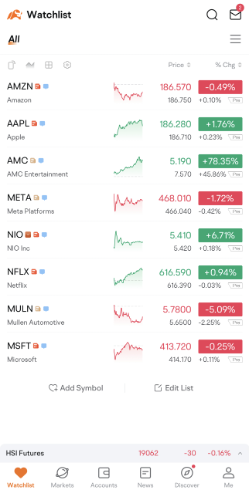
Step 1: Navigate to your Watchlist, then select a stock's "Detailed Quotes" page.
Images provided are not current and any securities are shown for illustrative purposes only and is not a recommendation.
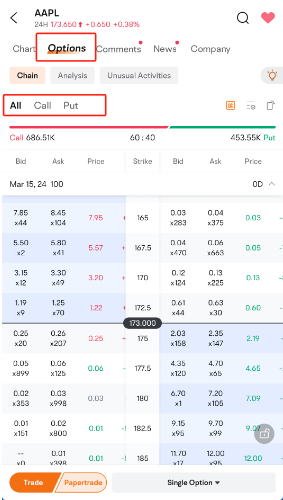
Step 2: Navigate to Options> Chain located at the top of the page.
Step 3: By default, all options with a specific expiration date are shown. For selective viewing of calls or puts, simply tap "Call/Put."
Images provided are not current and any securities are shown for illustrative purposes only and is not a recommendation.
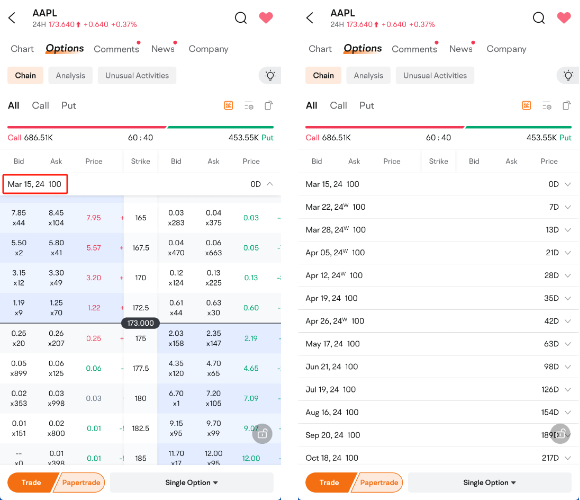
Step 4: Adjust the expiration date by choosing your preferred date from the menu.
Images provided are not current and any securities are shown for illustrative purposes only and is not a recommendation.
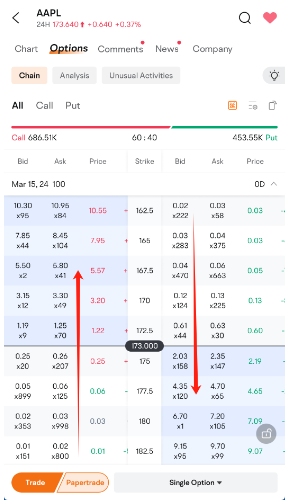
Step 5: Easily distinguish between options: white denotes out-of-the-money, and blue indicates in-the-money. Swipe horizontally to access additional option details.
Images provided are not current and any securities are shown for illustrative purposes only and is not a recommendation.
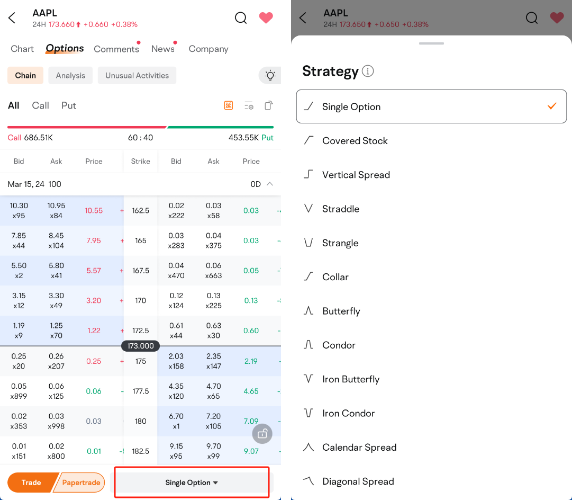
Step 6: Explore various trading strategies at the screen's bottom, offering flexibility for your investment approach.
Images provided are not current and any securities are shown for illustrative purposes only and is not a recommendation.
Leverage: Options allow you to control a larger position with less capital than buying the underlying asset outright, offering the potential for amplified returns.
Defined risk: When purchasing options, your theoretical maximum loss is limited to the premium you paid for the contract, providing a known and manageable downside.
Flexibility: Options can be used for a variety of strategies, including speculation on price movement, hedging against existing positions, or generating income through covered calls or other strategies.
Expiration risk: If the underlying asset doesn’t move as anticipated by the expiration date, the option may expire worthless, causing you to lose the premium paid. Leverage can also magnify losses, meaning that even small unfavorable movements in the asset's price can lead to significant losses relative to the initial investment.
Complexity: Options involve numerous variables such as strike prices and expirations, making them more complex than traditional stock investing.
Limited time: Since options have set expiration dates, investors face time pressure to achieve their desired outcomes, unlike stocks which can be held indefinitely.
Risk of early assignment (for sold calls): If you sell a call option, you may face early assignment, where the buyer exercises the option before its expiration. This typically happens if the underlying stock's price rises significantly or approaches the strike price, forcing you to deliver the stock or close the position at potentially unfavorable terms.
Call options and put options are two basic types of options contracts used in trading. A call option gives the holder the right, but not the obligation, to buy an underlying asset at a predetermined price before the contract expires. Investors typically buy calls when they expect the asset’s price to rise.
A put option, on the other hand, grants the holder the right to sell an underlying asset at a set price within a specific timeframe. Some traders purchase puts when they anticipate a decline in the asset’s price.
You can make money on a call option if the stock’s price rises above the strike price by more than the premium you paid, allowing you to sell the option for a profit or exercise it to buy the stock at a discount.
Call options offer leverage and lower upfront costs, but they expire, which adds time risk. Stocks, on the other hand, don’t expire and can be held indefinitely. It depends on your level of experience, goals, and risk tolerance.
Options generally allow traders to gain exposure to a stock’s price movement with less capital than buying the stock outright. They also provide flexible strategies for speculation, income, and hedging.
Your potential profit on buying a call option varies throughout the life of the option, not just at expiration. It depends on how much the stock price exceeds the strike price, minus the premium paid. As the stock price rises, the value of your option can increase, giving you the choice to sell it before expiration for a profit.
For selling a call option, your potential profit is the premium received, but if the stock price rises beyond the strike price, any gain is reduced by the cost to buy back the option or the loss from the stock price exceeding the strike price. You can close the position before expiration to manage profit or limit potential losses. You can also choose to maintain your short call position through expiration but risk assignment.
This presentation is for informational and educational use only and is not a recommendation or endorsement of any particular investment or investment strategy. Investment information provided in this content is general in nature, strictly for illustrative purposes, and may not be appropriate for all investors. Read more
Recommend
Moomoo Offers Extended Trading Hours for Options Trading on Oct 19
At-the-Money (ATM) - How It Works in Options Trading
Out-of-the-Money in Options Trading - How It Works & Examples

Covered Call: A Comprehensive Guide to Options Trading
Strangle Options Strategy - A Helpful Guide for Traders
Straddle vs. Strangle: Understanding the Key Differences
Triple Witching: Understanding Its Impact on the Stock Market
Underlying Asset: Definition, Types and Examples
What Are Option Premiums
Covered Calls and Covered Puts - Strategies for Options Trading
Expiration Date in Options Trading
Options Break-Even Point: Definition, Formula, and Examples
Credit Spread: Definition, Examples & How to Calculate
Bull Put Spread: Definitions, How It Works & Examples
How to Manage Your Risk in Options Trading
How to Pick the 'Right' Strike Price
Options Wheel Strategy Explained: Definition and How to Trade
Long Collar Options Strategy: Definition, How It Works & Examples
Long Call Options Strategy: Definition, Potential Benefits, and Risks
Exercise of Options: When and How to Exercise Options
Time Value: Definition, Calculation, Importance in Options Trading
Short Call Options Strategy: Guide & Examples
What Are Bitcoin ETF Options: Investment Insights & Strategies
Hedge with Options: Protect Your Portfolio in 2026
Options Chains: Definition, How to Read and Analyze Them
Options Profit Calculation: Overview, Formula & Examples
What is Theta in Options Trading: Overview and Strategies
Debit Spread: Definition, Types & Examples
Butterfly Spread: Definition and Application in Options Trading
What Is an Options Screener and How to Use?
Unusual Options Activity: Insights and Strategies for Traders
Protective Put Strategy: Definition, How It Works & Examples
What Are Stock Options: Types, How They Work and Examples
Weekly vs. Monthly Options: Choosing the Right Expiration Date
How to Practice Options Trading with Demo Trading Account
Sell to Open vs Sell to Close: Understanding the Difference
Long Put: Definition, Examples and How to Trade
Iron Condor: Understanding This Options Trading Strategy
Diagonal Spread: Definition, Types & How to Use
Implied Volatility (IV) Rank & Percentile in Options Trading
Trading Earnings with Options
Iron Butterfly: Mastering the Options Trading Strategy
Interest Rate Options: Definition & How They Work
Options Buy to Open vs Buy to Close: What's the difference?
Vertical Spread: Definition, Types, & Examples
Bear Put Spread: An Options Trading Strategy Explained
What is a Dividend Reinvestment Plan (DRIP)?
Put/Call Ratio (PCR): Definition & How to Use
How Are Options Priced? | Calculation and Examples
Naked Calls Options Strategy: Definition & How It Works
Options Vs. Futures: Understanding Their Key Differences
Extrinsic Value: Definition, Calculation, and Trading Strategies
Intrinsic Value: How It Works And How To Calculate It
Bull Call Spread - Examples and Applications in Options Trading
Index Options: Definitions, Strategies and Risks
Short Put Options: Strategies and Risks Explained
Quadruple Witching: How It Can Affect the Stock Market
What Are Options? Everything You Need to Know before Trading
Four Option Trading Strategies for Beginners
10 Options Strategies to Enhance Your Trading Portfolio
American Options vs. European Options
In-The-Money (ITM): Call and Put Options Examples
What is a Calendar Spread?
Open Interest: What it means for traders and investors
Options vs Stocks: Choosing the Right Investment Strategy
Options Strike Prices Explained: A Complete Guide for Beginners
Call vs Put Options: Your Essential Guide to the Basics
Zero Days to Expiration (0DTE) Options: Trade Mag 7 Stock Options Today
What Is An Options Contract? How Does It Work?
What is Synthetic Put? (How Does It Work)
How and When to Roll Covered Calls
Option Volume vs Open Interest: Understanding the Difference
4 Options Trading Levels
How to Trade Options for Beginners?
What Is Implied Volatility (IV)?
What Are Cash Secured Puts: How To Sell Them
What Is a Straddle Options Strategy?
What Is Ratio Spread in Options
What is a Call Option: Strategies and Tips
Taxes on Stocks: How Selling Stocks Affects Your Taxes
Option Greeks Explained - Option Greek Cheat Sheet
Put Options: Hedging Your Portfolio
Put Options: How to Use Them in Your Trading Strategy
Poor Man's Covered Call (PMCC): A Beginner's Guide
Four Option Trading Mistakes to Avoid
Trading Synthetic Options: Risks and Rewards
Call Spread vs. Put Spread: What are the differences?
What is stock options trading
What Is Margin Call and How Can You Avoid the Risks?
Options Trading Strategies: Iron Condor vs. Iron Butterfly
Moomoo Offers Extended Trading Hours for Options Trading on Oct 19
At-the-Money (ATM) - How It Works in Options Trading
Out-of-the-Money in Options Trading - How It Works & Examples
Covered Call: A Comprehensive Guide to Options Trading
Strangle Options Strategy - A Helpful Guide for Traders
Straddle vs. Strangle: Understanding the Key Differences
Triple Witching: Understanding Its Impact on the Stock Market
Underlying Asset: Definition, Types and Examples
What Are Option Premiums
Covered Calls and Covered Puts - Strategies for Options Trading
Expiration Date in Options Trading
Options Break-Even Point: Definition, Formula, and Examples
Credit Spread: Definition, Examples & How to Calculate
Bull Put Spread: Definitions, How It Works & Examples
How to Manage Your Risk in Options Trading
How to Pick the 'Right' Strike Price
Options Wheel Strategy Explained: Definition and How to Trade
Long Collar Options Strategy: Definition, How It Works & Examples
Long Call Options Strategy: Definition, Potential Benefits, and Risks
Exercise of Options: When and How to Exercise Options
Time Value: Definition, Calculation, Importance in Options Trading
Short Call Options Strategy: Guide & Examples
What Are Bitcoin ETF Options: Investment Insights & Strategies
Hedge with Options: Protect Your Portfolio in 2026
Options Chains: Definition, How to Read and Analyze Them
Options Profit Calculation: Overview, Formula & Examples
What is Theta in Options Trading: Overview and Strategies
Debit Spread: Definition, Types & Examples
Butterfly Spread: Definition and Application in Options Trading
What Is an Options Screener and How to Use?
Unusual Options Activity: Insights and Strategies for Traders
Protective Put Strategy: Definition, How It Works & Examples
What Are Stock Options: Types, How They Work and Examples
Weekly vs. Monthly Options: Choosing the Right Expiration Date
How to Practice Options Trading with Demo Trading Account
Sell to Open vs Sell to Close: Understanding the Difference
Long Put: Definition, Examples and How to Trade
Iron Condor: Understanding This Options Trading Strategy
Diagonal Spread: Definition, Types & How to Use
Implied Volatility (IV) Rank & Percentile in Options Trading
Trading Earnings with Options
Iron Butterfly: Mastering the Options Trading Strategy
Interest Rate Options: Definition & How They Work
Options Buy to Open vs Buy to Close: What's the difference?
Vertical Spread: Definition, Types, & Examples
Bear Put Spread: An Options Trading Strategy Explained
What is a Dividend Reinvestment Plan (DRIP)?
Put/Call Ratio (PCR): Definition & How to Use
How Are Options Priced? | Calculation and Examples
Naked Calls Options Strategy: Definition & How It Works
Options Vs. Futures: Understanding Their Key Differences
Extrinsic Value: Definition, Calculation, and Trading Strategies
Intrinsic Value: How It Works And How To Calculate It
Bull Call Spread - Examples and Applications in Options Trading
Index Options: Definitions, Strategies and Risks
Short Put Options: Strategies and Risks Explained
Quadruple Witching: How It Can Affect the Stock Market
What Are Options? Everything You Need to Know before Trading
Four Option Trading Strategies for Beginners
10 Options Strategies to Enhance Your Trading Portfolio
American Options vs. European Options
In-The-Money (ITM): Call and Put Options Examples
What is a Calendar Spread?
Open Interest: What it means for traders and investors
Options vs Stocks: Choosing the Right Investment Strategy
Options Strike Prices Explained: A Complete Guide for Beginners
Call vs Put Options: Your Essential Guide to the Basics
Zero Days to Expiration (0DTE) Options: Trade Mag 7 Stock Options Today
What Is An Options Contract? How Does It Work?
What is Synthetic Put? (How Does It Work)
How and When to Roll Covered Calls
Option Volume vs Open Interest: Understanding the Difference
4 Options Trading Levels
How to Trade Options for Beginners?
What Is Implied Volatility (IV)?
What Are Cash Secured Puts: How To Sell Them
What Is a Straddle Options Strategy?
What Is Ratio Spread in Options
What is a Call Option: Strategies and Tips
Taxes on Stocks: How Selling Stocks Affects Your Taxes
Option Greeks Explained - Option Greek Cheat Sheet
Put Options: Hedging Your Portfolio
Put Options: How to Use Them in Your Trading Strategy
Poor Man's Covered Call (PMCC): A Beginner's Guide
Four Option Trading Mistakes to Avoid
Trading Synthetic Options: Risks and Rewards
Call Spread vs. Put Spread: What are the differences?
What is stock options trading
What Is Margin Call and How Can You Avoid the Risks?
Options Trading Strategies: Iron Condor vs. Iron Butterfly

