


Moomoo Insights
Jul 16 15:38
TSMC Earnings: AI Demand Is Stronger Than the Chip Selloff Suggests
Moomoo Insights
Sep 30 05:04
Live Take | Anthropic’s $518B Compute Bet: Who Wins From the AI Buildout?
Options trading offers various strategies for investors that can help manage risk and potentially generate returns. One such strategy is the covered call, which involves selling call options while simultaneously holding an equivalent position in the underlying asset. This guide explores the covered call strategy in detail, including its mechanics, advantages, risks, and when to use or avoid it.
A covered call is an options trading strategy that involves two main components: owning the underlying asset and selling call options against it. This strategy provides investors with an opportunity to generate income through the premiums received from selling the call options. By holding the underlying asset, investors have coverage in case the option is assigned.

Beyond maximum profit and loss, it's crucial to calculate the break-even point. Many investors assume any price movement in their favor will be profitable, only to see gains eroded by high premium costs. Without precise profit calculations, you can't optimize your entry or fully assess the risk-reward ratio. Moomoo’s Options Analysis feature brings clarity to every trade. For any strategy, the system instantly calculates the exact break-even point, maximum potential loss, maximum potential profit, and even the theoretical probability of profit. By clicking any contract in the options chain, the analysis interface shows you precisely where you start making money, allowing you to adjust your strategy for better capital efficiency if the break-even point seems too distant. Register for a free account on Moomoo today to use our Options Analysis features and trade with a clear understanding of your bottom line.
The covered call strategy can potentially provide benefits for investors. Investors can generate additional income through the premiums received from selling call options. This also offers a way to potentially profit from a neutral or slightly bullish market.
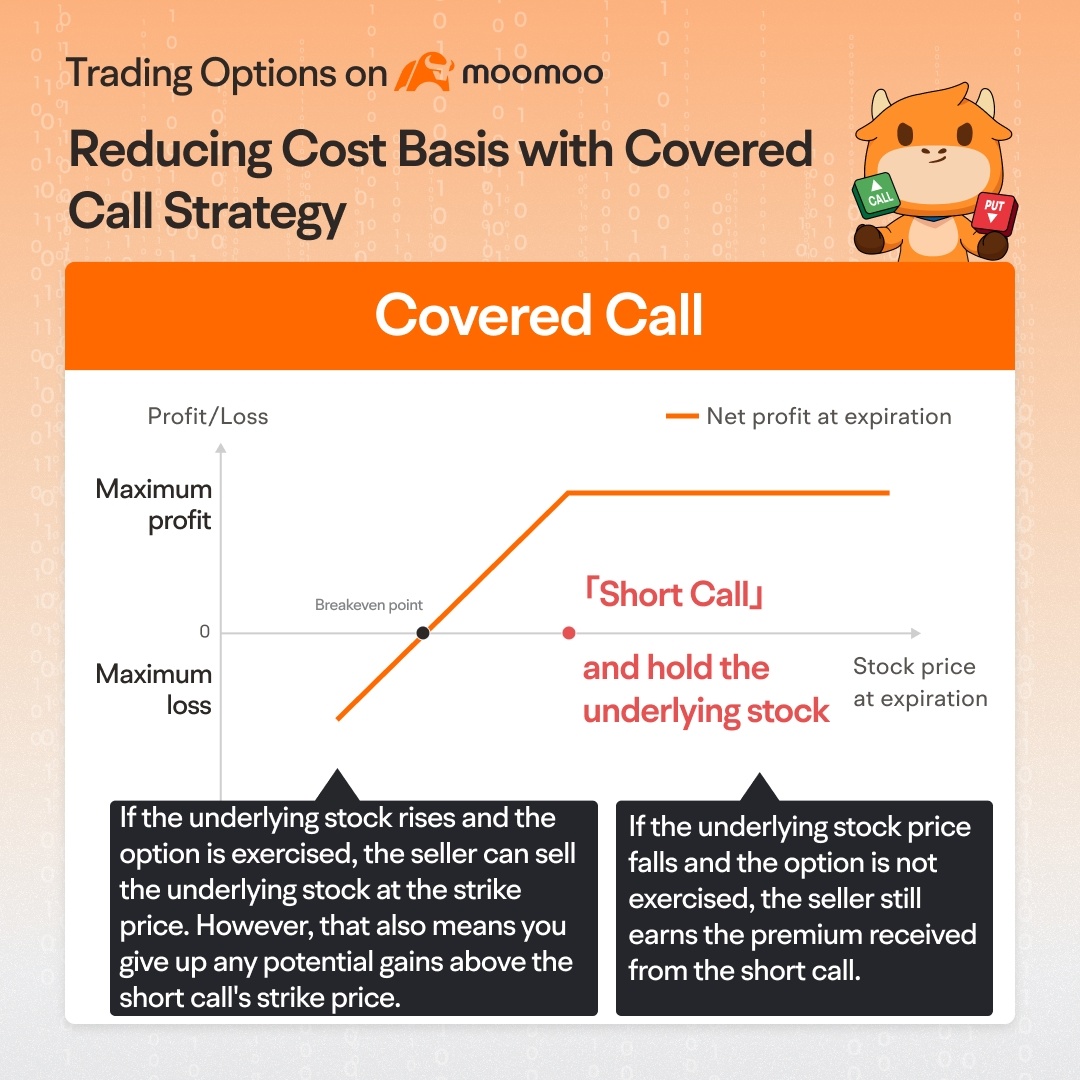
Maximum profit is achieved when the stock price remains below the call option's strike price at expiration. It is calculated as the difference between the strike price and the stock purchase price plus the premium received from selling the call option.
The maximum profit of a covered call is limited to the sum of the premium received from the sold call option and the gain from the stock's price rise up to the strike price of the call option.
For example
If an investor sells one call option with a strike price of $55 for a premium of $2 per share on 100 shares of a stock initially purchased at $50 per share. If the underlying stock rises to $55 at expiration, the maximum profit would be:
Maximum Profit = (Strike Price - Current Stock Price) + Premium Received x 100 shares
Maximum Profit = ($55 - $50) + ($2 x 100)
Maximum Profit = $500 ($5 X100 shares owned) + $200
Maximum Profit = $700
Maximum loss can be significant and occur if the stock price drops to zero. However, since the investor already owns the underlying shares, their loss is somewhat cushioned by the premium received from selling the call option. The maximum loss is slightly reduced by the amount of premium received.
For example, if the stock price decreases to zero, the maximum loss would be limited to the purchase price of the stock minus the premium received from selling the call option.
Suppose an investor owns 200 shares of a company trading at $45 per share. They decide to sell one call option with a strike price of $50 for a premium of $3 per share. Here's a few scenarios.
If the price of XYZ drops below the initial $45 cost basis, the call options expires worthless; however, the investor's $3 premium from selling the call ($300 for one option contract) offsets some of the stock's decrease in the stock's market value.
If the price of XYZ remains below $50 at expiration, the investor keeps the premium as a profit.
If the price rises above $50, the investor may have to sell their shares at $50 but still keep the premium. However, as an option writer, they cannot participate in any price growth above the strike price, so their upside is capped by the option.
Covered calls can be appropriate when investors aim to generate extra income from their stocks while managing some downside risk. This strategy tends to do well in stable or slightly bullish markets with low volatility, near resistance levels, or when seeking additional portfolio income and diversification. By understanding these opportune moments, investors may be able to effectively implement covered call strategies to potentially enhance their investment returns.
Many savvy investors are turning to the "seller" side to earn premiums, but without precise calculations, selling options can feel like high-risk gambling. A tool that quickly filters for safe and lucrative contracts allows you to lock in steady returns and profit scientifically. The Options Seller Dashboard on Moomoo is a powerful strategy screener that displays Cash-Secured Put and Covered Call opportunities across the market. It also supports custom filtering based on your risk appetite. For instance, you could screen for ETFs with an IV Rank below 30% to control risk, require premiums above $100, and sort by probability of profit. This helps you focus on contracts with a high probability of profit that align with a low-volatility, high-win-rate strategy. Stop selling blindly and download the Moomoo app to discover the highest quality selling opportunities while clearly managing the risk and reward of every premium earned.
When utilizing covered calls, consider the following for strike price selection:
Conservative Approach: Opt for out-of-the-money strike prices to help minimize assignment risk and maintain stock ownership.
Balanced Strategy: Choose close to at-the-money strike prices to align with an investor's market outlook while increasing the likelihood of the option being assigned. However, selecting an out-of-the-money strike price (a drawback is lower premiums) will help lower the chance of assignment, which can allow the investor to keep the premium as income.
Aggressive Strategy: Explore in-the-money options for higher premiums and limited downside protection, but be prepared for potential stock assignment.
Risk-Reward Assessment: Evaluate market conditions, volatility, and investment goals to optimize strike price selection in an attempt to maximize risk-adjusted returns.
For a step-by-step guide to trading option on Moomoo, see here:
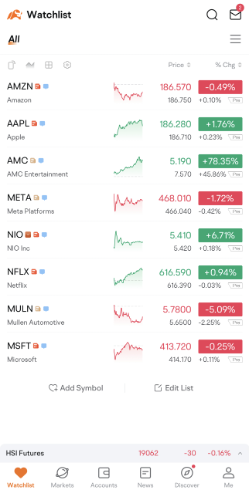
Step 1: Navigate to your Watchlist, then select a stock's "Detailed Quotes" page.
Disclaimer: Images provided are not current and any securities are shown for illustrative purposes only and is not a recommendation.
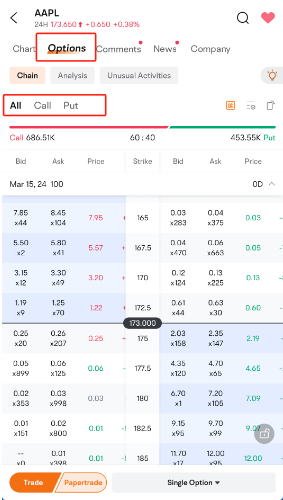
Step 2: Navigate to Options> Chain located at the top of the page.
Step 3: By default, all options with a specific expiration date are shown. For selective viewing of calls or puts, simply tap "Call/Put."
Disclaimer: Images provided are not current and any securities are shown for illustrative purposes only and is not a recommendation.
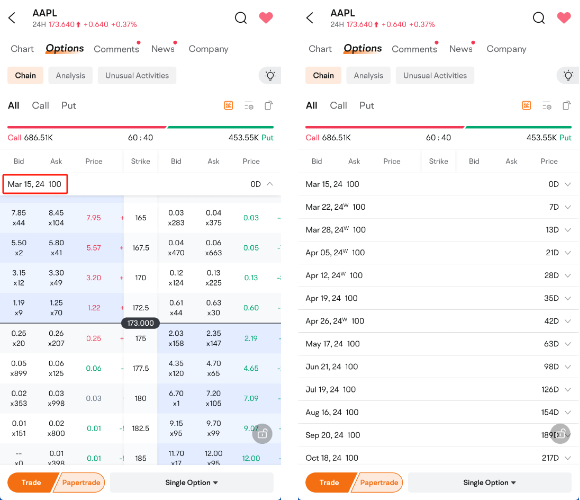
Step 4: Adjust the expiration date by choosing your preferred date from the menu.
Disclaimer: Images provided are not current and any securities are shown for illustrative purposes only and is not a recommendation.
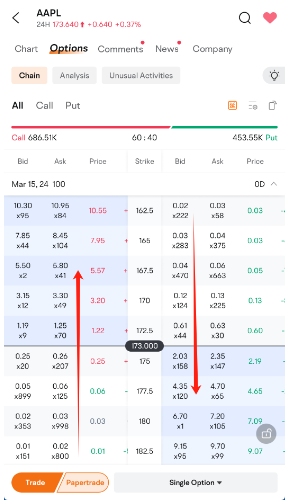
Step 5: Easily distinguish between options: white denotes out-of-the-money, and blue indicates in-the-money. Swipe horizontally to access additional option details.
Disclaimer: Images provided are not current and any securities are shown for illustrative purposes only and is not a recommendation.
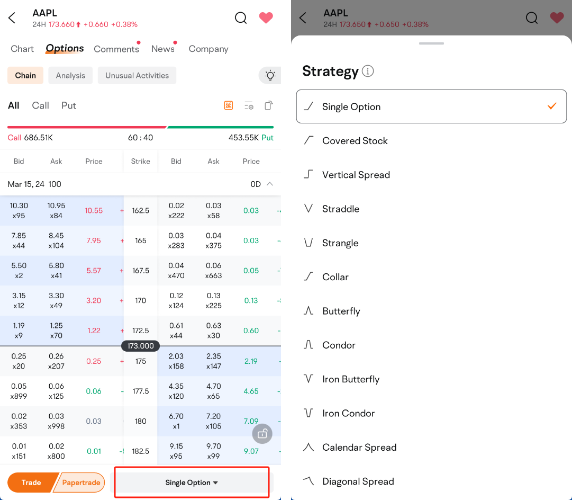
Step 6: Explore various trading strategies at the screen's bottom, offering flexibility for your investment approach.
Disclaimer: Images provided are not current and any securities are shown for illustrative purposes only and is not a recommendation.
Consider avoiding covered calls in high volatility, strongly bullish markets, ahead of earnings seasons, with high growth stocks, or when prioritizing portfolio protection. These situations may lead to increased risk of assignment, missed potential gains, and limited downside protection. Instead, consider alternative strategies aligned with investment objectives and risk tolerance.
When considering market volatility, it’s crucial to look beyond the current price. Many traders overlook the impact of Implied Volatility (IV), which can lead to unexpected outcomes. For a covered call seller, high IV means receiving a larger premium, but it also signals a greater risk of the stock being called away. A tool that provides historical context for IV can help you judge if an option's premium is appropriately priced for its risk. Moomoo’s Volatility Analysis feature provides this context with IV Rank, an intuitive pricing benchmark. For sellers, a high IV Rank (e.g., above 80) indicates premiums are historically high, offering attractive income but also warning of increased volatility. A low IV Rank (e.g., below 20) suggests premiums are cheaper, which might be less appealing for generating income. Moomoo helps you see through price surfaces to understand the essence of volatility. Register for a free account today to use our Volatility Analysis tools, accurately identify valuation traps, and ensure every trade is well-informed.
Income generation: Covered calls allow investors to potentially generate additional income from their existing stock holdings by selling call options. This income received from the premiums can supplement any dividends and help enhance portfolio returns.
Limited downside protection: By selling call options against their stock holdings, investors receive premiums that provide some cushion against potential losses if the stock price falls. This limited downside protection helps mitigate risks associated with stock ownership.
Profit potential in neutral markets: Covered calls can profit from neutral or slightly bullish market movements. Even if the stock price remains relatively unchanged, investors can still earn income from the premiums received.
Limited upside potential: If the stock price rises above the strike price of the call option, the investor may miss out on additional gains, as the stock may be called away.
Potential risk of assignment: There is a risk of assignment if the stock price rises above the strike price of the call option before expiration. In such cases, the investor may be required to sell their shares at the predetermined strike price, potentially missing out on further upside potential.
Opportunity Cost: By selling call options against their stock holdings, investors may limit their ability to participate fully in any significant upward movements in the stock price. This opportunity cost could result in missed investment opportunities.
Market Volatility: Increased market volatility can affect options premiums, impacting the effectiveness of covered calls. Higher volatility may lead to higher premiums, but it also implies greater uncertainty and potential risks for investors.
A covered call strategy is generally considered neutral to slightly bullish. It allows investors to generate income from receiving an options preimum from writing the call option. However, if the stock price rises above the strike price of the option, investors can forfeit potential stock gains.
Yes, there are risks involved with covered calls. While this strategy provides limited downside protection through the premium received, there is still the risk of potential losses if the stock price declines significantly or if the stock is called away at a price below its current market value.
Yes, it's possible to incur losses on a covered call. While the premium received provides some cushion against losses, if the stock price drops below the breakeven point (purchase price minus premium received), the investor may experience a loss. Additionally, if the stock price rises above the strike price of the call option, the investor may miss out on potential gains beyond that point.
A poor man's covered call is an alernative to the traditional covered call strategy. Instead of owning the underlying stock, the investor buys a longer-term in-the-money call option and sells near-term out-of-the-money call options against it. This strategy requires less capital but also offers higher potential returns compared to a traditional covered call.
Some drawbacks of this vs. a traditional covered call are the lack of potential dividends and time constraints as long equity positions are not constrained by an expiration date.
Covered calls can generally be appropriate in a recessionary environment, especially for investors looking to generate income from their existing stock holdings. However, it's essential to consider market conditions and potential risks carefully before implementing this strategy during a recession. Volatility may increase, affecting options premiums and potentially impacting the effectiveness of covered calls.
This presentation is for informational and educational use only and is not a recommendation or endorsement of any particular investment or investment strategy. Investment information provided in this content is general in nature, strictly for illustrative purposes, and may not be appropriate for all investors. Read more
Recommend
Moomoo Offers Extended Trading Hours for Options Trading on Oct 19
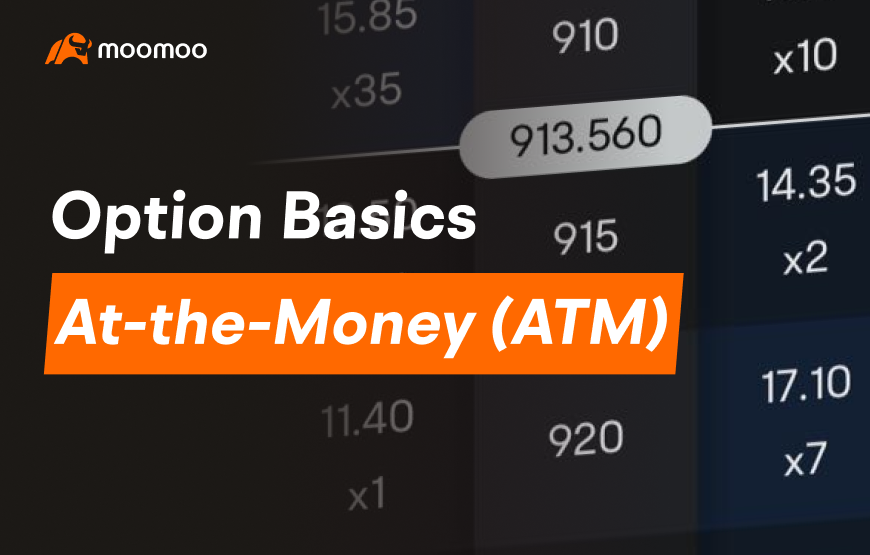
At-the-Money (ATM) - How It Works in Options Trading
Out-of-the-Money in Options Trading - How It Works & Examples

Covered Call: A Comprehensive Guide to Options Trading
Strangle Options Strategy - A Helpful Guide for Traders
Straddle vs. Strangle: Understanding the Key Differences
Triple Witching: Understanding Its Impact on the Stock Market
Underlying Asset: Definition, Types and Examples
What Are Option Premiums
Covered Calls and Covered Puts - Strategies for Options Trading
Expiration Date in Options Trading
Options Break-Even Point: Definition, Formula, and Examples
Credit Spread: Definition, Examples & How to Calculate
Bull Put Spread: Definitions, How It Works & Examples
How to Manage Your Risk in Options Trading
How to Pick the 'Right' Strike Price
Options Wheel Strategy Explained: Definition and How to Trade
Long Collar Options Strategy: Definition, How It Works & Examples
Long Call Options Strategy: Definition, Potential Benefits, and Risks
Exercise of Options: When and How to Exercise Options
Time Value: Definition, Calculation, Importance in Options Trading
Short Call Options Strategy: Guide & Examples
What Are Bitcoin ETF Options: Investment Insights & Strategies
Hedge with Options: Protect Your Portfolio in 2026
Options Chains: Definition, How to Read and Analyze Them
Options Profit Calculation: Overview, Formula & Examples
What is Theta in Options Trading: Overview and Strategies
Debit Spread: Definition, Types & Examples
Butterfly Spread: Definition and Application in Options Trading
What Is an Options Screener and How to Use?
Unusual Options Activity: Insights and Strategies for Traders
Protective Put Strategy: Definition, How It Works & Examples
What Are Stock Options: Types, How They Work and Examples
Weekly vs. Monthly Options: Choosing the Right Expiration Date
How to Practice Options Trading with Demo Trading Account
Sell to Open vs Sell to Close: Understanding the Difference
Long Put: Definition, Examples and How to Trade
Iron Condor: Understanding This Options Trading Strategy
Diagonal Spread: Definition, Types & How to Use
Implied Volatility (IV) Rank & Percentile in Options Trading
Trading Earnings with Options
Iron Butterfly: Mastering the Options Trading Strategy
Interest Rate Options: Definition & How They Work
Options Buy to Open vs Buy to Close: What's the difference?
Vertical Spread: Definition, Types, & Examples
Bear Put Spread: An Options Trading Strategy Explained
What is a Dividend Reinvestment Plan (DRIP)?
Put/Call Ratio (PCR): Definition & How to Use
How Are Options Priced? | Calculation and Examples
Naked Calls Options Strategy: Definition & How It Works
Options Vs. Futures: Understanding Their Key Differences
Extrinsic Value: Definition, Calculation, and Trading Strategies
Intrinsic Value: How It Works And How To Calculate It
Bull Call Spread - Examples and Applications in Options Trading
Index Options: Definitions, Strategies and Risks
Short Put Options: Strategies and Risks Explained
Quadruple Witching: How It Can Affect the Stock Market
What Are Options? Everything You Need to Know before Trading
Four Option Trading Strategies for Beginners
10 Options Strategies to Enhance Your Trading Portfolio
American Options vs. European Options
In-The-Money (ITM): Call and Put Options Examples
What is a Calendar Spread?
Open Interest: What it means for traders and investors
Options vs Stocks: Choosing the Right Investment Strategy
Options Strike Prices Explained: A Complete Guide for Beginners
Call vs Put Options: Your Essential Guide to the Basics
Zero Days to Expiration (0DTE) Options: Trade Mag 7 Stock Options Today
What Is An Options Contract? How Does It Work?
What is Synthetic Put? (How Does It Work)
How and When to Roll Covered Calls
Option Volume vs Open Interest: Understanding the Difference
4 Options Trading Levels
How to Trade Options for Beginners?
What Is Implied Volatility (IV)?
What Are Cash Secured Puts: How To Sell Them
What Is a Straddle Options Strategy?
What Is Ratio Spread in Options
What is a Call Option: Strategies and Tips
Taxes on Stocks: How Selling Stocks Affects Your Taxes
Option Greeks Explained - Option Greek Cheat Sheet
Put Options: Hedging Your Portfolio
Put Options: How to Use Them in Your Trading Strategy
Poor Man's Covered Call (PMCC): A Beginner's Guide
Four Option Trading Mistakes to Avoid
Trading Synthetic Options: Risks and Rewards
Call Spread vs. Put Spread: What are the differences?
What is stock options trading
What Is Margin Call and How Can You Avoid the Risks?
Options Trading Strategies: Iron Condor vs. Iron Butterfly
Moomoo Offers Extended Trading Hours for Options Trading on Oct 19
At-the-Money (ATM) - How It Works in Options Trading
Out-of-the-Money in Options Trading - How It Works & Examples
Covered Call: A Comprehensive Guide to Options Trading
Strangle Options Strategy - A Helpful Guide for Traders
Straddle vs. Strangle: Understanding the Key Differences
Triple Witching: Understanding Its Impact on the Stock Market
Underlying Asset: Definition, Types and Examples
What Are Option Premiums
Covered Calls and Covered Puts - Strategies for Options Trading
Expiration Date in Options Trading
Options Break-Even Point: Definition, Formula, and Examples
Credit Spread: Definition, Examples & How to Calculate
Bull Put Spread: Definitions, How It Works & Examples
How to Manage Your Risk in Options Trading
How to Pick the 'Right' Strike Price
Options Wheel Strategy Explained: Definition and How to Trade
Long Collar Options Strategy: Definition, How It Works & Examples
Long Call Options Strategy: Definition, Potential Benefits, and Risks
Exercise of Options: When and How to Exercise Options
Time Value: Definition, Calculation, Importance in Options Trading
Short Call Options Strategy: Guide & Examples
What Are Bitcoin ETF Options: Investment Insights & Strategies
Hedge with Options: Protect Your Portfolio in 2026
Options Chains: Definition, How to Read and Analyze Them
Options Profit Calculation: Overview, Formula & Examples
What is Theta in Options Trading: Overview and Strategies
Debit Spread: Definition, Types & Examples
Butterfly Spread: Definition and Application in Options Trading
What Is an Options Screener and How to Use?
Unusual Options Activity: Insights and Strategies for Traders
Protective Put Strategy: Definition, How It Works & Examples
What Are Stock Options: Types, How They Work and Examples
Weekly vs. Monthly Options: Choosing the Right Expiration Date
How to Practice Options Trading with Demo Trading Account
Sell to Open vs Sell to Close: Understanding the Difference
Long Put: Definition, Examples and How to Trade
Iron Condor: Understanding This Options Trading Strategy
Diagonal Spread: Definition, Types & How to Use
Implied Volatility (IV) Rank & Percentile in Options Trading
Trading Earnings with Options
Iron Butterfly: Mastering the Options Trading Strategy
Interest Rate Options: Definition & How They Work
Options Buy to Open vs Buy to Close: What's the difference?
Vertical Spread: Definition, Types, & Examples
Bear Put Spread: An Options Trading Strategy Explained
What is a Dividend Reinvestment Plan (DRIP)?
Put/Call Ratio (PCR): Definition & How to Use
How Are Options Priced? | Calculation and Examples
Naked Calls Options Strategy: Definition & How It Works
Options Vs. Futures: Understanding Their Key Differences
Extrinsic Value: Definition, Calculation, and Trading Strategies
Intrinsic Value: How It Works And How To Calculate It
Bull Call Spread - Examples and Applications in Options Trading
Index Options: Definitions, Strategies and Risks
Short Put Options: Strategies and Risks Explained
Quadruple Witching: How It Can Affect the Stock Market
What Are Options? Everything You Need to Know before Trading
Four Option Trading Strategies for Beginners
10 Options Strategies to Enhance Your Trading Portfolio
American Options vs. European Options
In-The-Money (ITM): Call and Put Options Examples
What is a Calendar Spread?
Open Interest: What it means for traders and investors
Options vs Stocks: Choosing the Right Investment Strategy
Options Strike Prices Explained: A Complete Guide for Beginners
Call vs Put Options: Your Essential Guide to the Basics
Zero Days to Expiration (0DTE) Options: Trade Mag 7 Stock Options Today
What Is An Options Contract? How Does It Work?
What is Synthetic Put? (How Does It Work)
How and When to Roll Covered Calls
Option Volume vs Open Interest: Understanding the Difference
4 Options Trading Levels
How to Trade Options for Beginners?
What Is Implied Volatility (IV)?
What Are Cash Secured Puts: How To Sell Them
What Is a Straddle Options Strategy?
What Is Ratio Spread in Options
What is a Call Option: Strategies and Tips
Taxes on Stocks: How Selling Stocks Affects Your Taxes
Option Greeks Explained - Option Greek Cheat Sheet
Put Options: Hedging Your Portfolio
Put Options: How to Use Them in Your Trading Strategy
Poor Man's Covered Call (PMCC): A Beginner's Guide
Four Option Trading Mistakes to Avoid
Trading Synthetic Options: Risks and Rewards
Call Spread vs. Put Spread: What are the differences?
What is stock options trading
What Is Margin Call and How Can You Avoid the Risks?
Options Trading Strategies: Iron Condor vs. Iron Butterfly

