

Moomoo Insights
Jul 16 15:38
TSMC Earnings: AI Demand Is Stronger Than the Chip Selloff Suggests
Moomoo Insights
Sep 30 05:04
Live Take | Anthropic’s $518B Compute Bet: Who Wins From the AI Buildout?
Many people put off beginning their options investing journey because they simply never learned how to trade or are scared to risk their hard-earned cash.
Due to its inherent complexities and the specialized knowledge required to navigate it successfully, options trading was once a type of investing only carried out by financial professionals and market makers. However, advancements in technology and the rise of online trading platforms have democratized access to options trading. Now everyday individuals can learn the ropes and develop their trading skills through user-friendly tools and resources.
One of those tools? Paper trading. Read on to learn more.
Paper trading involves trading or investing in a simulated environment that mimics the stock market using virtual money. In other words, you are not risking any of your own capital (think of it as 'pretend paper money'). Despite not using your own cash, you are still gaining exposure to the realities of the stock market's daily movements and how they can impact your investments.
Depending on which paper trading platform you use, you may be able to gain exposure to the 'fees' that are associated with investing. Fees can sometimes catch new investors off-guard, and failing to factor in the fees associated with your trading can see you lose more money than you had first thought. Paper trading platforms that include fees (i.e. fees that will be subtracted from your virtual funds), such as moomoo, can be a helpful way for investors to get used to this important part of trading.
While practicing with simulated fees is helpful, the real cost of each trade is a major concern for options investors. On many platforms, every buy or sell order comes with commissions and contract fees. These costs can gradually eat away at profits, even from a series of successful trades, which can be particularly challenging for those with smaller accounts or traders who frequently adjust their positions. To help ease this cost pressure, Moomoo offers $0 commission and $0 contract fees for U.S. stock options trading. This means you can more flexibly manage risk and potential gains by using smaller positions or taking profits in stages without worrying about extra charges on each transaction. After downloading moomoo, you can try applying your options ideas in an environment with lower trading costs and see how it impacts your overall results.
When learning a new skill, practical experience can be invaluable. Think about learning to drive a car — you can study for months but at some point, gaining hands-on experience is the only way you are likely to improve! The same can be said for trading. There are plenty of how-to guides available for traders and investors but without physcially trading or investing, it's hard to improve your skillset or build your confidence.
Paper trading is also a great resource for mid-level and experienced options traders wanting to test out unfamiliar products and new strategies and see how their virtual investments respond to the financial market. By engaging in paper trading, the risk is removed from the situation because there is no real money being traded. It can be an effective way for traders to build confidence in new trading techniques and asset classes. If you later choose to invest real money in the stock market, you'll hopefully be able to do so with a more comprehensive understanding of how market movement will impact your positions.
The 'realism' element of paper trading will depend upon which platform you use. For the sake of this article, we will compare moomoo's paper trading to moomoo's live trading functionality. Your paper trading platform of choice may differ in terms of functionality.
The moomoo paper trading tool is helpful as it mimics the real-time market conditions closely. It allows users to experience trading without the risk of losing actual money. This realism helps in developing effective trading strategies and building confidence.
However, while paper trading offers many benefits, it does have some limitations. The most significant is the lack of real emotional engagement. When actual money is not on the line, traders might take risks they wouldn’t normally consider, which can create a false sense of security.
Live trading on moomoo involves real money and, therefore, real emotional stakes. This adds a layer of pressure and helps traders develop discipline and risk management skills. The live market can be unpredictable, and the stakes are higher, making it crucial for traders to remain calm and make well-informed decisions.
Some traders believe in combining both paper trading and real trading as a way of gaining a comprehensive trading education, preparing them for the realities of the market.
Each platform's paper trading tool will vary in layout and design. A great way to prepare yourself for trading with real money is to use a paper trading tool that closely replicates your trading platform of choice.
On moomoo, the options paper trading platform is designed to look like 'the real thing' which means that once you graduate from paper trading, taking your first steps should be less daunting.
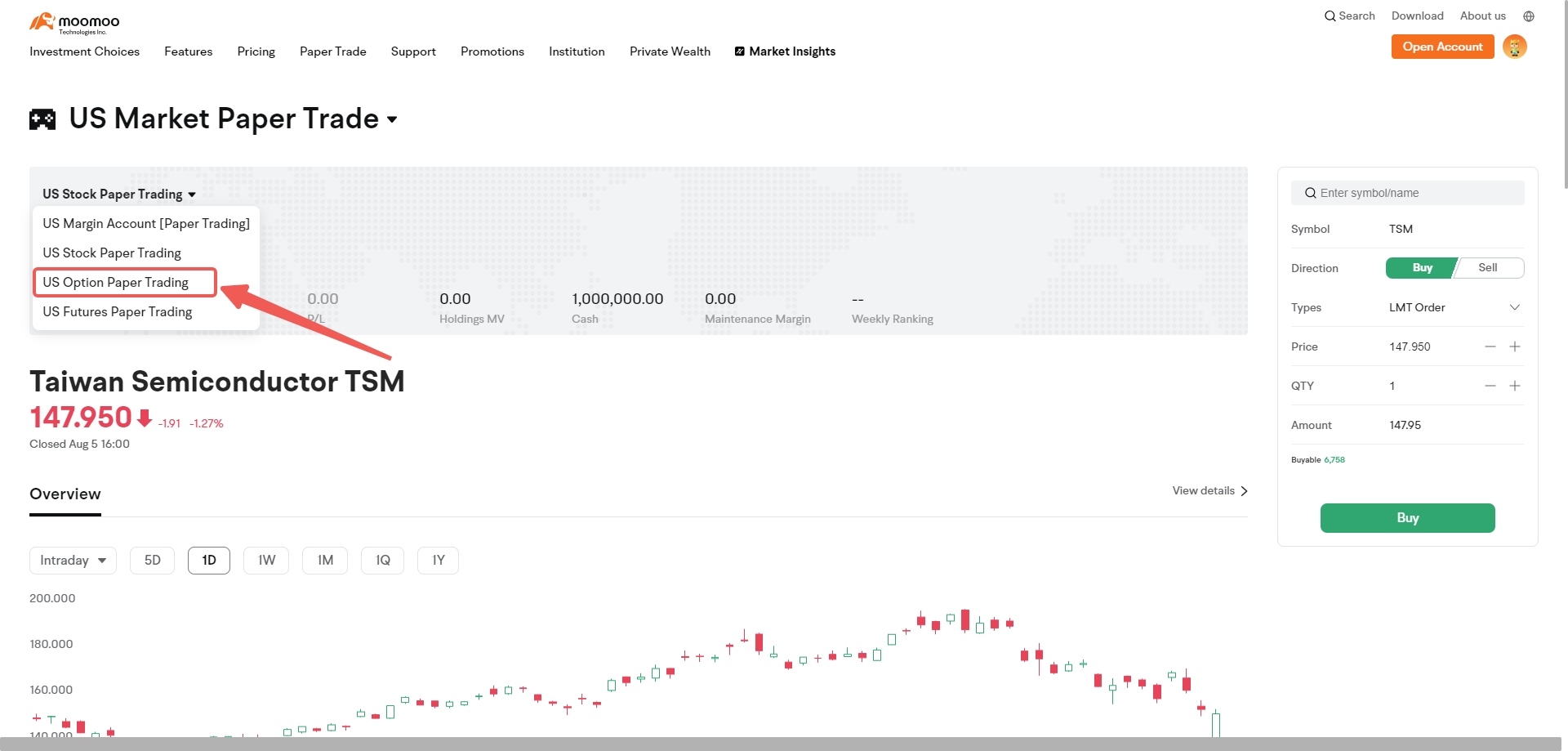
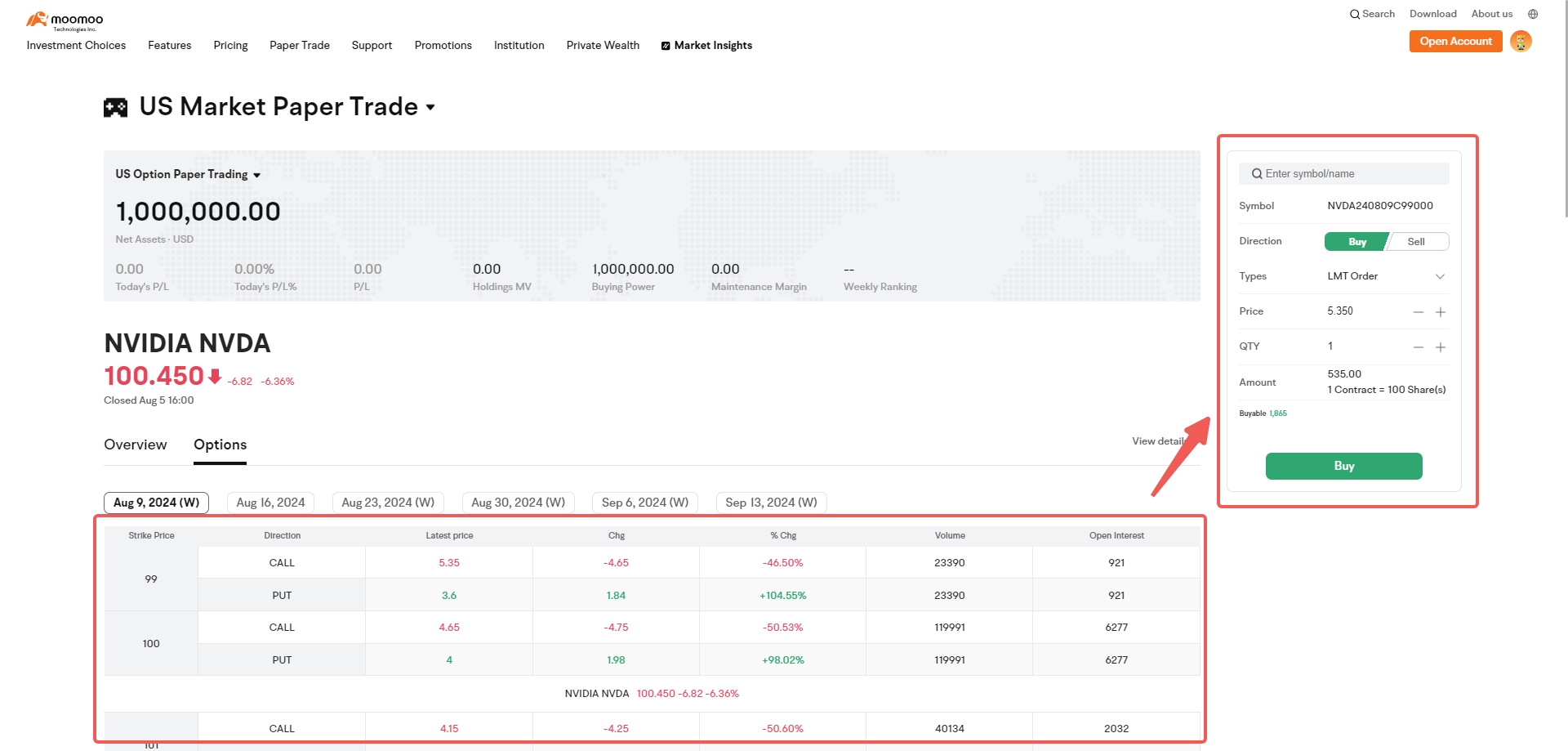
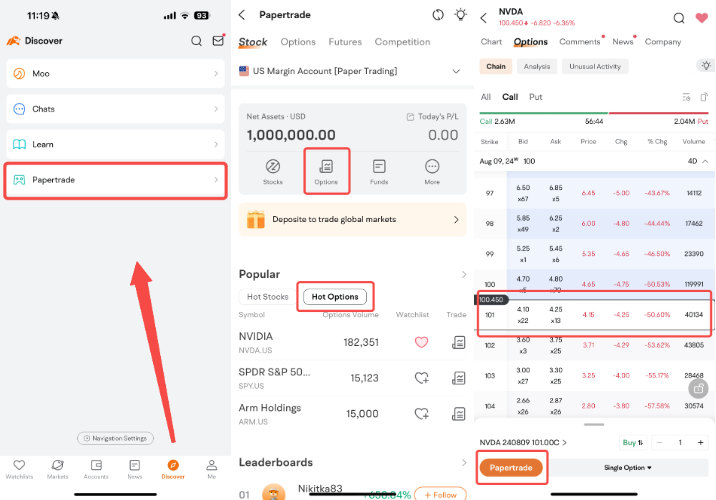
To practice options paper trading on moomoo, open the platform on your desktop, web browser, or phone and navigate to the 'Paper Trade' section> select 'Options' > 'US Options Paper Trading'.
On web browser
Images provided are not current and any securities are shown for illustrative purposes only and are not recommendations.
On moomoo app
Images provided are not current and any securities are shown for illustrative purposes only and are not recommendations.
Once you have decided on a specific option to virtually trade, you will then need to establish your order position by submitting an order for execution.
Enter the underlying symbol
Decide on order type (market order or limit order)
Decide on your strike price
Decide on the number of contracts you want to purchase or sell
Once your simulated order is submitted (note: no real order is actually placed), you will be routed to the market.
Deciding on the right strike price and contract can be difficult, especially when faced with what looks like a long, confusing spreadsheet of options. This can slow down decision-making when you're trying to act on market movements. The moomoo options chain helps simplify this process by displaying key data in a clear, intuitive layout. With a single click, you can view a profit-and-loss analysis for any contract, helping you visualize potential gains or losses under different price scenarios. On Moomoo, you can also filter contracts by expiration date or group them by strategy to quickly compare potential outcomes and select a contract that fits your risk tolerance. Open the moomoo app to explore the options chain and see how it can help you turn complex data into a clearer options plan.
Below are a few option trading strategies — using stocks as the underlying asset — to get to know.
A long call gives the holder the right to buy a stock at a set strike price before expiration. Your theoretical maximum loss is the premium paid, and the option can expire worthless if the stock doesn’t rise above the strike price plus the premium. Profit occurs if the stock price exceeds this level by expiration.
This strategy combines holding a stock with selling a call option on it. You receive a premium but cap your potential profit at the strike price plus the premium. You face losses if the stock price falls below the stock purchase price minus the premium.
Buying a put gives you the right to sell a stock at a set strike price. You lose the premium paid if the stock doesn’t fall below the strike price minus the premium. Profit occurs if the stock price drops below this level at expiration.
Selling a put option earns you a premium. Losses can occur if the stock falls below the strike price minus the premium by expiration. With a cash-secured put, you hold enough cash to buy the stock at the stock price if assigned.
This strategy involves buying a put option while holding the underlying stock. It provides protection against stock price declines past the strike price during the life of the option, with losses limited to the premium plus any stock price drop.
A long straddle involves buying both a call and put option with the same strike price and expiration date. Your theoretical maximum loss is the total premium paid, and profit occurs with significant stock price movement in either direction.
Learn without risk: Paper trading lets traders practice options strategies without risking real money, providing a safe but realistic environment to learn and experiment.
Test strategies and gain a better understanding of the market: See how different strategies perform under different market conditions and how different market conditions affect options pricing.
Grow your confidence: Become more familiar with the trading platform of your choice and order execution processes.
Track your performance: Track and analyze your paper trades to help identify your strengths and weaknesses in your trading approach.
No real financial stakes: Paper trading lacks the emotional intensity and stress associated with real money trading, which is an essential aspect of trading psychology.
Execution differences: Paper trades often get filled at the ideal price, whereas real trades may experience slippage and partial fills, leading to different outcomes.
Market conditions are not always realistic: Some market conditions and behaviors, such as liquidity and volatility, may not be accurately replicated in options paper trading.
Overconfidence: Successful paper trading may lead to overconfidence, which can result in traders taking excessive risks when they start trading with real money.
No real gains: There is no real money involved, so you can't make a profit. Some people may find this demotivating.
Traders, investors, and investors-to-be can practice options trading on any platform or app that offers options paper trading. Moomoo offers free options paper trading for all its users, including those that have not opened a brokerage account or those who have yet to add money to their account or place a trade.
Options trading is complex in nature and learning how to trade options can take some time. You can find free educational resources online that can help you to learn how to trade options. Moomoo has options training resources available in our learning centre, including helpful how-to articles and guides. We also have information on how to trade options on moomoo specifically. After learning the theory behind options trading, options paper trading offers learners a more practical way to learn the ropes.
Options are most commonly traded by experienced traders who have a certain level of familiarity with the stock market. This is because options trading involves many different specialized strategies and a deep understanding of market dynamics. However, with proper education and practice, beginners can also learn to trade options. It's crucial for new traders to thoroughly study the basics, perhaps starting with simpler strategies, and consider paper trading to gain experience without risking real money.
You can't make a profit from paper trading because there is no real money being traded. Paper trading is done using virtual money to allow people to practice trading in a simulated environment that mimics the stock market, that doesn't allow for any real money to be traded, or therefore, lost.
There are no strict rules requiring you to do paper trading before executing a real trade, nor are there specific guidelines on how long you should practice if you choose to do so. The decision to paper trade is entirely personal, but it can be a valuable tool for minimizing mistakes that could potentially lead to financial losses.
You've likely heard the saying, "practice makes perfect." While there's no guarantee that paper trading will lead to better performance in real trading, it can help to enhance your understanding of how market movements affect your portfolio. It also offers valuable practical insights into the intricacies of trading fees and the process of executing trades.
This presentation is for informational and educational use only and is not a recommendation or endorsement of any particular investment or investment strategy. Investment information provided in this content is general in nature, strictly for illustrative purposes, and may not be appropriate for all investors. Read more
Recommend
Moomoo Offers Extended Trading Hours for Options Trading on Oct 19
At-the-Money (ATM) - How It Works in Options Trading
Out-of-the-Money in Options Trading - How It Works & Examples

Covered Call: A Comprehensive Guide to Options Trading
Strangle Options Strategy - A Helpful Guide for Traders
Straddle vs. Strangle: Understanding the Key Differences
Triple Witching: Understanding Its Impact on the Stock Market
Underlying Asset: Definition, Types and Examples
What Are Option Premiums
Covered Calls and Covered Puts - Strategies for Options Trading
Expiration Date in Options Trading
Options Break-Even Point: Definition, Formula, and Examples
Credit Spread: Definition, Examples & How to Calculate
Bull Put Spread: Definitions, How It Works & Examples
How to Manage Your Risk in Options Trading
How to Pick the 'Right' Strike Price
Options Wheel Strategy Explained: Definition and How to Trade
Long Collar Options Strategy: Definition, How It Works & Examples
Long Call Options Strategy: Definition, Potential Benefits, and Risks
Exercise of Options: When and How to Exercise Options
Time Value: Definition, Calculation, Importance in Options Trading
Short Call Options Strategy: Guide & Examples
What Are Bitcoin ETF Options: Investment Insights & Strategies
Hedge with Options: Protect Your Portfolio in 2026
Options Chains: Definition, How to Read and Analyze Them
Options Profit Calculation: Overview, Formula & Examples
What is Theta in Options Trading: Overview and Strategies
Debit Spread: Definition, Types & Examples
Butterfly Spread: Definition and Application in Options Trading
What Is an Options Screener and How to Use?
Unusual Options Activity: Insights and Strategies for Traders
Protective Put Strategy: Definition, How It Works & Examples
What Are Stock Options: Types, How They Work and Examples
Weekly vs. Monthly Options: Choosing the Right Expiration Date
How to Practice Options Trading with Demo Trading Account
Sell to Open vs Sell to Close: Understanding the Difference
Long Put: Definition, Examples and How to Trade
Iron Condor: Understanding This Options Trading Strategy
Diagonal Spread: Definition, Types & How to Use
Implied Volatility (IV) Rank & Percentile in Options Trading
Trading Earnings with Options
Iron Butterfly: Mastering the Options Trading Strategy
Interest Rate Options: Definition & How They Work
Options Buy to Open vs Buy to Close: What's the difference?
Vertical Spread: Definition, Types, & Examples
Bear Put Spread: An Options Trading Strategy Explained
What is a Dividend Reinvestment Plan (DRIP)?
Put/Call Ratio (PCR): Definition & How to Use
How Are Options Priced? | Calculation and Examples
Naked Calls Options Strategy: Definition & How It Works
Options Vs. Futures: Understanding Their Key Differences
Extrinsic Value: Definition, Calculation, and Trading Strategies
Intrinsic Value: How It Works And How To Calculate It
Bull Call Spread - Examples and Applications in Options Trading
Index Options: Definitions, Strategies and Risks
Short Put Options: Strategies and Risks Explained
Quadruple Witching: How It Can Affect the Stock Market
What Are Options? Everything You Need to Know before Trading
Four Option Trading Strategies for Beginners
10 Options Strategies to Enhance Your Trading Portfolio
American Options vs. European Options
In-The-Money (ITM): Call and Put Options Examples
What is a Calendar Spread?
Open Interest: What it means for traders and investors
Options vs Stocks: Choosing the Right Investment Strategy
Options Strike Prices Explained: A Complete Guide for Beginners
Call vs Put Options: Your Essential Guide to the Basics
Zero Days to Expiration (0DTE) Options: Trade Mag 7 Stock Options Today
What Is An Options Contract? How Does It Work?
What is Synthetic Put? (How Does It Work)
How and When to Roll Covered Calls
Option Volume vs Open Interest: Understanding the Difference
4 Options Trading Levels
How to Trade Options for Beginners?
What Is Implied Volatility (IV)?
What Are Cash Secured Puts: How To Sell Them
What Is a Straddle Options Strategy?
What Is Ratio Spread in Options
What is a Call Option: Strategies and Tips
Taxes on Stocks: How Selling Stocks Affects Your Taxes
Option Greeks Explained - Option Greek Cheat Sheet
Put Options: Hedging Your Portfolio
Put Options: How to Use Them in Your Trading Strategy
Poor Man's Covered Call (PMCC): A Beginner's Guide
Four Option Trading Mistakes to Avoid
Trading Synthetic Options: Risks and Rewards
Call Spread vs. Put Spread: What are the differences?
What is stock options trading
What Is Margin Call and How Can You Avoid the Risks?
Options Trading Strategies: Iron Condor vs. Iron Butterfly
Moomoo Offers Extended Trading Hours for Options Trading on Oct 19
At-the-Money (ATM) - How It Works in Options Trading
Out-of-the-Money in Options Trading - How It Works & Examples
Covered Call: A Comprehensive Guide to Options Trading
Strangle Options Strategy - A Helpful Guide for Traders
Straddle vs. Strangle: Understanding the Key Differences
Triple Witching: Understanding Its Impact on the Stock Market
Underlying Asset: Definition, Types and Examples
What Are Option Premiums
Covered Calls and Covered Puts - Strategies for Options Trading
Expiration Date in Options Trading
Options Break-Even Point: Definition, Formula, and Examples
Credit Spread: Definition, Examples & How to Calculate
Bull Put Spread: Definitions, How It Works & Examples
How to Manage Your Risk in Options Trading
How to Pick the 'Right' Strike Price
Options Wheel Strategy Explained: Definition and How to Trade
Long Collar Options Strategy: Definition, How It Works & Examples
Long Call Options Strategy: Definition, Potential Benefits, and Risks
Exercise of Options: When and How to Exercise Options
Time Value: Definition, Calculation, Importance in Options Trading
Short Call Options Strategy: Guide & Examples
What Are Bitcoin ETF Options: Investment Insights & Strategies
Hedge with Options: Protect Your Portfolio in 2026
Options Chains: Definition, How to Read and Analyze Them
Options Profit Calculation: Overview, Formula & Examples
What is Theta in Options Trading: Overview and Strategies
Debit Spread: Definition, Types & Examples
Butterfly Spread: Definition and Application in Options Trading
What Is an Options Screener and How to Use?
Unusual Options Activity: Insights and Strategies for Traders
Protective Put Strategy: Definition, How It Works & Examples
What Are Stock Options: Types, How They Work and Examples
Weekly vs. Monthly Options: Choosing the Right Expiration Date
How to Practice Options Trading with Demo Trading Account
Sell to Open vs Sell to Close: Understanding the Difference
Long Put: Definition, Examples and How to Trade
Iron Condor: Understanding This Options Trading Strategy
Diagonal Spread: Definition, Types & How to Use
Implied Volatility (IV) Rank & Percentile in Options Trading
Trading Earnings with Options
Iron Butterfly: Mastering the Options Trading Strategy
Interest Rate Options: Definition & How They Work
Options Buy to Open vs Buy to Close: What's the difference?
Vertical Spread: Definition, Types, & Examples
Bear Put Spread: An Options Trading Strategy Explained
What is a Dividend Reinvestment Plan (DRIP)?
Put/Call Ratio (PCR): Definition & How to Use
How Are Options Priced? | Calculation and Examples
Naked Calls Options Strategy: Definition & How It Works
Options Vs. Futures: Understanding Their Key Differences
Extrinsic Value: Definition, Calculation, and Trading Strategies
Intrinsic Value: How It Works And How To Calculate It
Bull Call Spread - Examples and Applications in Options Trading
Index Options: Definitions, Strategies and Risks
Short Put Options: Strategies and Risks Explained
Quadruple Witching: How It Can Affect the Stock Market
What Are Options? Everything You Need to Know before Trading
Four Option Trading Strategies for Beginners
10 Options Strategies to Enhance Your Trading Portfolio
American Options vs. European Options
In-The-Money (ITM): Call and Put Options Examples
What is a Calendar Spread?
Open Interest: What it means for traders and investors
Options vs Stocks: Choosing the Right Investment Strategy
Options Strike Prices Explained: A Complete Guide for Beginners
Call vs Put Options: Your Essential Guide to the Basics
Zero Days to Expiration (0DTE) Options: Trade Mag 7 Stock Options Today
What Is An Options Contract? How Does It Work?
What is Synthetic Put? (How Does It Work)
How and When to Roll Covered Calls
Option Volume vs Open Interest: Understanding the Difference
4 Options Trading Levels
How to Trade Options for Beginners?
What Is Implied Volatility (IV)?
What Are Cash Secured Puts: How To Sell Them
What Is a Straddle Options Strategy?
What Is Ratio Spread in Options
What is a Call Option: Strategies and Tips
Taxes on Stocks: How Selling Stocks Affects Your Taxes
Option Greeks Explained - Option Greek Cheat Sheet
Put Options: Hedging Your Portfolio
Put Options: How to Use Them in Your Trading Strategy
Poor Man's Covered Call (PMCC): A Beginner's Guide
Four Option Trading Mistakes to Avoid
Trading Synthetic Options: Risks and Rewards
Call Spread vs. Put Spread: What are the differences?
What is stock options trading
What Is Margin Call and How Can You Avoid the Risks?
Options Trading Strategies: Iron Condor vs. Iron Butterfly

