
Moomoo Insights
Jul 16 15:38
TSMC Earnings: AI Demand Is Stronger Than the Chip Selloff Suggests
Moomoo Insights
Sep 30 05:04
Live Take | Anthropic’s $518B Compute Bet: Who Wins From the AI Buildout?
When researching potential trades, traders and investors may pay attention to different information. In options trading, one important variable to consider is open interest. This helps traders understand the total number of outstanding options contracts that have been traded but not yet liquidated or closed by either an offsetting trade, an exercise, or assignment.
Open interest represents the number of futures or options contracts held by traders in active positions at the end of each trading day. These positions have been opened but not closed out, expired, or exercised.
It also helps track open positions in a specific contract, providing a more accurate picture of its liquidity. It can be applied to futures and options markets and it can serve as an effective indicator of the trading activity and liquidity within these markets.
Open interest increases when a new buyer and seller enter a trade, creating a new contract. On the other hand, it decreases when holders of the opposite side in a contract decide to close out their positions. If a buyer and seller transfer their ownership to new parties, open interest remains unchanged.
Open interest can both increase and decrease as buyers (holders) and sellers (writers) open and close positions. But let's dig a little deeper into some examples of when open interest can change:
When traders close out more positions than were opened on a given day, open interest decreases.
To close a position, a trader must either take an offsetting position or exercise their option.
When investors and traders open new long positions or sellers write new short positions, open interest increases.

Understanding open interest is simpler than you might think. To determine the day's open interest, you start with the previous day's open interest, add the number of newly opened contracts, and subtract the number of contracts that were closed. This provides the total number of open contracts at the end of the trading day.
Take a look at this open interest chart to see these potential open interest changes (oi change).
Date | Trading Activity | Open Interest |
May 1 | Investor A buys (to open) 1 option and Investor B sells (to open) 1 option contract | 1 |
May 2 | Investor C buys (to open) 5 options and Investor D sells (to open) 5 option contracts | 6 |
May 3 | Investor A sells (to close)1 option and Investor D buys (to close) 1 option contact | 5 |
May 4 | Investor E buys (to open) 5 options from Investor C who sells 5 (to close) options contracts | 5 |
The chart above demonstrates how straightforward calculating open interest can be. Open interest is updated daily and reflects the net increase or decrease in the number of contracts for a particular market.
Here's a quick breakdown of how open interest works and can change:
A new contract is opened by a buyer and a seller: Open interest increases by one and will expand when new long positions (buyers) or new short positions (sellers) are opened.
Both a buyer and a seller close an existing contract: Open interest decreases by one and falls when traders close out existing positions either by taking an offsetting position or exercising their option.
An existing contract's ownership transfers from one party to another: Open interest does not change.
Open interest is critical to some traders and investors for many reasons:
Liquidity: Provides insights into the liquidity of a market; higher open interest indicates more activity and liquidity, which can lead to tighter spreads between bid and ask prices and better price discovery.
Market sentiment: Changes in open interest can signal market sentiment. An increasing open interest suggests new capital is coming into the market, possibly indicating bullishness if during an uptrend.
Declining interest: Decreasing open interest may imply the market is becoming less interested or that a trend may be nearing its end.
Market direction movements: Analyzing open interest in conjunction with price changes can help traders forecast short-term movements in market direction. For example, an increase in open interest along with a price increase can be seen as supportive of the current trend, indicating that it may continue.
Open interest is also a tool for assessing the strength of a trend. Rising open interest is typically taken as a sign that the current market trend is increasing in popularity or is likely to continue because it implies more capital and interest in a market.
For instance, increased open interest tends to support the sustainability of a trend where the price of the underlying asset, such as a stock, rises. The same idea holds for downward trends. When open interest rises, and the stock price falls, open interest encourages additional price falls.
Many technical analysts think that understanding open interest can reveal important market information. For instance, if open interest slows down after a long-term price trend, either up or down, that could signify that the trend is ending.
Many investors may confuse the difference between open interest vs. volume. Here are some key differences to understand.
Volume provides insight into daily trading activity, while open interest reflects the number of active contracts currently held by traders. Both help market participants to understand market dynamics and make more informed decisions in the derivatives market.
When new contracts are opened, open interest increases; when they are closed, it decreases. Meanwhile, trading volume is a real-time measure that tracks the number of contracts traded during each trading session. It can provide insights into the level of buying and selling activity happening in the market at any given moment and it reflects a running total throughout the trading day. Open interest is updated once per day.
Traders often view volume as an indicator of the strength of a price movement. More volume can imply short-term trading liquidity, meaning there are plenty of buyers and sellers in the market. For open interest, traders view changes to gauge the liquidity of the market and anticipate price movements. It's also essential to consider whether open interest is in calls or puts and whether contracts are being bought or sold.
To explore additional differences, read this open interest vs. options volume piece.
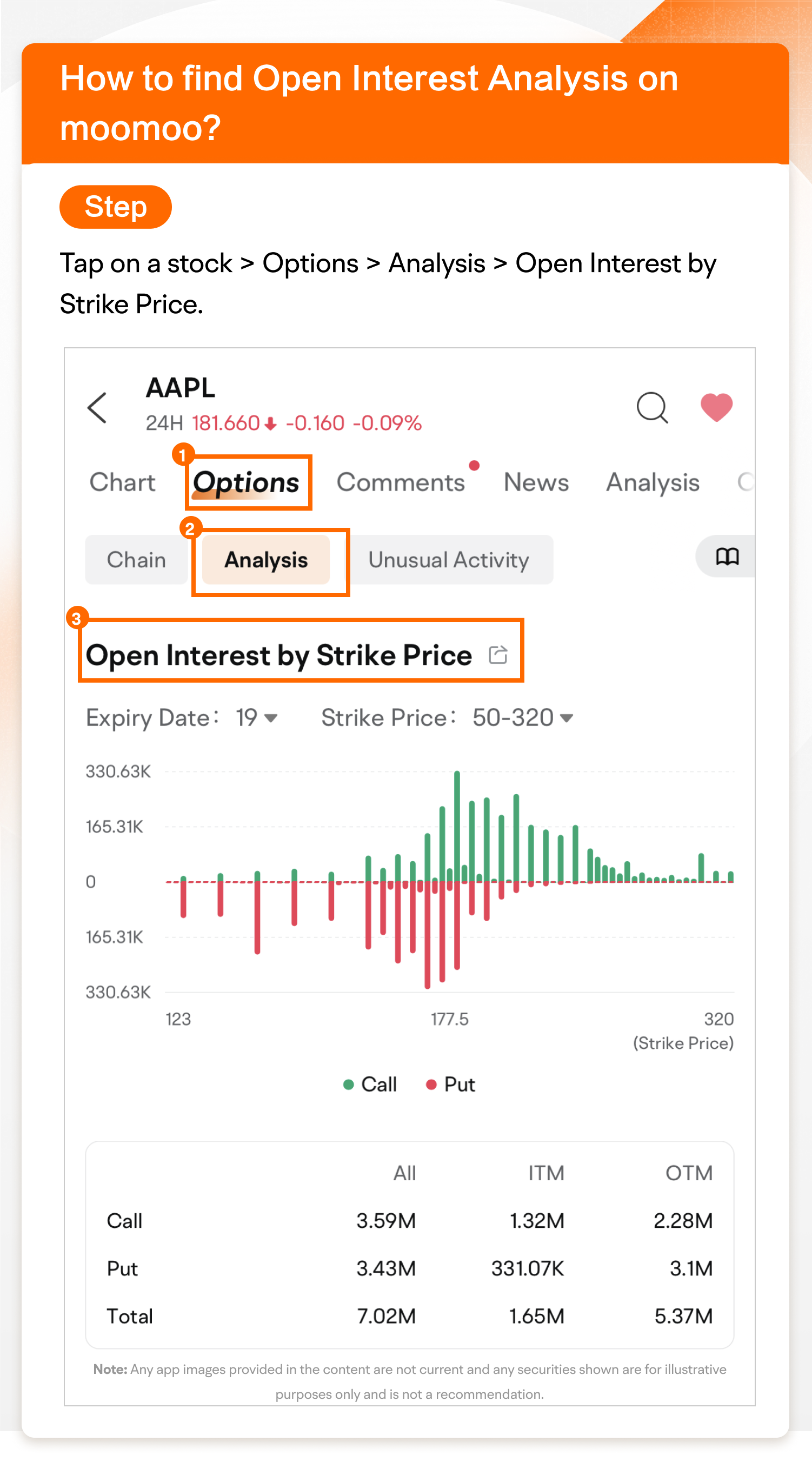
To check open interest in the moomoo app, follow these easy steps.
Step 1: Go to your watchlist and select a stock.
Step 2: Tap on the stock and select Options.
Step 3: Scroll down the page to Open Interest by Strike Price. To see different expiry dates or strike prices, tap on the downward-facing arrows for customization.
Open interest doesn't just illustrate a count of unsettled contracts — it also reflects the market's pulse. It can also help traders evaluate whether a current trend is likely to continue or if it’s losing steam, which can help traders anticipate market movements and make better informed decisions.
For instance, when both open interest and prices are rising, it often signals that new money is supporting the current trend, making it more robust. If prices are falling but open interest is rising, it could indicate that the trend is likely to continue downward.
Here's a few more takeaways.
High open interest: Indicates that a lot of positions are open in the market, suggesting strong interest or speculation in a particular asset.
Low open interest: Signifies fewer open contracts, indicating less activity or interest in the market.
High open interest in derivative markets is neither good nor bad. It has both positives and negatives.
Potential positives
Liquidity: Often indicates liquidity in a contract with high open interest. More participants mean smoother trading and narrower bid-ask spreads.
Market Confidence: Suggests traders are actively participating, which can boost market confidence.
Trend Confirmation: Rising open interest alongside price movement can help confirm trends.
Potential cons
Potential Reversals: When open interest reaches high levels signaling an overcrowded trade, it could signal a potential market trend reversal.
Profit-Taking: Some traders may close positions, leading to a decline in open interest.
Overcrowding: Extremely high open interest may make it harder for prices to move significantly.
Open interest in options markets plays a role in influencing the price of options contracts. Here are a few ways it can impact pricing.
Higher open interest indicates a higher level of liquidity, which can lead to narrower bid-ask spreads.
Open interest can also signal market sentiment towards a particular asset. For example, if open interest in call options is increasing, it might suggest that traders are bullish about the underlying asset's future price. This increased demand can drive up call options' prices.
Rising open interest in put options might indicate bearish sentiment, potentially increasing put option prices. However, it's essential for traders to analyze open interest in conjunction with other market indicators and trends to more accurately gauge its impact on options pricing.
Tracking open interest has many potential benefits; it's not just a number but for some investors, a crucial piece of the market puzzle. It can offer valuable insights that can help guide trading strategies, enhance market awareness, and inform investment decisions.
This presentation is for informational and educational use only and is not a recommendation or endorsement of any particular investment or investment strategy. Investment information provided in this content is general in nature, strictly for illustrative purposes, and may not be appropriate for all investors. Read more
Recommend
Moomoo Offers Extended Trading Hours for Options Trading on Oct 19
At-the-Money (ATM) - How It Works in Options Trading
Out-of-the-Money in Options Trading - How It Works & Examples

Covered Call: A Comprehensive Guide to Options Trading
Strangle Options Strategy - A Helpful Guide for Traders
Straddle vs. Strangle: Understanding the Key Differences
Triple Witching: Understanding Its Impact on the Stock Market
Underlying Asset: Definition, Types and Examples
What Are Option Premiums
Covered Calls and Covered Puts - Strategies for Options Trading
Expiration Date in Options Trading
Options Break-Even Point: Definition, Formula, and Examples
Credit Spread: Definition, Examples & How to Calculate
Bull Put Spread: Definitions, How It Works & Examples
How to Manage Your Risk in Options Trading
How to Pick the 'Right' Strike Price
Options Wheel Strategy Explained: Definition and How to Trade
Long Collar Options Strategy: Definition, How It Works & Examples
Long Call Options Strategy: Definition, Potential Benefits, and Risks
Exercise of Options: When and How to Exercise Options
Time Value: Definition, Calculation, Importance in Options Trading
Short Call Options Strategy: Guide & Examples
What Are Bitcoin ETF Options: Investment Insights & Strategies
Hedge with Options: Protect Your Portfolio in 2026
Options Chains: Definition, How to Read and Analyze Them
Options Profit Calculation: Overview, Formula & Examples
What is Theta in Options Trading: Overview and Strategies
Debit Spread: Definition, Types & Examples
Butterfly Spread: Definition and Application in Options Trading
What Is an Options Screener and How to Use?
Unusual Options Activity: Insights and Strategies for Traders
Protective Put Strategy: Definition, How It Works & Examples
What Are Stock Options: Types, How They Work and Examples
Weekly vs. Monthly Options: Choosing the Right Expiration Date
How to Practice Options Trading with Demo Trading Account
Sell to Open vs Sell to Close: Understanding the Difference
Long Put: Definition, Examples and How to Trade
Iron Condor: Understanding This Options Trading Strategy
Diagonal Spread: Definition, Types & How to Use
Implied Volatility (IV) Rank & Percentile in Options Trading
Trading Earnings with Options
Iron Butterfly: Mastering the Options Trading Strategy
Interest Rate Options: Definition & How They Work
Options Buy to Open vs Buy to Close: What's the difference?
Vertical Spread: Definition, Types, & Examples
Bear Put Spread: An Options Trading Strategy Explained
What is a Dividend Reinvestment Plan (DRIP)?
Put/Call Ratio (PCR): Definition & How to Use
How Are Options Priced? | Calculation and Examples
Naked Calls Options Strategy: Definition & How It Works
Options Vs. Futures: Understanding Their Key Differences
Extrinsic Value: Definition, Calculation, and Trading Strategies
Intrinsic Value: How It Works And How To Calculate It
Bull Call Spread - Examples and Applications in Options Trading
Index Options: Definitions, Strategies and Risks
Short Put Options: Strategies and Risks Explained
Quadruple Witching: How It Can Affect the Stock Market
What Are Options? Everything You Need to Know before Trading
Four Option Trading Strategies for Beginners
10 Options Strategies to Enhance Your Trading Portfolio
American Options vs. European Options
In-The-Money (ITM): Call and Put Options Examples
What is a Calendar Spread?
Open Interest: What it means for traders and investors
Options vs Stocks: Choosing the Right Investment Strategy
Options Strike Prices Explained: A Complete Guide for Beginners
Call vs Put Options: Your Essential Guide to the Basics
Zero Days to Expiration (0DTE) Options: Trade Mag 7 Stock Options Today
What Is An Options Contract? How Does It Work?
What is Synthetic Put? (How Does It Work)
How and When to Roll Covered Calls
Option Volume vs Open Interest: Understanding the Difference
4 Options Trading Levels
How to Trade Options for Beginners?
What Is Implied Volatility (IV)?
What Are Cash Secured Puts: How To Sell Them
What Is a Straddle Options Strategy?
What Is Ratio Spread in Options
What is a Call Option: Strategies and Tips
Taxes on Stocks: How Selling Stocks Affects Your Taxes
Option Greeks Explained - Option Greek Cheat Sheet
Put Options: Hedging Your Portfolio
Put Options: How to Use Them in Your Trading Strategy
Poor Man's Covered Call (PMCC): A Beginner's Guide
Four Option Trading Mistakes to Avoid
Trading Synthetic Options: Risks and Rewards
Call Spread vs. Put Spread: What are the differences?
What is stock options trading
What Is Margin Call and How Can You Avoid the Risks?
Options Trading Strategies: Iron Condor vs. Iron Butterfly
Moomoo Offers Extended Trading Hours for Options Trading on Oct 19
At-the-Money (ATM) - How It Works in Options Trading
Out-of-the-Money in Options Trading - How It Works & Examples
Covered Call: A Comprehensive Guide to Options Trading
Strangle Options Strategy - A Helpful Guide for Traders
Straddle vs. Strangle: Understanding the Key Differences
Triple Witching: Understanding Its Impact on the Stock Market
Underlying Asset: Definition, Types and Examples
What Are Option Premiums
Covered Calls and Covered Puts - Strategies for Options Trading
Expiration Date in Options Trading
Options Break-Even Point: Definition, Formula, and Examples
Credit Spread: Definition, Examples & How to Calculate
Bull Put Spread: Definitions, How It Works & Examples
How to Manage Your Risk in Options Trading
How to Pick the 'Right' Strike Price
Options Wheel Strategy Explained: Definition and How to Trade
Long Collar Options Strategy: Definition, How It Works & Examples
Long Call Options Strategy: Definition, Potential Benefits, and Risks
Exercise of Options: When and How to Exercise Options
Time Value: Definition, Calculation, Importance in Options Trading
Short Call Options Strategy: Guide & Examples
What Are Bitcoin ETF Options: Investment Insights & Strategies
Hedge with Options: Protect Your Portfolio in 2026
Options Chains: Definition, How to Read and Analyze Them
Options Profit Calculation: Overview, Formula & Examples
What is Theta in Options Trading: Overview and Strategies
Debit Spread: Definition, Types & Examples
Butterfly Spread: Definition and Application in Options Trading
What Is an Options Screener and How to Use?
Unusual Options Activity: Insights and Strategies for Traders
Protective Put Strategy: Definition, How It Works & Examples
What Are Stock Options: Types, How They Work and Examples
Weekly vs. Monthly Options: Choosing the Right Expiration Date
How to Practice Options Trading with Demo Trading Account
Sell to Open vs Sell to Close: Understanding the Difference
Long Put: Definition, Examples and How to Trade
Iron Condor: Understanding This Options Trading Strategy
Diagonal Spread: Definition, Types & How to Use
Implied Volatility (IV) Rank & Percentile in Options Trading
Trading Earnings with Options
Iron Butterfly: Mastering the Options Trading Strategy
Interest Rate Options: Definition & How They Work
Options Buy to Open vs Buy to Close: What's the difference?
Vertical Spread: Definition, Types, & Examples
Bear Put Spread: An Options Trading Strategy Explained
What is a Dividend Reinvestment Plan (DRIP)?
Put/Call Ratio (PCR): Definition & How to Use
How Are Options Priced? | Calculation and Examples
Naked Calls Options Strategy: Definition & How It Works
Options Vs. Futures: Understanding Their Key Differences
Extrinsic Value: Definition, Calculation, and Trading Strategies
Intrinsic Value: How It Works And How To Calculate It
Bull Call Spread - Examples and Applications in Options Trading
Index Options: Definitions, Strategies and Risks
Short Put Options: Strategies and Risks Explained
Quadruple Witching: How It Can Affect the Stock Market
What Are Options? Everything You Need to Know before Trading
Four Option Trading Strategies for Beginners
10 Options Strategies to Enhance Your Trading Portfolio
American Options vs. European Options
In-The-Money (ITM): Call and Put Options Examples
What is a Calendar Spread?
Open Interest: What it means for traders and investors
Options vs Stocks: Choosing the Right Investment Strategy
Options Strike Prices Explained: A Complete Guide for Beginners
Call vs Put Options: Your Essential Guide to the Basics
Zero Days to Expiration (0DTE) Options: Trade Mag 7 Stock Options Today
What Is An Options Contract? How Does It Work?
What is Synthetic Put? (How Does It Work)
How and When to Roll Covered Calls
Option Volume vs Open Interest: Understanding the Difference
4 Options Trading Levels
How to Trade Options for Beginners?
What Is Implied Volatility (IV)?
What Are Cash Secured Puts: How To Sell Them
What Is a Straddle Options Strategy?
What Is Ratio Spread in Options
What is a Call Option: Strategies and Tips
Taxes on Stocks: How Selling Stocks Affects Your Taxes
Option Greeks Explained - Option Greek Cheat Sheet
Put Options: Hedging Your Portfolio
Put Options: How to Use Them in Your Trading Strategy
Poor Man's Covered Call (PMCC): A Beginner's Guide
Four Option Trading Mistakes to Avoid
Trading Synthetic Options: Risks and Rewards
Call Spread vs. Put Spread: What are the differences?
What is stock options trading
What Is Margin Call and How Can You Avoid the Risks?
Options Trading Strategies: Iron Condor vs. Iron Butterfly

