
Moomoo Insights
Jul 16 15:38
TSMC Earnings: AI Demand Is Stronger Than the Chip Selloff Suggests
Moomoo Insights
Sep 30 05:04
Live Take | Anthropic’s $518B Compute Bet: Who Wins From the AI Buildout?
Traders and investors have many different tools and metrics that can help them make more informed investment decisions. These can vary based on investment goals, experience, market conditions and expectations, and the types of products they're interested in using.
For the options market, the put call ratio is an indicator used by some traders to gauge investor sentiment and market outlook. It's often used with other metrics to provide a more comprehensive view of market sentiment and can be applied to individual stocks as well as broader market indices.
Read on to learn more.
The put/call ratio (PCR) is a widely used sentiment indicator in options trading that measures the volume of put options traded relative to the volume of call options. It's calculated by dividing the total volume of put options traded by the total volume of call options traded within a specific time frame, typically a trading day. The resulting ratio can provide insights into whether investors are predominantly buying puts (bearish sentiment) or calls (bullish sentiment).
It can also be used as a contrarian indicator: high ratios suggest market bottoms and potential upward movements, while low ratios indicate market tops and possible downward corrections. A contrarian perspective can help investors position themselves ahead of market swings, with the potential to capitalize if and when the consensus view shifts in their favor.
The put/call ratio works by comparing the trading activity of put options to call options within a specific time frame, usually a trading day. It can offer insights into investor sentiment and their positioning within the options market. This information serves as a gauge for overall market sentiment and has the potential to reveal trends or possible reversals in the broader market.
Here are a few steps to illustrate how it works.
Gathering data: Traders and analysts collect data on the total volume of put options and call options traded on a particular underlying asset within a specified time frame, such as a trading day.
Calculating: The put/call ratio is calculated by dividing the total volume of put options traded by the total volume of call options traded. This calculation provides a numerical ratio that reflects the relationship between put and call option trading activity.
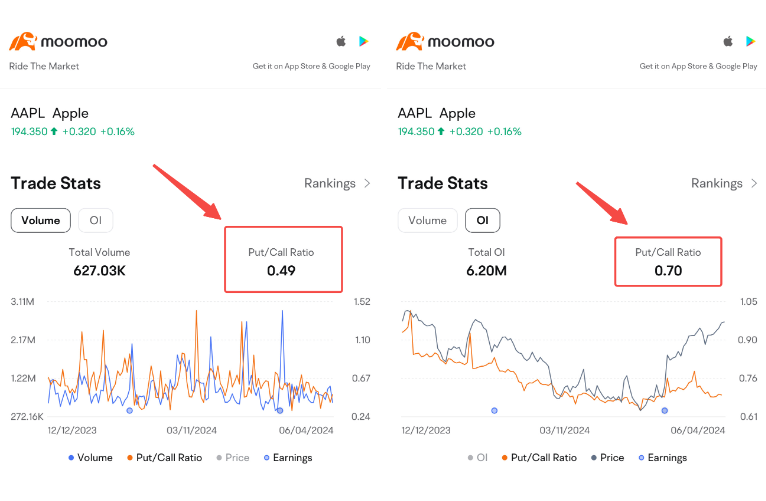
Images provided are not current and any securities are shown for illustrative purposes only and is not a recommendation.
The PCR ratio is calculated by dividing the total volume of put options traded by the total volume of call options traded. This calculation provides a numerical ratio that reflects the relationship between put and call option trading activity. Here's how to get started.
Total volume of call options and put options traded: Add up the volume of all call and put options traded for the specified timeframe on the underlying asset across different strike prices and expiration dates.
Divide the total volume of put options by the total volume of call options: After you've calculated the total volumes of call and put options traded, divide the total volume of put options by the total volume of call options to obtain the put/call ratio.
Let's review a put/call ratio example.
An investor is looking at a stock. During the trading day, the following options activity occurs:
Total volume of put options traded = 5,000 contracts
Total volume of call options traded = 7,500 contracts
To calculate the put/call ratio for this stock from this trading day, you divide the total volume of put options traded by the total volume of call options traded:
Put/Call Ratio = 5,000/7,500
Put/Call Ratio = 0.67
With the put/call ratio at 0.67, this means that for every put option traded there were 1.5 call options traded. In this put/call ratio example, it shows relatively more call options traded compared to put options, suggesting bullish sentiment for the stock on this particular trading day.
Put call ratios can provide insights into investor sentiment and market dynamics in the options market. Take a look.
Market sentiment gauge: Serves as a gauge of market sentiment, indicating whether investors are predominantly bullish or bearish on the underlying asset.
Contrarian indicator: Can signal potential market reversals with extreme values of the put/call ratio. An example of this is a put/call ratio of 2.5. This can suggest a very bearish sentiment while a put/call ratio such as 0.25, could indicate an extreme bullish sentiment.
Market timing tool: Can be used as a timing tool to assist in identifying potential entry or exit points in the market.
Indicator of option activity: Reflects the trading activity of put and call options, providing insights into option market activity and positioning.
Volatility forecasting: Changes in the put/call ratio can also provide signals for potential changes in market volatility.
Interpreting the put/call ratio can provide insights into market sentiment and potential future price movements. Here's a few key points to keep in mind:
Neutral Ratio (Around 1.0): Suggests a balanced view of the market with an equal number of puts and calls being traded. This neutral stance implies neither strong bullish nor bearish sentiment among traders.
Rising put/call ratio (Greater than 0.7 or exceeding 1.0): Suggests a bearish sentiment as traders are buying more puts than calls. Investors are speculating about a down market or hedging their portfolios against a possible sell-off.
Falling put/call ratio (Below 0.7 and approaching 0.5): Suggests a bullish indicator as it means more calls are being purchased vs. puts.
Context and Market Conditions: Considers the broader market context when interpreting the put/call ratio. For example, in a volatile market, an elevated ratio might reflect higher demand for protective puts rather than outright bearishness during a strong bull market.
Historical Benchmarks: Compares the current put/call ratio to historical levels. If the ratio is significantly above or below historical averages, it may suggest extreme sentiment, providing a potential signal for market turns. Keep in mind an extreme sentiment from the put/call ratio typically occurs when the ratio reaches significantly high or low levels compared to historical averages or recent readings.
The put/call ratio is often used as a contrarian indicator in options trading, as it can help investors identify potential market reversals by reflecting the prevailing sentiment of the majority. Contrarian traders believe that when the majority of market participants are overly bearish or bullish, the market is likely to move in the opposite direction.
Here's a few scenarios.
High put/call ratio: Indicates that more put options are being traded than call options, suggests widespread pessimism among investors. Contrarians view this as a bullish signal, anticipating that the market may soon experience an upward swing as the sentiment reaches an extreme.
Low put/call ratio: Signals excessive optimism with call options outnumbering put options; this might precede a market downturn. By leveraging the put/call ratio as a contrarian indicator, some option traders aim to capitalize on market corrections, looking to identify potential opportunities where the widespread sentiment may prove to be misguided.
Investors will find, similar to other indicators, pros and cons for the pc ratio.
Market Sentiment Gauge: May serve as a useful gauge of market sentiment, indicating whether investors are predominantly bullish or bearish on the underlying asset and provides insights into investor sentiment and positioning in the options market.
Contrarian indicator: Can signal potential market reversals with extreme values of the put/call ratio. Some option investors use the put/call ratio as a contrarian indicator, considering potential buying opportunities when the ratio reaches extremely high levels (indicating excessive fear) and considering potential selling opportunities when the ratio reaches extremely low levels (indicating excessive optimism).
Market timing tool: Can be used as a timing tool to assist in identifying potential entry or exit points in the market. Changes in the put/call ratio relative to historical levels or moving averages can provide insights into market sentiment shifts and potential turning points in the market.
Volatility forecasting: Changes in the put/call ratio can also provide signals for potential changes in market volatility. High put/call ratios may indicate expectations of increased volatility and vice versa, helping investors anticipate potential market movements.
Limited scope: Focuses solely on options trading activity and may not capture other market dynamics or factors influencing investor sentiment. It should be used in conjunction with other indicators and analysis tools for comprehensive market analysis.
Data interpretation: Interpreting the put/call ratio requires careful analysis and consideration of other factors. Extreme values of the ratio may not always lead to immediate market reversals, and false signals can occur, leading to potential losses if solely relied upon for trading decisions.
Short-term focus: May provide insights into short-term market sentiment and potential near-term reversals but may not necessarily indicate longer-term trends or sustained market movements. Investors should consider the broader market context and conduct thorough analysis before making trading decisions based on the put/call ratio.
Data quality: The accuracy and reliability of put/call ratio data depend on the quality of options trading data and reporting. Inaccurate or incomplete data could lead to incorrect interpretations and trading decisions.
Determining what constitutes a "good" pc ratio depends on various factors, including market conditions, the specific asset or index being analyzed, and the investor's trading strategy. There is no universally accepted threshold for what constitutes a "good" put/call ratio, as it can vary depending on the context and objectives of the analysis.
If the put/call ratio is greater than 1, it indicates there is a higher volume of put options being traded relative to call options within the specified time frame. This suggests that investors are predominantly buying or trading more puts compared to calls, which can signal bearish sentiment in the market. It may also indicate increased risk aversion among investors. They may be purchasing puts to help manage potential downside risk or to speculate on a decline in the market.
If the put/call ratio is less than 1, it indicates that there is a higher volume of call options being traded relative to put options within the specified time frame. This suggests that investors are predominantly buying or trading more calls compared to puts, which can signal bullish sentiment in the market.
This presentation is for informational and educational use only and is not a recommendation or endorsement of any particular investment or investment strategy. Investment information provided in this content is general in nature, strictly for illustrative purposes, and may not be appropriate for all investors. Read more
Recommend
Moomoo Offers Extended Trading Hours for Options Trading on Oct 19
At-the-Money (ATM) - How It Works in Options Trading
Out-of-the-Money in Options Trading - How It Works & Examples

Covered Call: A Comprehensive Guide to Options Trading
Strangle Options Strategy - A Helpful Guide for Traders
Straddle vs. Strangle: Understanding the Key Differences
Triple Witching: Understanding Its Impact on the Stock Market
Underlying Asset: Definition, Types and Examples
What Are Option Premiums
Covered Calls and Covered Puts - Strategies for Options Trading
Expiration Date in Options Trading
Options Break-Even Point: Definition, Formula, and Examples
Credit Spread: Definition, Examples & How to Calculate
Bull Put Spread: Definitions, How It Works & Examples
How to Manage Your Risk in Options Trading
How to Pick the 'Right' Strike Price
Options Wheel Strategy Explained: Definition and How to Trade
Long Collar Options Strategy: Definition, How It Works & Examples
Long Call Options Strategy: Definition, Potential Benefits, and Risks
Exercise of Options: When and How to Exercise Options
Time Value: Definition, Calculation, Importance in Options Trading
Short Call Options Strategy: Guide & Examples
What Are Bitcoin ETF Options: Investment Insights & Strategies
Hedge with Options: Protect Your Portfolio in 2026
Options Chains: Definition, How to Read and Analyze Them
Options Profit Calculation: Overview, Formula & Examples
What is Theta in Options Trading: Overview and Strategies
Debit Spread: Definition, Types & Examples
Butterfly Spread: Definition and Application in Options Trading
What Is an Options Screener and How to Use?
Unusual Options Activity: Insights and Strategies for Traders
Protective Put Strategy: Definition, How It Works & Examples
What Are Stock Options: Types, How They Work and Examples
Weekly vs. Monthly Options: Choosing the Right Expiration Date
How to Practice Options Trading with Demo Trading Account
Sell to Open vs Sell to Close: Understanding the Difference
Long Put: Definition, Examples and How to Trade
Iron Condor: Understanding This Options Trading Strategy
Diagonal Spread: Definition, Types & How to Use
Implied Volatility (IV) Rank & Percentile in Options Trading
Trading Earnings with Options
Iron Butterfly: Mastering the Options Trading Strategy
Interest Rate Options: Definition & How They Work
Options Buy to Open vs Buy to Close: What's the difference?
Vertical Spread: Definition, Types, & Examples
Bear Put Spread: An Options Trading Strategy Explained
What is a Dividend Reinvestment Plan (DRIP)?
Put/Call Ratio (PCR): Definition & How to Use
How Are Options Priced? | Calculation and Examples
Naked Calls Options Strategy: Definition & How It Works
Options Vs. Futures: Understanding Their Key Differences
Extrinsic Value: Definition, Calculation, and Trading Strategies
Intrinsic Value: How It Works And How To Calculate It
Bull Call Spread - Examples and Applications in Options Trading
Index Options: Definitions, Strategies and Risks
Short Put Options: Strategies and Risks Explained
Quadruple Witching: How It Can Affect the Stock Market
What Are Options? Everything You Need to Know before Trading
Four Option Trading Strategies for Beginners
10 Options Strategies to Enhance Your Trading Portfolio
American Options vs. European Options
In-The-Money (ITM): Call and Put Options Examples
What is a Calendar Spread?
Open Interest: What it means for traders and investors
Options vs Stocks: Choosing the Right Investment Strategy
Options Strike Prices Explained: A Complete Guide for Beginners
Call vs Put Options: Your Essential Guide to the Basics
Zero Days to Expiration (0DTE) Options: Trade Mag 7 Stock Options Today
What Is An Options Contract? How Does It Work?
What is Synthetic Put? (How Does It Work)
How and When to Roll Covered Calls
Option Volume vs Open Interest: Understanding the Difference
4 Options Trading Levels
How to Trade Options for Beginners?
What Is Implied Volatility (IV)?
What Are Cash Secured Puts: How To Sell Them
What Is a Straddle Options Strategy?
What Is Ratio Spread in Options
What is a Call Option: Strategies and Tips
Taxes on Stocks: How Selling Stocks Affects Your Taxes
Option Greeks Explained - Option Greek Cheat Sheet
Put Options: Hedging Your Portfolio
Put Options: How to Use Them in Your Trading Strategy
Poor Man's Covered Call (PMCC): A Beginner's Guide
Four Option Trading Mistakes to Avoid
Trading Synthetic Options: Risks and Rewards
Call Spread vs. Put Spread: What are the differences?
What is stock options trading
What Is Margin Call and How Can You Avoid the Risks?
Options Trading Strategies: Iron Condor vs. Iron Butterfly
Moomoo Offers Extended Trading Hours for Options Trading on Oct 19
At-the-Money (ATM) - How It Works in Options Trading
Out-of-the-Money in Options Trading - How It Works & Examples
Covered Call: A Comprehensive Guide to Options Trading
Strangle Options Strategy - A Helpful Guide for Traders
Straddle vs. Strangle: Understanding the Key Differences
Triple Witching: Understanding Its Impact on the Stock Market
Underlying Asset: Definition, Types and Examples
What Are Option Premiums
Covered Calls and Covered Puts - Strategies for Options Trading
Expiration Date in Options Trading
Options Break-Even Point: Definition, Formula, and Examples
Credit Spread: Definition, Examples & How to Calculate
Bull Put Spread: Definitions, How It Works & Examples
How to Manage Your Risk in Options Trading
How to Pick the 'Right' Strike Price
Options Wheel Strategy Explained: Definition and How to Trade
Long Collar Options Strategy: Definition, How It Works & Examples
Long Call Options Strategy: Definition, Potential Benefits, and Risks
Exercise of Options: When and How to Exercise Options
Time Value: Definition, Calculation, Importance in Options Trading
Short Call Options Strategy: Guide & Examples
What Are Bitcoin ETF Options: Investment Insights & Strategies
Hedge with Options: Protect Your Portfolio in 2026
Options Chains: Definition, How to Read and Analyze Them
Options Profit Calculation: Overview, Formula & Examples
What is Theta in Options Trading: Overview and Strategies
Debit Spread: Definition, Types & Examples
Butterfly Spread: Definition and Application in Options Trading
What Is an Options Screener and How to Use?
Unusual Options Activity: Insights and Strategies for Traders
Protective Put Strategy: Definition, How It Works & Examples
What Are Stock Options: Types, How They Work and Examples
Weekly vs. Monthly Options: Choosing the Right Expiration Date
How to Practice Options Trading with Demo Trading Account
Sell to Open vs Sell to Close: Understanding the Difference
Long Put: Definition, Examples and How to Trade
Iron Condor: Understanding This Options Trading Strategy
Diagonal Spread: Definition, Types & How to Use
Implied Volatility (IV) Rank & Percentile in Options Trading
Trading Earnings with Options
Iron Butterfly: Mastering the Options Trading Strategy
Interest Rate Options: Definition & How They Work
Options Buy to Open vs Buy to Close: What's the difference?
Vertical Spread: Definition, Types, & Examples
Bear Put Spread: An Options Trading Strategy Explained
What is a Dividend Reinvestment Plan (DRIP)?
Put/Call Ratio (PCR): Definition & How to Use
How Are Options Priced? | Calculation and Examples
Naked Calls Options Strategy: Definition & How It Works
Options Vs. Futures: Understanding Their Key Differences
Extrinsic Value: Definition, Calculation, and Trading Strategies
Intrinsic Value: How It Works And How To Calculate It
Bull Call Spread - Examples and Applications in Options Trading
Index Options: Definitions, Strategies and Risks
Short Put Options: Strategies and Risks Explained
Quadruple Witching: How It Can Affect the Stock Market
What Are Options? Everything You Need to Know before Trading
Four Option Trading Strategies for Beginners
10 Options Strategies to Enhance Your Trading Portfolio
American Options vs. European Options
In-The-Money (ITM): Call and Put Options Examples
What is a Calendar Spread?
Open Interest: What it means for traders and investors
Options vs Stocks: Choosing the Right Investment Strategy
Options Strike Prices Explained: A Complete Guide for Beginners
Call vs Put Options: Your Essential Guide to the Basics
Zero Days to Expiration (0DTE) Options: Trade Mag 7 Stock Options Today
What Is An Options Contract? How Does It Work?
What is Synthetic Put? (How Does It Work)
How and When to Roll Covered Calls
Option Volume vs Open Interest: Understanding the Difference
4 Options Trading Levels
How to Trade Options for Beginners?
What Is Implied Volatility (IV)?
What Are Cash Secured Puts: How To Sell Them
What Is a Straddle Options Strategy?
What Is Ratio Spread in Options
What is a Call Option: Strategies and Tips
Taxes on Stocks: How Selling Stocks Affects Your Taxes
Option Greeks Explained - Option Greek Cheat Sheet
Put Options: Hedging Your Portfolio
Put Options: How to Use Them in Your Trading Strategy
Poor Man's Covered Call (PMCC): A Beginner's Guide
Four Option Trading Mistakes to Avoid
Trading Synthetic Options: Risks and Rewards
Call Spread vs. Put Spread: What are the differences?
What is stock options trading
What Is Margin Call and How Can You Avoid the Risks?
Options Trading Strategies: Iron Condor vs. Iron Butterfly

