
Moomoo Insights
Jul 16 15:38
TSMC Earnings: AI Demand Is Stronger Than the Chip Selloff Suggests
Moomoo Insights
Sep 30 05:04
Live Take | Anthropic’s $518B Compute Bet: Who Wins From the AI Buildout?
Mark Monday, October 19, 2026. That is when Cboe Options Exchange (C1) plans to expand hours for select single-stock and ETF equity options — and when moomoo users can access those windows for eligible contracts.
In schedule notice C2026091401, Cboe says that effective October 19, 2026, C1 plans to expand hours for select equity options by adding a morning Global Trading Hours (GTH) session and an afternoon Curb session. That notice is the operational roadmap behind the Oct 19 date.
The deeper reason is a structural mismatch. Equity exchanges already let many stocks trade outside 9:30 a.m.–4:00 p.m. ET, but most multi-listed equity options stayed locked to regular hours. When an underlying moved on pre-market news or a post-close print, investors often could not hedge or adjust with exchange-traded options in the same window. Cboe's change aims to close that gap for designated liquid classes — aligning options with extended equity trading and improving access for U.S. and international participants who want options alongside the stock outside RTH.
The rollout is measured: eligibility favors highly active classes (up to 100 designated names, rebalanced semi-annually), and GTH/Curb are shorter than full equity extended hours. Oct 19 exists because stocks already moved after hours while options mostly did not — and Cboe is opening a controlled path for the most liquid names first.
Source: C1 Options to Offer Expanded Trading Hours for Select Equity Options
In practice, a limited set of high-liquidity options can react when catalysts hit — a post-close earnings beat, a pre-open guidance cut, or an early macro print — instead of waiting until 9:30. That may help investors who want to hedge sooner on liquid mega-caps and major ETFs. Spreads can still differ from RTH; smaller size and limit-only discipline remain process tools, not a signal to trade every print.
For eligible equity and ETF options, the planned timetable (U.S. Eastern Time) is:
7:00 a.m. ET — resting GTC orders load into the book
7:15 a.m. ET — pre-open queuing begins
7:30–9:25 a.m. ET — Global Trading Hours (GTH): the new options pre market session
9:30 a.m.–4:00 p.m. ET — regular trading hours (unchanged)
4:00–4:15 p.m. ET — Curb session: the new post-market / after-hours options window
In short: options pre market runs 7:30–9:25 a.m. ET, and the after-hours curb runs 4:00–4:15 p.m. ET for eligible single-stock options. Per Cboe's notice, ETF equity options that already trade until 4:15 p.m. ET continue that window as part of RTH (no separate Curb for those classes). Confirm sessions on the moomoo order ticket; index products (SPX, XSP, VIX, RUT) may follow different extended schedules.
Extended hours options trading at launch focuses on liquid single names and major ETFs. On moomoo, the eligible equity list includes:
Ticker | Company | Sector | Core Business |
AAPL | Apple | Consumer Electronics | Smartphones, PCs & software ecosystem |
AMD | AMD | Semiconductors | CPUs, GPUs & AI chips |
AMZN | Amazon | E-Commerce / Cloud | Online retail & AWS cloud services |
AVGO | Broadcom | Semiconductors | Networking & communication chips |
BABA | Alibaba | E-Commerce / Cloud | China e-commerce & cloud computing |
BAC | Bank of America | Banking | Retail & corporate banking |
F | Ford Motor | Automotive | Passenger vehicles & EVs |
GOOG | Alphabet Inc. Class C | Internet Tech | Search, YouTube & cloud |
GOOGL | Alphabet Inc. Class A | Internet Tech | Search, YouTube & cloud (voting shares) |
HOOD | Robinhood | Fintech | Retail trading platform |
INTC | Intel | Semiconductors | PC & server CPUs, foundry |
META | Meta Platforms | Social Media | Social networks & VR/AI |
MRVL | Marvell Technology | Semiconductors | Data center & network chips |
MSFT | Microsoft | Software / Cloud | Windows, Office & Azure |
MU | Micron Technology | Semiconductors | DRAM & NAND memory |
NFLX | Netflix | Streaming | Global video streaming service |
NOK | Nokia | Telecom Equipment | 5G network infrastructure |
NVDA | NVIDIA | Semiconductors | AI GPUs & data center hardware |
ORCL | Oracle | Enterprise Software | Database & cloud applications |
PFE | Pfizer | Biopharma | Pharmaceuticals & vaccines |
PLTR | Palantir Technologies | Enterprise Data Software | Data analytics & AI platforms |
SNDK | SanDisk | Semiconductors | Flash storage products |
SPCX | SpaceX | Aerospace | Rocket launch & Starlink satellite |
TSLA | Tesla | Automotive / Energy | Electric vehicles & energy storage |
TSM | Taiwan Semiconductor Manufacturing | Semiconductor Foundry | Chip manufacturing services |
Eligible ETFs include:
Ticker | Fund Name | Sector / Asset Class | Core Description |
SPY | SPDR S&P 500 ETF | US Large Cap Equity | Tracks S&P 500 large-cap US stocks |
QQQ | Invesco QQQ Trust | US Large Cap Tech | Tracks Nasdaq-100 growth & tech stocks |
IWM | iShares Russell 2000 ETF | US Small Cap Equity | Tracks Russell 2000 US small-cap stocks |
GLD | SPDR Gold Shares | Precious Metal | Tracks price of physical gold bullion |
XLF | Financial Select Sector SPDR Fund | Financial Sector | US banking, insurance & financial firms |
Cboe may rebalance the designated list over time. Availability also depends on account permissions, option approval level, and whether a series is open that session. Trust the order-ticket session flags if a listed name does not show extended eligibility.
Key mechanics from Cboe's notice that apply in GTH and Curb:
Limit orders only — market, stop, and stop-limit orders are not allowed
NBBO protection applies, same concept as RTH
GTC/GTD orders may carry across sessions when tagged All, RTH+Curb, or RTH only
Spreads can be wider than RTH — size and limit prices matter more
Having entry and exit levels ready before 7:30 a.m. or the 4:00 p.m. curb reduces rushed decisions when the book opens.
When a catalyst hits in the new window, speed without structure often becomes an ad-hoc single-leg guess. moomoo's one-click options strategy workflow shortens the path from outlook to a multi-leg template: pick a defined structure (for example verticals or other supported strategies), choose strikes and expirations that match your thesis, and send the package as a planned combo instead of building legs one by one under time pressure.
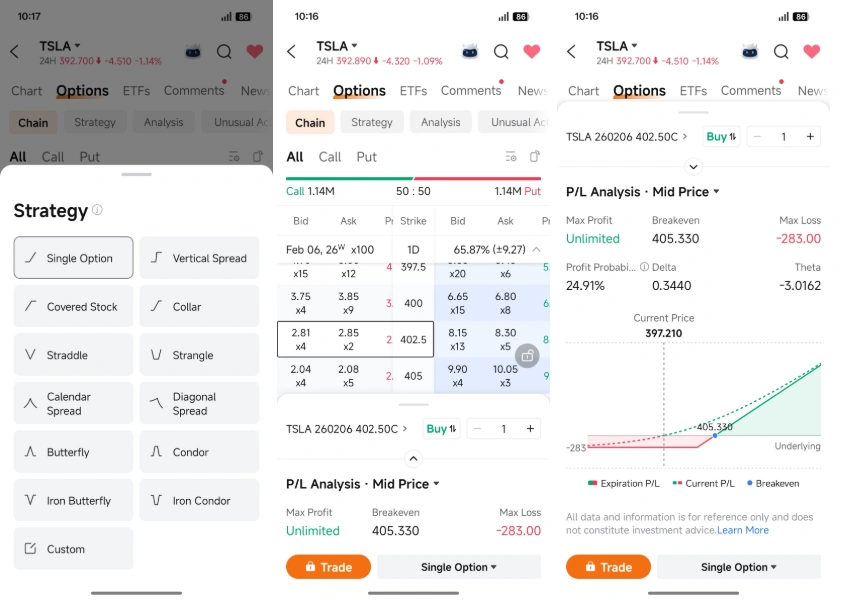
Around Oct 19, the practical use case is preparation — not prediction. Before a known pre-market release or post-close print on an eligible name, map one or two candidate structures in advance, then decide whether conditions still fit when the session opens. Templates support workflow; they do not replace risk limits.
Extended sessions can reprice underlyings quickly, so knowing max profit, max loss, and breakeven points before the click matters more — not less. moomoo's options P&L analysis tools let users visualize expiration P&L across prices, review breakeven levels, and explore how time decay and IV shifts can change current P&L before expiration.
A simple pre-session routine: load the strategy, confirm breakeven points against the move you are willing to underwrite, note theoretical max loss, then decide whether a GTH or curb limit still fits. Scenario tools are for planning; they do not guarantee fills or outcomes.
October's earnings calendar sits next to the launch date — the exact mismatch Cboe set out to fix. Traders who wanted to trade options after hours around a just-released report previously watched the stock move while options waited for the next RTH session. Eligible names now get a short 4:00–4:15 p.m. ET window for same-evening adjustments if a plan still fits.
moomoo Earnings Hub supports that workflow: open the company package, estimates context, news, and call-related follow-ups in one place (Markets> Earnings> Earnings Hub), then decide whether a planned structure still makes sense. Illustrative sequence only (not advice): confirm eligibility → open Earnings Hub → check whether the move and IV still match a pre-built one-click strategy → review P&L and breakeven → submit a limit only if risk limits still hold.
Cboe's notice explains the market-structure shift; moomoo's job is the tighter loop between news, structure, and a limit order. Ahead of Oct 19, narrow a watchlist to eligible names you already follow, confirm GTH and curb times on the ticket, and practice one-click strategies plus P&L / breakeven views in regular hours so the tools feel familiar when spreads are wider.
On earnings evenings, Earnings Hub sits next to that workflow: read the just-released package, decide whether a pre-built structure still fits, then consider a curb limit only if risk limits still hold. Standing aside when markets are too wide remains valid. For eligible accounts, moomoo combines one-click strategies, P&L analysis with breakeven points, and Earnings Hub with the new session access. Opening an account is optional and is not a recommendation to trade.
Can you buy options premarket?
Yes — for eligible contracts, options pre market (GTH) is planned for 7:30–9:25 a.m. ET. That window is typically limit-only, and your account must be approved for options.
When does extended hours trading start?
Cboe's planned start is Monday, October 19, 2026. Each day, GTH opens at 7:30 a.m. ET (after 7:00 book load and 7:15 queuing), and curb runs 4:00–4:15 p.m. ET.
When do moomoo options extended hours start?
moomoo access for eligible equity and ETF options extended sessions tracks the same Oct 19, 2026 target. Confirm live availability in the moomoo order-entry interface for your account and contract.
What are the exact pre-market and after-hours times?
For eligible equity/ETF options, GTH (pre-market) is 7:30–9:25 a.m. ET and curb (after-hours) is 4:00–4:15 p.m. ET. Regular hours remain 9:30 a.m.–4:00 p.m. ET. ETF classes that already trade until 4:15 p.m. ET typically keep that window as part of RTH.
Can I use market orders in the new sessions?
No. Per Cboe's notice, market, stop, and stop-limit orders are not allowed in GTH or Curb — limit orders only.
How do Earnings Hub and options tools fit together?
Earnings Hub consolidates just-released report context; one-click strategies help structure an outlook; P&L analysis shows max profit/loss and breakeven points before a curb limit. Tools support planning — they do not eliminate risk.
Is every options series on the stock list tradeable after hours?
Not necessarily. Class-level eligibility does not guarantee every strike/expiration is open in GTH or curb on a given day. Order-ticket session flags remain authoritative.
This presentation is for informational and educational use only and is not a recommendation or endorsement of any particular investment or investment strategy. Investment information provided in this content is general in nature, strictly for illustrative purposes, and may not be appropriate for all investors. Read more
Recommend
Moomoo Offers Extended Trading Hours for Options Trading on Oct 19
At-the-Money (ATM) - How It Works in Options Trading
Out-of-the-Money in Options Trading - How It Works & Examples

Covered Call: A Comprehensive Guide to Options Trading
Strangle Options Strategy - A Helpful Guide for Traders
Straddle vs. Strangle: Understanding the Key Differences
Triple Witching: Understanding Its Impact on the Stock Market
Underlying Asset: Definition, Types and Examples
What Are Option Premiums
Covered Calls and Covered Puts - Strategies for Options Trading
Expiration Date in Options Trading
Options Break-Even Point: Definition, Formula, and Examples
Credit Spread: Definition, Examples & How to Calculate
Bull Put Spread: Definitions, How It Works & Examples
How to Manage Your Risk in Options Trading
How to Pick the 'Right' Strike Price
Options Wheel Strategy Explained: Definition and How to Trade
Long Collar Options Strategy: Definition, How It Works & Examples
Long Call Options Strategy: Definition, Potential Benefits, and Risks
Exercise of Options: When and How to Exercise Options
Time Value: Definition, Calculation, Importance in Options Trading
Short Call Options Strategy: Guide & Examples
What Are Bitcoin ETF Options: Investment Insights & Strategies
Hedge with Options: Protect Your Portfolio in 2026
Options Chains: Definition, How to Read and Analyze Them
Options Profit Calculation: Overview, Formula & Examples
What is Theta in Options Trading: Overview and Strategies
Debit Spread: Definition, Types & Examples
Butterfly Spread: Definition and Application in Options Trading
What Is an Options Screener and How to Use?
Unusual Options Activity: Insights and Strategies for Traders
Protective Put Strategy: Definition, How It Works & Examples
What Are Stock Options: Types, How They Work and Examples
Weekly vs. Monthly Options: Choosing the Right Expiration Date
How to Practice Options Trading with Demo Trading Account
Sell to Open vs Sell to Close: Understanding the Difference
Long Put: Definition, Examples and How to Trade
Iron Condor: Understanding This Options Trading Strategy
Diagonal Spread: Definition, Types & How to Use
Implied Volatility (IV) Rank & Percentile in Options Trading
Trading Earnings with Options
Iron Butterfly: Mastering the Options Trading Strategy
Interest Rate Options: Definition & How They Work
Options Buy to Open vs Buy to Close: What's the difference?
Vertical Spread: Definition, Types, & Examples
Bear Put Spread: An Options Trading Strategy Explained
What is a Dividend Reinvestment Plan (DRIP)?
Put/Call Ratio (PCR): Definition & How to Use
How Are Options Priced? | Calculation and Examples
Naked Calls Options Strategy: Definition & How It Works
Options Vs. Futures: Understanding Their Key Differences
Extrinsic Value: Definition, Calculation, and Trading Strategies
Intrinsic Value: How It Works And How To Calculate It
Bull Call Spread - Examples and Applications in Options Trading
Index Options: Definitions, Strategies and Risks
Short Put Options: Strategies and Risks Explained
Quadruple Witching: How It Can Affect the Stock Market
What Are Options? Everything You Need to Know before Trading
Four Option Trading Strategies for Beginners
10 Options Strategies to Enhance Your Trading Portfolio
American Options vs. European Options
In-The-Money (ITM): Call and Put Options Examples
What is a Calendar Spread?
Open Interest: What it means for traders and investors
Options vs Stocks: Choosing the Right Investment Strategy
Options Strike Prices Explained: A Complete Guide for Beginners
Call vs Put Options: Your Essential Guide to the Basics
Zero Days to Expiration (0DTE) Options: Trade Mag 7 Stock Options Today
What Is An Options Contract? How Does It Work?
What is Synthetic Put? (How Does It Work)
How and When to Roll Covered Calls
Option Volume vs Open Interest: Understanding the Difference
4 Options Trading Levels
How to Trade Options for Beginners?
What Is Implied Volatility (IV)?
What Are Cash Secured Puts: How To Sell Them
What Is a Straddle Options Strategy?
What Is Ratio Spread in Options
What is a Call Option: Strategies and Tips
Taxes on Stocks: How Selling Stocks Affects Your Taxes
Option Greeks Explained - Option Greek Cheat Sheet
Put Options: Hedging Your Portfolio
Put Options: How to Use Them in Your Trading Strategy
Poor Man's Covered Call (PMCC): A Beginner's Guide
Four Option Trading Mistakes to Avoid
Trading Synthetic Options: Risks and Rewards
Call Spread vs. Put Spread: What are the differences?
What is stock options trading
What Is Margin Call and How Can You Avoid the Risks?
Options Trading Strategies: Iron Condor vs. Iron Butterfly
Moomoo Offers Extended Trading Hours for Options Trading on Oct 19
At-the-Money (ATM) - How It Works in Options Trading
Out-of-the-Money in Options Trading - How It Works & Examples
Covered Call: A Comprehensive Guide to Options Trading
Strangle Options Strategy - A Helpful Guide for Traders
Straddle vs. Strangle: Understanding the Key Differences
Triple Witching: Understanding Its Impact on the Stock Market
Underlying Asset: Definition, Types and Examples
What Are Option Premiums
Covered Calls and Covered Puts - Strategies for Options Trading
Expiration Date in Options Trading
Options Break-Even Point: Definition, Formula, and Examples
Credit Spread: Definition, Examples & How to Calculate
Bull Put Spread: Definitions, How It Works & Examples
How to Manage Your Risk in Options Trading
How to Pick the 'Right' Strike Price
Options Wheel Strategy Explained: Definition and How to Trade
Long Collar Options Strategy: Definition, How It Works & Examples
Long Call Options Strategy: Definition, Potential Benefits, and Risks
Exercise of Options: When and How to Exercise Options
Time Value: Definition, Calculation, Importance in Options Trading
Short Call Options Strategy: Guide & Examples
What Are Bitcoin ETF Options: Investment Insights & Strategies
Hedge with Options: Protect Your Portfolio in 2026
Options Chains: Definition, How to Read and Analyze Them
Options Profit Calculation: Overview, Formula & Examples
What is Theta in Options Trading: Overview and Strategies
Debit Spread: Definition, Types & Examples
Butterfly Spread: Definition and Application in Options Trading
What Is an Options Screener and How to Use?
Unusual Options Activity: Insights and Strategies for Traders
Protective Put Strategy: Definition, How It Works & Examples
What Are Stock Options: Types, How They Work and Examples
Weekly vs. Monthly Options: Choosing the Right Expiration Date
How to Practice Options Trading with Demo Trading Account
Sell to Open vs Sell to Close: Understanding the Difference
Long Put: Definition, Examples and How to Trade
Iron Condor: Understanding This Options Trading Strategy
Diagonal Spread: Definition, Types & How to Use
Implied Volatility (IV) Rank & Percentile in Options Trading
Trading Earnings with Options
Iron Butterfly: Mastering the Options Trading Strategy
Interest Rate Options: Definition & How They Work
Options Buy to Open vs Buy to Close: What's the difference?
Vertical Spread: Definition, Types, & Examples
Bear Put Spread: An Options Trading Strategy Explained
What is a Dividend Reinvestment Plan (DRIP)?
Put/Call Ratio (PCR): Definition & How to Use
How Are Options Priced? | Calculation and Examples
Naked Calls Options Strategy: Definition & How It Works
Options Vs. Futures: Understanding Their Key Differences
Extrinsic Value: Definition, Calculation, and Trading Strategies
Intrinsic Value: How It Works And How To Calculate It
Bull Call Spread - Examples and Applications in Options Trading
Index Options: Definitions, Strategies and Risks
Short Put Options: Strategies and Risks Explained
Quadruple Witching: How It Can Affect the Stock Market
What Are Options? Everything You Need to Know before Trading
Four Option Trading Strategies for Beginners
10 Options Strategies to Enhance Your Trading Portfolio
American Options vs. European Options
In-The-Money (ITM): Call and Put Options Examples
What is a Calendar Spread?
Open Interest: What it means for traders and investors
Options vs Stocks: Choosing the Right Investment Strategy
Options Strike Prices Explained: A Complete Guide for Beginners
Call vs Put Options: Your Essential Guide to the Basics
Zero Days to Expiration (0DTE) Options: Trade Mag 7 Stock Options Today
What Is An Options Contract? How Does It Work?
What is Synthetic Put? (How Does It Work)
How and When to Roll Covered Calls
Option Volume vs Open Interest: Understanding the Difference
4 Options Trading Levels
How to Trade Options for Beginners?
What Is Implied Volatility (IV)?
What Are Cash Secured Puts: How To Sell Them
What Is a Straddle Options Strategy?
What Is Ratio Spread in Options
What is a Call Option: Strategies and Tips
Taxes on Stocks: How Selling Stocks Affects Your Taxes
Option Greeks Explained - Option Greek Cheat Sheet
Put Options: Hedging Your Portfolio
Put Options: How to Use Them in Your Trading Strategy
Poor Man's Covered Call (PMCC): A Beginner's Guide
Four Option Trading Mistakes to Avoid
Trading Synthetic Options: Risks and Rewards
Call Spread vs. Put Spread: What are the differences?
What is stock options trading
What Is Margin Call and How Can You Avoid the Risks?
Options Trading Strategies: Iron Condor vs. Iron Butterfly

