
Moomoo Insights
Jul 16 15:38
TSMC Earnings: AI Demand Is Stronger Than the Chip Selloff Suggests
Moomoo Insights
Sep 30 05:04
Live Take | Anthropic’s $518B Compute Bet: Who Wins From the AI Buildout?
One important concept option traders should learn is the break-even point, which determines when a trade will no longer result in a loss. In this article, we’ll break down what the break-even point is, how to calculate it for options, and why it's crucial for traders. We'll also cover how to find the break-even point on moomoo.
The break-even point in options trading is the price level at which the buyer of an option neither makes a profit nor incurs a loss. In other words, it's the price at which the total cost of the trade, including the premium paid, is recovered. This point varies for call and put options, as each has a different calculation method (more on this later). Understanding the break-even point is essential for assessing risk and planning your exit strategies.
The break-even point serves as a benchmark for options traders, helping them determine whether their trade will be profitable or result in a loss. It is calculated based on the strike price of the option, the premium paid, and the type of option (call or put). When the price of the underlying asset reaches or exceeds this point, the trader can break even or make a profit. For any long option position that expires worthless, the loss is equal to the premium paid (assuming no exercise). For trades that reach or move past the break-even point, gains begin to accumulate.
Calculating the break-even point in options involves a simple formula. However, it differs for call and put options due to the nature of each. The break-even point tells traders where the cost of entering the position is fully recovered. Here's how you can calculate it.
For a call option, the break-even point is calculated by adding the premium paid to the strike price of the option.
Formula (Call Option): Break-even = Strike Price + Premium Paid
For a put option, the formula is slightly different. The break-even point is calculated by subtracting the premium from the strike price.
Formula (Put Option): Break-even = Strike Price - Premium Paid
In both cases, the premium paid is a crucial factor. It represents the cost of the option, and it must be accounted for to determine the point at which the trade becomes profitable.
Strike Price: $50
Premium Paid: $5
Break-even Point = $50 (Strike Price) + $5 (Premium Paid) = $55
For this call option, you would need the price of the underlying asset to rise to $55 for you to break even. Any price above $55 could result in a profit.
Strike Price: $50
Premium Paid: $4
Break-even Point = $50 (Strike Price) - $4 (Premium Paid) = $46
For this put option, the price of the underlying asset needs to fall to $46 for you to break even. Any price below $46 could result in a profit.
The break-even point calculation varies with different options strategies. Here's how you can calculate the break-even for some common strategies.
A long call involves purchasing a call option with the expectation that the underlying asset's price will rise. The break-even point for a long call strategy is the strike price plus the premium paid.
For a short call (selling a call option), the break-even point is the strike price plus the premium received.
Long call example: If you buy a call option with a strike price of $50 and a premium of $5, the break-even point is $55.
Short call example: If you sell a call option with a strike price of $50 and receive a premium of $5, the break-even point is $55.
A long put involves buying a put option, anticipating a decline in the underlying asset's price. This strategy can profit when the stock price falls below the breakeven point price. The break-even point is the strike price minus the premium paid.
A short put involves selling a put option, expecting the asset’s price to stay above the strike price or rise. It can profit when the stock price stays above the breakeven point. The break-even point is the strike price minus the premium received.
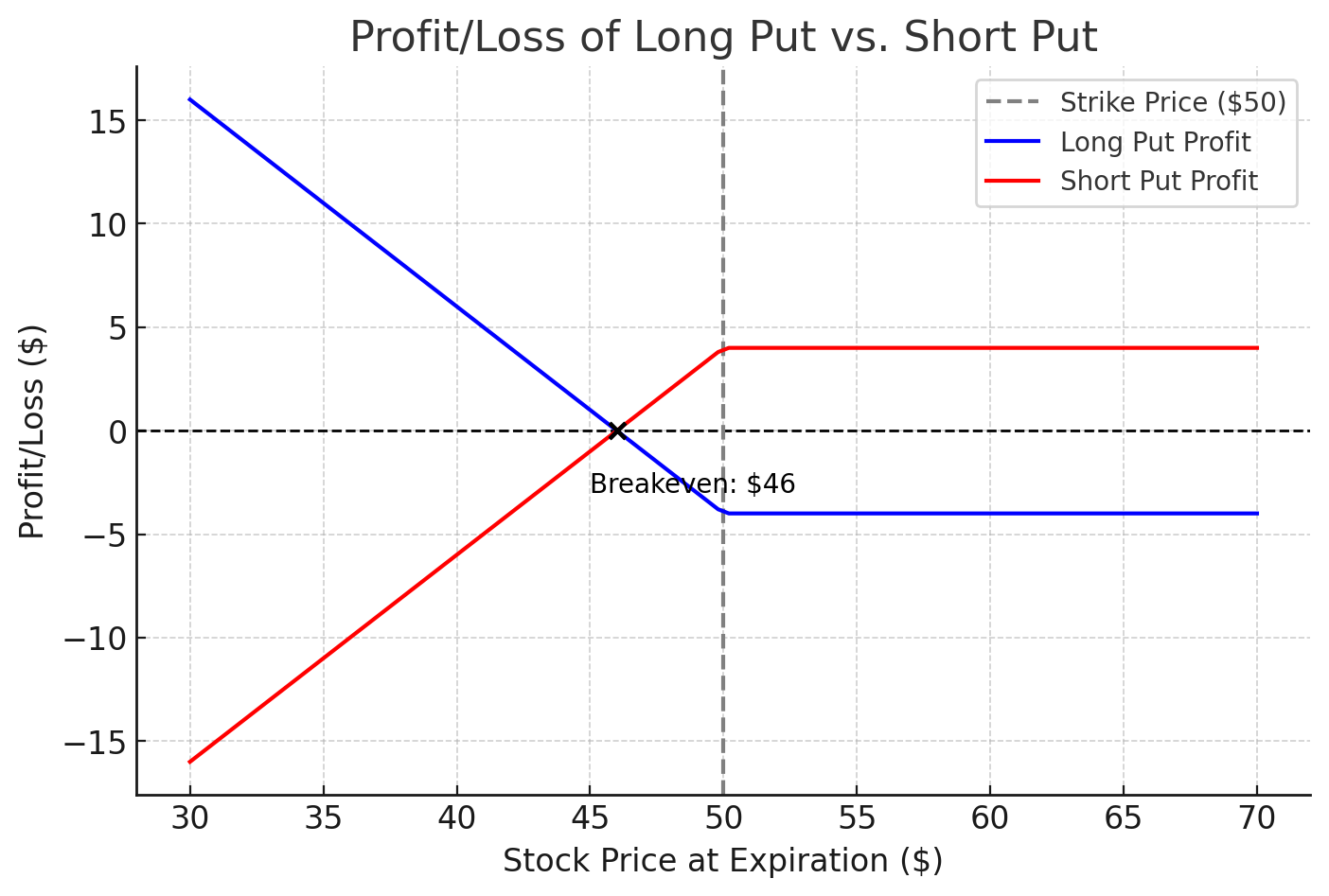
Long Put: Buy a put with a $50 strike price and $4 premium → Break-even = $46. Profits grow as the stock price drops below $46.
Short Put: Sell a put with a $50 strike price and $4 premium → Break-even = $46. Profits grow as the stock price stays above $46.
Here’s the profit/loss graph for a long put (blue) and short put (red).
Long Put: Profits increase as the stock price drops below the breakeven point ($46).
Short Put: Profits when the stock price stays above $46 but risks significant losses if the price drops precipitously.
Before you start trading options on moomoo, you'll need to get approval. Your approval level determines which strategies you can use, with more advanced trades—like short puts—requiring a higher level due to their added risk. Don't worry, though — moomoo guides you through the process step by step!
Tap the "Markets" tab on the bottom navigation bar.
Search for the stock or asset you want to analyze.
Select the "Options" tab to view available options contracts.
Browse through the list of available options.
Tap on an option contract (e.g., a call or put) you’re interested in.
Review the contract details such as strike price, expiration date, and premium.
Scroll down to the "Analysis" section of the selected option.
Tap the Profit/Loss (P/L) chart button to visualize the potential outcomes.
Adjust parameters: Modify key factors like strike price, premium, or quantity to see how they impact projected profit and loss.
Set scenarios: Use sliders to simulate changes in the underlying asset’s price.
Break-even point: Identify where potential profit starts (strike price + premium for long calls).
Tap "Compare Strategies" to overlay multiple P/L charts, such as a long call and a long put.
This helps you understand how these strategies respond differently to market movements.
Save your analysis for future reference or proceed to place a trade directly from the app.
Use the insights from the P/L chart to make more informed decisions.
Tips for using the P/L chart effectively
Look for break-even points to understand where the strategy can start being profitable.
Check the maximum profit and loss ranges to evaluate risks and rewards.
Before you actually begin trading options, first practice with moomoo's options paper trading.
The break-even point is a vital part of options trading because it helps traders understand the minimum price at which they can recover the cost of their trade. It acts as a reference point for making trading decisions, managing risk, and setting realistic expectations for potential returns. By knowing the break-even point, traders can plan their exit strategies.
Risk management: Knowing the break-even point helps traders assess potential risks and set stop-loss orders if needed.
Profitability analysis: It allows traders to evaluate how likely their options trades are to become profitable or incure a loss based on current market conditions.
Strategic planning: Helps traders decide when to exit a trade to lock in profits or minimize losses.
Incorrect calculations: Miscalculations can lead to inaccurate profitability predictions, resulting in unexpected losses.
Market volatility: Break-even analysis is based on the assumption that the stock price will move in a favorable direction. Market volatility can impact this.
The break-even point in options trading varies depending on the type of option. For a long call, it’s calculated by adding the premium to the strike price, while for a long put, it’s found by subtracting the premium from the strike price. These break-even levels represent the price the underlying asset must reach at expiration for the buyer to recover the premium paid. For sellers of options (short calls or puts), the same formulas apply, but the break-even indicates the price beyond which they would start incurring losses.
The break-even price in options trading is where a trader neither profits nor loses, accounting for the premium paid or received. For a call option buyer, it’s the strike price plus the premium, while for a put option buyer, it’s the strike price minus the premium. Sellers of calls or puts break even when the premium they receive offsets losses from the asset price moving against them. For buyers of calls and puts, it’s the key price level traders use to gauge the minimum movement needed to avoid a loss.
The break-even price for a call option is calculated as the strike price plus the premium paid. This is the price at which the holder of the call option neither makes a profit nor incurs a loss upon expiration of the option contract. If the underlying asset’s price rises above this level at expiration, the option holder can start to make a profit, as the value of the option will exceed the premium paid. For example, if a call option has a strike price of $100 and a premium of $5, the break-even price is $105. Any price above $105 at expiration can result in a profit for the holder.
The break-even and profit/loss (P/L) calculations discussed here are based on the assumption of exercise or assignment of the option at expiration, with an immediate purchase or sale of the underlying asset at that price. This is a simplified way to evaluate the trade. During the life of the option, however, the P/L and break-even estimates are more complex and dynamic.
Options traders often close their positions before expiration, either for a profit or a loss, by selling or buying back the option contract. In these instnces, the break-even price and P/L calculations are different, as they reflect the current market price of the option rather than waiting until expiration. A P/L calculator typically shows two lines: one for the P/L at expiration and another that dynamically adjusts based on the current price of the underlying asset and the option’s time value. These dynamic estimates help traders make decisions based on real-time market conditions rather than just the expiration date.
This presentation is for informational and educational use only and is not a recommendation or endorsement of any particular investment or investment strategy. Investment information provided in this content is general in nature, strictly for illustrative purposes, and may not be appropriate for all investors. Read more
Recommend
Moomoo Offers Extended Trading Hours for Options Trading on Oct 19
At-the-Money (ATM) - How It Works in Options Trading
Out-of-the-Money in Options Trading - How It Works & Examples

Covered Call: A Comprehensive Guide to Options Trading
Strangle Options Strategy - A Helpful Guide for Traders
Straddle vs. Strangle: Understanding the Key Differences
Triple Witching: Understanding Its Impact on the Stock Market
Underlying Asset: Definition, Types and Examples
What Are Option Premiums
Covered Calls and Covered Puts - Strategies for Options Trading
Expiration Date in Options Trading
Options Break-Even Point: Definition, Formula, and Examples
Credit Spread: Definition, Examples & How to Calculate
Bull Put Spread: Definitions, How It Works & Examples
How to Manage Your Risk in Options Trading
How to Pick the 'Right' Strike Price
Options Wheel Strategy Explained: Definition and How to Trade
Long Collar Options Strategy: Definition, How It Works & Examples
Long Call Options Strategy: Definition, Potential Benefits, and Risks
Exercise of Options: When and How to Exercise Options
Time Value: Definition, Calculation, Importance in Options Trading
Short Call Options Strategy: Guide & Examples
What Are Bitcoin ETF Options: Investment Insights & Strategies
Hedge with Options: Protect Your Portfolio in 2026
Options Chains: Definition, How to Read and Analyze Them
Options Profit Calculation: Overview, Formula & Examples
What is Theta in Options Trading: Overview and Strategies
Debit Spread: Definition, Types & Examples
Butterfly Spread: Definition and Application in Options Trading
What Is an Options Screener and How to Use?
Unusual Options Activity: Insights and Strategies for Traders
Protective Put Strategy: Definition, How It Works & Examples
What Are Stock Options: Types, How They Work and Examples
Weekly vs. Monthly Options: Choosing the Right Expiration Date
How to Practice Options Trading with Demo Trading Account
Sell to Open vs Sell to Close: Understanding the Difference
Long Put: Definition, Examples and How to Trade
Iron Condor: Understanding This Options Trading Strategy
Diagonal Spread: Definition, Types & How to Use
Implied Volatility (IV) Rank & Percentile in Options Trading
Trading Earnings with Options
Iron Butterfly: Mastering the Options Trading Strategy
Interest Rate Options: Definition & How They Work
Options Buy to Open vs Buy to Close: What's the difference?
Vertical Spread: Definition, Types, & Examples
Bear Put Spread: An Options Trading Strategy Explained
What is a Dividend Reinvestment Plan (DRIP)?
Put/Call Ratio (PCR): Definition & How to Use
How Are Options Priced? | Calculation and Examples
Naked Calls Options Strategy: Definition & How It Works
Options Vs. Futures: Understanding Their Key Differences
Extrinsic Value: Definition, Calculation, and Trading Strategies
Intrinsic Value: How It Works And How To Calculate It
Bull Call Spread - Examples and Applications in Options Trading
Index Options: Definitions, Strategies and Risks
Short Put Options: Strategies and Risks Explained
Quadruple Witching: How It Can Affect the Stock Market
What Are Options? Everything You Need to Know before Trading
Four Option Trading Strategies for Beginners
10 Options Strategies to Enhance Your Trading Portfolio
American Options vs. European Options
In-The-Money (ITM): Call and Put Options Examples
What is a Calendar Spread?
Open Interest: What it means for traders and investors
Options vs Stocks: Choosing the Right Investment Strategy
Options Strike Prices Explained: A Complete Guide for Beginners
Call vs Put Options: Your Essential Guide to the Basics
Zero Days to Expiration (0DTE) Options: Trade Mag 7 Stock Options Today
What Is An Options Contract? How Does It Work?
What is Synthetic Put? (How Does It Work)
How and When to Roll Covered Calls
Option Volume vs Open Interest: Understanding the Difference
4 Options Trading Levels
How to Trade Options for Beginners?
What Is Implied Volatility (IV)?
What Are Cash Secured Puts: How To Sell Them
What Is a Straddle Options Strategy?
What Is Ratio Spread in Options
What is a Call Option: Strategies and Tips
Taxes on Stocks: How Selling Stocks Affects Your Taxes
Option Greeks Explained - Option Greek Cheat Sheet
Put Options: Hedging Your Portfolio
Put Options: How to Use Them in Your Trading Strategy
Poor Man's Covered Call (PMCC): A Beginner's Guide
Four Option Trading Mistakes to Avoid
Trading Synthetic Options: Risks and Rewards
Call Spread vs. Put Spread: What are the differences?
What is stock options trading
What Is Margin Call and How Can You Avoid the Risks?
Options Trading Strategies: Iron Condor vs. Iron Butterfly
Moomoo Offers Extended Trading Hours for Options Trading on Oct 19
At-the-Money (ATM) - How It Works in Options Trading
Out-of-the-Money in Options Trading - How It Works & Examples
Covered Call: A Comprehensive Guide to Options Trading
Strangle Options Strategy - A Helpful Guide for Traders
Straddle vs. Strangle: Understanding the Key Differences
Triple Witching: Understanding Its Impact on the Stock Market
Underlying Asset: Definition, Types and Examples
What Are Option Premiums
Covered Calls and Covered Puts - Strategies for Options Trading
Expiration Date in Options Trading
Options Break-Even Point: Definition, Formula, and Examples
Credit Spread: Definition, Examples & How to Calculate
Bull Put Spread: Definitions, How It Works & Examples
How to Manage Your Risk in Options Trading
How to Pick the 'Right' Strike Price
Options Wheel Strategy Explained: Definition and How to Trade
Long Collar Options Strategy: Definition, How It Works & Examples
Long Call Options Strategy: Definition, Potential Benefits, and Risks
Exercise of Options: When and How to Exercise Options
Time Value: Definition, Calculation, Importance in Options Trading
Short Call Options Strategy: Guide & Examples
What Are Bitcoin ETF Options: Investment Insights & Strategies
Hedge with Options: Protect Your Portfolio in 2026
Options Chains: Definition, How to Read and Analyze Them
Options Profit Calculation: Overview, Formula & Examples
What is Theta in Options Trading: Overview and Strategies
Debit Spread: Definition, Types & Examples
Butterfly Spread: Definition and Application in Options Trading
What Is an Options Screener and How to Use?
Unusual Options Activity: Insights and Strategies for Traders
Protective Put Strategy: Definition, How It Works & Examples
What Are Stock Options: Types, How They Work and Examples
Weekly vs. Monthly Options: Choosing the Right Expiration Date
How to Practice Options Trading with Demo Trading Account
Sell to Open vs Sell to Close: Understanding the Difference
Long Put: Definition, Examples and How to Trade
Iron Condor: Understanding This Options Trading Strategy
Diagonal Spread: Definition, Types & How to Use
Implied Volatility (IV) Rank & Percentile in Options Trading
Trading Earnings with Options
Iron Butterfly: Mastering the Options Trading Strategy
Interest Rate Options: Definition & How They Work
Options Buy to Open vs Buy to Close: What's the difference?
Vertical Spread: Definition, Types, & Examples
Bear Put Spread: An Options Trading Strategy Explained
What is a Dividend Reinvestment Plan (DRIP)?
Put/Call Ratio (PCR): Definition & How to Use
How Are Options Priced? | Calculation and Examples
Naked Calls Options Strategy: Definition & How It Works
Options Vs. Futures: Understanding Their Key Differences
Extrinsic Value: Definition, Calculation, and Trading Strategies
Intrinsic Value: How It Works And How To Calculate It
Bull Call Spread - Examples and Applications in Options Trading
Index Options: Definitions, Strategies and Risks
Short Put Options: Strategies and Risks Explained
Quadruple Witching: How It Can Affect the Stock Market
What Are Options? Everything You Need to Know before Trading
Four Option Trading Strategies for Beginners
10 Options Strategies to Enhance Your Trading Portfolio
American Options vs. European Options
In-The-Money (ITM): Call and Put Options Examples
What is a Calendar Spread?
Open Interest: What it means for traders and investors
Options vs Stocks: Choosing the Right Investment Strategy
Options Strike Prices Explained: A Complete Guide for Beginners
Call vs Put Options: Your Essential Guide to the Basics
Zero Days to Expiration (0DTE) Options: Trade Mag 7 Stock Options Today
What Is An Options Contract? How Does It Work?
What is Synthetic Put? (How Does It Work)
How and When to Roll Covered Calls
Option Volume vs Open Interest: Understanding the Difference
4 Options Trading Levels
How to Trade Options for Beginners?
What Is Implied Volatility (IV)?
What Are Cash Secured Puts: How To Sell Them
What Is a Straddle Options Strategy?
What Is Ratio Spread in Options
What is a Call Option: Strategies and Tips
Taxes on Stocks: How Selling Stocks Affects Your Taxes
Option Greeks Explained - Option Greek Cheat Sheet
Put Options: Hedging Your Portfolio
Put Options: How to Use Them in Your Trading Strategy
Poor Man's Covered Call (PMCC): A Beginner's Guide
Four Option Trading Mistakes to Avoid
Trading Synthetic Options: Risks and Rewards
Call Spread vs. Put Spread: What are the differences?
What is stock options trading
What Is Margin Call and How Can You Avoid the Risks?
Options Trading Strategies: Iron Condor vs. Iron Butterfly

