


Moomoo Insights
Jul 16 15:38
TSMC Earnings: AI Demand Is Stronger Than the Chip Selloff Suggests
Moomoo Insights
Sep 30 05:04
Live Take | Anthropic’s $518B Compute Bet: Who Wins From the AI Buildout?
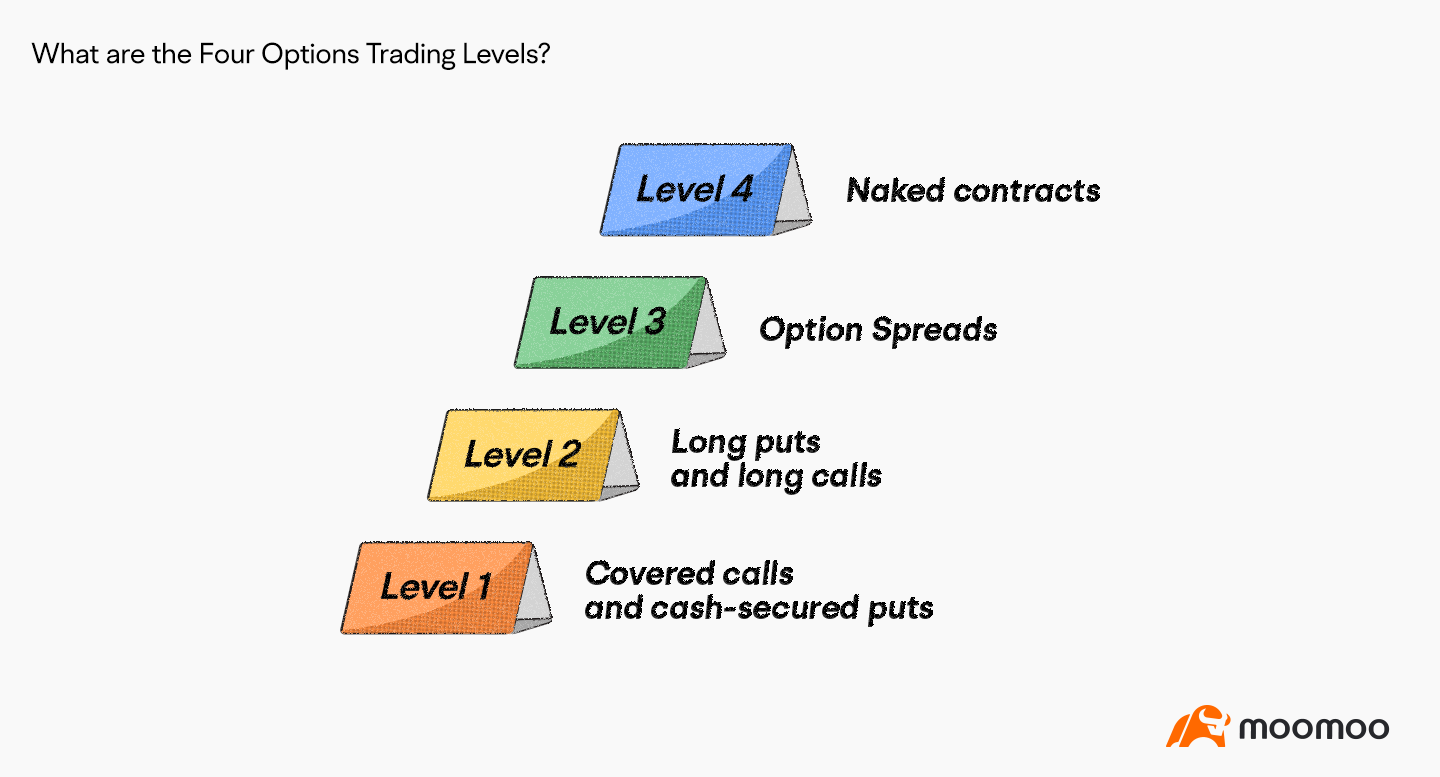
If you are getting started with options trading, you may have seen that your broker has several options trading levels, each with their own strategies. Reaching higher levels as an options trader gives you more flexibility with how you trade options and may potentially profit from stock price movements but may also come with greater potential risk of losses. Some traders want every options trading choice, while others prefer to only have the basics. Understanding how each options trading level works will help you determine which level makes sense for you.
Options trading levels help manage certain risks by giving new traders an opportunity to start with less complex options trading strategies. Every investment strategy carries risks, but Level 1 options trading strategies are generally less risky when compared to than Level 4 options trading strategies. You can start as a Level 1 options trader and potentially move up as you gain more experience. Some brokerage firms quiz you on options trading to assess your level, while others raise your level after you’ve had enough experience trading at the first level.
You can’t start trading options upon opening a brokerage account. Every trader must apply to trade options and specify which level they want. Level 1 options trading is typically the most common for new applicants. While you may get approved for Level 4 options trading on the first try, you may have to trade options at other levels before receiving Level 4 privileges. In general, these are the available options trading levels.
Level 1 lets you access covered calls and cash-secured puts. These strategies are generally less risky when compared to other advanced strategies and can be good for beginners. If you want to sell a covered call, you must have 100 shares of the underlying company. If you have a $50-per-share cost basis for 100 shares and sell a covered call with a $55 strike price, you have to sell your shares at $55 per share at expiration if the stock hits or exceeds $55 per share. If not, you get to keep the premium. Having the underlying shares before selling the call limits your losses and lets you get immediate income through the premium. However, there are two big risks of this strategy. Losing money if the stock price declines below the breakeven point and the opportunity risk of not participating on the upside in case of a large stock price rise past the strike price of the call option.
Level 2 trading lets you access long puts and calls. Puts are contracts that gain value when the underlying stock’s price decreases, while calls gain value when a stock experiences bullishness. The premium and strike price contributes to the investor’s break-even price point. If a trader buys a long call with a strike price of $75 and pays a $2 premium, that trader needs the stock price to reach $77 to break even. Anything above $77 represents a profit.
Some investors sell out of their long positions before the expiration date if the option has gained in value. As an option gets closer to its expiration date, it will lose value, especially if it is far out of the money. Traders need stock prices to move in their direction to compensate for an option contract’s time decay.
An options spread involves trading multiple options contracts of the same company. The strike prices and expiration dates vary depending on the trader’s objective. Traders using bull spreads will purchase a long call with a lower strike price. The trader will then lower the net cost by simultaneously selling a call with the same expiration date but a higher strike price.
An options trader lowers their cost for initiating the long position but also caps their
upside. Potential profit is limited to the difference between the long call strike price and the short call strike minus the net debit paid. A bull spread is one of the many spreads you can use once you become a Level 3 options trader.
Naked contracts are the highest level of options trading because of the risks. Only the most experienced options traders should use naked call contracts. These contracts are like covered calls and cash-secured puts but without the protection of having the underlying assets. .These traders can sell uncovered calls and puts to earn the premiums. A trader will have to raise enough funds before the expiration date to purchase 100 shares for a
naked call if it's exercised. Naked puts are risk defined when compared to naked calls. A naked call's theoretical risk is unlimited since there's no cap to how high a stock price can rise. A naked put 's potential loss is also substantial, but limited to the strike price minus the premium received if the stock goes to zero.
Each brokerage lets its clients apply for options trading. You will have to complete an application before accessing any options trading level. After filling out basic information and answering questions about options trading and your investment goals, your brokerage firm will assign an options trading level for your account. If you want a higher level among other requirements, you must first demonstrate your ability to trade options at your current level.
Brokerage firms establish options trading levels based on experience level and risk tolerance. Incurring more risk creates the opportunity for potentially higher returns, while lower levels provide less complex and more risk defined strategies. If you are just getting started with options trading, the first level can be a great starting point. This level gives you the opportunity to learn the basics. As you get better with options trading and feel more confident, you can reach out to your broker and request to trade at a higher level.
Follow these steps to apply for or update your option level on the moomoo app:
Step 1: Navigate to the option level section by going to: Accounts> Select an Account > More > Option Level
Step 2: On the option strategies introduction page, you can switch accounts and submit your application for or update of an option level. Note that margin accounts approved for Option Level 3 require at least $2,000 in assets, and Level 4 requires a minimum of $10,000 to trade the corresponding strategies.
Step 3: After submitting your application, moomoo will evaluate your account profile and desired option level. This evaluation may require you to update your investment information or schedule a call. First-time applicants must also read and sign the Risk Disclosure.
Step 4: Follow the on-page instructions to complete your application (steps may vary by individual). You can also apply for or update your option level via https://option.us.moomoo.com/index.
Experience is a good teacher, but it's good to build up your knowledge and start with a low level if you decide to pursue options trading. Understanding the available trading strategies at each level will help you acquire additional flexibility that aligns with your financial goals.
It depends on your risk tolerance and options trading experience. Level 1 options trading are generally less complex and the strategies are risk defined. Level 4 is generally better for people who have high-risk tolerances and are advanced option traders.
The first level is a great way to get started because traders at this level can only use covered calls and cash-secured puts. Be aware that each has their own risks. The risks for the covered call was covered above. For cash secured puts, the big risk is getting assigned and the stock price potentially falls drastically.
You should start at the first level to become familiar with how options trading works.
This presentation is for informational and educational use only and is not a recommendation or endorsement of any particular investment or investment strategy. Investment information provided in this content is general in nature, strictly for illustrative purposes, and may not be appropriate for all investors. Read more
Recommend
Moomoo Offers Extended Trading Hours for Options Trading on Oct 19
At-the-Money (ATM) - How It Works in Options Trading
Out-of-the-Money in Options Trading - How It Works & Examples

Covered Call: A Comprehensive Guide to Options Trading
Strangle Options Strategy - A Helpful Guide for Traders
Straddle vs. Strangle: Understanding the Key Differences
Triple Witching: Understanding Its Impact on the Stock Market
Underlying Asset: Definition, Types and Examples
What Are Option Premiums
Covered Calls and Covered Puts - Strategies for Options Trading
Expiration Date in Options Trading
Options Break-Even Point: Definition, Formula, and Examples
Credit Spread: Definition, Examples & How to Calculate
Bull Put Spread: Definitions, How It Works & Examples
How to Manage Your Risk in Options Trading
How to Pick the 'Right' Strike Price
Options Wheel Strategy Explained: Definition and How to Trade
Long Collar Options Strategy: Definition, How It Works & Examples
Long Call Options Strategy: Definition, Potential Benefits, and Risks
Exercise of Options: When and How to Exercise Options
Time Value: Definition, Calculation, Importance in Options Trading
Short Call Options Strategy: Guide & Examples
What Are Bitcoin ETF Options: Investment Insights & Strategies
Hedge with Options: Protect Your Portfolio in 2026
Options Chains: Definition, How to Read and Analyze Them
Options Profit Calculation: Overview, Formula & Examples
What is Theta in Options Trading: Overview and Strategies
Debit Spread: Definition, Types & Examples
Butterfly Spread: Definition and Application in Options Trading
What Is an Options Screener and How to Use?
Unusual Options Activity: Insights and Strategies for Traders
Protective Put Strategy: Definition, How It Works & Examples
What Are Stock Options: Types, How They Work and Examples
Weekly vs. Monthly Options: Choosing the Right Expiration Date
How to Practice Options Trading with Demo Trading Account
Sell to Open vs Sell to Close: Understanding the Difference
Long Put: Definition, Examples and How to Trade
Iron Condor: Understanding This Options Trading Strategy
Diagonal Spread: Definition, Types & How to Use
Implied Volatility (IV) Rank & Percentile in Options Trading
Trading Earnings with Options
Iron Butterfly: Mastering the Options Trading Strategy
Interest Rate Options: Definition & How They Work
Options Buy to Open vs Buy to Close: What's the difference?
Vertical Spread: Definition, Types, & Examples
Bear Put Spread: An Options Trading Strategy Explained
What is a Dividend Reinvestment Plan (DRIP)?
Put/Call Ratio (PCR): Definition & How to Use
How Are Options Priced? | Calculation and Examples
Naked Calls Options Strategy: Definition & How It Works
Options Vs. Futures: Understanding Their Key Differences
Extrinsic Value: Definition, Calculation, and Trading Strategies
Intrinsic Value: How It Works And How To Calculate It
Bull Call Spread - Examples and Applications in Options Trading
Index Options: Definitions, Strategies and Risks
Short Put Options: Strategies and Risks Explained
Quadruple Witching: How It Can Affect the Stock Market
What Are Options? Everything You Need to Know before Trading
Four Option Trading Strategies for Beginners
10 Options Strategies to Enhance Your Trading Portfolio
American Options vs. European Options
In-The-Money (ITM): Call and Put Options Examples
What is a Calendar Spread?
Open Interest: What it means for traders and investors
Options vs Stocks: Choosing the Right Investment Strategy
Options Strike Prices Explained: A Complete Guide for Beginners
Call vs Put Options: Your Essential Guide to the Basics
Zero Days to Expiration (0DTE) Options: Trade Mag 7 Stock Options Today
What Is An Options Contract? How Does It Work?
What is Synthetic Put? (How Does It Work)
How and When to Roll Covered Calls
Option Volume vs Open Interest: Understanding the Difference
4 Options Trading Levels
How to Trade Options for Beginners?
What Is Implied Volatility (IV)?
What Are Cash Secured Puts: How To Sell Them
What Is a Straddle Options Strategy?
What Is Ratio Spread in Options
What is a Call Option: Strategies and Tips
Taxes on Stocks: How Selling Stocks Affects Your Taxes
Option Greeks Explained - Option Greek Cheat Sheet
Put Options: Hedging Your Portfolio
Put Options: How to Use Them in Your Trading Strategy
Poor Man's Covered Call (PMCC): A Beginner's Guide
Four Option Trading Mistakes to Avoid
Trading Synthetic Options: Risks and Rewards
Call Spread vs. Put Spread: What are the differences?
What is stock options trading
What Is Margin Call and How Can You Avoid the Risks?
Options Trading Strategies: Iron Condor vs. Iron Butterfly
Moomoo Offers Extended Trading Hours for Options Trading on Oct 19
At-the-Money (ATM) - How It Works in Options Trading
Out-of-the-Money in Options Trading - How It Works & Examples
Covered Call: A Comprehensive Guide to Options Trading
Strangle Options Strategy - A Helpful Guide for Traders
Straddle vs. Strangle: Understanding the Key Differences
Triple Witching: Understanding Its Impact on the Stock Market
Underlying Asset: Definition, Types and Examples
What Are Option Premiums
Covered Calls and Covered Puts - Strategies for Options Trading
Expiration Date in Options Trading
Options Break-Even Point: Definition, Formula, and Examples
Credit Spread: Definition, Examples & How to Calculate
Bull Put Spread: Definitions, How It Works & Examples
How to Manage Your Risk in Options Trading
How to Pick the 'Right' Strike Price
Options Wheel Strategy Explained: Definition and How to Trade
Long Collar Options Strategy: Definition, How It Works & Examples
Long Call Options Strategy: Definition, Potential Benefits, and Risks
Exercise of Options: When and How to Exercise Options
Time Value: Definition, Calculation, Importance in Options Trading
Short Call Options Strategy: Guide & Examples
What Are Bitcoin ETF Options: Investment Insights & Strategies
Hedge with Options: Protect Your Portfolio in 2026
Options Chains: Definition, How to Read and Analyze Them
Options Profit Calculation: Overview, Formula & Examples
What is Theta in Options Trading: Overview and Strategies
Debit Spread: Definition, Types & Examples
Butterfly Spread: Definition and Application in Options Trading
What Is an Options Screener and How to Use?
Unusual Options Activity: Insights and Strategies for Traders
Protective Put Strategy: Definition, How It Works & Examples
What Are Stock Options: Types, How They Work and Examples
Weekly vs. Monthly Options: Choosing the Right Expiration Date
How to Practice Options Trading with Demo Trading Account
Sell to Open vs Sell to Close: Understanding the Difference
Long Put: Definition, Examples and How to Trade
Iron Condor: Understanding This Options Trading Strategy
Diagonal Spread: Definition, Types & How to Use
Implied Volatility (IV) Rank & Percentile in Options Trading
Trading Earnings with Options
Iron Butterfly: Mastering the Options Trading Strategy
Interest Rate Options: Definition & How They Work
Options Buy to Open vs Buy to Close: What's the difference?
Vertical Spread: Definition, Types, & Examples
Bear Put Spread: An Options Trading Strategy Explained
What is a Dividend Reinvestment Plan (DRIP)?
Put/Call Ratio (PCR): Definition & How to Use
How Are Options Priced? | Calculation and Examples
Naked Calls Options Strategy: Definition & How It Works
Options Vs. Futures: Understanding Their Key Differences
Extrinsic Value: Definition, Calculation, and Trading Strategies
Intrinsic Value: How It Works And How To Calculate It
Bull Call Spread - Examples and Applications in Options Trading
Index Options: Definitions, Strategies and Risks
Short Put Options: Strategies and Risks Explained
Quadruple Witching: How It Can Affect the Stock Market
What Are Options? Everything You Need to Know before Trading
Four Option Trading Strategies for Beginners
10 Options Strategies to Enhance Your Trading Portfolio
American Options vs. European Options
In-The-Money (ITM): Call and Put Options Examples
What is a Calendar Spread?
Open Interest: What it means for traders and investors
Options vs Stocks: Choosing the Right Investment Strategy
Options Strike Prices Explained: A Complete Guide for Beginners
Call vs Put Options: Your Essential Guide to the Basics
Zero Days to Expiration (0DTE) Options: Trade Mag 7 Stock Options Today
What Is An Options Contract? How Does It Work?
What is Synthetic Put? (How Does It Work)
How and When to Roll Covered Calls
Option Volume vs Open Interest: Understanding the Difference
4 Options Trading Levels
How to Trade Options for Beginners?
What Is Implied Volatility (IV)?
What Are Cash Secured Puts: How To Sell Them
What Is a Straddle Options Strategy?
What Is Ratio Spread in Options
What is a Call Option: Strategies and Tips
Taxes on Stocks: How Selling Stocks Affects Your Taxes
Option Greeks Explained - Option Greek Cheat Sheet
Put Options: Hedging Your Portfolio
Put Options: How to Use Them in Your Trading Strategy
Poor Man's Covered Call (PMCC): A Beginner's Guide
Four Option Trading Mistakes to Avoid
Trading Synthetic Options: Risks and Rewards
Call Spread vs. Put Spread: What are the differences?
What is stock options trading
What Is Margin Call and How Can You Avoid the Risks?
Options Trading Strategies: Iron Condor vs. Iron Butterfly

