


Moomoo Insights
Jul 16 15:38
TSMC Earnings: AI Demand Is Stronger Than the Chip Selloff Suggests
Moomoo Insights
Sep 30 05:04
Live Take | Anthropic’s $518B Compute Bet: Who Wins From the AI Buildout?
In the world of options trading, understanding the distinctions between American and European options is crucial. From this guide, learn about their features, differences, and how you might trade them more effectively.
When it comes to American options vs. European options, the main difference lies with their exercise rights and assignment. It's also important to note that these two option types can both be bought and/or sold at any time before expiration. Here's some more details.
American options grant holders the right to exercise their options at any point before expiration, offering flexibility in potentially capitalizing on market movements, which makes these options come with higher premiums while European options only allow exercise at expiration, limiting flexibility to capitalize on short-term fluctuations but offering lower premiums. Traders must assess their risk tolerance and trading strategies when choosing between the two.
American and European options are types of financial contracts granting the holder the right, but not the obligation, to buy or sell an underlying asset at a predetermined price within a specified timeframe. American options generally provide the holder flexibility through their ability to exercise at any time before expiration, while European options only permit exercise at expiration.
American options provide flexibility for both buyers and sellers. Buyers can exercise their options before expiration, allowing quick reactions to market changes and potential profits from favorable price movements. Sellers face numerous risks with an early exercise, including opportunity cost (losing interest that could be earned on their money), undergoing the impact of a potential risk or reward of the overall position, and uncertainty of share value.
For instance, a trader buying an American call option with a strike price of $50 on a stock currently trading at $55 may pay a premium of $5. If the market price rises to $60, the trader can exercise the option, and sell the shares immediately, earning a net profit of about $10 per share - the premium paid for the call option/s plus any commissions and fees.
European options offer relatively more simplicity for both buyers and sellers. They only allow exercise at expiration, simplifying decision-making and resulting generally in lower premiums than American options.
For instance, a trader purchasing a European call option with a strike price of $50 may pay a premium of $4. However, they cannot exercise the option until expiration, regardless of any favorable market movements before then. However, keep in mind that European-style options can still be closed out early if the price has appreciated in value or to limit further losses. Traders who prefer straightforward trading when compared to American-style options and are willing to forego early exercise rights may choose European options.

European and American options differ in key aspects. American options offer holders the flexibility to exercise at any time before expiration, while European options only offer the opportunity to exercise at expiration. European options commonly settle in cash at expiration, whereas American options may settle in cash or take delivery of the underlying asset, depending on the option's terms and the nature of the underlying asset. Additionally, the settlement price for European options relies on the underlying asset's expiration price, while American options may vary based on exercise timing.
American options provide holders with the right to exercise the option at any time before expiration, offering flexibility. This feature provides traders with potentially greater control over their positions and the ability to adjust their strategies as market conditions change. However, is not generally beneficial to exercise options early as you can lose any extrinsic (time) value. An investor may choose to do so in certain instances, such as in relation to dividend dates or with deep in-the-money options.
In contrast, European options only permit exercise at expiration, limiting flexibility and simplifying decision-making for traders.
European options typically settle in cash at expiration where the option holder receives the cash value of the option's intrinsic value. This cash settlement eliminates the need for physical delivery of the underlying asset, streamlining the settlement process. Keep in mind that index options are European-style options and will therefore undergo a cash settlement.
American options result in either cash settlement or physical delivery of the underlying asset. There are instances when the underlying shares from the option contract may not be delivered. This can occur if the holder submits a Do Not Exercise (DNE) within the appropriate timeframe or they don't have sufficient funds in the account to support the exercise.
This flexibility may help traders to choose an appropriate settlement method based on their trading objectives and market conditions.
For American options, the settlement price may vary depending on whether the option is exercised early. Options holders can choose to exercise their option whenever they believe the market conditions are most favorable, up until the expiration date. This means the settlement price is essentially the market price of the underlying asset at the time of exercise.
The settlement price for European options is determined at the close of trading on the expiration date. Since these options can only be exercised at expiration, the relevant market's closing price for the underlying asset is used as the settlement price. This is a more standardized approach, as all exercises of European options at expiration will use the same final market price to settle.
American-style options | European-style options | |
Underlying assets | Typically available for individual stocks, commodities, and ETFs | Commonly used for index options |
Exercise Rights | Can be exercised at any time before expiration | Can only be exercised at the expiration date |
Settlement | Settlement involves cash or physical delivery, depending on the contract | Typically settled in cash at expiration |
Settlement Price | Settlement price vary based on exercise timing | Settlement price based on the market price of the underlying asset |
Premiums | Generally higher premiums due to their early exercise advantage | Often lower premiums due to limited exercise rights |
Popularity | Widely traded due to flexibility, adaptability and underlying assets | Traded less compared to American options |
Risk | Higher potential risk due to early exercise rights | Reduced risk exposure due to lack of early exercise |
Hedging | Offers more flexibility to hedge against price movements because of their ability to be exercised any time up to their expiration |
|
Trading | May be appropriate for those desiring more contract and timing flexibility as well as volatile markets | May be appropriate for trading straightforward, time-specific hedges, providing a more calculated approach to managing financial risk. |
Moomoo provides a user-friendly platform for trading options. Here's a step-by-step guide:
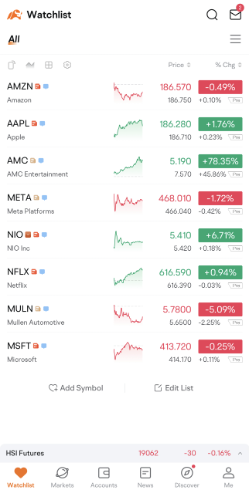
Step 1: Navigate to your Watchlist, then select a stock's "Detailed Quotes" page.
Disclaimer: Images provided are not current and any securities are shown for illustrative purposes only and is not a recommendation.
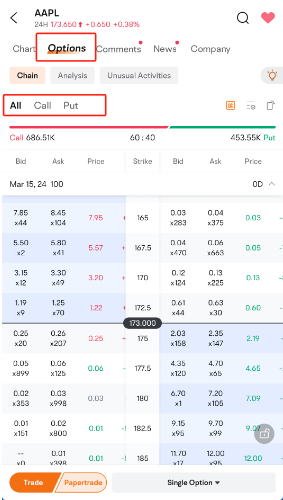
Step 2: Navigate to Options> Chain located at the top of the page.
Step 3: By default, all options with a specific expiration date are shown. For selective viewing of calls or puts, simply tap "Call/Put."
Disclaimer: Images provided are not current and any securities are shown for illustrative purposes only and is not a recommendation.
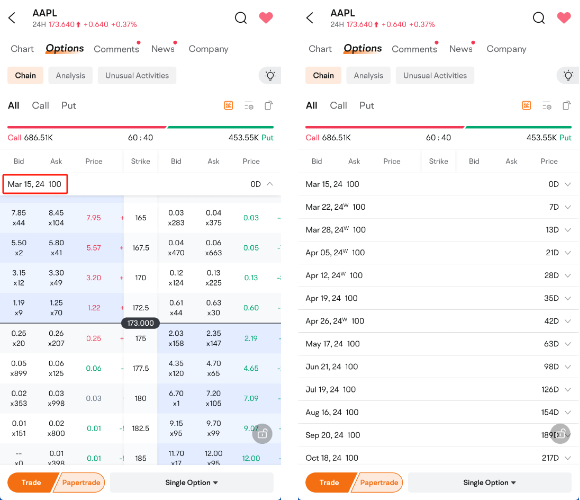
Step 4: Adjust the expiration date by choosing your preferred date from the menu.
Disclaimer: Images provided are not current and any securities are shown for illustrative purposes only and is not a recommendation.
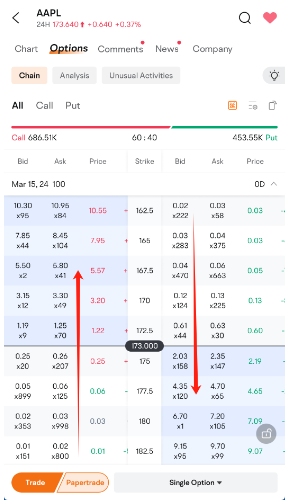
Step 5: Easily distinguish between options: white denotes out-of-the-money, and blue indicates in-the-money. Swipe horizontally to access additional option details.
Disclaimer: Images provided are not current and any securities are shown for illustrative purposes only and is not a recommendation.
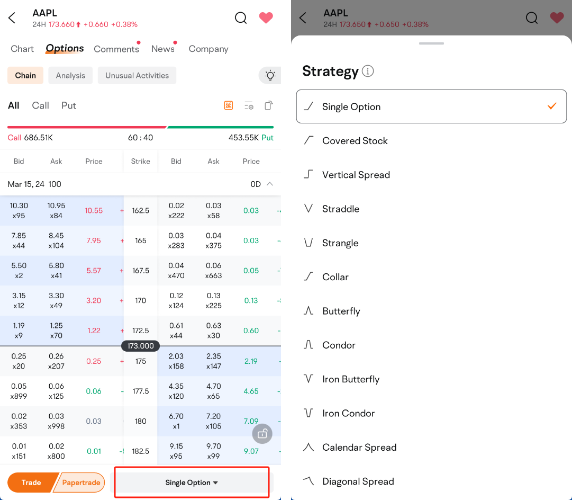
Step 6: Explore various trading strategies at the screen's bottom, offering flexibility for your investment approach.
Disclaimer: Images provided are not current and any securities are shown for illustrative purposes only and is not a recommendation.
Step 7: Select an option and tap enter to view detailed information at the bottom left corner (in this example with the red outline, it's AAPL 240426 162.5). Hit enter on this option and then scroll vertically to check if the options are American or European.
Disclaimer: Images provided are not current and any securities are shown for illustrative purposes only and is not a recommendation.
American-style options are financial derivatives that can be exercised at any time before expiration, as opposed to European-style options, which can only be exercised at expiration. Both option styles give the holder the right, but not the obligation, to buy (in the case of a call option) or sell (in the case of a put option) the underlying asset at a predetermined price (strike price) at any time before the option's expiration date.
An example of an American-style option is a call option for Apple Inc. (AAPL) with an expiration date of December (in the same year) and a $6 premium, while options on the S&P 500 index (SPX) is an example of a European-style option.
Investors choose these option types for different reasons and investment goals. Traders may weigh flexibility against cost when choosing between them.
Investors may find this information in the contract details provided by your broker or trading platform (for moomoo users, please see above in the section, "How to trade options on moomoo" to find these designations). Look for terms like "American-style" or "European-style" options. Additionally, verify the exercise rights of the option, as American options allow early exercise while European options do not.
American options offer flexibility with early exercise rights, allowing traders the potential to capitalize on market movements. This flexibility provides greater control over positions, enabling traders to adjust strategies and more actively manage risks.
No, European options cannot be exercised early. Unlike American options, which grant holders the right to exercise at any time before expiration, European options only permit exercise at expiration. This limitation can simplify decision-making for traders but reduces flexibility compared to American options.
This presentation is for informational and educational use only and is not a recommendation or endorsement of any particular investment or investment strategy. Investment information provided in this content is general in nature, strictly for illustrative purposes, and may not be appropriate for all investors. Read more
Recommend
Moomoo Offers Extended Trading Hours for Options Trading on Oct 19
At-the-Money (ATM) - How It Works in Options Trading
Out-of-the-Money in Options Trading - How It Works & Examples

Covered Call: A Comprehensive Guide to Options Trading
Strangle Options Strategy - A Helpful Guide for Traders
Straddle vs. Strangle: Understanding the Key Differences
Triple Witching: Understanding Its Impact on the Stock Market
Underlying Asset: Definition, Types and Examples
What Are Option Premiums
Covered Calls and Covered Puts - Strategies for Options Trading
Expiration Date in Options Trading
Options Break-Even Point: Definition, Formula, and Examples
Credit Spread: Definition, Examples & How to Calculate
Bull Put Spread: Definitions, How It Works & Examples
How to Manage Your Risk in Options Trading
How to Pick the 'Right' Strike Price
Options Wheel Strategy Explained: Definition and How to Trade
Long Collar Options Strategy: Definition, How It Works & Examples
Long Call Options Strategy: Definition, Potential Benefits, and Risks
Exercise of Options: When and How to Exercise Options
Time Value: Definition, Calculation, Importance in Options Trading
Short Call Options Strategy: Guide & Examples
What Are Bitcoin ETF Options: Investment Insights & Strategies
Hedge with Options: Protect Your Portfolio in 2026
Options Chains: Definition, How to Read and Analyze Them
Options Profit Calculation: Overview, Formula & Examples
What is Theta in Options Trading: Overview and Strategies
Debit Spread: Definition, Types & Examples
Butterfly Spread: Definition and Application in Options Trading
What Is an Options Screener and How to Use?
Unusual Options Activity: Insights and Strategies for Traders
Protective Put Strategy: Definition, How It Works & Examples
What Are Stock Options: Types, How They Work and Examples
Weekly vs. Monthly Options: Choosing the Right Expiration Date
How to Practice Options Trading with Demo Trading Account
Sell to Open vs Sell to Close: Understanding the Difference
Long Put: Definition, Examples and How to Trade
Iron Condor: Understanding This Options Trading Strategy
Diagonal Spread: Definition, Types & How to Use
Implied Volatility (IV) Rank & Percentile in Options Trading
Trading Earnings with Options
Iron Butterfly: Mastering the Options Trading Strategy
Interest Rate Options: Definition & How They Work
Options Buy to Open vs Buy to Close: What's the difference?
Vertical Spread: Definition, Types, & Examples
Bear Put Spread: An Options Trading Strategy Explained
What is a Dividend Reinvestment Plan (DRIP)?
Put/Call Ratio (PCR): Definition & How to Use
How Are Options Priced? | Calculation and Examples
Naked Calls Options Strategy: Definition & How It Works
Options Vs. Futures: Understanding Their Key Differences
Extrinsic Value: Definition, Calculation, and Trading Strategies
Intrinsic Value: How It Works And How To Calculate It
Bull Call Spread - Examples and Applications in Options Trading
Index Options: Definitions, Strategies and Risks
Short Put Options: Strategies and Risks Explained
Quadruple Witching: How It Can Affect the Stock Market
What Are Options? Everything You Need to Know before Trading
Four Option Trading Strategies for Beginners
10 Options Strategies to Enhance Your Trading Portfolio
American Options vs. European Options
In-The-Money (ITM): Call and Put Options Examples
What is a Calendar Spread?
Open Interest: What it means for traders and investors
Options vs Stocks: Choosing the Right Investment Strategy
Options Strike Prices Explained: A Complete Guide for Beginners
Call vs Put Options: Your Essential Guide to the Basics
Zero Days to Expiration (0DTE) Options: Trade Mag 7 Stock Options Today
What Is An Options Contract? How Does It Work?
What is Synthetic Put? (How Does It Work)
How and When to Roll Covered Calls
Option Volume vs Open Interest: Understanding the Difference
4 Options Trading Levels
How to Trade Options for Beginners?
What Is Implied Volatility (IV)?
What Are Cash Secured Puts: How To Sell Them
What Is a Straddle Options Strategy?
What Is Ratio Spread in Options
What is a Call Option: Strategies and Tips
Taxes on Stocks: How Selling Stocks Affects Your Taxes
Option Greeks Explained - Option Greek Cheat Sheet
Put Options: Hedging Your Portfolio
Put Options: How to Use Them in Your Trading Strategy
Poor Man's Covered Call (PMCC): A Beginner's Guide
Four Option Trading Mistakes to Avoid
Trading Synthetic Options: Risks and Rewards
Call Spread vs. Put Spread: What are the differences?
What is stock options trading
What Is Margin Call and How Can You Avoid the Risks?
Options Trading Strategies: Iron Condor vs. Iron Butterfly
Moomoo Offers Extended Trading Hours for Options Trading on Oct 19
At-the-Money (ATM) - How It Works in Options Trading
Out-of-the-Money in Options Trading - How It Works & Examples
Covered Call: A Comprehensive Guide to Options Trading
Strangle Options Strategy - A Helpful Guide for Traders
Straddle vs. Strangle: Understanding the Key Differences
Triple Witching: Understanding Its Impact on the Stock Market
Underlying Asset: Definition, Types and Examples
What Are Option Premiums
Covered Calls and Covered Puts - Strategies for Options Trading
Expiration Date in Options Trading
Options Break-Even Point: Definition, Formula, and Examples
Credit Spread: Definition, Examples & How to Calculate
Bull Put Spread: Definitions, How It Works & Examples
How to Manage Your Risk in Options Trading
How to Pick the 'Right' Strike Price
Options Wheel Strategy Explained: Definition and How to Trade
Long Collar Options Strategy: Definition, How It Works & Examples
Long Call Options Strategy: Definition, Potential Benefits, and Risks
Exercise of Options: When and How to Exercise Options
Time Value: Definition, Calculation, Importance in Options Trading
Short Call Options Strategy: Guide & Examples
What Are Bitcoin ETF Options: Investment Insights & Strategies
Hedge with Options: Protect Your Portfolio in 2026
Options Chains: Definition, How to Read and Analyze Them
Options Profit Calculation: Overview, Formula & Examples
What is Theta in Options Trading: Overview and Strategies
Debit Spread: Definition, Types & Examples
Butterfly Spread: Definition and Application in Options Trading
What Is an Options Screener and How to Use?
Unusual Options Activity: Insights and Strategies for Traders
Protective Put Strategy: Definition, How It Works & Examples
What Are Stock Options: Types, How They Work and Examples
Weekly vs. Monthly Options: Choosing the Right Expiration Date
How to Practice Options Trading with Demo Trading Account
Sell to Open vs Sell to Close: Understanding the Difference
Long Put: Definition, Examples and How to Trade
Iron Condor: Understanding This Options Trading Strategy
Diagonal Spread: Definition, Types & How to Use
Implied Volatility (IV) Rank & Percentile in Options Trading
Trading Earnings with Options
Iron Butterfly: Mastering the Options Trading Strategy
Interest Rate Options: Definition & How They Work
Options Buy to Open vs Buy to Close: What's the difference?
Vertical Spread: Definition, Types, & Examples
Bear Put Spread: An Options Trading Strategy Explained
What is a Dividend Reinvestment Plan (DRIP)?
Put/Call Ratio (PCR): Definition & How to Use
How Are Options Priced? | Calculation and Examples
Naked Calls Options Strategy: Definition & How It Works
Options Vs. Futures: Understanding Their Key Differences
Extrinsic Value: Definition, Calculation, and Trading Strategies
Intrinsic Value: How It Works And How To Calculate It
Bull Call Spread - Examples and Applications in Options Trading
Index Options: Definitions, Strategies and Risks
Short Put Options: Strategies and Risks Explained
Quadruple Witching: How It Can Affect the Stock Market
What Are Options? Everything You Need to Know before Trading
Four Option Trading Strategies for Beginners
10 Options Strategies to Enhance Your Trading Portfolio
American Options vs. European Options
In-The-Money (ITM): Call and Put Options Examples
What is a Calendar Spread?
Open Interest: What it means for traders and investors
Options vs Stocks: Choosing the Right Investment Strategy
Options Strike Prices Explained: A Complete Guide for Beginners
Call vs Put Options: Your Essential Guide to the Basics
Zero Days to Expiration (0DTE) Options: Trade Mag 7 Stock Options Today
What Is An Options Contract? How Does It Work?
What is Synthetic Put? (How Does It Work)
How and When to Roll Covered Calls
Option Volume vs Open Interest: Understanding the Difference
4 Options Trading Levels
How to Trade Options for Beginners?
What Is Implied Volatility (IV)?
What Are Cash Secured Puts: How To Sell Them
What Is a Straddle Options Strategy?
What Is Ratio Spread in Options
What is a Call Option: Strategies and Tips
Taxes on Stocks: How Selling Stocks Affects Your Taxes
Option Greeks Explained - Option Greek Cheat Sheet
Put Options: Hedging Your Portfolio
Put Options: How to Use Them in Your Trading Strategy
Poor Man's Covered Call (PMCC): A Beginner's Guide
Four Option Trading Mistakes to Avoid
Trading Synthetic Options: Risks and Rewards
Call Spread vs. Put Spread: What are the differences?
What is stock options trading
What Is Margin Call and How Can You Avoid the Risks?
Options Trading Strategies: Iron Condor vs. Iron Butterfly

