

Moomoo Insights
Jul 16 15:38
TSMC Earnings: AI Demand Is Stronger Than the Chip Selloff Suggests
Moomoo Insights
Sep 30 05:04
Live Take | Anthropic’s $518B Compute Bet: Who Wins From the AI Buildout?
In options trading, the short call options strategy is when investors write (or sell) call options on stocks to collect a premium upfront. With this bearish strategy, the options traders' belief is that the underlying stock prices will either drop or remain relatively stable.
A short call strategy is when traders write call options in the hopes of profiting from retaining the premium with the options contract expiring worthless as they desire the underlying asset's price will not rise above the strike price before the option expires.
In a covered call, the short call option is secondary to the long position in the underlying stock. In this case, you may want the underlying to increase in value (in-the-money) and potentially cause your short call to be assigned. This would call away the shares you own and cap your profit at the strike price.
Keep in mind that short call options can be either covered or uncovered calls (naked calls) with the latter being extremely risky, potentially resulting in unlimited losses for the call option writer if the underlying security's price keeps rising.
The short call strategy allows for call option writers to potentially profit from the contract premium. If a call option is exercised, the writer is assigned short on the underlying stock. However, if the call seller already owned the stock, it would be considered a covered call.
The ultimate goal of the short call strategy is for option writers to profit from neutral or bearish price action. For option writers, the profit potential is limited to the premium collected.
For call option buyers, the goal is to make a profit despite having to pay the premium, by exercising their option to buy the securities for less than they're trading for on the market and then selling them at the higher market price.
For short call option writers, the maximum profit is limited to the premium collected from the option buyer.
The maximum risk for short call option writers differs depending on if they already own the securities they're writing contracts for. With naked calls, the theoretical maximum loss is unlimited because the stock can continue to rise infinitely.
In contrast, short call options written while owning the underlying security are called covered calls. With covered calls, there is a risk of the shareholder limiting his potential profit and possibly losing shares, if they are called away through assignment, that he may feel bullish about the longer-term. Additionally, with covered calls, there is also a limited but still significant theoretical maximum loss of the stock dropping to zero.
The breakeven stock price for a short call (naked) is the Strike Price + Premium received from the option buyer.
For example, if you sell a call option:
• Strike Price: $20
• Premium received: $10 per share (*The premium price depends on the time to expiration, relative volatility, and proximity to being close to, or already ITM.)
Therefore, the breakeven stock price at expiration for the short call option is:
$20+$10=$30
If the stock price is below $30 when the option contract expires, the short call position may result in a profit for the contract writer.

You own one of Company XYZ's standard options contract, which generally represents 100 shares of the underlying stock. At the moment, Company XYZ's shares trade at $100, but based on your chart and other technical analysis, you are confident that the price will decline to $95 a share.
As a result, you decide to sell a call with a strike price of $115 and a $2 premium. Upfront, you receive a net premium credit of $200 ($2 premium x 100 shares of the standard options contract).
Your projection of Company XYZ's stock price ends up being right, with the stock price dropping. The calls therefore are unexercised and expire worthless, so you get to keep the premium as profit. That's the best case scenario.
It's important to be aware of the worst case scenario as well, which is that your analysis is wrong: Company XYZ's shares continue to go up, rather than down. This would create unlimited risk for you because however high the share price might go until the expiration date, you would still have to cover the cost. For instance, if the share price increased to $300 per share, your call holder would exercise the option to buy the shares at the $115 strike price. Per the contract, you would have to deliver the 100 shares at the current market price of $300 per share.
In this scenario, the result would be:
Buy 100 shares at the current $300 per share = $30,000
Receive $115 per share from buyer = $11,500
Loss to trader is $30,000 - $11,500 = $18,500
$18,500 loss minus $200 premium = $18,300
Moomoo provides a user-friendly options trading platform. Here's a step-by-step guide for options traders:
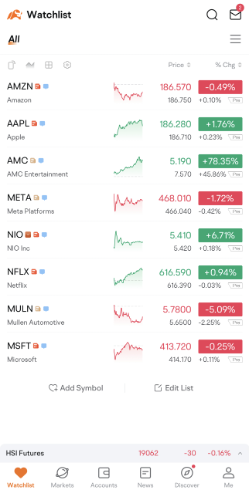
Step 1: Go to to a stock on your Watchlist and select its "Detailed Quotes" page.
Images provided are not current and any securities are shown for illustrative purposes only and is not a recommendation.
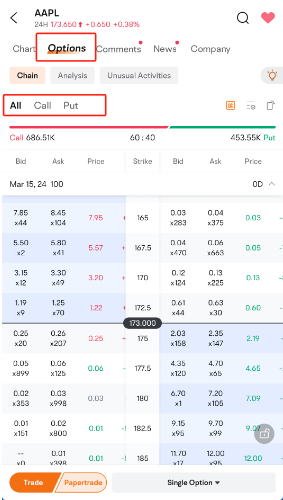
Step 2: Navigate to Options> Chain located at the top of the page.
Step 3: All options with a specific expiration date are displayed by default. To view just calls or puts, tap "Call/Put."
Images provided are not current and any securities are shown for illustrative purposes only and is not a recommendation.
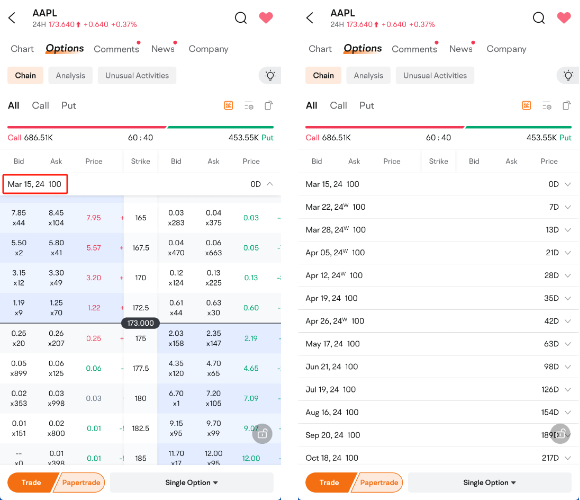
Step 4: Adjust the expiration date by choosing your preferred date from the menu.
Images provided are not current and any securities are shown for illustrative purposes only and is not a recommendation.
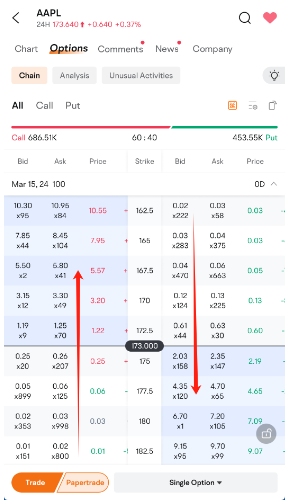
Step 5: To see out-of-the money options, you can view them in white, while in-the-money options are displayed in blue. To see more information about available options, scroll horizontally.
Images provided are not current and any securities are shown for illustrative purposes only and is not a recommendation.
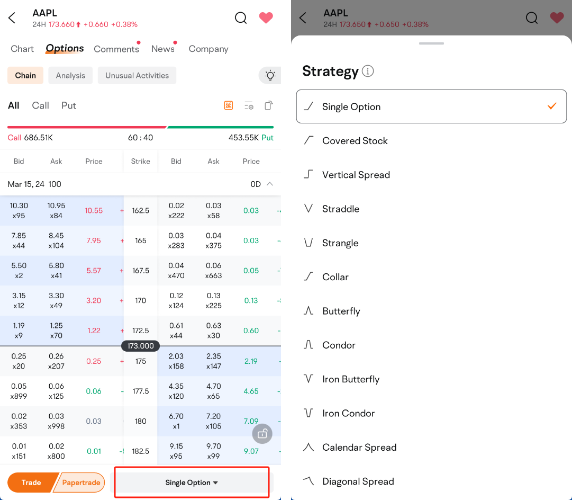
Step 6: At the bottom of the screen, you can switch between different trading strategies.
Images provided are not current and any securities are shown for illustrative purposes only and is not a recommendation.
The potential profitability and risks of the short call option strategy in options trading can be impacted by several factors, including:
Underlying stock price movement:
The primary factor influencing a short call position is the movement of the underlying stock's price relative to the strike price of the call option.
Strike price selection:
The strike price of the chosen call option affects both the premium received and the likelihood of the option being exercised.
Time decay (Theta Decay):
As time passes, the value of options tends to decrease, especially as expiration approaches. This phenomenon is known as time decay or theta decay.
Volatility (Vega):
Vega directly relates to implied volatility. Vega measures the amount of increase or decrease in an option premium based on a 1% change in implied volatility.
Market sentiment and events:
Public sentiment on unexpected events can impact the price of the underlying stock.
Current events and financial disclosures, such as earnings reports, can all influence stock prices and volatility levels.
With short call options and options trading in general, the "underlying price change" usually refers to the underlying stock prices' changes relative to the strike price.
Here's some examples of how the underlying change usually impacts a short call option strategy:
Below the strike price (Out-of-the-money):
If the price of the underlying stock remains below the strike price of the short call option throughout its life, the option will generally expire worthless.
The seller of the short call option keeps the premium received initially as profit. This outcome is favorable for the short call seller because they secure a profit and do not need to deliver the underlying stock.
Above the strike price (In-the-money):
If the price of the underlying stock rises above the strike price of the short call option, the option may be exercised by the buyer.
As a result, the seller of the short call option may be assigned and required to sell the underlying stock at the strike price, regardless of the current market price.
This situation can lead to potentially unlimited losses for the short call seller, as they may need to buy back the stock at a higher market price.
Near the strike price:
When the price of the underlying stock is close to the strike price of the short call option, the outcome can depend on factors such as time remaining until expiration, volatility, and the cost of buying back the option.
You may choose to manage your position by rolling the option (closing the current position and realizing a gain or loss, then opening a new one with different terms), or taking other actions based on your outlook and risk tolerance.
Impact of volatility and time decay:
Volatility and time decay (theta decay) are additional factors that influence the profit potential of short call options.
Higher volatility can increase the premiums of options, potentially benefiting the seller if the underlying stock price remains below the strike price. However, if volatility increases after the sale of the option contract and before its expiration, it could be detrimental to the option seller.
Time decay usually works in favor of the seller of options, as options lose value as expiration approaches, assuming other factors remain constant.
Volatility plays a crucial role in options trading.
Premiums and pricing: When volatility increases, the premium you receive for selling a call option (short call) tends to increase as well. Conversely, lower volatility leads to lower premiums.
Risk exposure: Short calls involve taking on the obligation to sell the underlying asset at the strike price if the option is exercised by the buyer. Higher volatility can increase the likelihood of the underlying price moving significantly, potentially resulting in the option being exercised and you having to sell the asset at a lower price than the current market price. The increased volatility thus tends to increase the risk of assignment for short call positions.
Strategy adjustments: Traders often adjust their strategies based on volatility levels. For instance, during periods of high volatility, option traders might be more inclined to sell options (including short calls) aiming to benefit from relatively higher premiums. However, they may also need to adjust their risk management strategies more actively due to the increased potential for large price swings.
Implied vs. historical volatility: Implied volatility (the market's expectation of future volatility) is particularly relevant for options pricing. If implied volatility increases after you sell a short call, the market is anticipating greater price swings, which can impact the option's value and thus your potential profit or loss.
Time decay (theta decay) is a critical concept in options trading.
Options premium reduction: Time decay is the erosion of the extrinsic value of an option as it approaches its expiration date. Extrinsic value comprises the portion of an option's premium that is not innate or intrinsic (the difference between the strike price and the current price of the underlying asset for in-the-money options). As time passes, all else being equal, the extrinsic value of an option decreases. This means that the option premium decreases as expiration approaches, impacting both buyers and sellers.
Accelerated decay closer to expiration: Time decay accelerates as an option approaches expiration. This phenomenon is particularly pronounced in the last few days before expiration. Options generally lose value more rapidly the closer they are to expiration, which can affect the potential profitability of options positions.
Impact on Option Buyers: For option buyers, regardless of whether they're buying calls or puts, time decay is detrimental. If the price of the underlying asset doesn't move in the anticipated direction, the option can lose value simply due to time passing, even if the underlying price doesn't change.
Impact on Option Sellers: For option sellers, time decay generally works in their favor. As time passes, the option they sold tends to lose value, potentially allowing them to buy it back at a lower price or let it expire worthless to keep the premium received.
Strategic Considerations: Traders and investors need to take time decay into mind when planning options strategies. Long-term options (with farther expiration dates) are less affected initially by time decay compared to short-term options.
As you can probably guess, multiple factors impact the efficacy of options trading. Besides the factors already discussed, with option trading, you should also consider:
Strike price selection: For example, the strike price is the price at which the short call is sold and it determines the level at which the seller would potentially have to sell the underlying asset if the option is exercised. You can choose strike prices based on technical analysis, potential support and resistance levels, or your outlook on the underlying asset's price movement.
Interest rates: Interest rates can impact options pricing. Changes in interest rates can affect the cost of carry for the underlying asset and influence options pricing models.
Dividends: If the underlying asset pays dividends, it can affect options pricing. A significant dividend payment can lower the price of the underlying asset, potentially impacting short call positions. Dividends can also lead to an early assignment. Option writers should continuously monitor for that risk.
When considering short call options trading, it's important to carefully think over the pros and cons of the strategy, because only you know your financial circumstances and goals fully. Here are some things to consider:
Pros:
Potential income generation: Selling short calls allows traders to collect premiums upfront to generate potential income. This premium can be kept as profit if the option expires worthless (out of the money).
Time decay advantage: Time decay (theta decay) works in favor of the seller of options. As time passes, all else being equal, the value of the option decreases, allowing the seller to potentially buy it back at a lower price or let it expire worthless.
Strategy diversification: Short calls can be part of a diversified options trading strategy. They can complement other strategies such as bull call spreads and married puts.
Cons
Unlimited risk: Remember that one of the major risks of selling short naked calls is the potential for unlimited losses if the underlying asset's price rises sharply above the strike price. In such cases, the seller is obligated to sell the asset at the lower strike price, resulting in substantial losses.
Margin requirements: Depending on the brokerage and the specific circumstances, selling short calls may have stricter margin requirements, tying up capital or requiring margin maintenance if the position moves against the trader.
Opportunity cost of profit potential: Selling short calls puts a ceiling on the potential profit received: it's the premium received when selling the call option. If the underlying stock's price drops significantly before the expiration date, the seller would miss out on the potential gains from holding a short position in the stock or using alternative strategies.
Market timing risk: Short calls require careful market timing and analysis. Selling calls in a strongly bullish market or during periods of high volatility is extremely risky, as the likelihood of the underlying asset's price exceeding the strike price increases.
Assignment risk: There's always a risk of early assignment with short options positions. However, typically this is more of a concern with in-the-money options that are also close to expiration. Early assignment can disrupt trading plans and lead to unexpected losses or gains.
A short and long call are opposite sides of a transaction. One of the main differences is that in a short call position, the trader is the seller (writer) of the call option, while in a long call position, the trader is the buyer of the call option.
When you're thinking about whether to trade a short or long call, keep in mind your risk tolerance, and the market conditions and outlook. Key differences:
Short Call | Long Call | |
Position | Trader is the seller (writer) of the call option. | Trader is the buyer (holder) of the call option. |
Obligation/Right | Seller has the obligation to sell the underlying asset (security) at the strike price if the option is exercised by the buyer. | Buyer has the right, but not the obligation to buy the underlying asset at the strike price if they choose to exercise the option. |
Profit Potential | Limited to the premium collected. | Theoretically unlimited because there's no ceiling for how high the security price can rise. |
Risk | Extremely high. Potential Loss is unlimited. | Limited to the premium paid, assuming no exercise. |
Time Decay | Time decay (theta) works in favor of the seller. As time passes and assuming the underlying asset's price remains below the strike price, the option tends to lose value, allowing the seller to potentially buy it back at a lower price or let it expire worthless. | Time decay (theta) works against the buyer of a long call option. As time passes, all else being equal, the option loses value, potentially reducing the buyer's profit potential or increasing their loss if the underlying asset's price does not move in the buyer's favor. |
Depending on the context, a naked call and a short call can be used interchangeably since both call options involve the seller not owning the security or stock that they're writing contracts for.
However, the slight and de facto difference is that a naked call implies that the seller has not taken any measures to hedge against the unlimited risks of the price rising sharply above the strike price.
You should consider your financial circumstances, risk tolerance, market outlook, and specific trading objectives (such as generating income or hedging) when deciding whether to short a call or go long on a put.
Fundamentally, shorting a call allows you to collect a premium upfront and can be beneficial in neutral to bearish markets.
If you're in, or believe you will soon be in strongly bearish market conditions, going long on (or buying) a put option may make sense. Going long can also make sense if you're looking to hedge riskier strategies.
This presentation is for informational and educational use only and is not a recommendation or endorsement of any particular investment or investment strategy. Investment information provided in this content is general in nature, strictly for illustrative purposes, and may not be appropriate for all investors. Read more
Recommend
Moomoo Offers Extended Trading Hours for Options Trading on Oct 19
At-the-Money (ATM) - How It Works in Options Trading
Out-of-the-Money in Options Trading - How It Works & Examples

Covered Call: A Comprehensive Guide to Options Trading
Strangle Options Strategy - A Helpful Guide for Traders
Straddle vs. Strangle: Understanding the Key Differences
Triple Witching: Understanding Its Impact on the Stock Market
Underlying Asset: Definition, Types and Examples
What Are Option Premiums
Covered Calls and Covered Puts - Strategies for Options Trading
Expiration Date in Options Trading
Options Break-Even Point: Definition, Formula, and Examples
Credit Spread: Definition, Examples & How to Calculate
Bull Put Spread: Definitions, How It Works & Examples
How to Manage Your Risk in Options Trading
How to Pick the 'Right' Strike Price
Options Wheel Strategy Explained: Definition and How to Trade
Long Collar Options Strategy: Definition, How It Works & Examples
Long Call Options Strategy: Definition, Potential Benefits, and Risks
Exercise of Options: When and How to Exercise Options
Time Value: Definition, Calculation, Importance in Options Trading
Short Call Options Strategy: Guide & Examples
What Are Bitcoin ETF Options: Investment Insights & Strategies
Hedge with Options: Protect Your Portfolio in 2026
Options Chains: Definition, How to Read and Analyze Them
Options Profit Calculation: Overview, Formula & Examples
What is Theta in Options Trading: Overview and Strategies
Debit Spread: Definition, Types & Examples
Butterfly Spread: Definition and Application in Options Trading
What Is an Options Screener and How to Use?
Unusual Options Activity: Insights and Strategies for Traders
Protective Put Strategy: Definition, How It Works & Examples
What Are Stock Options: Types, How They Work and Examples
Weekly vs. Monthly Options: Choosing the Right Expiration Date
How to Practice Options Trading with Demo Trading Account
Sell to Open vs Sell to Close: Understanding the Difference
Long Put: Definition, Examples and How to Trade
Iron Condor: Understanding This Options Trading Strategy
Diagonal Spread: Definition, Types & How to Use
Implied Volatility (IV) Rank & Percentile in Options Trading
Trading Earnings with Options
Iron Butterfly: Mastering the Options Trading Strategy
Interest Rate Options: Definition & How They Work
Options Buy to Open vs Buy to Close: What's the difference?
Vertical Spread: Definition, Types, & Examples
Bear Put Spread: An Options Trading Strategy Explained
What is a Dividend Reinvestment Plan (DRIP)?
Put/Call Ratio (PCR): Definition & How to Use
How Are Options Priced? | Calculation and Examples
Naked Calls Options Strategy: Definition & How It Works
Options Vs. Futures: Understanding Their Key Differences
Extrinsic Value: Definition, Calculation, and Trading Strategies
Intrinsic Value: How It Works And How To Calculate It
Bull Call Spread - Examples and Applications in Options Trading
Index Options: Definitions, Strategies and Risks
Short Put Options: Strategies and Risks Explained
Quadruple Witching: How It Can Affect the Stock Market
What Are Options? Everything You Need to Know before Trading
Four Option Trading Strategies for Beginners
10 Options Strategies to Enhance Your Trading Portfolio
American Options vs. European Options
In-The-Money (ITM): Call and Put Options Examples
What is a Calendar Spread?
Open Interest: What it means for traders and investors
Options vs Stocks: Choosing the Right Investment Strategy
Options Strike Prices Explained: A Complete Guide for Beginners
Call vs Put Options: Your Essential Guide to the Basics
Zero Days to Expiration (0DTE) Options: Trade Mag 7 Stock Options Today
What Is An Options Contract? How Does It Work?
What is Synthetic Put? (How Does It Work)
How and When to Roll Covered Calls
Option Volume vs Open Interest: Understanding the Difference
4 Options Trading Levels
How to Trade Options for Beginners?
What Is Implied Volatility (IV)?
What Are Cash Secured Puts: How To Sell Them
What Is a Straddle Options Strategy?
What Is Ratio Spread in Options
What is a Call Option: Strategies and Tips
Taxes on Stocks: How Selling Stocks Affects Your Taxes
Option Greeks Explained - Option Greek Cheat Sheet
Put Options: Hedging Your Portfolio
Put Options: How to Use Them in Your Trading Strategy
Poor Man's Covered Call (PMCC): A Beginner's Guide
Four Option Trading Mistakes to Avoid
Trading Synthetic Options: Risks and Rewards
Call Spread vs. Put Spread: What are the differences?
What is stock options trading
What Is Margin Call and How Can You Avoid the Risks?
Options Trading Strategies: Iron Condor vs. Iron Butterfly
Moomoo Offers Extended Trading Hours for Options Trading on Oct 19
At-the-Money (ATM) - How It Works in Options Trading
Out-of-the-Money in Options Trading - How It Works & Examples
Covered Call: A Comprehensive Guide to Options Trading
Strangle Options Strategy - A Helpful Guide for Traders
Straddle vs. Strangle: Understanding the Key Differences
Triple Witching: Understanding Its Impact on the Stock Market
Underlying Asset: Definition, Types and Examples
What Are Option Premiums
Covered Calls and Covered Puts - Strategies for Options Trading
Expiration Date in Options Trading
Options Break-Even Point: Definition, Formula, and Examples
Credit Spread: Definition, Examples & How to Calculate
Bull Put Spread: Definitions, How It Works & Examples
How to Manage Your Risk in Options Trading
How to Pick the 'Right' Strike Price
Options Wheel Strategy Explained: Definition and How to Trade
Long Collar Options Strategy: Definition, How It Works & Examples
Long Call Options Strategy: Definition, Potential Benefits, and Risks
Exercise of Options: When and How to Exercise Options
Time Value: Definition, Calculation, Importance in Options Trading
Short Call Options Strategy: Guide & Examples
What Are Bitcoin ETF Options: Investment Insights & Strategies
Hedge with Options: Protect Your Portfolio in 2026
Options Chains: Definition, How to Read and Analyze Them
Options Profit Calculation: Overview, Formula & Examples
What is Theta in Options Trading: Overview and Strategies
Debit Spread: Definition, Types & Examples
Butterfly Spread: Definition and Application in Options Trading
What Is an Options Screener and How to Use?
Unusual Options Activity: Insights and Strategies for Traders
Protective Put Strategy: Definition, How It Works & Examples
What Are Stock Options: Types, How They Work and Examples
Weekly vs. Monthly Options: Choosing the Right Expiration Date
How to Practice Options Trading with Demo Trading Account
Sell to Open vs Sell to Close: Understanding the Difference
Long Put: Definition, Examples and How to Trade
Iron Condor: Understanding This Options Trading Strategy
Diagonal Spread: Definition, Types & How to Use
Implied Volatility (IV) Rank & Percentile in Options Trading
Trading Earnings with Options
Iron Butterfly: Mastering the Options Trading Strategy
Interest Rate Options: Definition & How They Work
Options Buy to Open vs Buy to Close: What's the difference?
Vertical Spread: Definition, Types, & Examples
Bear Put Spread: An Options Trading Strategy Explained
What is a Dividend Reinvestment Plan (DRIP)?
Put/Call Ratio (PCR): Definition & How to Use
How Are Options Priced? | Calculation and Examples
Naked Calls Options Strategy: Definition & How It Works
Options Vs. Futures: Understanding Their Key Differences
Extrinsic Value: Definition, Calculation, and Trading Strategies
Intrinsic Value: How It Works And How To Calculate It
Bull Call Spread - Examples and Applications in Options Trading
Index Options: Definitions, Strategies and Risks
Short Put Options: Strategies and Risks Explained
Quadruple Witching: How It Can Affect the Stock Market
What Are Options? Everything You Need to Know before Trading
Four Option Trading Strategies for Beginners
10 Options Strategies to Enhance Your Trading Portfolio
American Options vs. European Options
In-The-Money (ITM): Call and Put Options Examples
What is a Calendar Spread?
Open Interest: What it means for traders and investors
Options vs Stocks: Choosing the Right Investment Strategy
Options Strike Prices Explained: A Complete Guide for Beginners
Call vs Put Options: Your Essential Guide to the Basics
Zero Days to Expiration (0DTE) Options: Trade Mag 7 Stock Options Today
What Is An Options Contract? How Does It Work?
What is Synthetic Put? (How Does It Work)
How and When to Roll Covered Calls
Option Volume vs Open Interest: Understanding the Difference
4 Options Trading Levels
How to Trade Options for Beginners?
What Is Implied Volatility (IV)?
What Are Cash Secured Puts: How To Sell Them
What Is a Straddle Options Strategy?
What Is Ratio Spread in Options
What is a Call Option: Strategies and Tips
Taxes on Stocks: How Selling Stocks Affects Your Taxes
Option Greeks Explained - Option Greek Cheat Sheet
Put Options: Hedging Your Portfolio
Put Options: How to Use Them in Your Trading Strategy
Poor Man's Covered Call (PMCC): A Beginner's Guide
Four Option Trading Mistakes to Avoid
Trading Synthetic Options: Risks and Rewards
Call Spread vs. Put Spread: What are the differences?
What is stock options trading
What Is Margin Call and How Can You Avoid the Risks?
Options Trading Strategies: Iron Condor vs. Iron Butterfly

