Protective Call
You may consider using a protective call strategy when you expect the stock to fall sharply and want to limit the upside risk simultaneously.
Construction of the strategy
A protective call involves two trades:
● Short 100 shares of a stock
● Buy a call
The number of shares shorted equals the number of shares call options represent.
Brief description
The protective call strategy combines a short stock position and a long call.
If the underlying falls sharply, traders using this strategy will benefit from the short position. The potential return on the protective call strategy will be slightly lower than only shorting the underlying because of the call premium paid.
If the security price rises sharply and goes higher than the call's strike price, traders can exercise the call option and buy the stock at the strike price. This is where the strategy's name "protective" comes from, i.e., protecting the short position.
This strategy is not widely used because it involves shorting a stock. Even though a protective call can cap the potentially unlimited losses of the short position, shorting the stock still requires a margin account which will incur high interest.
An investor generally does not use this strategy unless he is experienced and confident that the stock will fall quickly.
Generally, seasoned traders might consider this strategy when they are confident about their judgment that the stock will fall sharply in the near term.
Gain & Loss
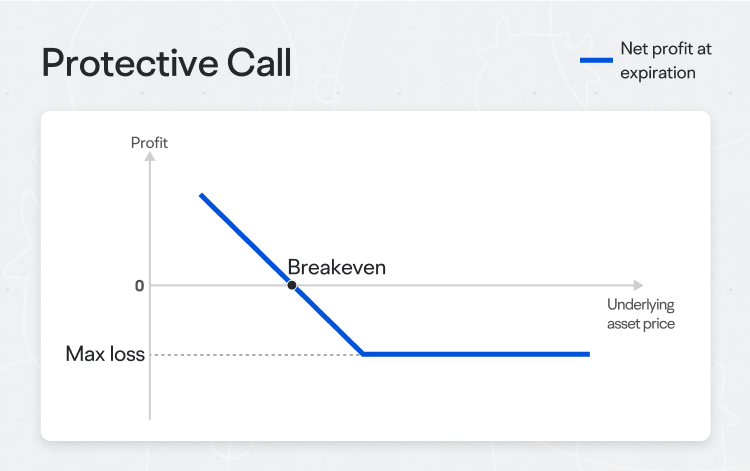
● Breakeven
The break-even point for a protective call is when the price of the underlying stock is equal to the total of the sale price of the underlying stock and the premium paid.
Breakeven Point = Short Stock Price+Net Premium
● Max gain
Due to the short position, there’s a substantial profit potential if the stock goes to zero. However, it's very unlikely for that to happen since stocks usually don’t go down to zero.
Max Gain = Short Stock Price+Net Premium
● Max loss
When the strike of the call is more than or equal to the purchase price of the underlying, potential losses may occur:
Max Loss= Call Strike Price - Short Stock Price- Net Premium
Example
Suppose there is a theoretical stock called TUTU trading at $52 on the Nasdaq. You expect it to fall sharply but want to limit its upside risk, so you use a protective call:
● Short 100 shares of TUTU at $52
● Buy a $2 TUTU call with a strike of $52
(The following calculations do not include commissions and other charges.)
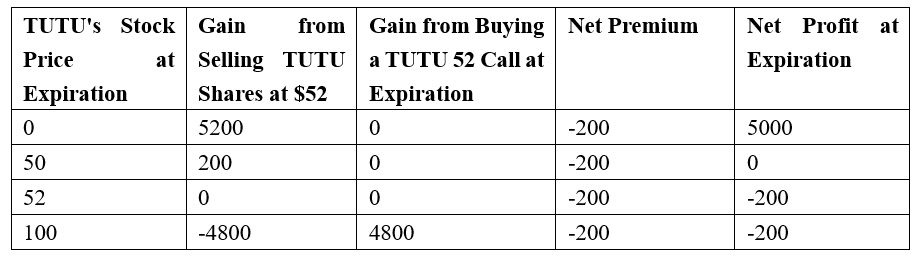
This hypothetical example is for illustrative purposes only and is not intended to represent any specific investment.
In terms of short selling, there is no limit on how high a stock price could rise, so the potential loss is unlimited. Other risks include dividend risk and margin risk. Strategies involving short-selling are not appropriate for all investors.
This presentation is for informational and educational use only and is not a recommendation or endorsement of any particular investment or investment strategy. Investment information provided in this content is general in nature, strictly for illustrative purposes, and may not be appropriate for all investors. Read more