Short Put Butterfly
You can use a short put butterfly if you expect a security's price to move in either direction and want to limit the risk.
Strategy breakdown
The short put butterfly strategy involves trading four options of an underlying asset.
● Sell a put1
● Buy two put2s
● Sell a put3
Put1, put2, and put3 have the same expiration but different strike prices.
Strike price: put1 < put2 < put3, put2 - put1 = put3 - put2
The higher and lower strikes are equal distances from the middle price.
Understanding
The short put butterfly strategy involves buying two puts with a middle strike price, selling one put with a lower strike price, and selling another put with a higher strike price.
Generally, the middle strike equals the current market price of the underlying asset, and the lower and upper strike prices (wings) are the same distance from the middle strike price. Also, all puts have the same expiration.
This strategy has the maximum potential profit and limited risk before the option contracts expire.
You can profit when the asset price moves in either direction, and get the maximum profit if the asset's price is above the higher strike price or below the lower strike price at expiration.
The maximum loss occurs if the price of an underlying asset reaches the middle strike at expiration.
When using this strategy, you should pay attention to the cost (including commissions) because it includes at least four option trades. It is important to ensure a favorable risk/reward ratio.
Gain & Loss
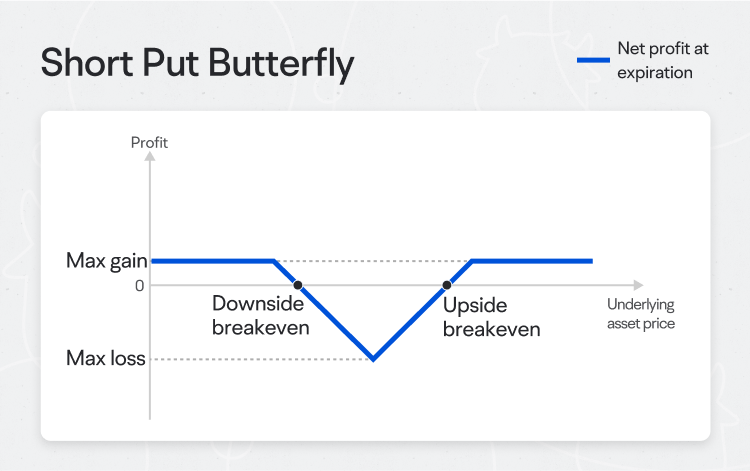
● Breakeven
Upside Breakeven = Higher Strike - Net Premium Received
Downside Breakeven = Lower Strike + Net Premium Received
● Max gain
Net Premium Received
● Max loss
Max loss= High Strike - Middle Strike - Net Premium Received
Example
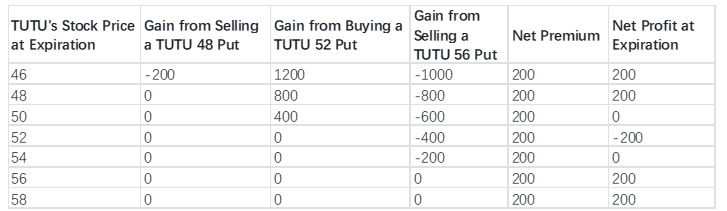
Imagine a stock called TUTU is currently trading at $52.
You expect its price is likely to move above $56 or below $48. So you decide to use a short put butterfly:
● Sell a $2 TUTU put with a strike of $48
● Buy two $3 TUTU puts with a strike of $52
● Sell a $6 TUTU put with a strike of $56
(The following calculations do not include transaction costs.)
This presentation is for informational and educational use only and is not a recommendation or endorsement of any particular investment or investment strategy. Investment information provided in this content is general in nature, strictly for illustrative purposes, and may not be appropriate for all investors. Read more