Options Earnings Series 2: Option Buying and Selling Strategies for Earnings
Quick Poll: What’s Your Earnings Season Strategy?
Before we dive in, tell us — how do you usually trade options around earnings?
I buy options, aiming for a big move
I sell options to profit from volatility crush
I avoid trading during earnings — too risky
I use spreads or multi-leg strategies to manage risk
I’m still learning and just watching for now
A Quick Recap of Session 1
In Session 1, we learned that stock price reactions after earnings aren’t just about beating or missing estimates. They depend on actual results, forward guidance, and how “priced-in” the expectations were. Even strong numbers can cause a price drop if the outlook disappoints or the stock was already "expensive".
Now, let’s look at how options traders can approach earnings — especially how implied volatility (IV) impacts potential profit and risk.
1. Why Options Become More Expensive Before Earnings
As earnings day approaches, uncertainty usually increases. No one knows whether the company will deliver good or bad news. Because of this, traders become willing to pay more for options — hoping to catch a big move. This demand causes implied volatility to rise, and with it, the price of options increases.
"Implied volatility reflects the market’s expectations of how much an underlying asset might move, and it directly influences option pricing."
However, once the earnings report is released, that uncertainty diminishes. Implied volatility usually drops sharply — a phenomenon known as volatility crush. This drop in IV causes option premiums to fall, often very quickly.
This is bad news for option buyers. Even if you correctly guess the stock’s direction, you might still lose money because the premium deflates after earnings. On the other hand, this effect tends to benefit option sellers, who collect increased premiums before earnings and can potentially profit from IV dropping.
2. When Buying Options Makes Sense
Despite the challenges, there are still moments when buying options around earnings can be the right move. The key question is: Will the stock move more than the market expects?
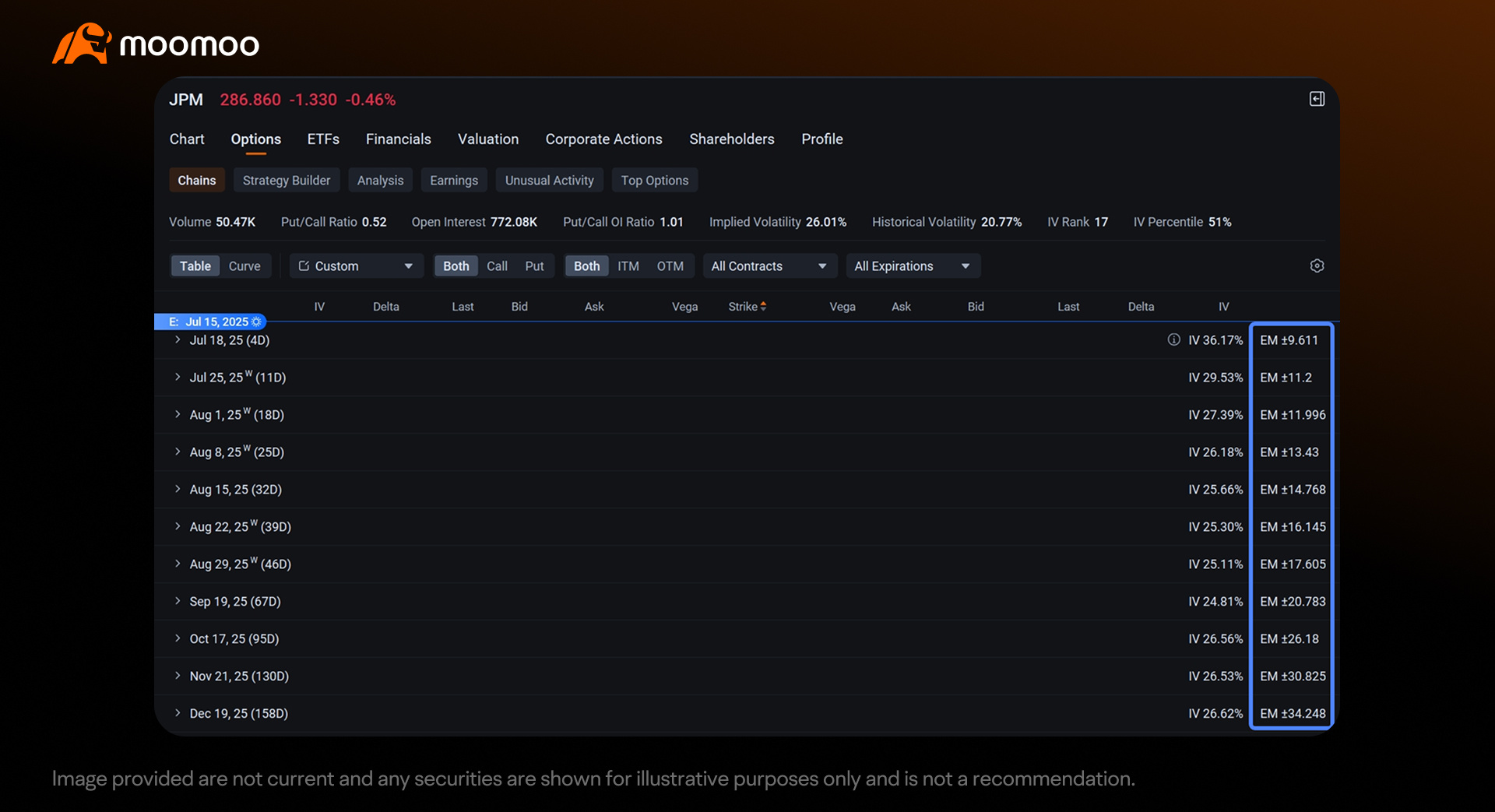
This is where the expected move comes into play. The expected move estimates how much the market anticipates a stock might rise or fall over a specific time frame — and it's derived from the implied volatility of at-the-money options for a given expiration. Platforms like moomoo display expected move so you can compare it with your own analysis, especially around earnings.
For example, if a stock is $100 and the expected move is ±$5, this can be interpreted to mean that the market is pricing in a move between $95 and $105. If your research suggests the stock might swing by $10 instead, a buying strategy could be worth the risk.
This is also where your analysis from Session 1 becomes crucial. If you’ve reviewed a company’s earnings trend, forward guidance, and current valuation, and you believe the market is underestimating the report’s impact, buying options may offer strong upside potential. A stock with a "low valuation" and strong outlook, for example, could break sharply higher — beyond the expected move.
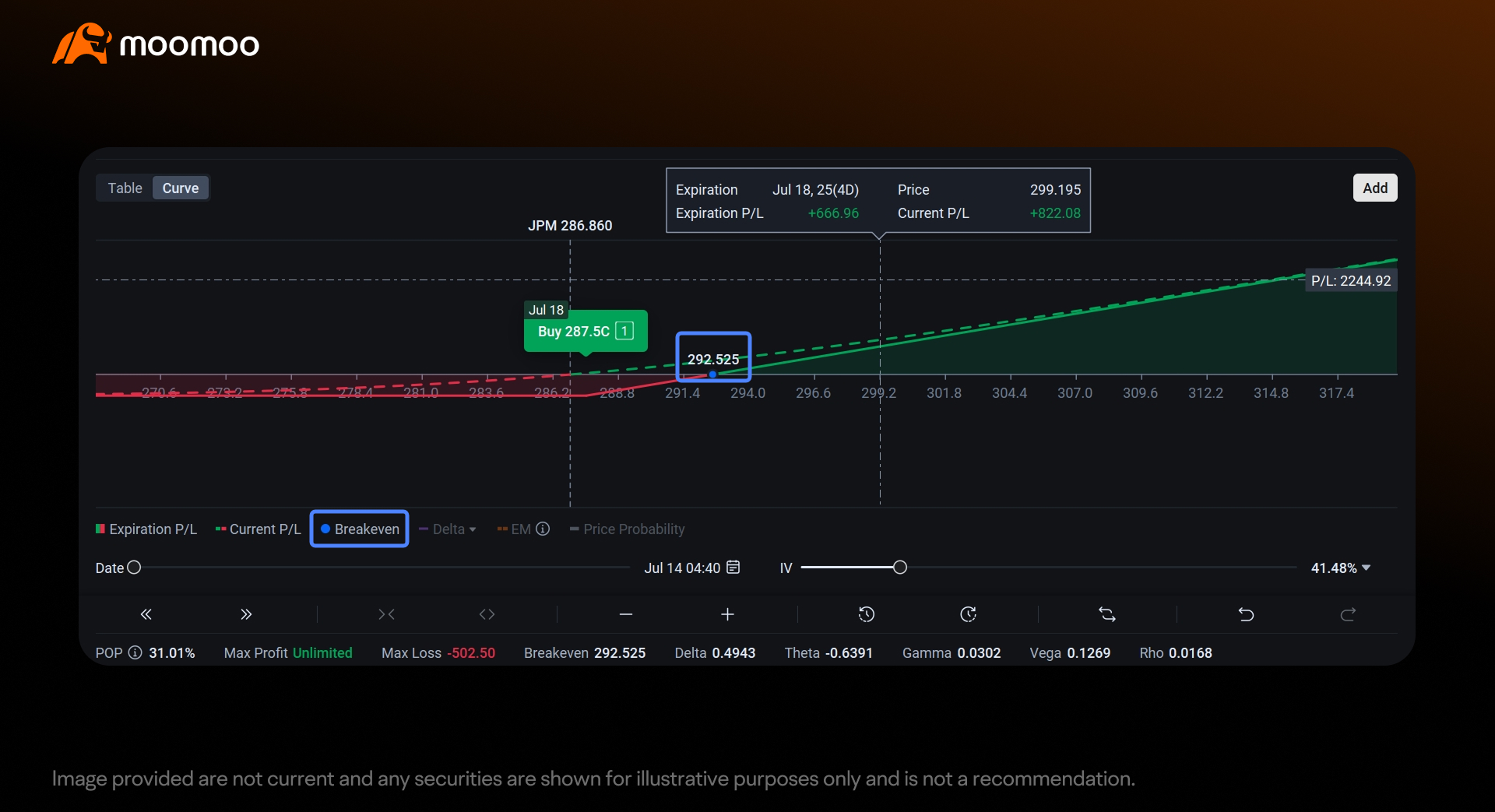
To explore possible outcomes, use the Curve (Profit/Loss Diagram). This tool shows how much the stock needs to move for your trade to break even — and how much you could potentially gain or lose. You can move the cursor along the curve to see both the current P/L and the expiration P/L at different price points. Try pointing at the target price from your analysis to see the theoretical result. This helps you understand whether the trade setup aligns with your expectations and how different scenarios may affect your position.
Still, it’s important to be cautious. If the stock moves less than expected — or if implied volatility drops sharply after earnings — the value of your options may fall, even if you forecasted the direction correctly. That’s the key challenge for option buyers around earnings.
3. Why Selling Options Can be Effective
While buying options has its place, some options traders lean toward selling options before earnings — especially when implied volatility (IV) is elevated. That’s because option premiums tend to rise before earnings due to uncertainty, and once the report is out, IV typically drops. This “volatility crush” favors the seller, as the pre-earnings premium shrinks.
However, it’s important to understand the risks.Selling options—especially naked positions—carries a high level of risk and isn’t suitable for most traders. Short puts can lead to significant losses if the stock drops, while short calls carry unlimited loss potential if the stock rises sharply. Selling a naked at-the-money call before earnings is among the most dangerous trades, due to the potential for sharp post-earnings moves. This strategy should only be considered by experienced traders who fully understand the risks and have the financial capacity to manage substantial losses.
Let’s break this down with a simplified hypothetical example:
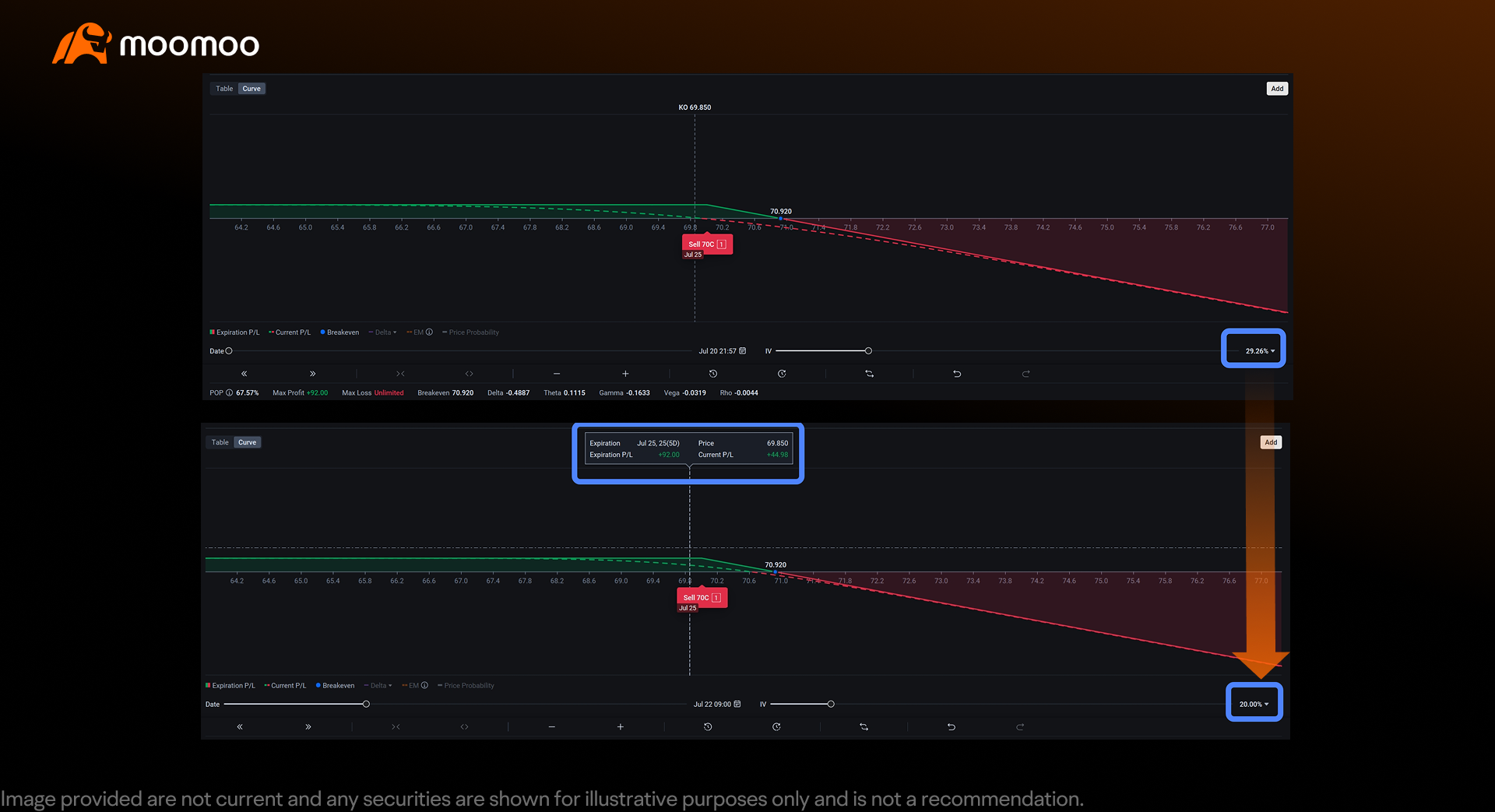
4. Example: Selling a Naked Call Option Before Earnings
Earnings release: Pre-market on Tuesday, July 22
Trade entry: Monday, July 21 (1 day before earnings)
Stock price at entry: $69.85
Call strike price: $70
Call premium received: $0.92
Implied volatility at entry: 29.26%
Expiration date: Friday, July 25
Breakeven: 70 + 0.92 = $70.92
Assume you sell a $70 strike call option for $0.92 on Monday, July 21 — one day before earnings — when the stock is trading at $69.85. The option is slightly out-of-the-money, and the premium reflects both time value and elevated implied volatility ahead of the earnings event.
Now imagine the earnings report is released before the market opens on Tuesday, July 22, and the stock price remains unchanged at $69.85 at open. However, as is typical after earnings, implied volatility drops — from 29.26% down to 20%.
As a result of this IV drop, the theoretical value of the call option decreases from $0.92 to approximately $0.47. This results in a theoretical profit of $0.45 per share, or $45 per contract due to the decline in implied volatility, even though the stock price hasn’t moved.
Even better, you’re not just profitable if the price stays flat. As long as the stock remains below the breakeven level (~$70.92) by expiration, you stay in the profit zone. This means the price can even move slightly against you, and you could potentially still close the trade with gains.
Of course, if the stock moves significantly above breakeven, losses begin to grow — and in the case of an uncovered call, losses can be unlimited. So while selling options ahead of earnings can offer certain potential advantages related to volatility, managing risk is still essential.
Conclusion
Trading options around earnings is strongly impacted by implied volatility.
If you expect the stock to move more than the market’s expected move, buying options could offer strong upside — as long as it is believed that the reward outweighs the risk. But if IV is already elevated and you believe the market is overpricing uncertainty, selling options may be an effective approach.
Neither strategy guarantees success. The goal is to align your approach with what the market is pricing in — and apply solid analysis to find mismatches.
“Earnings announcements typically occur outside regular trading hours, which can lead to significant overnight price gaps. This can be especially risky for short option positions, where losses may be substantial and occur rapidly. Stop-loss orders may not be effective in these scenarios. Careful position sizing, monitoring, and risk management are essential when trading options around earnings, and these strategies may not be suitable for all investors.”
This presentation is for informational and educational use only and is not a recommendation or endorsement of any particular investment or investment strategy. Investment information provided in this content is general in nature, strictly for illustrative purposes, and may not be appropriate for all investors. Read more