Short Collar
You can use a short collar when you short an underlying asset for the long term and want to hedge this position against its near-term potential volatility.
Construction of the strategy
A short collar strategy involves three trades:
● Short 100 shares of a stock
● Short a put of that stock
● Long a call of that stock
The strike price of the call is higher than that of the put.
The call and the put have the same expiration date.
Brief description
A short collar strategy usually consists of shorting an underlying stock, selling an out-of-the-money put, and buying an out-of-the-money call of that stock. The put and call have the same expiration.
This strategy helps protect against downside losses but also limits upside gains.
Suppose you exercised a short collar strategy.
If the price decreases, you may profit from shorting the underlying stock. On the flip side, if the price rises, you may suffer a loss.
Since you also sold an out-of-the-money put, if the stock price drops below the strike price of the put, you may suffer a loss as the stock moves downward. This potential loss may neutralize the upside gain of shorting the stock.
The value of the out-of-the-money call you bought will increase if the stock moves upward. In this case, the potential gain generated by the call may offset the loss from the rising stock price.
Investors often use a short collar if they believe a stock is likely to fall in the long term but rise in the short term.
It should be noted that the trading fee of a short collar is higher than that of a long collar because the short collar involves shorting the stock.
Gain & Loss
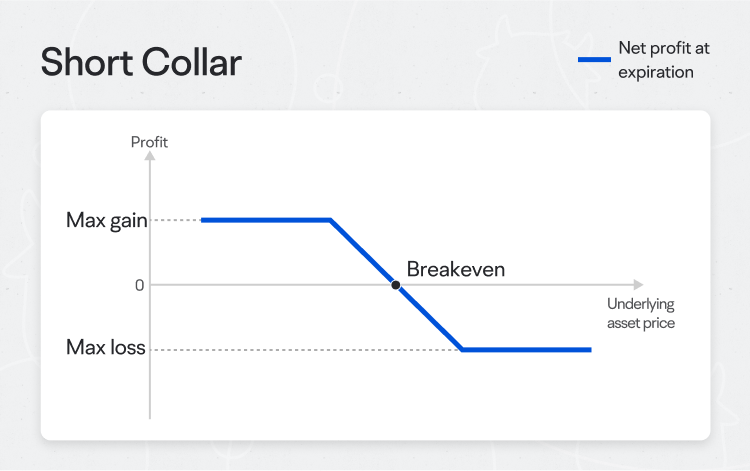
● Breakeven
Breakeven = Short Stock Price - Net Premium
● Max Profit
Maximum Profit = Short Stock Price-Put Strike Price+Net Premium
● Max Loss
Max Loss= Short Stock Price-Call Strike Price + Net Premium
Example
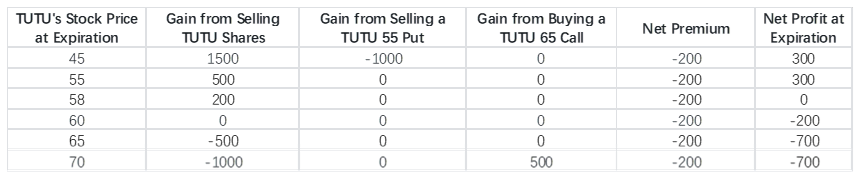
Imagine that there is a theoretical stock called TUTU on Nasdaq. You short 100 shares at $60 and believe it will go down to $45. You see a short-term risk of the price going up, so you use a short collar strategy:
● Shorting 100 shares of TUTU at $60
● Selling a $6 TUTU put with a strike of $55
● Buying a $8 TUTU call with a strike of $65
This presentation is for informational and educational use only and is not a recommendation or endorsement of any particular investment or investment strategy. Investment information provided in this content is general in nature, strictly for illustrative purposes, and may not be appropriate for all investors. Read more