Long Iron Butterfly
You may consider a long iron butterfly when you expect the price of an underlying asset to move beyond a certain price range and want to limit risk.
Construction of the strategy
A long iron butterfly strategy involves trading four options of the same underlying asset.
● Sell a put1
● Buy a put2
● Buy a call1
● Sell a call2
Put1, put2, call1, and call2 have the same expiration date but different strike prices.
Strike price: put1 < put2 = call1 < call2, and put2 - put1 = call2 - call1
Brief description
A long iron butterfly strategy consists of buying a call and a put at the same strike price (middle strike) and selling a put with a lower strike and a call with a higher strike. The lower and higher strike prices are equidistant from the middle strike price. All options have the same expiration date.
A long iron butterfly is also a combination of two strategies: bull call spread and bear put spread, or long straddle and short strangle.
This strategy potentially has limited maximum profit and limited risk before the contracts expire.
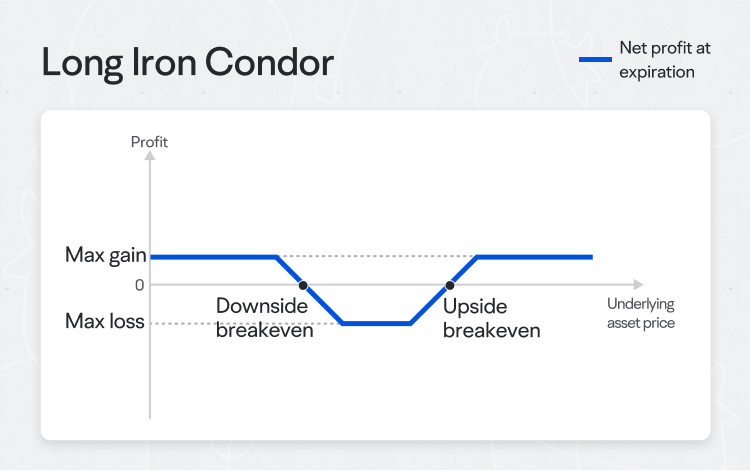
You can profit when the asset price moves in either direction and potentially get the maximum profit if the asset price moves above the higher or below the lower strike price at expiration. The maximum risk can potentially occur if the asset price reaches the middle strike at expiration.
A long iron butterfly has a similar profit-loss pattern to the short call/put butterfly strategies. But the difference is that the long iron butterfly is a net debit strategy, while the short call/put butterfly strategies are net credit strategies. A net debit strategy means requiring a net outflow of cash.
When using this strategy, you should pay attention to the cost (including commissions) because it includes at least four option trades. It is important to ensure a favorable risk/reward ratio.
Gain & Loss
● Breakeven
Upside Breakeven = Middle Strike + Net Premium Paid.
Downside Breakeven = Middle Strike - Net Premium Paid.
● Max gain
Max Gain = Higher Strike - Middle Strike - Net Premium Paid
● Max loss
Net Premium Paid
Example
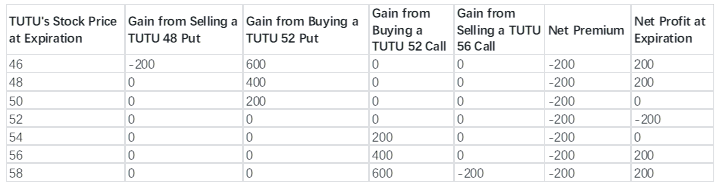
Suppose a theoretical stock called TUTU on Nasdaq is currently trading at $52.
You expect its price to have some volatility and will likely move above $56 or below $48. So you decide to use a long iron butterfly:
● Sell a $2 TUTU put with a strike of $48
● Buy a $3 TUTU put with a strike of $52
● Buy a $3 TUTU call with a strike of $52
● Sell a $2 TUTU call with a strike of $56
(The following calculations do not include transaction costs.)
This presentation is for informational and educational use only and is not a recommendation or endorsement of any particular investment or investment strategy. Investment information provided in this content is general in nature, strictly for illustrative purposes, and may not be appropriate for all investors. Read more