Understanding Implied Volatility in Options Trading
Introduction
Implied volatility (IV) is a key concept in options trading, reflecting the market's expectation of future price fluctuations. Unlike historical volatility, which looks at past movements, IV is forward-looking and influences an option’s price. Understanding IV helps traders make better decisions, manage risks, and spot potential opportunities in the options market.
Breakdown of the Article
What is Implied Volatility and How It Works
Why Implied Volatility Matters to Traders
How to Use It and Common Mistakes
1. What is Implied Volatility?
Implied volatility represents the market’s expectation of how much an asset’s price is expected to move in the future, expressed as a percentage. It is “implied” because it is calculated from the current prices of options, not from past data. For example, if a stock’s option has a high IV, the market expects significant price swings, while a low IV suggests smaller price changes.
Unlike historical volatility, which measures actual price movements over a specific period (e.g., the past 30 days), implied volatility is a forward-looking estimate. It’s like a weather forecast for a stock’s price—it doesn’t guarantee what will happen but gives an idea of what the market expects.
For option traders, understanding IV is essential because it directly affects the price of options. Higher IV increases option premiums (the cost of buying an option), while lower IV reduces them.
How Implied Volatility Works
Implied volatility is a key input in option pricing models, such as the Black-Scholes model. These models use IV to calculate an option’s fair value based on factors like the stock price, strike price, time to expiration, interest rates, and dividends. When IV rises, option prices increase because the market anticipates larger price movements, making the option more valuable. Conversely, when IV falls, option prices decrease.
Several factors influence implied volatility:
Market Events: Earnings reports, economic data releases, or geopolitical events can increase IV as traders expect bigger price swings.
Supply and Demand: High demand for an option (e.g., during a bullish trend) can push IV higher.
Time to Expiration: IV can temporarily rise ahead of major market events—such as earnings announcements—because traders anticipate significant price movements. However, in general, implied volatility tends to decrease as an option nears expiration due to the erosion of time value. This means any spike in IV is usually event-driven and often followed by a sharp decline once the event passes—a phenomenon known as IV crush.
2. Why Implied Volatility is Important for Option Traders
Implied volatility helps traders in two main ways: shaping trading strategies and evaluating market sentiment.
Trading Strategies: IV affects whether an option is “expensive” or “cheap.” High IV means options are pricier, which may favor strategies like selling options (e.g., covered calls or cash-secured puts) to collect higher premiums. Low IV suggests cheaper options, making it a better time to buy options (e.g., straddles or strangles) if you expect a big price move.
Market Sentiment: IV reflects the market’s mood. High IV often signals uncertainty or fear, while low IV indicates confidence or stability. By comparing a stock’s IV to its historical IV or the market’s overall IV (e.g., via the VIX index), traders can gauge whether the market is overly optimistic or pessimistic.
For traders, monitoring IV can help decide when to enter or exit trades and avoid overpaying for options.
3. How to Use Implied Volatility in Trading
Here are practical ways traders can use implied volatility:
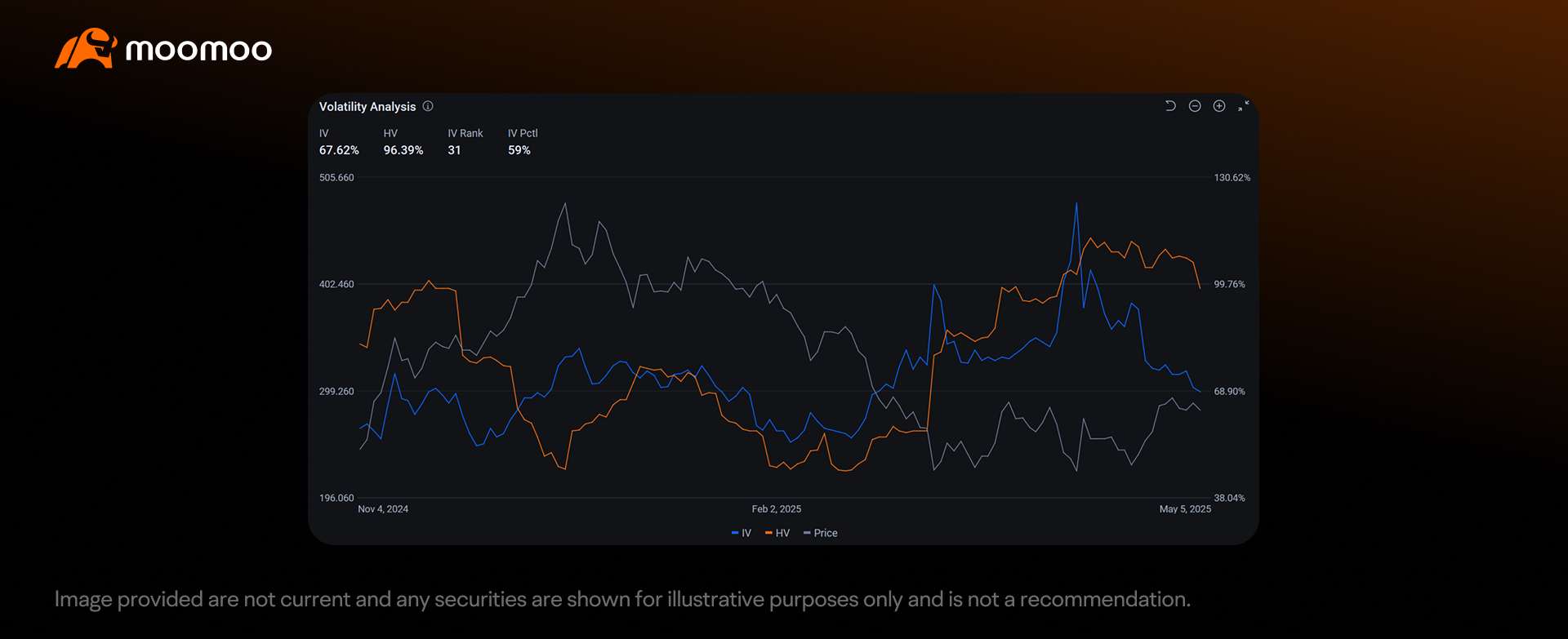
Compare IV to Historical Volatility: If a stock’s IV is much higher than its historical volatility, options may be overpriced, signaling a potential opportunity to sell. If IV is lower, options may be undervalued, making buying more attractive.
Use IV Percentile or Rank: IV percentile (or IV rank) shows how the current IV compares to its range over the past year. For example, an IV percentile of 80% means the current IV is higher than 80% of its values in the last year. High IV percentiles may favor option sellers, while low percentiles suit buyers.
Monitor the VIX Index: The VIX, often called the “fear index,” measures the market’s overall IV based on S&P 500 options. A rising VIX suggests increasing market uncertainty, which can affect individual stock options.
Example Scenario: Suppose you’re trading options on a tech stock before its earnings report. The IV is high (e.g., 50% compared to a historical IV of 30%). Instead of buying an expensive option, you might sell a straddle (selling both a call and a put) to collect a higher premium, speculating that the stock’s price movement won’t exceed the market’s expectations.
Common Mistakes to Avoid
Option traders often make these mistakes with implied volatility:
Misinterpreting High IV: High IV reflects the market’s expectations for larger price movements, but those expectations may not materialize. Options can be more expensive during high IV periods, which may not offer good value if the actual move is smaller than anticipated. Rather than immediately buying options in high-IV environments, traders might consider evaluating whether the potential move justifies the cost.
Ignoring IV Crush: After events like earnings, IV often drops sharply—known as IV crush. This can lower an option’s value even if the stock moves in the expected direction, especially if the move doesn’t exceed the breakeven point.
Overlooking IV in Strategies: Failing to check IV can lead to poor trade timing. Compare IV to historical levels or market benchmarks before entering a trade.
By staying aware of IV and its implications, traders can make more informed decisions.
Conclusion
Implied volatility is a powerful tool in options trading. It helps traders gauge market expectations, evaluate option pricing, and select suitable strategies. By comparing IV to historical levels, tracking sentiment, and avoiding common pitfalls, traders can better position themselves to improve their outcomes. Checking IV regularly and applying it in practice even with small trades can be a valuable part of the decision-making process, bringing greater confidence to navigating the options market.
Disclaimer
Options trading entails significant risk and is not appropriate for all customers. It is important that investors read Characteristics and Risks of Standardized Options before engaging in any options trading strategies. Opening new options positions close to or on their expiration date comes with substantial risk of losses for reasons that include potential volatility of the underlying security and limited time to expiration. Options transactions are often complex and may involve the potential of losing the entire investment in a relatively short period of time. Certain complex options strategies carry additional risk, including the potential for losses that may exceed the original investment amount. Supporting documentation for any claims, if applicable, will be furnished upon request. Options trading subject to eligibility requirements. Strategies available will depend on options level approved.
Options volatility rankings: Keep in mind that implied volatility values, IV Rankings, and IV Percentiles are theoretical estimates, and the actual market conditions may not always align with the theoretical information shown. Therefore, traders should exercise caution and use multiple sources of information when making investment decisions. There is no guarantee or assurance that the use of any tools or data provided on the moomoo app will result in investment success or reduce investment risk.
This presentation is for informational and educational use only and is not a recommendation or endorsement of any particular investment or investment strategy. Investment information provided in this content is general in nature, strictly for illustrative purposes, and may not be appropriate for all investors. It is provided without respect to individual investors’ financial sophistication, financial situation, investment objectives, investing time horizon, or risk tolerance. You should consider the appropriateness of this information having regard to your relevant personal circumstances before making any investment decisions. Past investment performance does not indicate or guarantee future success. Returns will vary, and all investments carry risks, including loss of principal. moomoo makes no representation or warranty as to its adequacy, completeness, accuracy or timeliness for any particular purpose of the above content.
Moomoo is a financial information and trading app offered by Moomoo Technologies Inc. Securities offered through moomoo Financial Inc, Member FINRA/SIPC.
In Singapore, investment products and services available through the moomoo app are offered through Moomoo Financial Singapore Pte. Ltd. regulated by the Monetary Authority of Singapore (MAS). Moomoo Financial Singapore Pte. Ltd. is a Capital Markets Services Licence (License No. CMS101000) holder with the Exempt Financial Adviser Status. This advertisement has not been reviewed by the Monetary Authority of Singapore.Moomoo Technologies Inc., Moomoo Financial Inc., Moomoo Financial Singapore Pte. Ltd.,Moomoo Securities Australia Limited, Moomoo Financial Canada Inc., and Moomoo Securities Malaysia Sdn. Bhd. are affiliated companies.
In Australia, financial products and services available through the moomoo app are provided by Moomoo Securities Australia Limited, an Australian Financial Services Licensee (AFSL No. 224663) regulated by the Australian Securities and Investment Commission (ASIC). Please read and understand our Financial Services Guide, Terms and Conditions, Privacy Policy and other disclosure documents which are available on our website https://www.moomoo.com/au .
In Canada, order-execution only services available through the moomoo app are provided by Moomoo Financial Canada Inc., regulated by the Canadian Investment Regulatory Organization (CIRO).
In Malaysia, investment products and services available through the moomoo app are offered through Moomoo Securities Malaysia Sdn. Bhd. ("Moomoo MY")regulated by the Securities Commission of Malaysia (SC). Moomoo Securities Malaysia Sdn. Bhd. is a Capital Markets Services Licence (License No. eCMSL/A0397/2024) holder. This advertisement has not been reviewed by the SC.
This presentation is for informational and educational use only and is not a recommendation or endorsement of any particular investment or investment strategy. Investment information provided in this content is general in nature, strictly for illustrative purposes, and may not be appropriate for all investors. Read more