Options Earnings Series 3: Exploring Common Two-Legged Option Strategies for Earnings Season
Quick Poll: What’s Your Approach to Two-Legged Strategies During Earnings?
Before we jump into Session 3, tell us: Have you ever traded a short straddle or strangle around earnings?
Yes — I use them often to capture volatility crush
I’ve tried them a few times, still learning
I’ve heard of them but never used them
No — I avoid short premium strategies
What’s a straddle or strangle?
Reminder: A “volatility crush” refers to the sharp drop in implied volatility that often happens after an earnings report — which can reduce option prices and benefit sellers.
A Quick Look Back
In Session 1, we discussed what really drives post-earnings stock movements: not just whether a company beats or misses expectations, but also factors like forward guidance and valuation. Then in Session 2, we learned that implied volatility (IV) usually increases before earnings and drops right after — a change that tends to benefit sellers.
Now, in Session 3, we go one step further: How can you utilize high IV while trying to increase your chances of profiting?
This is where two-legged selling strategies — the short straddle and short strangle — come into play.
1. The Core Strategy: Short Straddle vs. Short Strangle
Seeking to take advantage of elevated implied volatility (IV) before earnings, traders often turn to two-legged selling strategies — namely, the short straddle and the short strangle.
Both strategies involve selling a call and a put with the same expiration, aiming to profit from the volatility crush after the earnings report. The key difference is where you place the strike prices.
Straddle vs. Strangle – What’s the Difference?
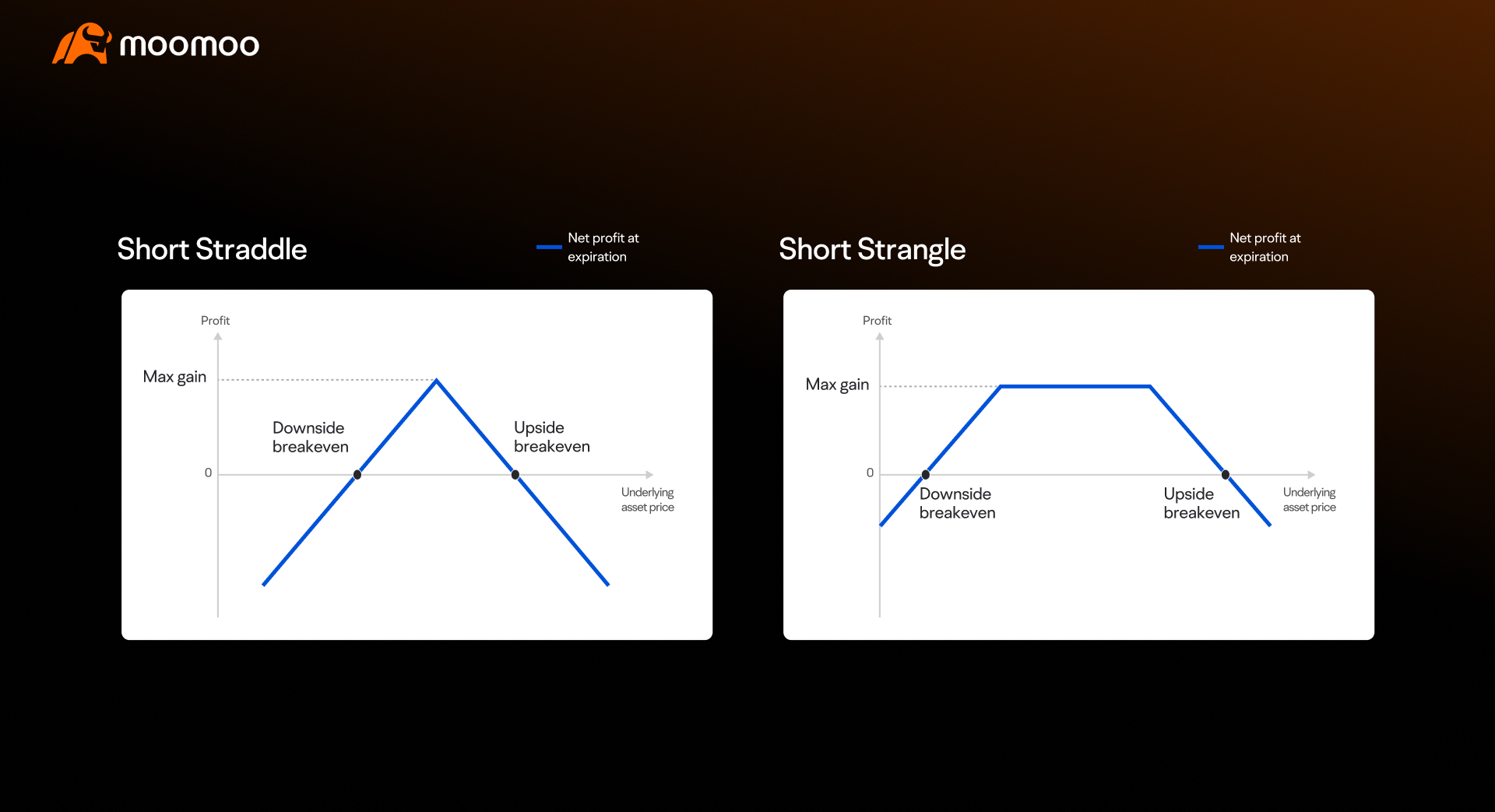
Short Straddle:
Sell a call and a put at the same strike, usually at-the-money (ATM).
Higher premium, but the stock must stay in a tighter range.
Short Strangle:
Sell a call and a put with different strikes, both out-of-the-money (OTM).
Lower premium, but the stock can move more and still be potentially profit.
In both cases, you're not speculating on direction — you're speculating that the stock won’t move too far and that IV will drop after earnings.
Short straddles and short strangles are advanced, high-risk options strategies that involve selling both a call and a put, exposing the trader to unlimited loss on the short call if the stock rises significantly and substantial loss on the short put if the stock falls sharply or to zero; these strategies are not suitable for all investors and should only be used by experienced traders who fully understand the risks and have the ability to manage and monitor positions closely.
Choosing Expiration Date
Many options traders use the nearest weekly expiration after earnings, so the trade is able to fully capture the IV drop and has limited time exposure.
Shorter expirations also offer faster time decay, which helps option sellers.
For example, suppose a company is set to report earnings on Wednesday after the close, and today is Monday. The moomoo platform shows weekly options expiring that Friday.
That’s the nearest expiration after earnings, and it’s the one many traders typically choose — because it aligns best with the goal of capturing maximum IV drop in the shortest time frame.
Choosing Strike Prices
For a straddle, use the ATM strike — where the stock is currently trading.
For a strangle, traders usually consider OTM strikes that reflect:
The Expected Move (EM) shown on moomoo's option chain.
A range you believe the stock will stay within, based on your research (see Session 1).
For any given option chain, the wider the distance between the strikes, the lower the premium but the higher the probability of success. In short:
Straddle = More premium, tighter range
Strangle = Less premium, wider safety zone
This balance between premium and probability helps you pick the setup that fits your view — whether you expect a quiet report or just a less dramatic move than the market fears.
2. Why Consider These Two Strategies?
You might wonder: why specifically the short straddle and short strangle?
There are two key reasons:
They Benefit from the Volatility Crush
As we learned in Session 2, implied volatility (IV) often rises ahead of earnings due to uncertainty and typically falls once the announcement is released. Short straddles and strangles aim to take advantage of this pattern — by selling options when IV is elevated, traders may be able to collect more premiums than usual. If IV drops after the event and the stock doesn’t move much, the options may decline in value more quickly, potentially allowing the trader to buy them back for less.
That’s why these strategies are often used around earnings — they align well with the elevated option pricing that tends to occur before major events. However, timing is critical: entering too early can expose the position to an IV spike as anticipation builds, which can reduce or eliminate the benefit of the expected post-earnings volatility drop.
They Focus on Range, Not Direction
Unlike strategies that require you to forecast whether the stock will go up or down, straddles and strangles are based on a range. You're not speculating on direction — you're speculating that the stock will stay within a certain window. This makes them attractive when:
You think the market is overestimating how far the stock will move.
You're unsure of the direction, but confident the move will be contained.
In other words, these strategies shift the question from:
“Will it go up or down?”
to
“Will it move less than the market expects”
That’s why some options traders often choose short straddles or strangles during earnings — they align well with the reality that many stocks don’t move as much as expected, and IV crush helps even further.
3. Example: NVDA Earnings – Short Strangle Strategy
Let’s look at NVDA’s earnings on May 28, 2025, released after the close.
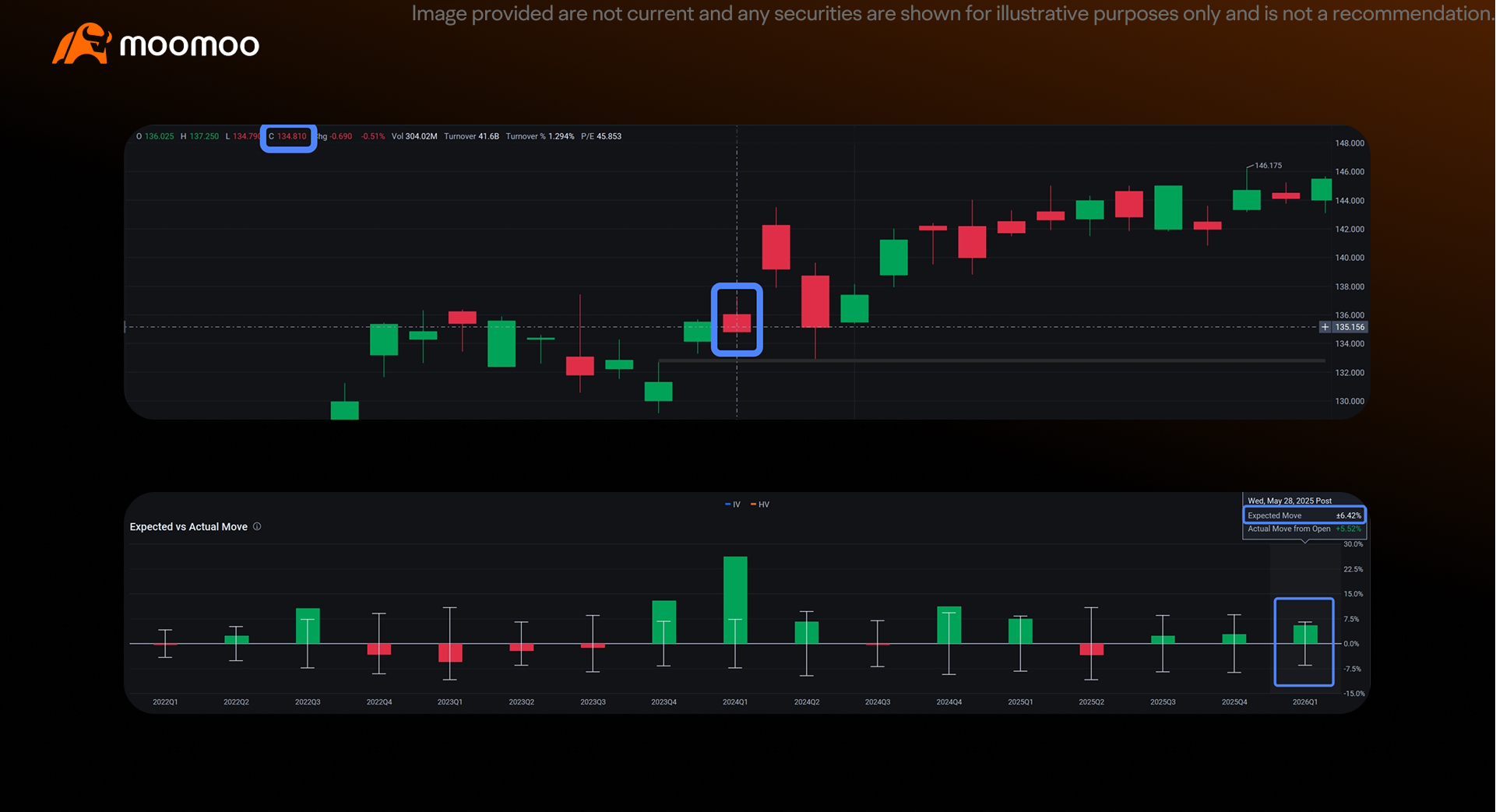
At the time, NVDA traded at $134.81, and the platform showed an expected move of ±6.42% — indicating a projected post-earnings range of:
Upper bound: $143.46
Lower bound: $126.16
To build a strangle, it is common to select strikes just outside that range:
Setup
Expiration: May 30, 2025 (nearest weekly after earnings, two days later)
Sell 144 Call (premium: $1.46)
Sell 125 Put (premium: $1.00)
Total premium collected: $2.46
Breakeven Range
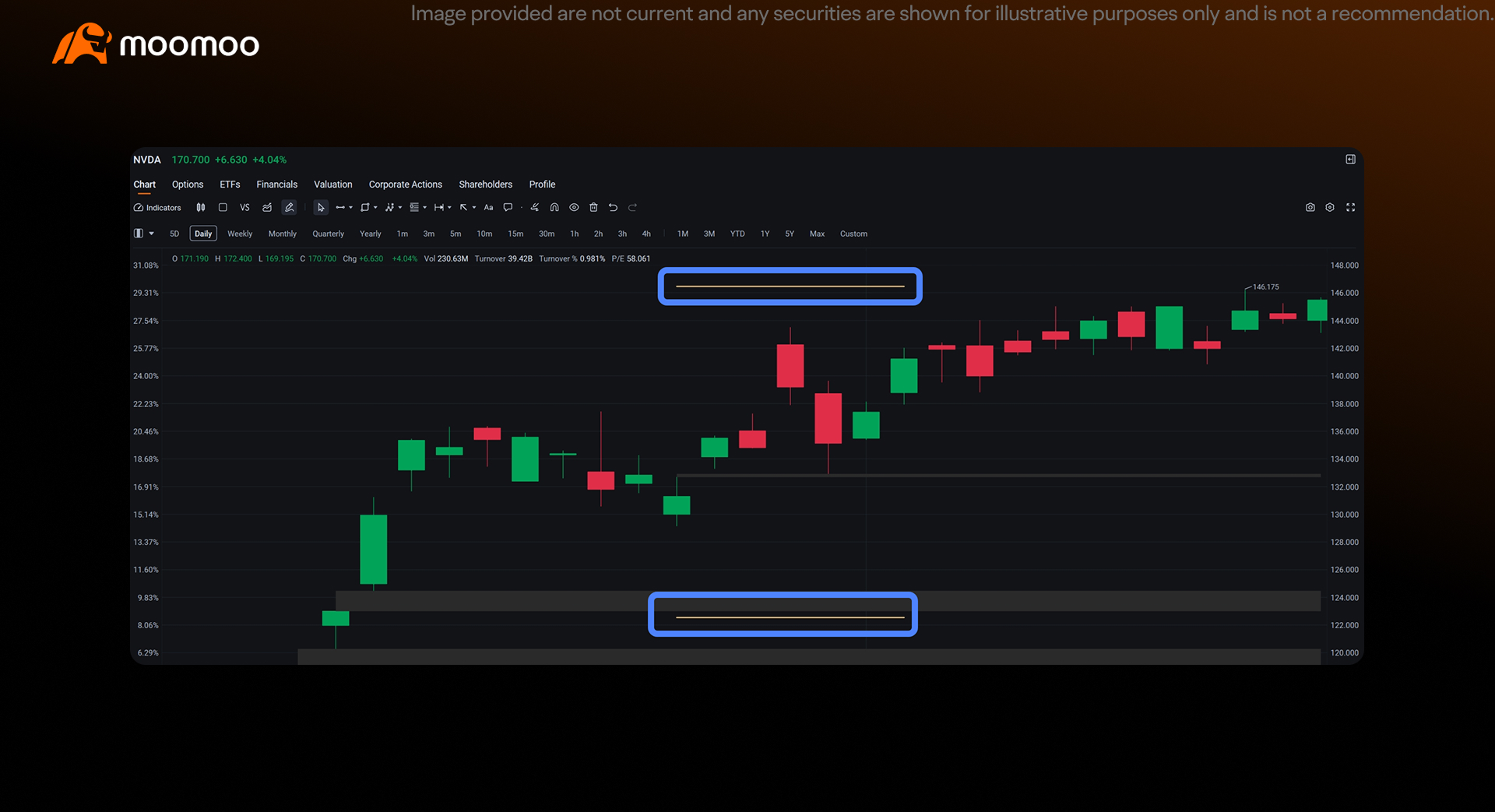
Upper: 144 + 2.46 = $146.46
Lower: 125 – 2.46 = $122.54
The trade can be profitable as long as the stock’s price at expiration is within the breakeven range of $122.54 to $146.46 — especially if post-earnings implied volatility declines, reducing the options’ value more quickly.
What Happened
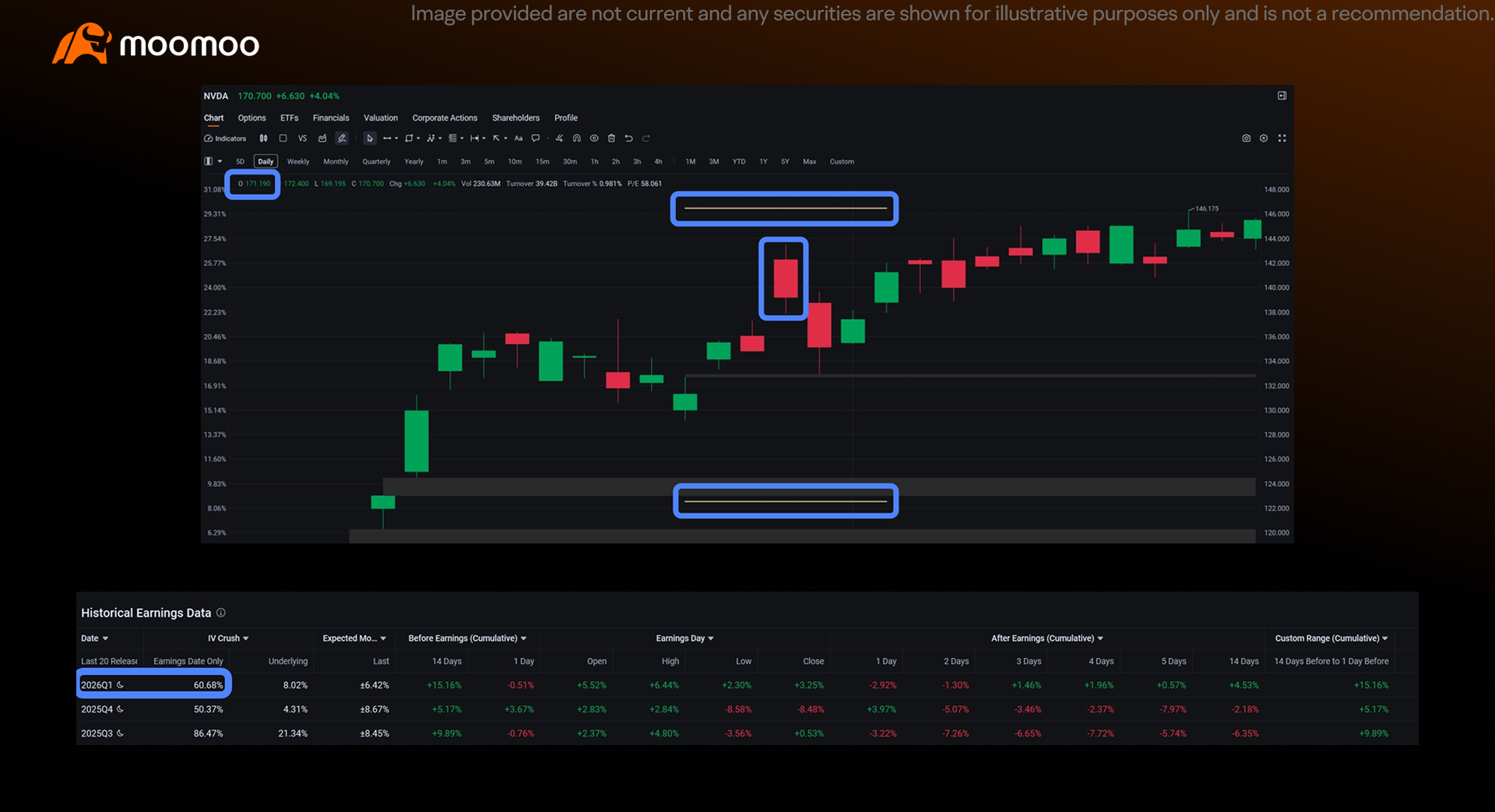
On May 29, 2025, NVDA opened at $142.245 — within the strangle range.
Post-earnings, IV collapsed by 60.68%, and the option prices adjusted:
144 Call rose slightly from $1.46 → $1.65 → Loss of $0.19
125 Put dropped sharply from $1.00 → $0.055 → Gain of $0.945
Net Theoretical Profit:
$0.945 (Put gain) – $0.19 (Call loss) = $0.755 profit per share, or $75.50 per strangle (before commissions and slippage)
This profit assumes both options are bought to close at the listed prices to realize the gain.
Note: Most earnings announcements occur outside regular trading hours, when options markets are closed — limit the ability to adjust or exit positions in real time and increase risk.
What If the Stock Breaks Out of the Range?
If NVDA had moved beyond $146.46 or below $122.54, the trade could begin to show losses. Because a short strangle carries undefined risk, sharp price moves can result in significant drawdowns.
Some traders attempt to manage this risk through position monitoring and timely exits, but it’s important to understand that stop-loss orders are not guaranteed in options trading. This is especially true around earnings, when price gaps can occur outside of trading hours and slippage may be high.
While limiting position size can reduce overall exposure to loss, it does not eliminate the potential for large or unlimited losses, particularly on short call positions. These strategies require active risk management and may not be appropriate for all traders.
4. What About Risk?
As with any short option strategy, risk needs to be managed.
Losses can become significant if the stock moves beyond breakeven.
Volatility around earnings can lead to large price gaps, especially since most announcements occur outside regular trading hours, limiting the ability to adjust positions in real time.
Some traders attempt to manage risk by using stop-losses or adding long options to define risk — for example, turning the strangle into an iron condor. However, stop-loss orders are not guaranteed and may be less effective during volatile events like earnings.
Conclusion
You don’t always have to forecast the direction of the earnings move to profit — sometimes, it can be more effective to speculate on how far the stock won’t move.
Two-leg selling strategies like straddles and strangles are commonly used during earnings season to take advantage of elevated implied volatility and potential post-earnings volatility drops.
Used with discipline and proper risk management, these strategies can be a structured approach to earnings-related trades.
This presentation is for informational and educational use only and is not a recommendation or endorsement of any particular investment or investment strategy. Investment information provided in this content is general in nature, strictly for illustrative purposes, and may not be appropriate for all investors. Read more