Looking to profit passively with ETFs in the U.S. market? Here are two key tips
You've probably heard investment experts and financial bloggers recommend market index ETFs as the go-to option for easy and low-risk investing. However, investing in these ETFs doesn't always guarantee success.
So, what's the issue? Is it picking the wrong ETF or poor timing? Let's break it down by looking at two key factors: the underlying asset and the timing.
Question 1: Which ETF is right for you?
The first step in investing in ETFs is to check the index they track. Warren Buffett, for example, often recommends $S&P 500 Index (.SPX.US)$ , a benchmark for the U.S. stock market. Other major U.S. indices include the Nasdaq and the Dow Jones Industrial Average.
Globally, there are many other indices, such as the FTSE 100 in the UK, the Nikkei 225 in Japan, the CSI 300 in China, the Hang Seng in Hong Kong, and the Straits Times in Singapore. Each of these indices reflects the economic health of their respective regions.
By understanding what each index represents, you can choose the ETF that best matches your investment goals.
How to choose the index and ETF
Unsure which index to invest in? Start by defining your investment goals. Ask yourself these questions:
Do you believe a particular index will continue to grow in the future?
Is the market it represents fair, transparent, and healthy?
Is the country's economy, which the index reflects, expected to perform well?
But remember, the past performance of an index doesn't guarantee future results. The composition of an index determines its performance, and you can decide which index to invest in based on its constituent stocks.
Here are some examples:
If you want to invest in the U.S. broad stock market, you might choose $S&P 500 Index (.SPX.US)$ because of its wide coverage and numerous constituents.
If you're interested in technology stocks, you might prefer $Nasdaq Composite Index (.IXIC.US)$ , which has a higher proportion of tech companies.
If you want to include small-cap stocks in your portfolio, $Dow Jones Industrial Average (.DJI.US)$ might not be suitable due to its focus on blue-chip stocks. Instead, an ETF tracking the Russell 2000 Index would be more appropriate.
Besides these mainstream indices, others can help you track specific types of stocks, such as the index covering large-cap value stocks.
Picking the ETF
Once you've identified your investment goal and the specific index, the next step is to choose the appropriate ETF. But with multiple ETFs tracking the same index, how do you decide which one to pick?
Let's compare the ETF's size, trading volume, and management fees.
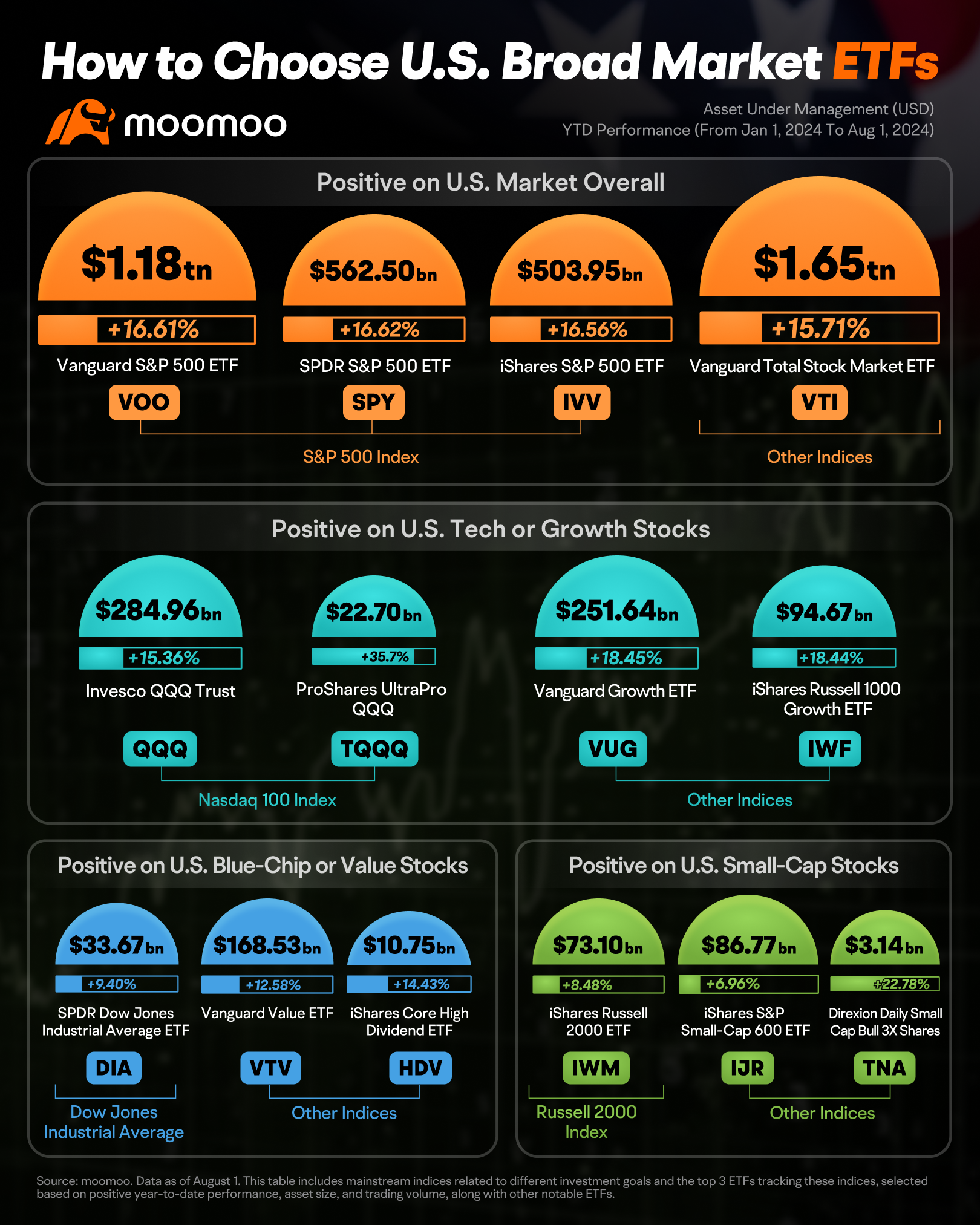
For instance, if you are optimistic about the overall U.S. stock market, you might choose ETFs that track the S&P 500 index, such as $Vanguard S&P 500 ETF (VOO.US)$, $SPDR S&P 500 ETF (SPY.US)$ or $iShares Core S&P 500 ETF (IVV.US)$ ; alternatively, you might opt for an ETF that tracks the total stock market index, like VTI. The difference between these two types of ETFs is that the latter tracks the performance of the entire U.S. stock market, including stocks that are not part of the S&P 500 index, thus covering a broader range of stocks.
If you are bullish on U.S. tech stocks or growth stocks, most investors might choose ETFs related to the NASDAQ, such as $Invesco QQQ Trust (QQQ.US)$ or $ProShares UltraPro QQQ ETF (TQQQ.US)$ , which track the $NASDAQ 100 Index (.NDX.US)$ . If you also want to invest in stocks beyond the NASDAQ constituents, you might consider other growth stock-related index ETFs, such as $Augustus Minerals Ltd (AUG.AU)$ or $Ishares Russell 1000 Growth ETF (IWF.US)$ .
Investors who prefer large blue-chip or value stocks might consider ETFs focusing on value stock indices, such as $Vanguard Value ETF (VTV.US)$ or $Ishares Trust Ishares Core High Dividend (HDV.US)$ , or even consider ETFs related to the Dow Jones Industrial Average, like $SPDR Dow Jones Industrial Average Trust (DIA.US)$ .
For those interested in investing in small-cap stocks without picking individual stocks, ETFs that track the Russell 2000 index or other small-cap stock indices, like $iShares Russell 2000 ETF (IWM.US)$ , $iShares Core S&P Small-Cap ETF (IJR.US)$ , or $Direxion Daily Small Cap Bull 3X ETF (TNA.US)$ , might be an option worth considering.
How to find major index ETFs on moomoo
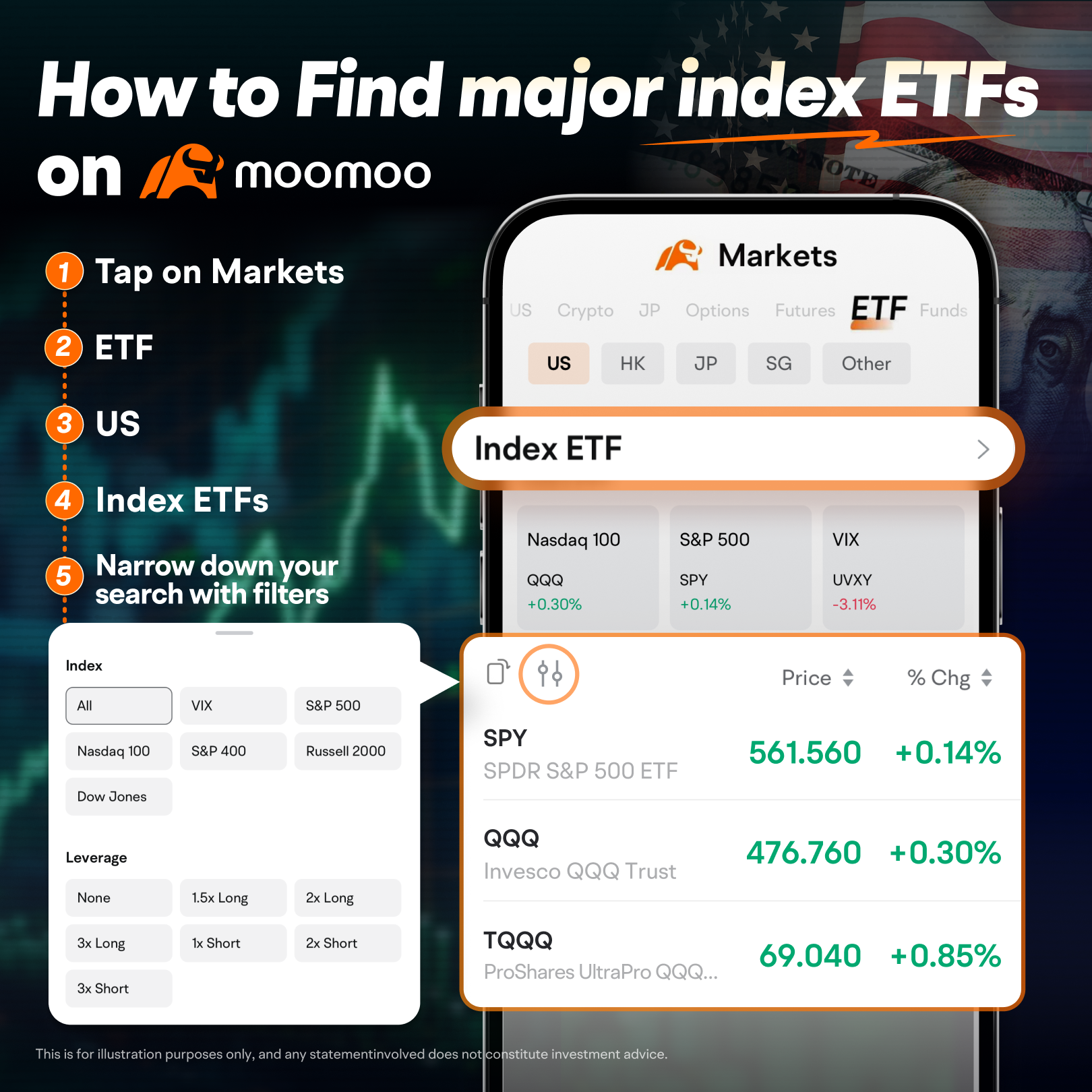
Open moomoo and tap Markets > ETF > US.
Click the arrow next to Index ETFs to see a list of ETFs tracking major U.S. market indices.
To further narrow down your selection, click the filter icon in the top left corner and set your desired criteria
If you prefer low-risk or long-term investments, consider non-leveraged ETFs.
Leveraged and inverse ETFs aim for short-term index performance through derivatives like futures contracts and are designed for experienced investors seeking short-term hedging. They are not suitable for long-term investments.For more on leveraged and inverse ETFs, watch the video: What are the different types of ETFs?
Example: If you believe the U.S. stock market will trend upward over the next few years, you might choose a non-leveraged S&P 500 ETF.
After filtering, you may find many similar ETFs. Here's how to further narrow down your choices:
Asset Under Management (AUM): Larger asset sizes usually mean better liquidity and tighter bid-ask spreads.
Fees (Expense Ratio): Lower fees reduce the cost of holding the ETF, which is important for long-term investors.
Other Factors: Consider dividend yield, bid-ask spreads, etc.
In the ETF list, you can sort by asset size.
For more on ETF costs and selection methods, watch these courses:
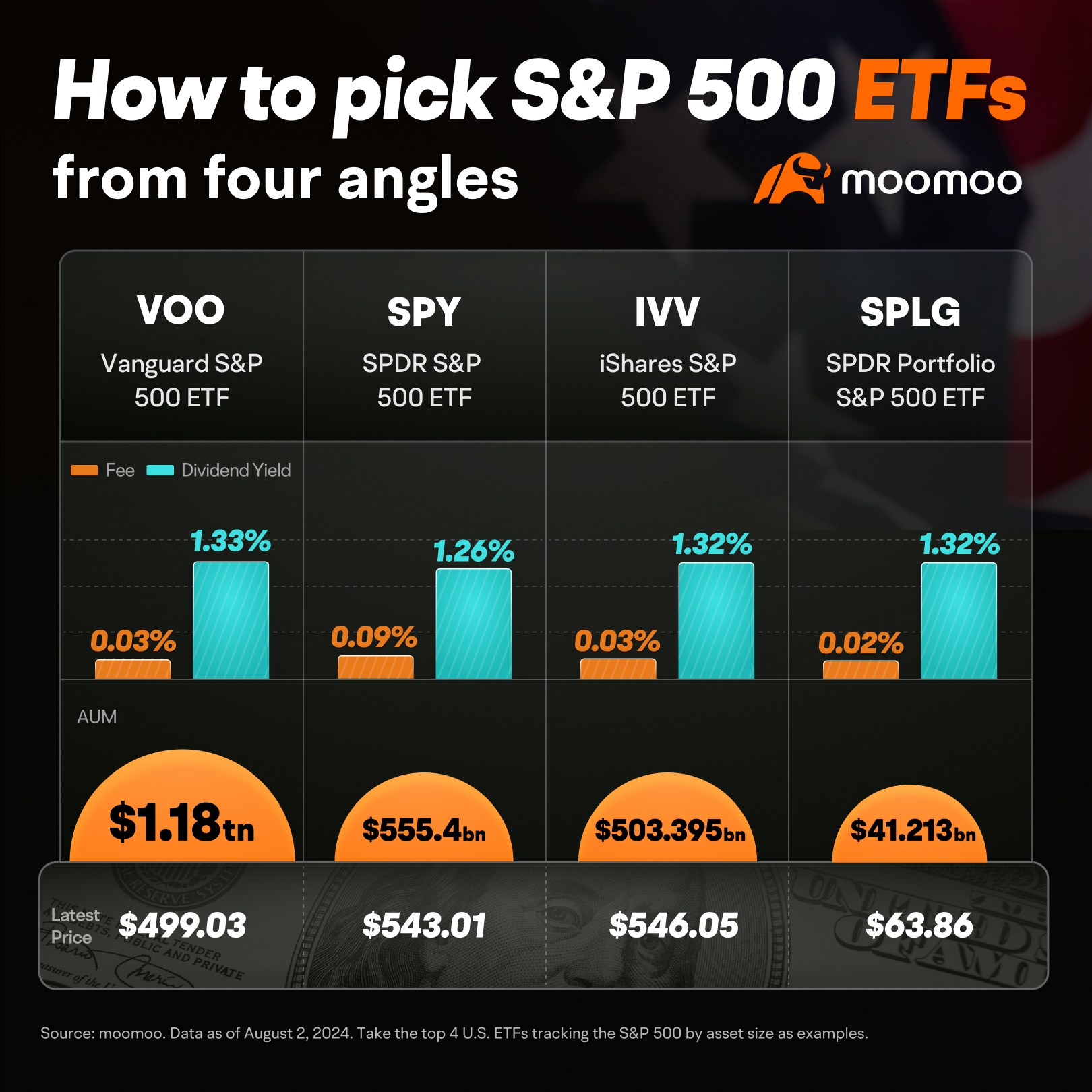
By comparing these ETFs, it's clear that:
$Vanguard S&P 500 ETF (VOO.US)$ : The largest by asset size, with relatively low fees and a higher dividend yield, but comes with a higher share price.
$SPDR S&P 500 ETF (SPY.US)$ : The most well-known and the oldest, but also has the highest fees among the four.
$SPDR Portfolio S&P 500 ETF (SPLG.US)$ : Issued by the same company as SPY, it has the lowest fees and entry price and the smallest AUM.
Question 2: When to buy and sell? How long to hold?
The timing and duration of your ETF investments depend on your goals:
Short to Medium-Term: If you're looking to capitalize on short to medium-term market trends, use technical analysis to identify the high and low points of the index. Buy low and sell high.
Long-Term: If you have a positive long-term outlook on a country’s or region’s economy, or if you're not an experienced investor, short-term market timing is less important.
Stocks fluctuate, but for long-term investments, the key is that the overall trend is upward.
Example: Over a 10-year period (July 2014 to July 2024), the S&P 500 index saw several pullbacks but still increased by 181.72%.
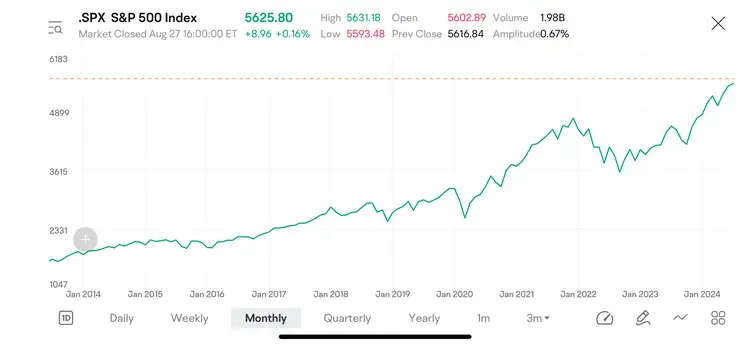
That is, suppose someone invested $10,000 in May 2013 and completely ignored it until selling it in May 2023. This person would end up with $28,720 (without considering any associated costs).
However, most people find it difficult to avoid making trades over such a long period, as it goes against human nature. Frequent trading at the wrong times can reduce profits or even lead to losses.
Is there a way to avoid market timing and still enhance potential returns? A Regular Savings Plan (RSP) might be an answer.
Instead of a lump-sum investment, assume our investor decides to invest $300 every month into the S&P 500 index and makes no other trades. Assuming a 10% annual return over 10 years, the final return would be $60,482.53 (without considering any associated costs).
By regularly contributing to an investment, your funds could grow steadily without needing active management. Additionally, you could potentially buy more shares when prices are low and fewer when prices are high, effectively balancing your average purchase cost.
Summary
Choose a market index: Invest in a market index ETF that you have a long-term positive outlook on. If a market has multiple indices, pick the one that best fits your needs based on its constituent stocks.
Evaluate ETFs: If an index is tracked by multiple ETFs, choose the one that suits you best by considering factors such as market cap, management fees, dividend yield, and trading volume.
Extend investment horizon: Aim for a longer investment period. To potentially enhance returns, consider a regular savings plan in a promising market index ETF.
This presentation is for informational and educational use only and is not a recommendation or endorsement of any particular investment or investment strategy. Investment information provided in this content is general in nature, strictly for illustrative purposes, and may not be appropriate for all investors. Read more