Practical Guide: Quick Tips for Filtering ETFs and Key Considerations
Discover how to find ETFs that match your goals and risk tolerance. This video will show you the ropes.
1. Define Your Investment Goals and Risk Tolerance
First off, you need to ask yourself two key questions:
What's your purpose for investing in ETFs?
And what's your risk tolerance?
For a goal of earning an average market return, you might consider ETFs that track market indexes.
If you're looking to generate more cash flow, investing in stock ETFs with high dividend yields or bond ETFs could provide you with regular monthly or quarterly dividend income.
To hedge the risks of your stock holdings, you might opt for ETFs in asset classes that often have a negative correlation with stocks, such as gold or bonds.
And if you're particularly risk-averse, you might look for ETFs with lower volatility.
Based on your investment goals and risk tolerance, you can roughly determine a category your ETFs will fall into. The next step is to narrow down that range gradually.
Let's say, for example, you're bullish on the overall trend of the US stock market and want to invest in a US equity market index with ETFs. Here's how you can do that using moomoo; let me walk you through it:
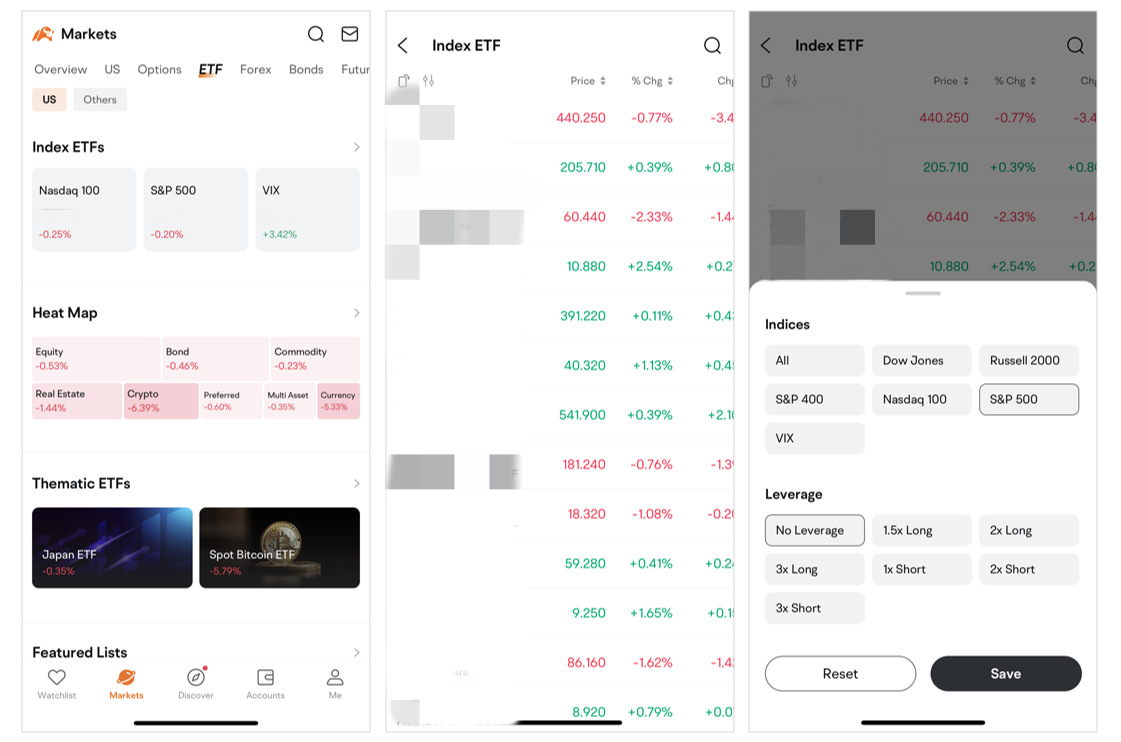
First, tap on 'Markets,' and you'll land on an overview page. Navigate to 'ETF' at the top.
On this page, you can continue to choose ETFs from the U.S. stock market, the Hong Kong market, or other international markets.
When you enter the "US" section, you'll see a list of Index ETFs, ETF Heatmap, Thematic ETFs, ETFs featured lists, and Leveraged and Inverse ETFs.
Tap on the "Index ETFs" category to view ETFs related to major market indices.
Overwhelmed by the information? No worries. You can tap on this filter icon, and then further narrow down your selection based on the index that the ETF tracks and the level of leverage.
For example, select "S&P 500," "No Leverage," and then tap "Save". Then, the list will display all the non-leveraged ETFs that track the S&P 500 index.
(*Images provided are not current and any securities are shown for illustrative purposes only and are not a recommendation.)
2. Factors to Consider When Selecting ETFs
What's the next step in choosing an ETF to invest in?
First, based on your investment goals, decide if you need to invest in leveraged ETFs or ETNs.
We've previously discussed the nature and risks of leveraged and inverse ETFs. A quick reminder: these ETFs amplify the performance of an index or allow for gains when prices drop, which might lead to larger price fluctuations. Fund managers of these types of ETFs frequently rebalance their holdings, which can lead to higher fees. Therefore, leveraged and inverse ETFs are not suitable for long-term investors or investors with a lower risk tolerance.
Exchange-Traded Notes (ETNs) may sound similar to ETFs, but they function more like bonds.
We won't go into ETNs in detail here, but if you're interested, feel free to check our previous videos (*a link to the relevant video will be attached here). In short, ETNs carry higher inherent risks, and while they can be suitable for investing in specialty assets, it's advisable to thoroughly understand the terms detailed in the fund prospectus.
Typically, leveraged ETFs and ETNs are easily identifiable by their names. You can just keep an eye out before trading.
Comparing liquidity and bid-ask spreads if multiple ETFs are tracking the same asset.
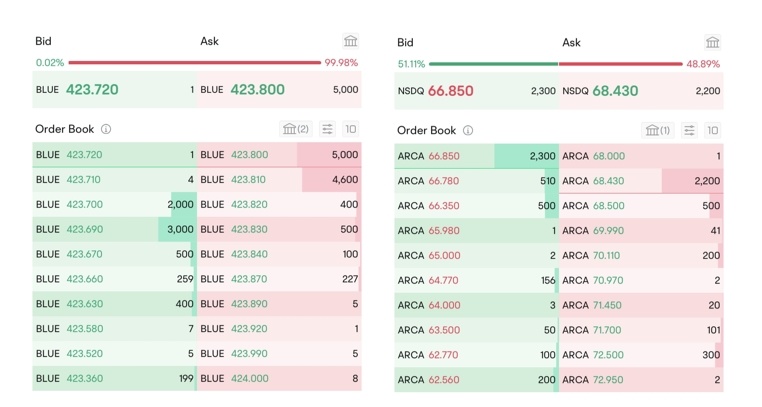
In a previous video, we mentioned that the bid-ask spread, the difference between the buy and sell price, is one of the crucial factors affecting our eventual returns. All ETFs have bid-ask spreads, and generally, those with higher volumes and better liquidity tend to have smaller spreads.
To find these more liquid ETFs, you can swipe left on the Price column to find the 'AUM' column, and tap it to sort the ETFs by asset under management.
Why AUM and not trading volume? Because the market is ever-changing, and a single day's volume might spike or drop significantly, making it an unreliable metric. However, typically, ETFs with larger asset sizes tend to have higher trading volumes. For example, in the chart below, the ETF on the left, with a larger asset size compared to the one on the right, will generally have a smaller spread.
(*Images provided are not current and any securities are shown for illustrative purposes only and are not a recommendation.)
Compare expense ratios and dividend yields based on your investment goals.
Naturally, the lower the expense ratio, the better, but the spread issue also needs to be considered.
Furthermore, you can choose ETFs based on individual stocks of interest.
If there's a stock you want to invest in but can't due to insufficient funds or other reasons, you can potentially find an ETF with a significant holding in that stock. With moomoo, this is easy to do.
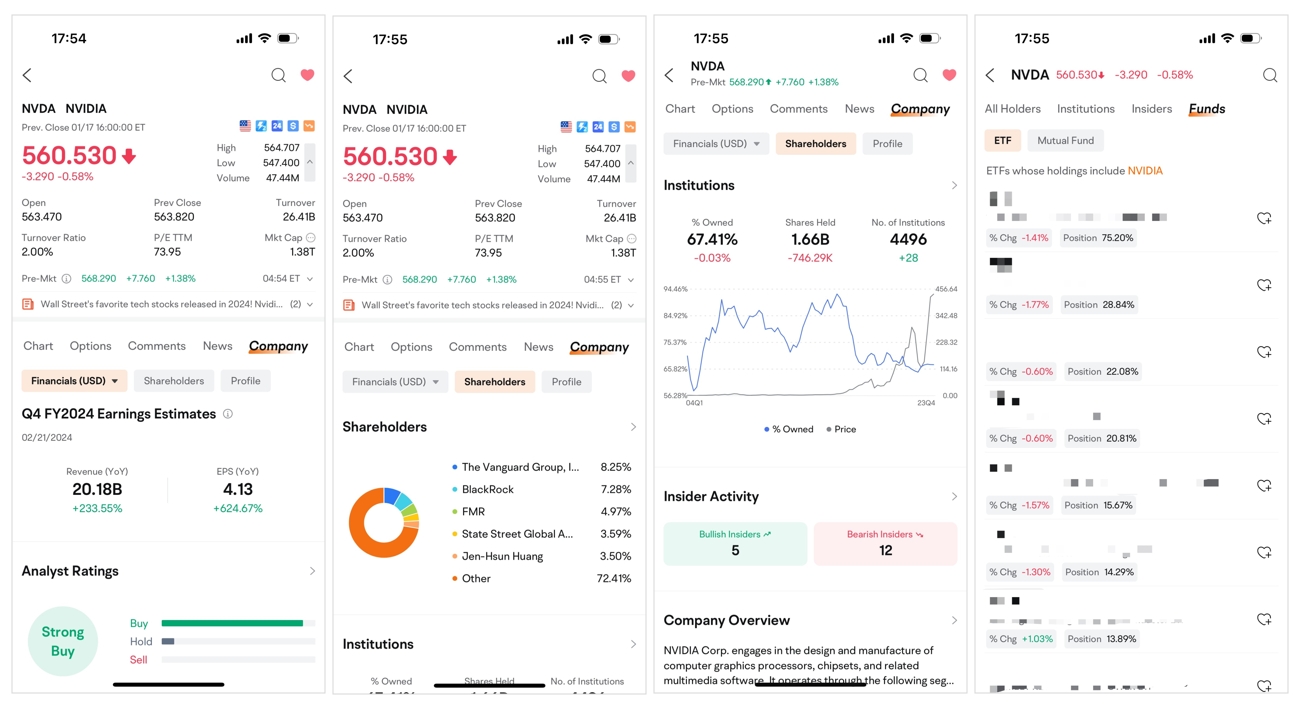
Search for the stock name or ticker in moomoo, like NVDA. Tap to enter the stock's detailed quotes page.
Above the candlestick chart, find 'Company,' then tap 'Shareholders.' Here, you can see the shareholder structure of the company. Tap the small arrow to the right of 'Institutional Holdings Overview' to see which institutions and funds hold the stock.
Select 'Funds' and view 'ETFs.' In this list, you can see which ETFs hold NVIDIA stock and their holding percentages. Tap on the ETF name for more details.
(*Images provided are not current and any securities are shown for illustrative purposes only and are not a recommendation.)
3. Be Aware of Portfolio Overlap in ETFs
When you've shortlisted several ETFs, it's crucial to consider portfolio overlap.
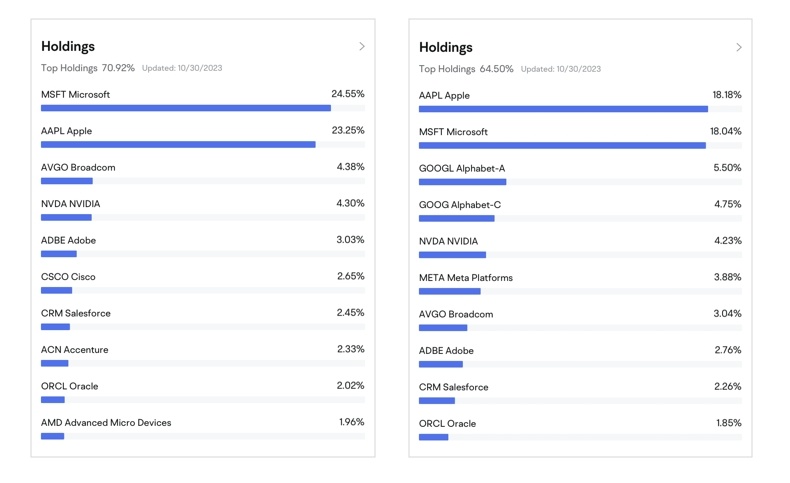
This refers to how much the fund's holdings are the same. One of the main reasons investors choose ETFs is for diversification. If the ETFs you select have a high overlap, meaning they hold many of the same stocks, you're not effectively diversifying your investment, which could defeat the purpose.
(*Diversification is an investment strategy that can help manage risk within your portfolio, but it does not guarantee profits or protect against loss in declining markets.)
To check for overlap, you can closely examine the holdings within each ETF's portfolio. For example, if two ETFs are primarily focused on tech stocks, there's a good chance their holdings might overlap significantly, reducing the diversification effect and potentially increasing your risk exposure.
(*Images provided are not current and any securities are shown for illustrative purposes only and are not a recommendation.)
You can also make use of some third-party tools that provide a quick analysis of ETF overlap for free.
That wraps up our session. If you find our content helpful, please give us a thumbs-up or share them.
We welcome any questions or feedback in the comment section below.
This presentation is for informational and educational use only and is not a recommendation or endorsement of any particular investment or investment strategy. Investment information provided in this content is general in nature, strictly for illustrative purposes, and may not be appropriate for all investors. Read more