Navigate bear markets with inverse ETFs
In our course What are the different types of ETFs?, we explored inverse ETFs, which allow you to profit when the market declines by tracking an index in reverse. Their simplicity and effectiveness make them popular during bear markets.
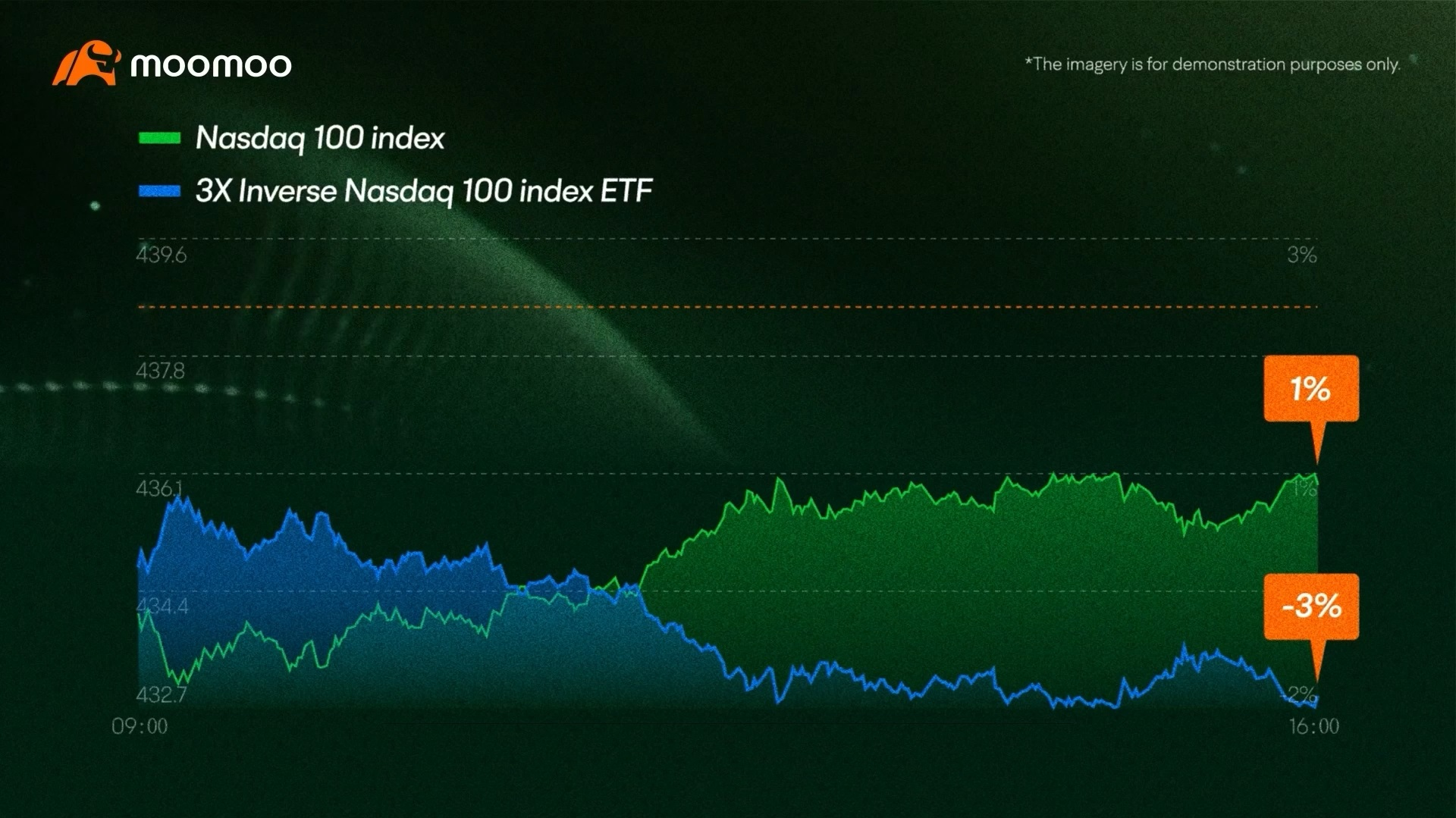
If you're unsure how to use or choose these ETFs, this article will equip you with a practical guide to confidently navigate challenging market conditions.
When do inverse ETFs come into play?
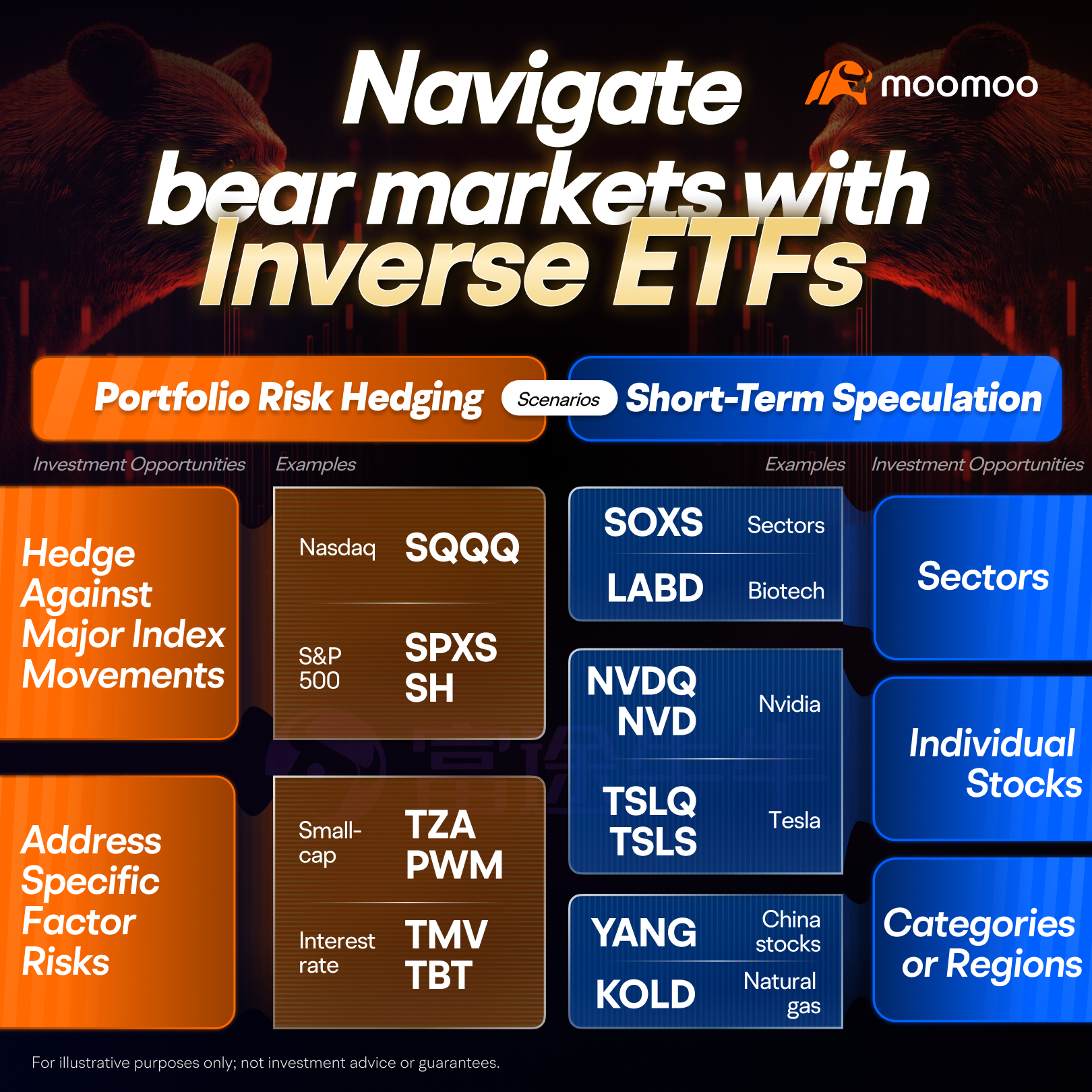
Inverse ETFs are useful when you sense a market downturn or are already experiencing one. They serve two main purposes: portfolio risk hedging and short-term speculation.
1. Portfolio risk hedging
For investors with long positions, inverse ETFs can help hedge against market declines, allowing them to avoid selling off their holdings.
For example, if an investor has a U.S. stock portfolio and the market takes a downturn, purchasing an inverse ETF that tracks a major index may offer some protection. Popular examples include $ProShares UltraPro Short QQQ ETF (SQQQ.US)$ , $Direxion Daily S&P 500 Bear 3X Shares ETF (SPXS.US)$ , and $Short S&P 500 Proshares (SH.US)$ .
In addition to hedging overall market risk, investors can consider using inverse ETFs to address specific factor risks. For instance:
Small-cap risk: Inverse small-cap ETFs, like $Direxion Daily Small Cap Bear 3X Shares ETF (TZA.US)$ or $Short Russell 2000 Proshares (RWM.US)$ .
Interest rate risk (i.e. rate hikes): Inverse treasury ETFs, like $Direxion Daily 20+ Year Treasury Bear 3x Shares ETF (TMV.US)$ or $ProShares UltraShort 20+ Year Treasury (TBT.US)$ .
2. Short-term speculative trading
Many of these ETFs also have leveraged features, making them even more appealing for short-term speculation.
Short-term traders often look for several types of opportunities, such as:
Negative news on individual stocks: For instance, some may consider products like $T-REX 2X INVERSE NVIDIA DAILY TARGET ETF (NVDQ.US)$ , which shorts $NVIDIA (NVDA.US)$ , and $Tradr 2X Short TSLA Daily ETF (TSLQ.US)$ , which shorts $Tesla (TSLA.US)$ .
Sector-specific downturns: Traders might explore options like $Direxion Daily Semiconductor Bear 3x Shares ETF (SOXS.US)$ for shorting the semiconductor sector or $Direxion Daily S&P Biotech Bear 3x Shares ETF (LABD.US)$ for shorting biotech.
Category or regional declines: For example, $Direxion Daily FTSE China Bear 3X Shares ETF (YANG.US)$ could be used to short Chinese stocks, while $ProShares UltraShort Bloomberg Natural Gas (KOLD.US)$ may be considered for shorting natural gas.
Caution: Short-term speculation involves significant risks. It may not be suitable for all investors. This strategy may be more appropriate for investors who have a high risk tolerance.
Using inverse ETFs in real trading
Here are a few strategies for effectively using inverse ETFs:
1. Combine technical analysis
Since inverse ETFs are often used for short-term trading, technical analysis can be very helpful.
For those interested, there are various technical analysis courses available on moomoo Learn.
2. Capitalize on market open time
The market opening period is typically the most active time, characterized by significant price fluctuations and high trading volume, which can benefit short-term speculation with inverse ETFs.
3. Set profit and loss limits
Short-term market movements can be unpredictable. Therefore, it's crucial to establish profit and loss limits to mitigate the risks associated with potential market reversals or incorrect directional bets.
Reverse ETFs are not suitable for long-term holding due to erosion effects and high fees.
Trade inverse ETFs on moomoo
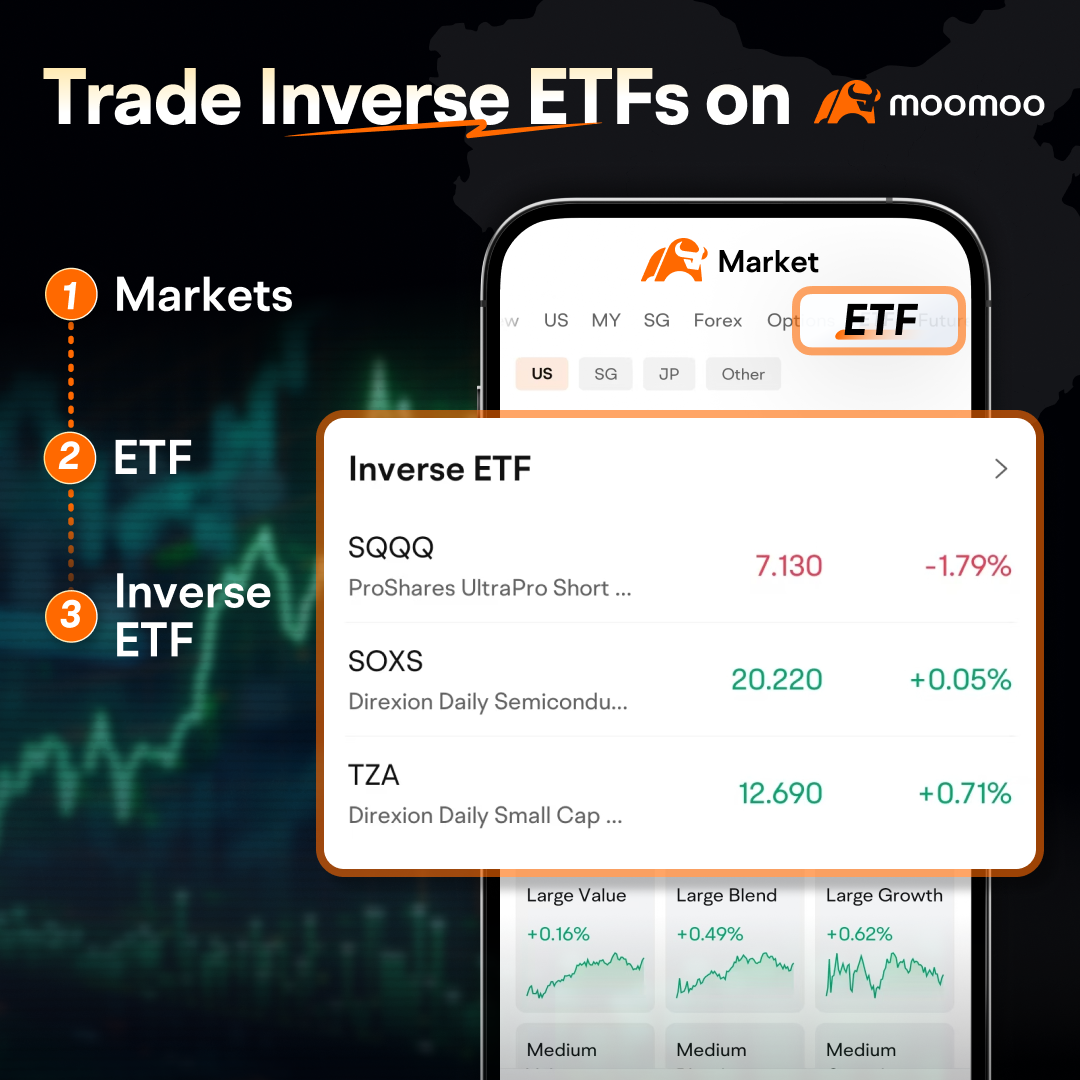
Access 1: Markets > ETF > Inverse ETF
Access 2: Markets > ETF > Screener > Create Strategy
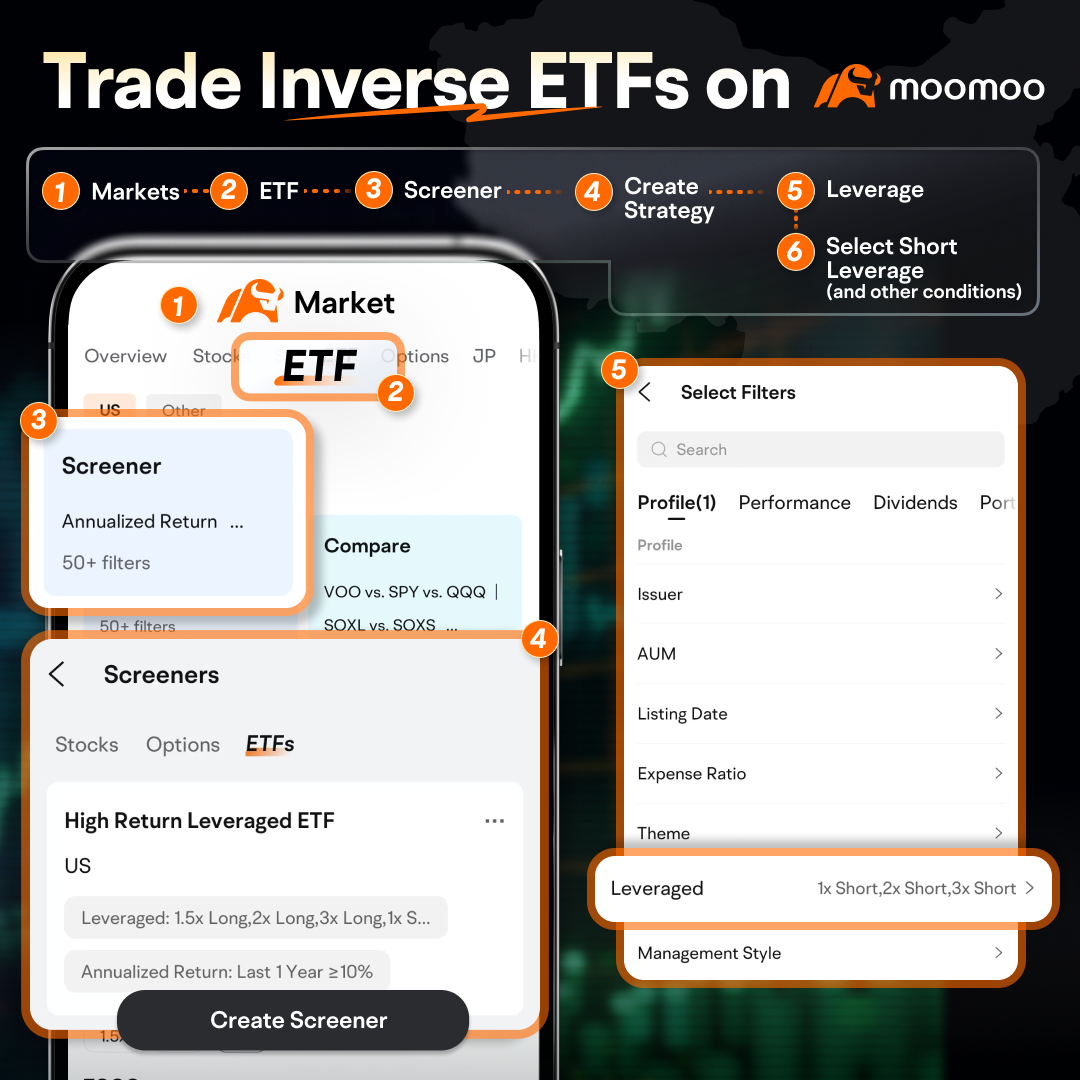
Learn how to use ETF screener: How to Use ETF Screener on moomoo
This presentation is for informational and educational use only and is not a recommendation or endorsement of any particular investment or investment strategy. Investment information provided in this content is general in nature, strictly for illustrative purposes, and may not be appropriate for all investors. Read more