Emerging markets set for a turnaround? How to get ahead of a potential rate cut cycle with ETFs
Since September 2023, when the Fed halted interest rate hikes, the MSCI Emerging Markets Index has rebounded by about 20%. Some individual markets have even entered bull territory, with the MSCI Taiwan Index up over 40% and the MSCI India Index up over 30%.
This has led investors to speculate: could emerging markets see significant gains when the Fed begins cutting rates? It's worth noting that during the last rate cut cycle (2019-2021), the MSCI Emerging Markets Index surged over 80% at its peak.
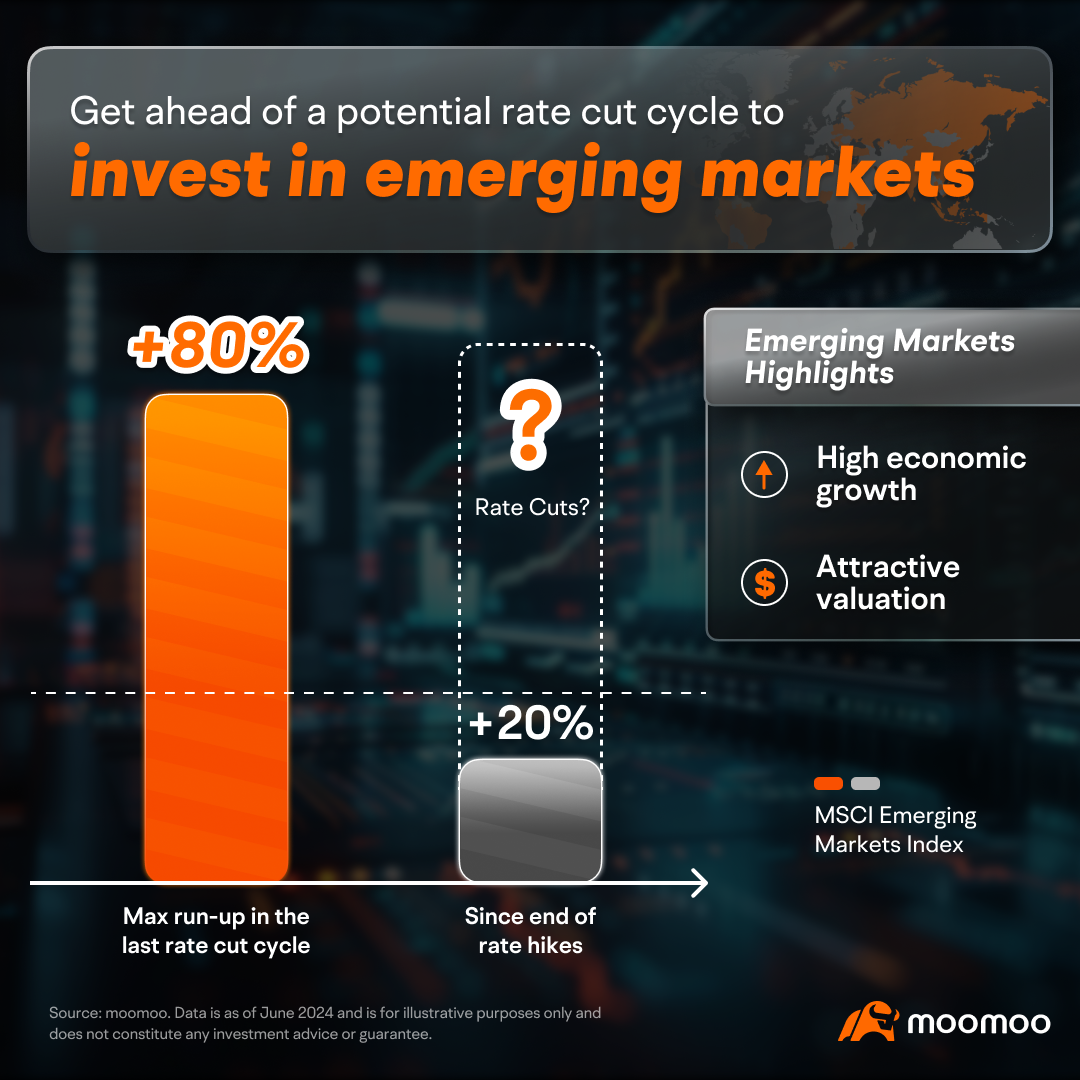
Why might a rate cut present an opportunity? Historically, interest rate cuts have often triggered significant capital inflows into emerging economies, driving up asset prices and occasionally leading to economic overheating.
If you are optimistic about the potential of emerging markets during a rate-cut cycle, ETFs can be an effective way to gain exposure. Let's first explore the basics of emerging markets and then discuss how to invest in them with ETFs.
An overview of emerging markets
Emerging markets are developing countries or regions that present significant opportunities for investors. Typically, these are fast-growing economies with the potential for higher returns compared to developed markets, though they also come with higher risks.
Currently, around 25 countries and regions are widely recognized as emerging markets. These include major economies such as the BRICS (Brazil, Russia, India, China, South Africa) and the MINT (Mexico, Indonesia, Nigeria, Turkey). Together, these countries and regions boast a combined population of over 4.3 billion people and account for about half of the world's GDP.
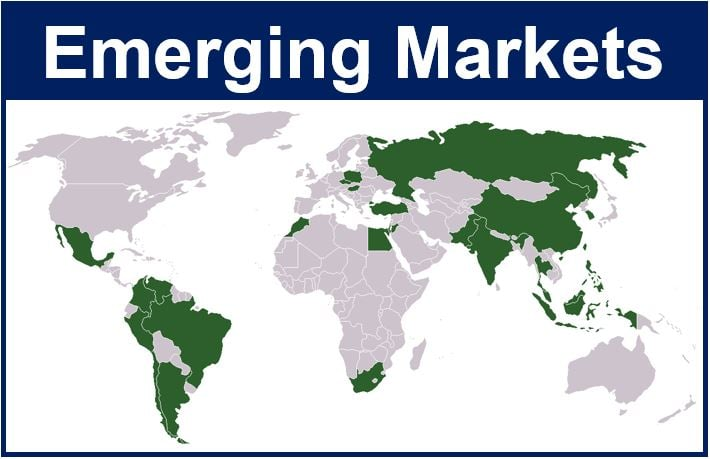
Why are these markets seen as opportunities? Emerging markets offer higher potential growth. According to the International Monetary Fund (IMF), emerging markets are expected to grow at a rate of 4.2% for both years, significantly outpacing developed economies.
Additionally, emerging markets are currently valued more attractively. The MSCI Emerging Markets Index has a lower price-to-earnings (P/E) ratio of about 14x, compared to approximately 22x for the S&P 500.
How can investors unfamiliar with foreign stocks invest? Emerging markets ETFs could be a solution.
How to choose an emerging markets ETF
1. Broad-based emerging market ETFs
These ETFs have exposure to a wide range of emerging markets. They are large in size and spread risk across various emerging economies, making them suitable for "lazy" traders. However, the downside is that the performance of different markets may offset each other, potentially reducing overall returns.
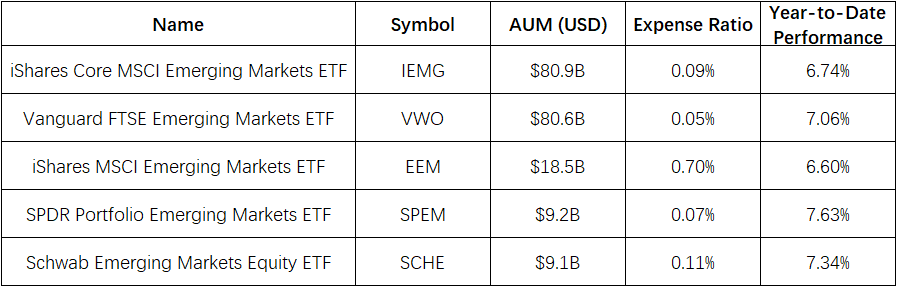
For example, in the US market, here are some notable broad-based emerging market ETFs based on AUM (Assets under Management):
Geographical distribution of the fund's holdings is an important selection criterion. Simply put, if investors are more bullish on certain countries or regions, they might choose ETFs that have a higher allocation to those areas.
Let's take:
$iShares Core MSCI Emerging Markets ETF(IEMG.US)$
$Vanguard FTSE Emerging Markets ETF(VWO.US)$
$iShares MSCI Emerging Markets ETF(EEM.US)$
as examples. The charts below show the distribution of these three ETFs. Among them, VWO has minimal exposure to Korea but a higher allocation to China and India. In contrast, IEMG and EEM have more diversified allocations, with IEMG holding more assets in India and fewer in China compared to EEM.
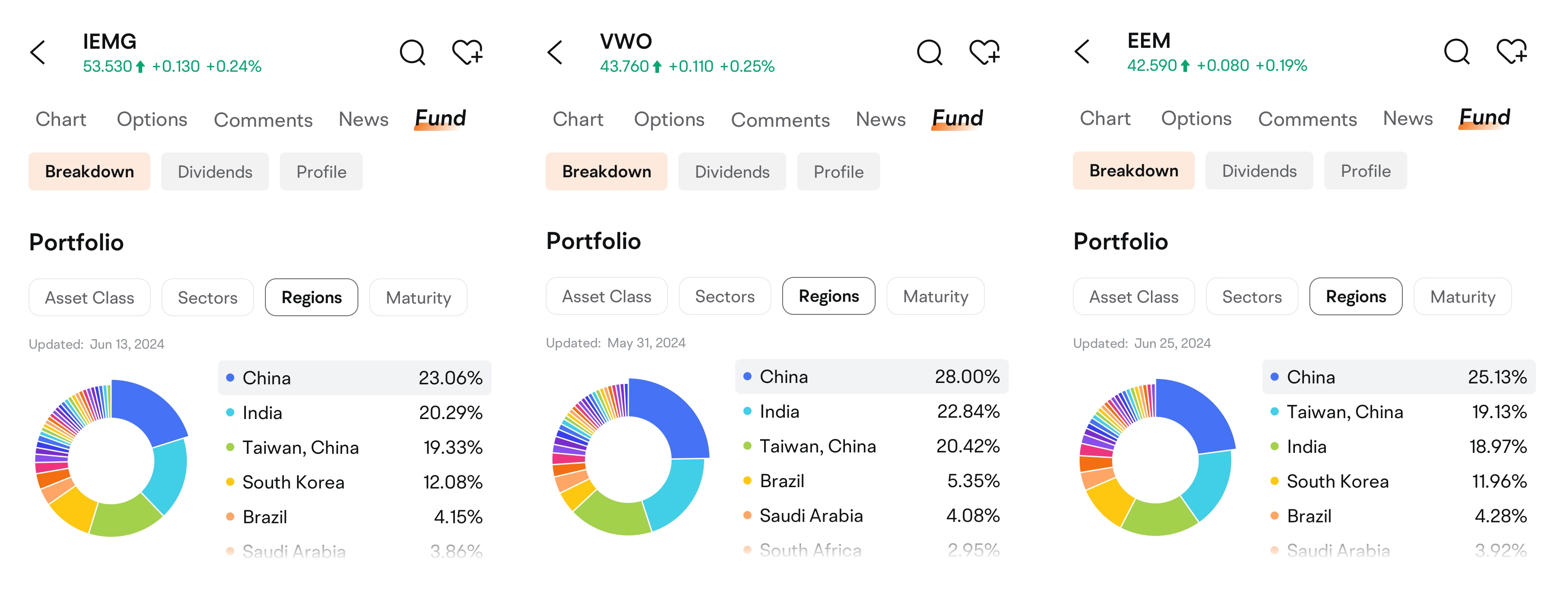
You can find these charts on moomoo by clicking on an ETF and going to Fund > Breakdown > Regions.
2. ETFs that exclude certain countries
Some investors may find broad-market ETFs too diversified and prefer to exclude certain countries or regions. For instance, to better track trends in most emerging markets, some ETFs specifically exclude China due to its significant impact on a broad-based portfolio.
In the U.S. market, ETFs that exclude China often have "ex China" in their names. Here are a few examples selected based on their AUM for reference only:
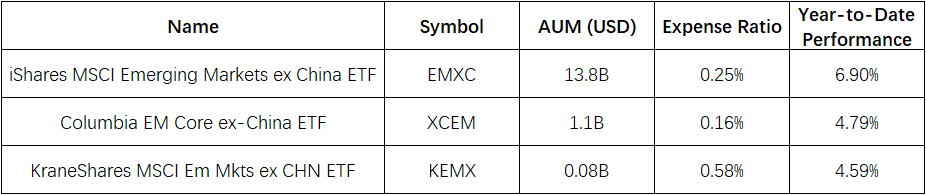
In 2023, China's stock market performance was weak, and emerging market ETFs that exclude China outperformed those that do not. For example:
$Ishares Msci Emerging Markets Ex China Etf(EMXC.US)$
$Columbia EM Core ex-China ETF(XCEM.US)$
$Kraneshares Tr Msci Emerging Markets Ex China Index Etf(KEMX.US)$
returned 18.96%, 19.96%, and 20.58% respectively, compared to:
$iShares Core MSCI Emerging Markets ETF(IEMG.US)$
$Vanguard FTSE Emerging Markets ETF(VWO.US)$
$iShares MSCI Emerging Markets ETF(EEM.US)$
which returned 11.53%, 9.25%, and 8.95% respectively.
However, as of year-to-date 2024, there is no significant performance difference between China-excluded and more inclusive ETFs.
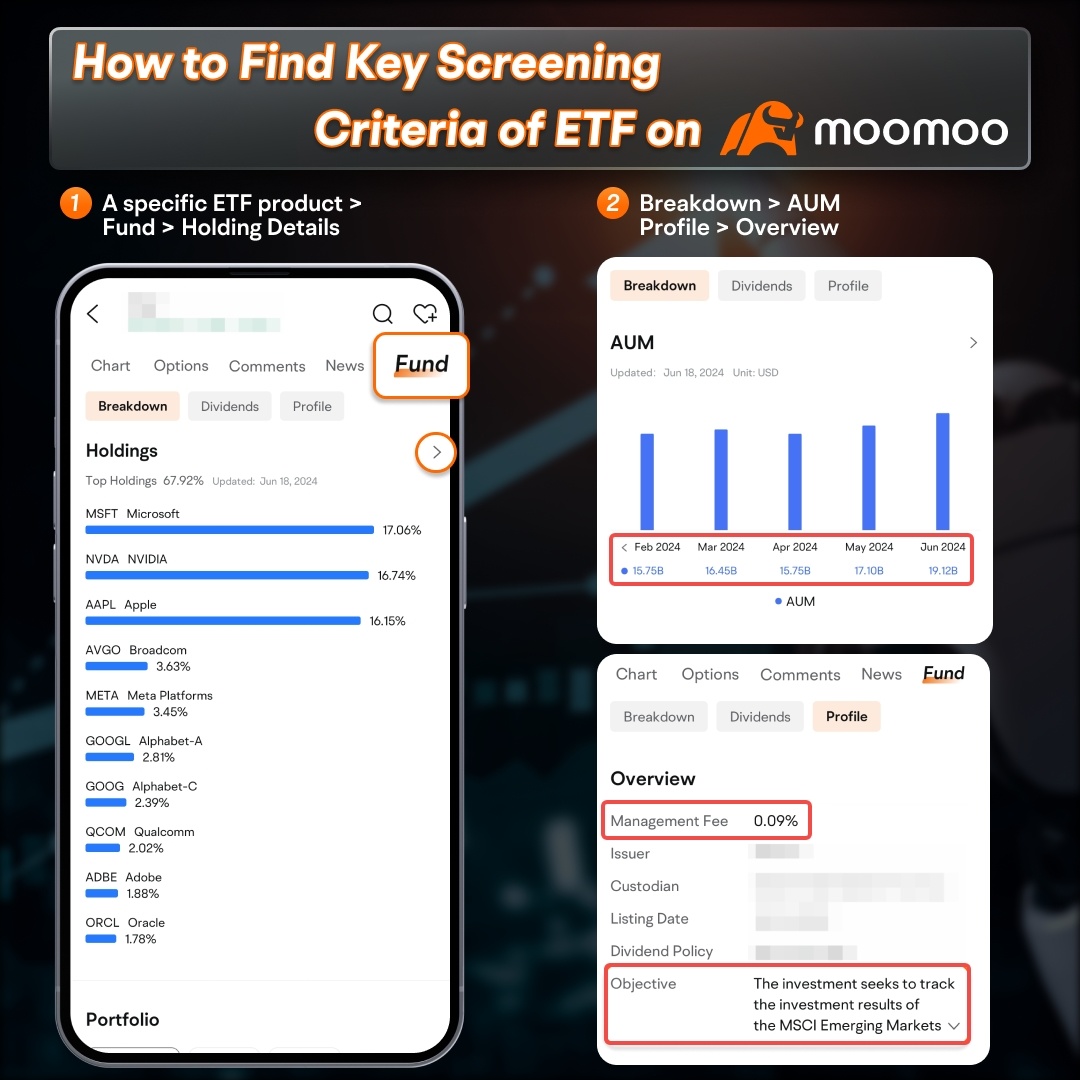
When choosing an ETF that excludes a certain region, prioritize large-sized ones due to their liquidity and lower risk of high premiums. On moomoo, you can check an ETF's size and the history of its AUM changes under Fund > AUM.
3. Specialty ETFs
Unlike the broad-based ETFs that typically track market leaders in emerging economies, specialty ETFs focus on niche markets or employ distinct strategies.
In the U.S. market, ETF names often reflect their strategies. Here are a few examples:
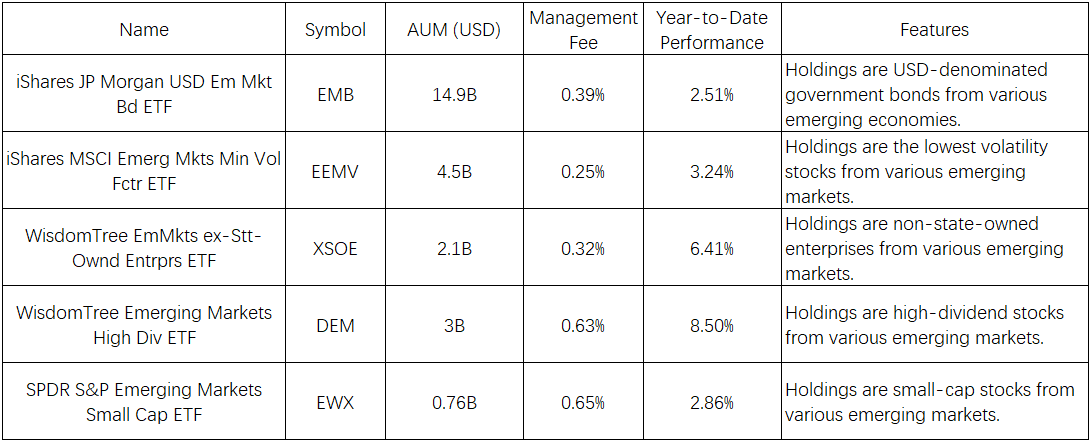
These ETFs have unique features:
$iShares J.P. Morgan USD Emerging Markets Bond ETF(EMB.US)$ focuses on the bond market rather than stocks;
$iShares MSCI Min Vol Emerging Markets ETF(EEMV.US)$ aims to create a low-volatility portfolio by tracking an index of emerging market firms;
$Wisdomtree Emerging Markets Ex-State Owned Enterprises Fund(XSOE.US)$ tracks the performance of emerging market stocks that are not state-owned enterprises.
The management fees for these specialty ETFs are usually higher than those for broad-based ETFs, which rate-sensitive investors should consider.
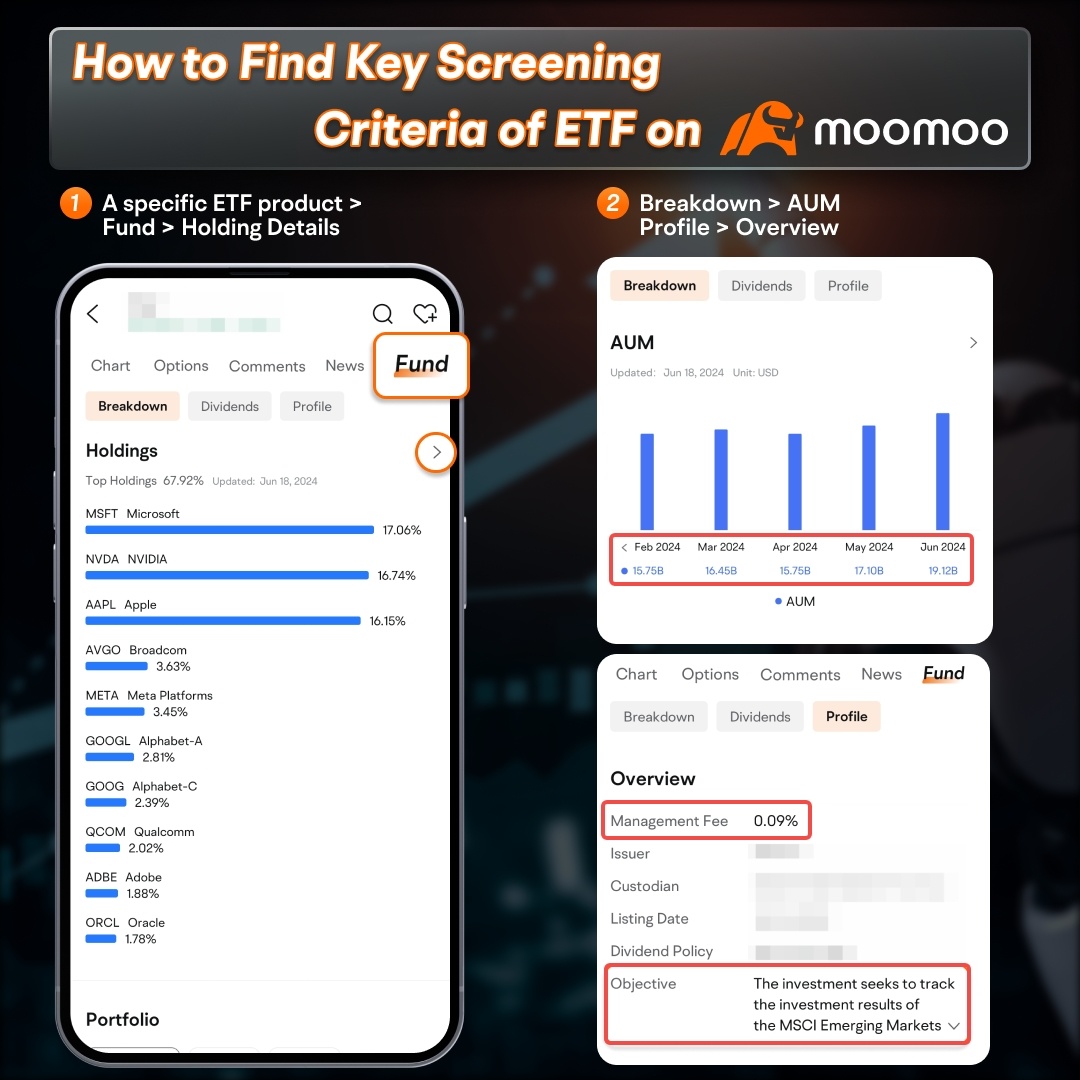
On moomoo, you can check an ETF's management fee and investment objective (representing strategy and features) by going to Fund > Breakdown > Overview.
Takeaways
To summarize the selection methods and examples mentioned in the previous section:
1. Broad-based ETFs focus on diversification. Examples include:
- $Vanguard FTSE Emerging Markets ETF(VWO.US)$: Excludes Korean positions.
- $iShares Core MSCI Emerging Markets ETF(IEMG.US)$: The largest fund.
- $iShares MSCI Emerging Markets ETF(EEM.US)$: Offers a high degree of diversification.
2. Country-specific Exclusion ETFs: Some products can exclude certain countries, such as China. An example is:
- $Ishares Msci Emerging Markets Ex China Etf(EMXC.US)$: A large, liquid fund.
3. Specialty ETFs: they focus on emerging markets with specific strategies. Examples include:
- $iShares J.P. Morgan USD Emerging Markets Bond ETF(EMB.US)$: Specializes in emerging economy bonds.
- $iShares MSCI Min Vol Emerging Markets ETF(EEMV.US)$: Focuses on low volatility factors.
While there are opportunities to invest in emerging markets, there are particular risks, such as geopolitical and exchange rate risks, and emerging markets are generally more volatile than mature markets. Although ETFs help diversify risks, these risks should not be ignored.
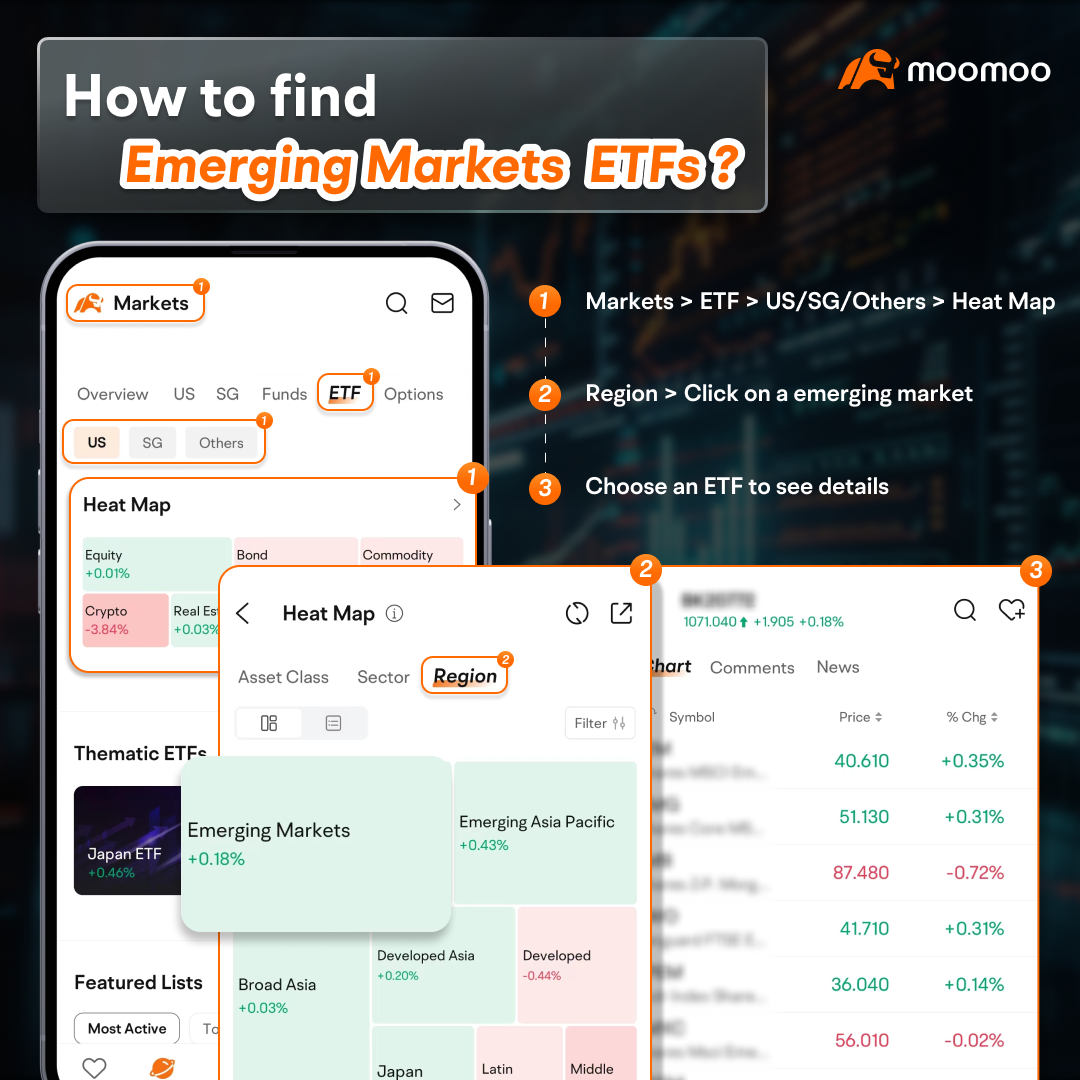
Want to know where to find emerging markets ETFs? On moomoo, you can easily find them! Click Markets > ETFs > Heat Map > Region > Emerging Markets to see a more detailed list of emerging markets ETFs.
This presentation is for informational and educational use only and is not a recommendation or endorsement of any particular investment or investment strategy. Investment information provided in this content is general in nature, strictly for illustrative purposes, and may not be appropriate for all investors. Read more