Leveraged ETPs: How they could boost or bust your returns
When investing, certain strategies may increase your exposure to market movements. One such approach is leveraging your money through margin trading, which involves borrowing funds to invest. However, be mindful that leverage involves risk. If the market takes a significant dive, you may face larger losses.
For those not looking to borrow, there's another choice: leveraged exchange-traded products (ETPs). These financial instruments offer a way to gain magnified exposure to market returns.
Takeaways:
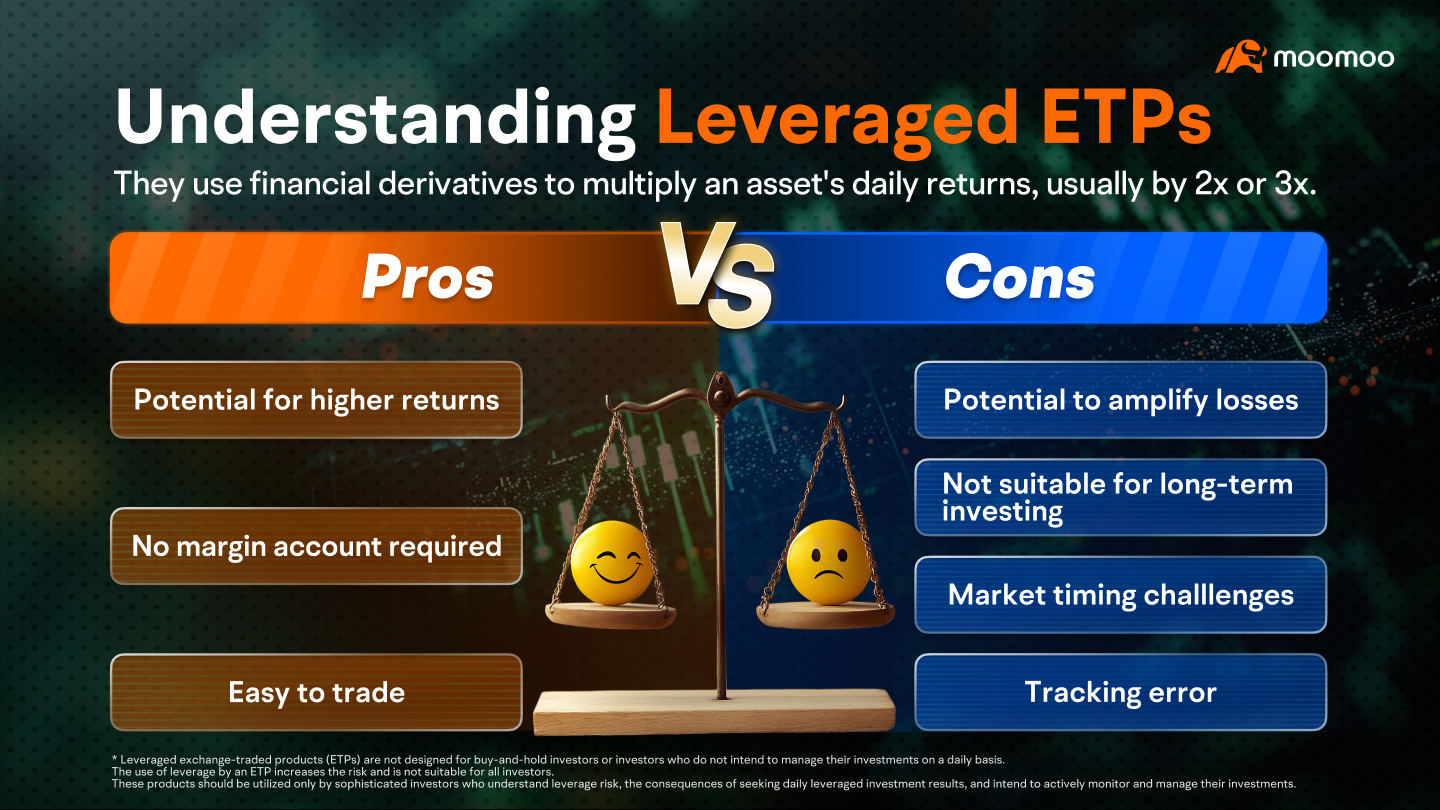
● Leveraged ETPs aim to multiply daily returns of an asset, usually by 2x or 3x.
● They're designed for short-term trading, not long-term investing.
● Over time, market volatility and daily rebalancing can significantly impact their performance.
1. What are leveraged ETPs?
Leveraged ETPs are investments that try to multiply an asset's gains or losses, usually by 2x or 3x, on a daily basis. They achieve this by using financial derivatives such as futures or swaps.
For example, a 2x leveraged S&P 500 ETP aims to double the index's daily return. If the index rises 1% in a day, the ETP should go up 2%, but it would also fall 2% if the index drops 1%.
Leveraged ETPs are designed for very short-term use, generally for one day or a few days at most. They are not suitable for long-term investing.
It's important to understand that they don't simply multiply your overall returns over time. Holding them long-term often leads to unexpected results.
2. Understanding "daily rebalancing"
Most leveraged ETPs adjust their investments daily to maintain the promised performance levels. This is called "daily rebalancing."
Here's a basic example:
Let's say a 2x leveraged ETP has 20% of its money in Company A's stock. If Company A rises 10% in one day, the ETP's stake would grow 20%. This might make Company A's stock a bigger part of the ETP than it should be. So, the ETP then rebalances its investments to match its original plan.
Over time, these daily rebalancing can lead to unexpected results:
● Performance may not exactly match the goal of achieving 2x the market's overall returns.
● More market volatility, higher leverage, and longer holding periods can increase the difference from your expected returns.
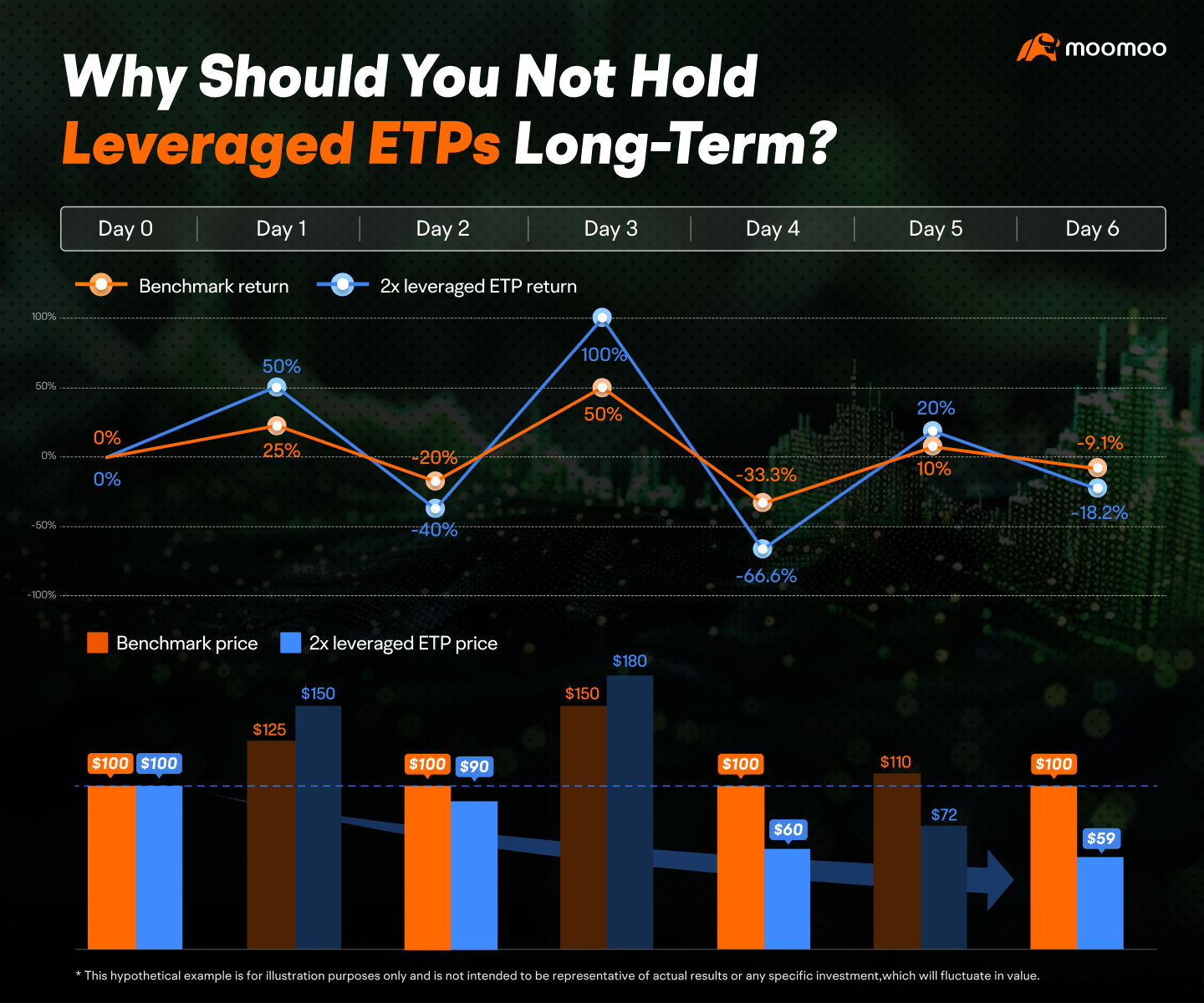
This is why leveraged ETPs are for short-term trading, not long-term investing. They're riskier than traditional non-leveraged ETPs.
3. Who might benefit from using leveraged ETPs?
Leveraged ETPs are complex financial instruments for advanced investors with a high risk tolerance. They are primarily intended for traders seeking short-term tactical trading strategies based on market fluctuations.
Before thinking about investing in these products, ask yourself:
● Do I fully understand how they work and how they perform?
● Am I prepared for the potential of substantial losses?
● Can I commit to monitoring and managing my investments on a daily basis?
● Do I accept the impact of daily rebalancing on long-term performance?
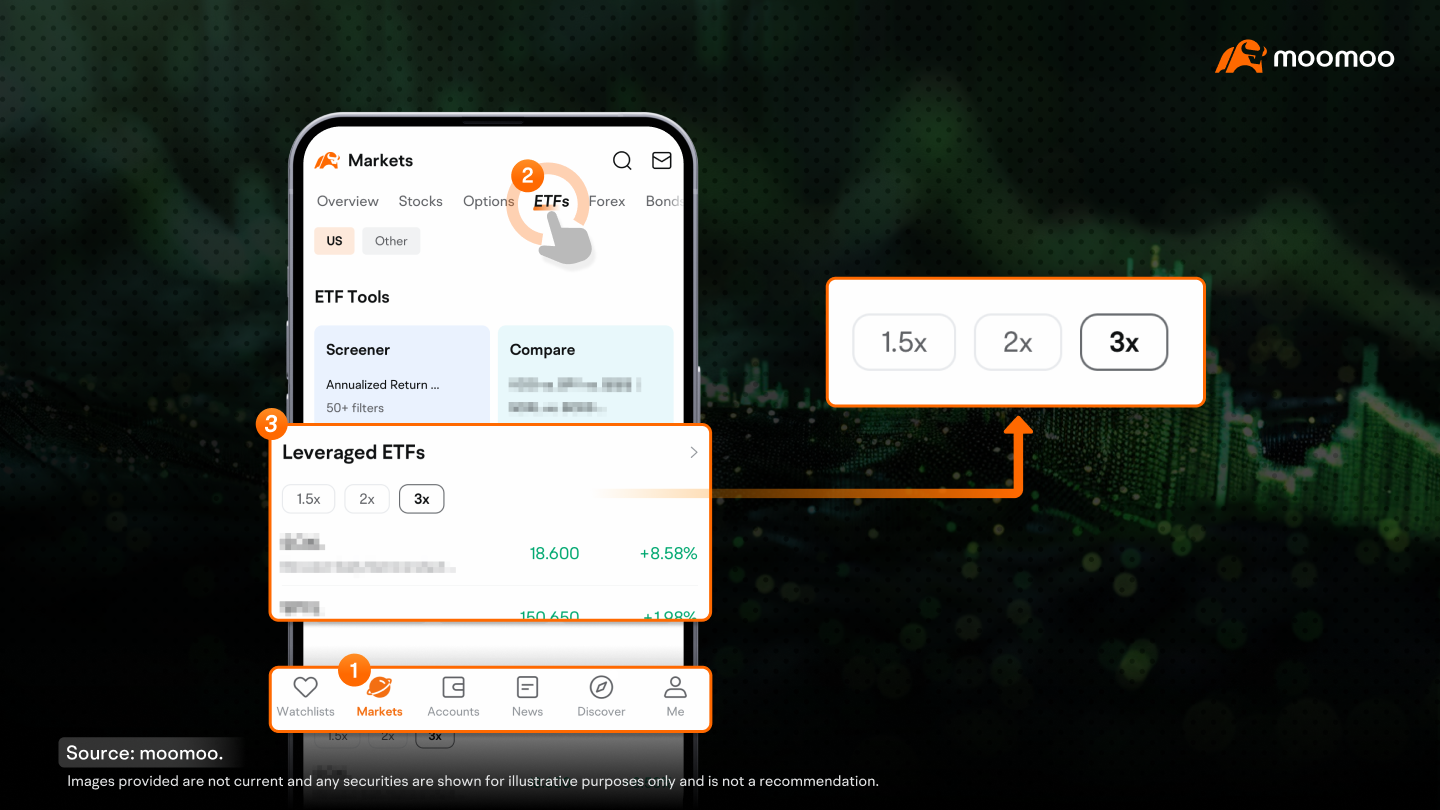
With moomoo, leveraged ETPs can be found under Markets> ETFs> Leveraged ETFs. These products may track various underlying assets, including broad market indexes, specific sectors, or individual stocks.
Remember that leveraged ETPs are generally unsuitable for long-term investment strategies. When trading with leverage, it's crucial to manage your risk effectively. Hint: Implementing stop-loss orders is one way to help limit potential losses.
Disclosure:
Exchange-traded products (ETPs) are subject to market volatility and the risks of their underlying securities, which may include the risks associated with investing in smaller companies, foreign securities, commodities, and fixed income investments. ETPs that use derivatives, leverage, or complex investment strategies are subject to additional risks. The return of an index ETP is usually different from that of the index it tracks because of fees, expenses, and tracking error.
Before investing in an ETP, you should read both its summary prospectus and its full prospectus, which provide detailed information on the ETP's investment objective, principal investment strategies, risks, costs, and historical performance (if any). You can find prospectuses on the websites of the financial firms that sponsor a particular ETP, as well as through your broker.
A Word about Risk: Investment returns will fluctuate and are subject to market volatility, so that an investor's shares, when redeemed or sold, may be worth more or less than their original cost. ETPs are subject to market volatility and the risks of their underlying securities, which may include the risks associated with investing in smaller companies, international securities, commodities, fixed income, and more. An ETP may trade at a premium or discount to its net asset value (NAV).
Leveraged ETPs are not designed for buy and hold Investors or investors who do not intend to manage their investment on a daily basis. The use of leverage by an ETP increases the risk and are not suitable for all investors and should be utilized only by sophisticated investors who understand leverage risk, consequences of seeking daily leveraged investment results and intend to actively monitor and manage their investment.
This presentation is for informational and educational use only and is not a recommendation or endorsement of any particular investment or investment strategy. Investment information provided in this content is general in nature, strictly for illustrative purposes, and may not be appropriate for all investors. Read more