
Moomoo Insights
Jul 16 15:38
TSMC Earnings: AI Demand Is Stronger Than the Chip Selloff Suggests
Moomoo Insights
Sep 30 05:04
Live Take | Anthropic’s $518B Compute Bet: Who Wins From the AI Buildout?
Within the limits of a single day is what is meant by the term "intraday." From the financial perspective, this word is shorthand for referring to securities traded on exchanges during ordinary business hours. These financial instruments include equities and exchange-traded funds (ETFs). Additionally, intraday refers to the lows and highs that the asset touched during a single trading day. Price changes during a single trading session are known as intraday price fluctuations. They are particularly relevant to traders who engage in short-term or day trading and want to execute many deals during a single session. These active traders will close out their holdings at the end of the trading day.
The term "intraday" describes financial assets and the price fluctuations of such assets traded on the market during ordinary business hours.
Day traders pay particular attention to intraday price movements and carefully time their deals in the hope of profiting from the rapid price shifts that occur over a single trading day.
Intraday trading tactics can be subdivided into many categories, including scalping, range trading, and trading based on news events.
A given security's daily highs and lows are sometimes referred to as its intraday highs and lows. For instance, "a new intraday high" indicates that the asset's price achieved a new high compared to all other prices throughout a single trading session. There are times when the closing price and an intraday high will have the same value.
Traders pay particular attention to intraday price swings and use real-time charts to profit from price variations over very short periods. When trading within a single trading day, traders focusing on the short term generally use intraday charts with time frames of one minute, five minutes, 15 minutes, 30 minutes, and 60 minutes. High-speed trading strategies like intraday scalping often use one-minute and five-minute charts. For transactions with hold lengths of many hours, other intraday trading systems may employ 30- and 60-minute charts. Scalping is a trading method that involves making a large number of trades every day in the expectation of making a profit from very little changes in the price of a stock. Even if they may maintain their positions for extended periods, traders who engage in intraday trading nonetheless subject themselves to significant levels of risk.
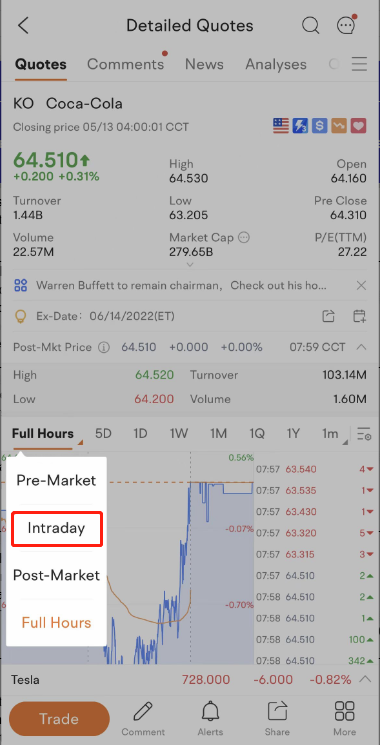
moomoo provides pre-market, intraday, after hour trading (post-market), and full hours for the stock charts. Investors and traders can select one of these stock charts based on their trading strategy.
Intraday trade execution efficiency can be improved with volume-weighted average cost, or VWAP (Volume Weighted Average Price), orders. These orders expose an order to a range of prices during the trading day. The VWAP provides an average price certain security trades at during a single trading day.
Intraday trading strategies come in a wide variety for traders to choose from. The following methods are included in these strategies:
Scalping is a day trading in which participants aim to generate several modest gains by capitalizing on very few price fluctuations.
Trading in a range, which is generally determined by using resistance and support levels to establish their buy and sell choices
News-based trading, in which trading opportunities are often taken advantage of by capitalizing on the increased volatility that surrounds news events
High-frequency trading refers to trading tactics that use complex algorithms to capitalize on modest or short-term market distortions.
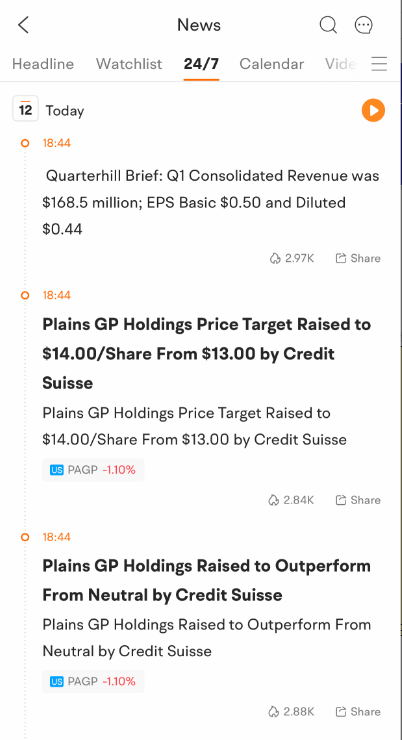
moomoo trading app can provide traders and investors with free 24/7 real-time global news from authoritative news agencies such as Dow Jones, Benzinga, and more. Download moomoo app today to get free access to 24/7 latest news and discover potential investing opportunities.
The most important advantage of intraday trading is that positions are not influenced by the prospect of unfavorable information that emerges overnight and can have a substantial effect on the price of shares. These types of data include essential economic and earnings numbers and broker upgrades and downgrades that might occur either before the market starts or after it ends for the day.
Trading on an intraday basis provides traders with many important additional benefits. One of the benefits is the opportunity to place tight stop-loss orders, which refers to increasing a stop price to limit the amount of money lost on a long position. Another aspect is the expanded availability of margin, which results in a higher level of leverage. The chances for learning presented to traders by intraday trading are also increased.
Nevertheless, a dark cloud hangs over every cloud with a silver lining. There is not enough time for a position to experience profit rises, and in some situations, there is no profit, which is one of the drawbacks of intraday trading. Additionally, greater commission expenses are incurred due to trading more often, which chips away at the profitability a trader might anticipate.
Pros
The risk posed by overnight information or broker actions outside trading hours does not affect positions.
Protecting holdings with strict stop-loss orders.
Leverage is available to regular traders at higher levels.
The amount of practical experience one gains may be increased by working in various trades.
Cons
Frequent transactions involve various commission expenses.
Mutual funds are an example of an asset that is unavailable for purchase.
There is a possibility that there will not be enough time for a position to make a profit before it has to be closed out.
Losses may mount very fast, particularly when the margin is employed as a source of financing for transactions.
Trading during the intraday period is not allowed in mutual funds. These funds are intended to be held for an extended time. The only way to buy or sell them is via the intermediary of a broker or the investing business that manages the fund. Additionally, the value of a mutual fund is only published once, at the end of each trading day, when the fund's shares are bought and sold. Net asset value (NAV) is the per-share price that indicates the daily change in the value of a mutual fund based on its assets, less its liabilities.
Therefore, mutual funds do not provide intraday pricing since the market price of their assets is always changing, and their managers always make choices on whether to purchase or sell shares. On the other hand, exchange-traded funds (ETFs), which are similar to mutual funds but are managed less actively, have prices determined by the value of their underlying assets during a given trading session.
The fluctuations in the value of any stock are recorded all through the trading day and compiled after the session for easy reference. For instance, shares of Apple Inc. (AAPL) moved from an opening price of $174.57 to a closing price of $178.44 on April 4, 2022. Shares went as low as $174.44 during the trading day, referred to as the intraday low, and reached a height of $178.49, which is referred to as the intraday high. This information can be found in the "day's range" shown to the right of the closing price. Day traders and technical analysts who monitor Apple's stock would analyze its price movements to spot any discernible patterns or gaps (a sharp increase in price with no intervening activity).
This presentation is for informational and educational use only and is not a recommendation or endorsement of any particular investment or investment strategy. Investment information provided in this content is general in nature, strictly for illustrative purposes, and may not be appropriate for all investors. Read more
Recommend
How to Trade Volatility: Strategies & Tips for Success
How to File Taxes: 6 Steps for Beginners

Best AI Stock Trading Tools on moomoo Trading App

What is Algorithmic Trading | Benefits, Strategies & Future Trends
How to Diversify Your Portfolio: 6 Strategies to Consider
How to Invest in Dividend Stocks for Beginners
How to Invest in DeepSeek Stock: Easy Steps to Follow
How to Invest in Silver for Beginners
Meme Stocks: Definition, Examples, and Impact on the Market
What is an ACH Transfer: Definition, Types & Benefits
Stop-Limit Order: What it is in Stocks
How to Invest In OpenAI Stock in 2026
Fractional Shares: Definition & How to Buy
Cash Accounts: What Are They and How Do They Work
What Are International Stocks & American Stocks?
Margin Account vs Cash Account: Which is Right for You?
Volatility: Definition in Finance and How to Calculate
What is a Brokerage Account: Definition and How to Open
What Are Bitcoin ETFs and How to Trade
How to Transfer Stocks From One Broker to Another
New "T+1" Settlement Cycle | What You Need to Know
SEC Form 13F: Definition, Filling Requirements, and Examples
How to Choose a Good Online Brokerage for Stock Trading
Bitcoin Futures: What Are They and How to Invest
What Is 403(b) Plan? How Does It Work
Price Action Trading: A Guide to Understanding the Basics
Margin Trading: Strategies, Benefits, and Risks
How to Invest in Index Funds for Beginners
Pre-Market and After-Hours Trading: Definition & How It Works
What is the Stock Market: Key Concepts and Functions
Common Stock: Definition, Benefits, and vs. Preferred Stock
Stock Dividends vs. Capital Gains: What You Need to Know
What Is a Stock Split - Definitions, How It Works, & Examples
Institutional Investors: Definitions & How They Invest
How to Invest in the S&P 500 for Beginners
The Impacts of ChatGPT on the Stock Market
ETFs vs. Mutual Funds
How to Practice Trading Stocks with a Free Demo Account?
The Basics of Financial Literacy: Why You Should Care
Stocks vs. Bonds
Choosing the Best Trading Platform for You — moomoo vs. Webull vs. Robinhood
The Consumer Price Index (CPI) Explained For Investors
How to Use moomoo Paper Trading Online?
What Is the Price-to-Sales (P/S) Ratio?
What Is a Quarterly Report?
What Is the Price-to-Book (P/B) Ratio?
Margin Account Explained: Definition, Benefits, and How to Use It
What Is A 10-K?
What Is SEC Form 10-Q?
What Is Ethical Investing
What Is Earnings Season
What Is Socially Responsible Investment (SRI)?
What Is a Stop Order?
Reading the Annual Report
What Is Open Trade Equity (OTE)?
What Is Impact Investing
How to Use moomoo Paper Trading
What Is a Limit Order?
Margin Trading: How It Works, Risks and Benefits
What Is Initial Margin?
How to Invest in Stocks: From Basic to Advanced
Stock Market Courses that Seek to Empower Investment Goals
How Can You Calculate Margin Interest?
What is Intraday?
Retail Investors vs. Institutional Investors: What You Need to Know
What are Cyclical stocks?
How to Buy Stocks Online without A Broker
How to Trade Volatility: Strategies & Tips for Success
How to File Taxes: 6 Steps for Beginners
Best AI Stock Trading Tools on moomoo Trading App
What is Algorithmic Trading | Benefits, Strategies & Future Trends
How to Diversify Your Portfolio: 6 Strategies to Consider
How to Invest in Dividend Stocks for Beginners
How to Invest in DeepSeek Stock: Easy Steps to Follow
How to Invest in Silver for Beginners
Meme Stocks: Definition, Examples, and Impact on the Market
What is an ACH Transfer: Definition, Types & Benefits
Stop-Limit Order: What it is in Stocks
How to Invest In OpenAI Stock in 2026
Fractional Shares: Definition & How to Buy
Cash Accounts: What Are They and How Do They Work
What Are International Stocks & American Stocks?
Margin Account vs Cash Account: Which is Right for You?
Volatility: Definition in Finance and How to Calculate
What is a Brokerage Account: Definition and How to Open
What Are Bitcoin ETFs and How to Trade
How to Transfer Stocks From One Broker to Another
New "T+1" Settlement Cycle | What You Need to Know
SEC Form 13F: Definition, Filling Requirements, and Examples
How to Choose a Good Online Brokerage for Stock Trading
Bitcoin Futures: What Are They and How to Invest
What Is 403(b) Plan? How Does It Work
Price Action Trading: A Guide to Understanding the Basics
Margin Trading: Strategies, Benefits, and Risks
How to Invest in Index Funds for Beginners
Pre-Market and After-Hours Trading: Definition & How It Works
What is the Stock Market: Key Concepts and Functions
Common Stock: Definition, Benefits, and vs. Preferred Stock
Stock Dividends vs. Capital Gains: What You Need to Know
What Is a Stock Split - Definitions, How It Works, & Examples
Institutional Investors: Definitions & How They Invest
How to Invest in the S&P 500 for Beginners
The Impacts of ChatGPT on the Stock Market
ETFs vs. Mutual Funds
How to Practice Trading Stocks with a Free Demo Account?
The Basics of Financial Literacy: Why You Should Care
Stocks vs. Bonds
Choosing the Best Trading Platform for You — moomoo vs. Webull vs. Robinhood
The Consumer Price Index (CPI) Explained For Investors
How to Use moomoo Paper Trading Online?
What Is the Price-to-Sales (P/S) Ratio?
What Is a Quarterly Report?
What Is the Price-to-Book (P/B) Ratio?
Margin Account Explained: Definition, Benefits, and How to Use It
What Is A 10-K?
What Is SEC Form 10-Q?
What Is Ethical Investing
What Is Earnings Season
What Is Socially Responsible Investment (SRI)?
What Is a Stop Order?
Reading the Annual Report
What Is Open Trade Equity (OTE)?
What Is Impact Investing
How to Use moomoo Paper Trading
What Is a Limit Order?
Margin Trading: How It Works, Risks and Benefits
What Is Initial Margin?
How to Invest in Stocks: From Basic to Advanced
Stock Market Courses that Seek to Empower Investment Goals
How Can You Calculate Margin Interest?
What is Intraday?
Retail Investors vs. Institutional Investors: What You Need to Know
What are Cyclical stocks?
How to Buy Stocks Online without A Broker

