
Moomoo Insights
Jul 16 15:38
TSMC Earnings: AI Demand Is Stronger Than the Chip Selloff Suggests
Moomoo Insights
Sep 30 05:04
Live Take | Anthropic’s $518B Compute Bet: Who Wins From the AI Buildout?
Buying on margin refers to borrowing money from a broker to purchase stock. With a margin account, investors can boost their financial leverage by using someone else's money. Indeed, margin trading is a great alternative to traditional trading. It also brings many risks.
Buying on margin also boosts the loss effects. Purchasing stocks on margin amplifies the impact of losses. Besides, there're also chances of a margin call. In this case, you may require additional money to maintain your investment and liquidate your position.
KEY TAKEAWAYS
•Buying stocks on margin refers to borrowing money to purchase stock shares and securities.
•Trading on margin allows investors to use leverage to maintain or boost their position.
•Trading on margin involves risk because it requires traders to pay the money back to the broker.
•Buying on margin can amplify both losses and gains.
•Too much drop in the account market value leads to a margin call. As a result, investors have to deposit more cash or sell their shares.
Typically, brokers pay the investors through their brokerage account. When an investor buys a stock, cash is debited from their brokerage account to pay for the purchase.
Based on the number of shares and stock price, investors can buy 100% of their stock with cash.
Margin trading refers to borrowing money from a broker to purchase equity shares and securities.
Investors can also buy more stock than they could once they have taken out a loan. Investors have to pay a specific interest on the loan amount to leverage these benefits.
Establishing a margin account is necessary for a margin account. This account is distinct from the standard cash account. The stocks or assets kept in the margin account serve as security for the margin loan. Not all securities, nevertheless, can be bought on margin.
Trading on margin requires investors to deposit a minimum margin with their brokerage firm. The minimum margin is $2000 or 100% of the purchase price. The minimum margin could also be higher than $2000 for some firms. [1]
Federal Reserve set a limiting value for the amount to be borrowed. This limiting value is known as the initial margin.
An investor can borrow up to 50% of the total stock price. They can then use this borrowed money to purchase new stocks. It means you need to deposit 50% to the broker if you want to borrow 50% of the stock amount. Some brokerage firms also require you to submit more than 50% of the stock price. [2]
The margin requirement was just 10% before the Stock Market Crash in 1929. An investor could buy stocks worth $100,000 if they have a $10,000 balance in their account.
As a result, investors enjoyed a dramatic boost in leverage. But a sudden stock market crash causes them to lose all their money. Margin investing was therefore discouraged. Additionally, some Federal reserved board stock speculation leads to the wastage of resources. [3]
Suppose you want to purchase stocks worth $10,000 more than the amount present in your margin account. You need to have at least 50% cash amount as an initial 50% margin requirement.
However, it will allow you to double your purchasing power, enabling you to buy stock worth $20,000.
Once you have bought the stock with the money borrowed, two scenarios could happen:
The first scenario will help you understand how purchasing on margin could increase the gains.
Suppose you want to purchase stock worth $20,000. After purchasing stock worth $20,000, you owe the broker $10,000. Now, suppose the stock's price increases; the following scenarios could happen:
•Buy Stocks of worth $20,000; finance of $10,000 in cash and $10,000 via a margin loan
•Increase in stock market value to $30,000
•Stock price moves higher; new market value = $30,000
•Sell the stock at the new market value
•Pay the loan+interest from the profit
•The account balance will be $20,000
It indicates that investors have earned 100% profit on an investment of $10,000. Had you initially paid for the entire $20,000 with cash (no margin loan) and sold at $30,000, the gain would be only 50%.
A fall in stock price could amplify the losses in the same way a rise in stock price amplifies the gains.
Let's imagine you have the same amount of stock. But stock price drops instead of rising.
•Buy Stocks of worth $20,000; finance of $10,000 in cash and $10,000 via a margin loan
•The decline in stock market value to $15,000
•Sell the stock at the new market value
•Pay the loan+interest from the profit
•The account balance will be $5,000
So, your new account balance will be $5,000. To conclude, you've lost 50% on your initial investment on the stock's market value decline of only 25%.
Investment in any form comes with risks. Margin trading boosts the chances of these risks.
Your margin account needs to include a minimum amount of equity after you've purchased the stock on margin. Equity refers to the stock's market value, excluding the margin loan amount.
According to the Financial Industry Regulatory Authority (FINRA), investors need to own at least 25% of the entire market value of the securities. [4]
The requirement for maintenance margin could be different for different brokers. Some brokers charge 30-40%.
There is not much risk involved in the maintenance margin of 25%. However, the decline in the market value of securities may run the investors into financial trouble.
If the decline in stock price causes your equity to drop below the maintenance margin, it may lead to a margin call. As a result, investors have to liquidate stock to increase equity. Additionally,
they may also have to deposit additional cash.
•Suppose your broker demands a 40% maintenance margin instead of a 25% FINRA requirement, then
•You purchased the stock of worth $20,000 with $10,000 borrowed on margin.
•The decline in stock price to $15,000 leads the equity to decline to $5,000.
•Equity refers to total security value - margin loan. So, in the current scenario, it would be $15,000-$10,000= 5,000.
•Equity is 33% of the stock's market value in this case. So, the current equity is less than 40%.
•Your broker could sell your stock without your consent if you don't want to deposit extra money to cover the margin call.
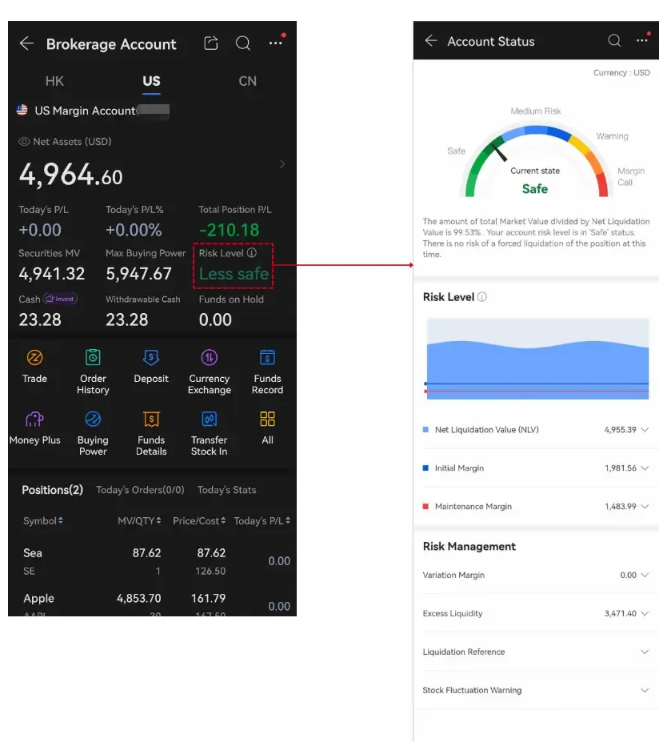
moomoo app discloses the risks on the user's account risk details page. It will contain descriptions of your account risks, disposal suggestions, and early warning information on fluctuations of
individual stocks. You could easily find out the risk level of the stock when you do margin trading and be better informed of the dangers in the early stage.
Buying stocks on margin refers to borrowing money from brokers to buy stocks. Margin loans allow investors to purchase more stock than their buying power.
To buy stocks on margin, you need to open a margin account first. Then you need to get approval for the loan.
Investors can sell the stock once the stock's market value rises. After paying the loan, they could then keep the gains. On the other hand, a decrease in the stock's price could lead to a margin call.
A margin call requires you to sell the stock at a loss or deposit more cash. Whatever the scenario, you need to repay the broker's loan.
[1] SEC.gov | Margin: Borrowing Money to Pay for Stocks
[2] Federal Register: Request Access
This presentation is for informational and educational use only and is not a recommendation or endorsement of any particular investment or investment strategy. Investment information provided in this content is general in nature, strictly for illustrative purposes, and may not be appropriate for all investors. Read more
Recommend
How to Trade Volatility: Strategies & Tips for Success

How to File Taxes: 6 Steps for Beginners

Best AI Stock Trading Tools on moomoo Trading App

What is Algorithmic Trading | Benefits, Strategies & Future Trends
How to Diversify Your Portfolio: 6 Strategies to Consider
How to Invest in Dividend Stocks for Beginners
How to Invest in DeepSeek Stock: Easy Steps to Follow
How to Invest in Silver for Beginners
Meme Stocks: Definition, Examples, and Impact on the Market
What is an ACH Transfer: Definition, Types & Benefits
Stop-Limit Order: What it is in Stocks
How to Invest In OpenAI Stock in 2026
Fractional Shares: Definition & How to Buy
Cash Accounts: What Are They and How Do They Work
What Are International Stocks & American Stocks?
Margin Account vs Cash Account: Which is Right for You?
Volatility: Definition in Finance and How to Calculate
What is a Brokerage Account: Definition and How to Open
What Are Bitcoin ETFs and How to Trade
How to Transfer Stocks From One Broker to Another
New "T+1" Settlement Cycle | What You Need to Know
SEC Form 13F: Definition, Filling Requirements, and Examples
How to Choose a Good Online Brokerage for Stock Trading
Bitcoin Futures: What Are They and How to Invest
What Is 403(b) Plan? How Does It Work
Price Action Trading: A Guide to Understanding the Basics
Margin Trading: Strategies, Benefits, and Risks
How to Invest in Index Funds for Beginners
Pre-Market and After-Hours Trading: Definition & How It Works
What is the Stock Market: Key Concepts and Functions
Common Stock: Definition, Benefits, and vs. Preferred Stock
Stock Dividends vs. Capital Gains: What You Need to Know
What Is a Stock Split - Definitions, How It Works, & Examples
Institutional Investors: Definitions & How They Invest
How to Invest in the S&P 500 for Beginners
The Impacts of ChatGPT on the Stock Market
ETFs vs. Mutual Funds
How to Practice Trading Stocks with a Free Demo Account?
The Basics of Financial Literacy: Why You Should Care
Stocks vs. Bonds
Choosing the Best Trading Platform for You — moomoo vs. Webull vs. Robinhood
The Consumer Price Index (CPI) Explained For Investors
How to Use moomoo Paper Trading Online?
What Is the Price-to-Sales (P/S) Ratio?
What Is a Quarterly Report?
What Is the Price-to-Book (P/B) Ratio?
Margin Account Explained: Definition, Benefits, and How to Use It
What Is A 10-K?
What Is SEC Form 10-Q?
What Is Ethical Investing
What Is Earnings Season
What Is Socially Responsible Investment (SRI)?
What Is a Stop Order?
Reading the Annual Report
What Is Open Trade Equity (OTE)?
What Is Impact Investing
How to Use moomoo Paper Trading
What Is a Limit Order?
Margin Trading: How It Works, Risks and Benefits
What Is Initial Margin?
How to Invest in Stocks: From Basic to Advanced
Stock Market Courses that Seek to Empower Investment Goals
How Can You Calculate Margin Interest?
What is Intraday?
Retail Investors vs. Institutional Investors: What You Need to Know
What are Cyclical stocks?
How to Buy Stocks Online without A Broker
How to Trade Volatility: Strategies & Tips for Success
How to File Taxes: 6 Steps for Beginners
Best AI Stock Trading Tools on moomoo Trading App
What is Algorithmic Trading | Benefits, Strategies & Future Trends
How to Diversify Your Portfolio: 6 Strategies to Consider
How to Invest in Dividend Stocks for Beginners
How to Invest in DeepSeek Stock: Easy Steps to Follow
How to Invest in Silver for Beginners
Meme Stocks: Definition, Examples, and Impact on the Market
What is an ACH Transfer: Definition, Types & Benefits
Stop-Limit Order: What it is in Stocks
How to Invest In OpenAI Stock in 2026
Fractional Shares: Definition & How to Buy
Cash Accounts: What Are They and How Do They Work
What Are International Stocks & American Stocks?
Margin Account vs Cash Account: Which is Right for You?
Volatility: Definition in Finance and How to Calculate
What is a Brokerage Account: Definition and How to Open
What Are Bitcoin ETFs and How to Trade
How to Transfer Stocks From One Broker to Another
New "T+1" Settlement Cycle | What You Need to Know
SEC Form 13F: Definition, Filling Requirements, and Examples
How to Choose a Good Online Brokerage for Stock Trading
Bitcoin Futures: What Are They and How to Invest
What Is 403(b) Plan? How Does It Work
Price Action Trading: A Guide to Understanding the Basics
Margin Trading: Strategies, Benefits, and Risks
How to Invest in Index Funds for Beginners
Pre-Market and After-Hours Trading: Definition & How It Works
What is the Stock Market: Key Concepts and Functions
Common Stock: Definition, Benefits, and vs. Preferred Stock
Stock Dividends vs. Capital Gains: What You Need to Know
What Is a Stock Split - Definitions, How It Works, & Examples
Institutional Investors: Definitions & How They Invest
How to Invest in the S&P 500 for Beginners
The Impacts of ChatGPT on the Stock Market
ETFs vs. Mutual Funds
How to Practice Trading Stocks with a Free Demo Account?
The Basics of Financial Literacy: Why You Should Care
Stocks vs. Bonds
Choosing the Best Trading Platform for You — moomoo vs. Webull vs. Robinhood
The Consumer Price Index (CPI) Explained For Investors
How to Use moomoo Paper Trading Online?
What Is the Price-to-Sales (P/S) Ratio?
What Is a Quarterly Report?
What Is the Price-to-Book (P/B) Ratio?
Margin Account Explained: Definition, Benefits, and How to Use It
What Is A 10-K?
What Is SEC Form 10-Q?
What Is Ethical Investing
What Is Earnings Season
What Is Socially Responsible Investment (SRI)?
What Is a Stop Order?
Reading the Annual Report
What Is Open Trade Equity (OTE)?
What Is Impact Investing
How to Use moomoo Paper Trading
What Is a Limit Order?
Margin Trading: How It Works, Risks and Benefits
What Is Initial Margin?
How to Invest in Stocks: From Basic to Advanced
Stock Market Courses that Seek to Empower Investment Goals
How Can You Calculate Margin Interest?
What is Intraday?
Retail Investors vs. Institutional Investors: What You Need to Know
What are Cyclical stocks?
How to Buy Stocks Online without A Broker

