

Moomoo Insights
Jul 16 15:38
TSMC Earnings: AI Demand Is Stronger Than the Chip Selloff Suggests
Moomoo Insights
Sep 30 05:04
Live Take | Anthropic’s $518B Compute Bet: Who Wins From the AI Buildout?
Investors have many choices when it comes to investments. Selecting the right investment can vary based on the investor's goals, capital, access, knowledge, and more.
Fractional shares are appealing for their low cost, their potential opportunities to diversify a portfolio, and flexibility.
Read on to learn about fractional shares.
Fractional shares are portions or slices of a company’s stock that are less than one whole share.
Instead of buying complete shares, investors can invest in fractional shares based on a dollar amount rather than the number of shares. This can enable investors to manage their investment strategies and allocations with greater flexibility by allocating any amount of money to specific stocks or ETFs, rather than being restricted to whole shares.
Investors also retain the same benefits as full equity stock shares in terms of dividends and capital gains, proportionate to the size of the fractional share owned.
Fractional shares are portions of an equity stock that are less than one full share. These shares are accessible through various scenarios. You can acquire them not just by directly purchasing from a brokerage or an online trading platform, but also through opportunities like stock splits, dividend reinvestment plans (DRIPs), and mergers and acquisitions (M&As).
Keep in mind, not all brokerage firms offer fractional shares and even the ones that do, they don't offer them on all stocks and ETFs.
When a company splits its stock, it can increase the number of shares available and potentially enhance trading liquidity. A stock split also lowers the price of a single share, making the company’s stock more accessible to a broader range of investors without fundamentally changing the company’s overall value.
A company can increase the total number of shares by giving existing shareholders additional shares. For instance, in a 3:2 stock split, an investor would receive three shares for every two shares already owned. As a result, an investor might end up with fractional shares — portions of an equity stock that are less than one full share.
There's also reverse stock splits, where a company reduces the number of its outstanding shares. In this case, an investor may receive fractional shares. This may occur when the split ratio doesn't evenly divide an investor's total share count. For example if an investor had five shares of stock, and there’s a 2-for-3 reverse split, they may end up with fractional shares (e.g., 3.33 shares).
Please note that how fractional shares are handled can depend on the company’s policy and the brokerage firm. Some companies might round down to the nearest whole number (in this example, it could be 3 shares), pay out the fractional share in cash, or have other policies.
A dividend reinvestment plan (DRIP) is a program that enables shareholders to automatically reinvest a stock's cash dividends into additional or fractional shares of the underlying company. Investors can use the reinvested dividend amount to purchase fractional shares, accumulating additional smaller portions of shares and expanding their portfolio of stock holdings.
When a company merges or it is acquired, its stock may be exchanged for new shares of the acquiring company. Typically, a predetermined ratio is used to combine stocks from different companies during the merger or acquisition process.
For example, if company A merges with company B, five shares of company A might become three shares of company B. This process can result in fractional shares for exisiting shareholders of the targeted company.
Fractional stock enables investors to purchase a portion of a single share, rather than requiring them to purchase a whole share. This means that investors can own a piece of a company's stock with a significantly smaller investment and also be able to diversify their portfolios.
For example, if a company's stock is trading at $500 per share, an investor could choose to buy a fractional share for as little as $5, owning 1% of a share.
There are many reasons why investors may purchase fractional shares. Here's a few.
Affordability: Fractional shares allow investors to buy a portion of a stock based on a dollar amount, rather than the number of whole shares. This makes it easier to invest in expensive stocks that would otherwise be out of reach costwise to the investor.
Diversification: By owning fractional shares, investors can diversify their portfolios with limited funds. Instead of putting all their money into a single stock, investors can spread their investments across multiple companies.
Accessibility: Fractional shares democratize investing by allowing investors, regardless of their capital, to participate in the stock market. Whether you have a small or large budget, fractional shares provide an opportunity to invest in companies you believe in.
Investors can buy and sell fractional shares using the Moomoo app. However, investors should keep in mind that certain securities may not be available for fractional share trading.
To get started, we'll show you how to gain access to fractional shares and then how to trade them — all in a few steps.
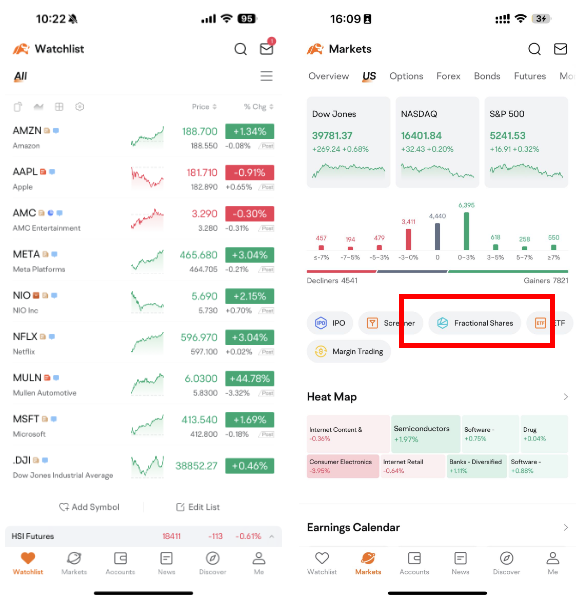
Step 1: To access fractional shares, go to Markets tab>US> Fractional Shares. Here you can check the list of fractional shares available for trading.
Disclaimer: Images provided are not current and any securities are shown for illustrative purposes only and is not a recommendation.
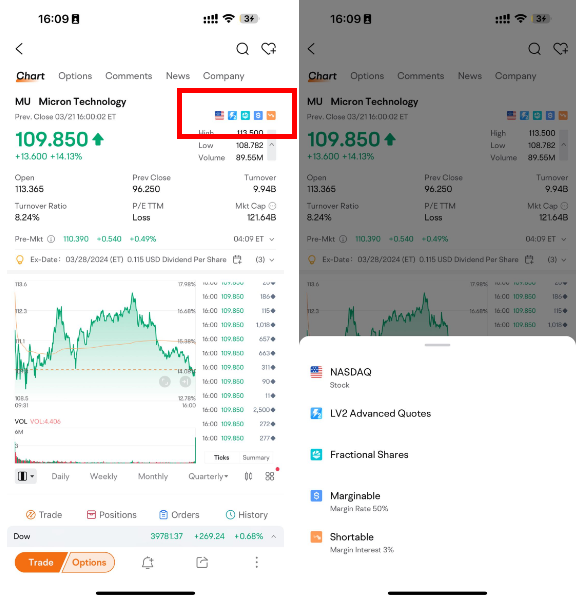
Step 2: Another way to access fractional shares is to go to the stock's Detailed Quotes page and check the Fractional Shares icon. Currently, there are over 300 U.S. Stocks supported for fractional trading on Moomoo.
Disclaimer: Images provided are not current and any securities are shown for illustrative purposes only and is not a recommendation.
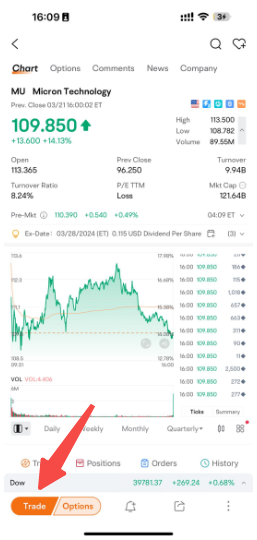
Step 3: To trade fractional shares after finding your desired stock, tap on Trade (in orange) to place an order.
Disclaimer: Images provided are not current and any securities are shown for illustrative purposes only and is not a recommendation.
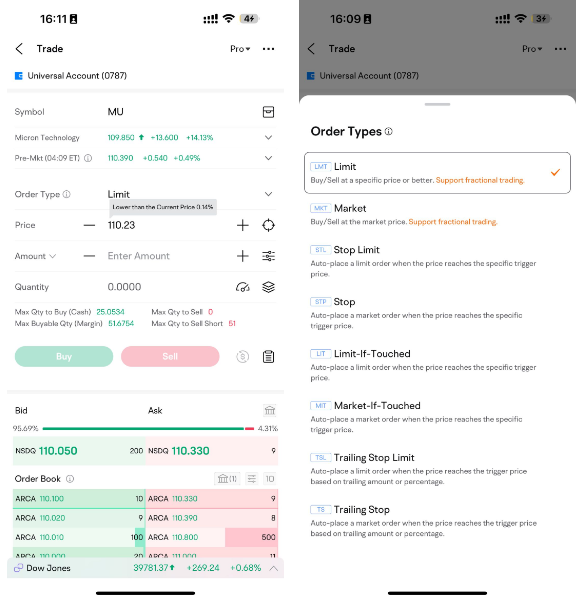
Step 4: Select either a limit or market order for the order type.
Disclaimer: Images provided are not current and any securities are shown for illustrative purposes only and is not a recommendation.
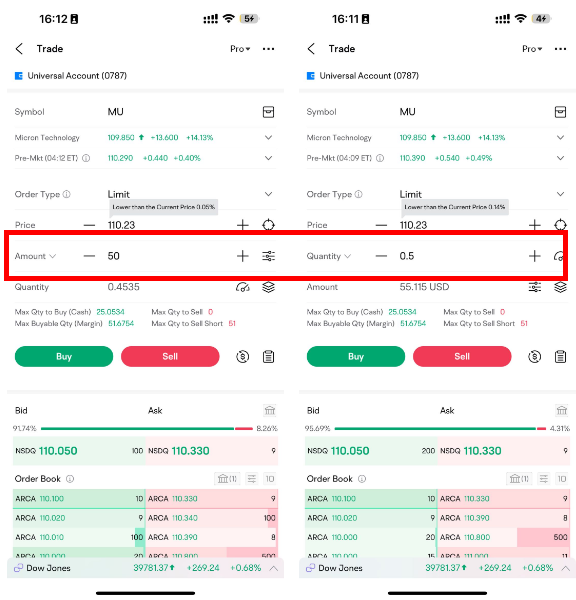
Step 5: Enter the trading quantity or amount.
Disclaimer: Images provided are not current and any securities are shown for illustrative purposes only and is not a recommendation.
Step 6: Tap on "Buy" to submit your order.
Fractional share trading comes with its share of pros and cons. Take a look:
Pros | Cons |
|
|
A stock split occurs when a company either increases or decreases its share count and an investor can end up with fractional shares as a result.
When a company has a forward stock split, it increases shares and distributes additional ones to existing shareholders. For example, in a 3:2 stock split, an investor receives three new shares for every two shares they own.
In a reverse stock split, the company consolidates its existing shares into fewer shares. Any fractional shares resulting from the consolidation are typically converted into whole shares. For example, if an investor held 0.5 shares before the split, they would be converted into 1 whole share after the reverse split.
Fractional shares are a portion of an equity stock that is less than one full share. It can result from stock splits, bought and sold as a fractional share as well as other actions.
But here's where stock splits and fractional shares differ: stock splits affect the total number of shares, while fractional shares allow investors to own smaller portions of a stock.
Selling fractional shares can be a straightforward process. The value of the fractional share is determined by the current market price of the full share, multiplied by the fraction of the share an investor owns. The investor receives the cash equivalent of this value, minus any applicable trading fees or commissions.
Yes, it is possible to purchase dividend stocks as fractional shares. When buying a fractional share of a dividend-paying stock, an investor owns a piece of the company, just as they would with a full share, it is just a smaller portion. An investor is entitled to receive dividends proportional to the size of their share.
Yes, combining fractional shares is a common practice, especially when an investor has multiple fractional portions of the same stock. To combine fractional share portions, an investor can do so by:
Buying more: Purchase additional shares to round up your fractional holdings. For example, if you have 1.75 shares, consider buying 0.25 more shares to reach a whole number (2 shares).
Participating in stock splits: When a stock splits (e.g., 2-for-1 or 3-for-1), fractional shares can become whole shares. For example, if an investor owns 0.333 shares and the stock undergoes a 3-for-1 split, the fractional shares would become a whole share.
Using a brokerage service: Some brokerages automatically consolidate fractional shares for you, allowing you to hold whole shares.
Disclosures
Fractional shares are illiquid outside of Moomoo Financial Inc. ("MFI"), and cannot be transferred. Not all securities offered by MFI can be traded as fractional shares. See the Fractional Share Trading Disclosure for more details.
This presentation is for informational and educational use only and is not a recommendation or endorsement of any particular investment or investment strategy. Investment information provided in this content is general in nature, strictly for illustrative purposes, and may not be appropriate for all investors. Read more
Recommend
How to Trade Volatility: Strategies & Tips for Success

How to File Taxes: 6 Steps for Beginners

Best AI Stock Trading Tools on moomoo Trading App

What is Algorithmic Trading | Benefits, Strategies & Future Trends
How to Diversify Your Portfolio: 6 Strategies to Consider
How to Invest in Dividend Stocks for Beginners
How to Invest in DeepSeek Stock: Easy Steps to Follow
How to Invest in Silver for Beginners
Meme Stocks: Definition, Examples, and Impact on the Market
What is an ACH Transfer: Definition, Types & Benefits
Stop-Limit Order: What it is in Stocks
How to Invest In OpenAI Stock in 2026
Fractional Shares: Definition & How to Buy
Cash Accounts: What Are They and How Do They Work
What Are International Stocks & American Stocks?
Margin Account vs Cash Account: Which is Right for You?
Volatility: Definition in Finance and How to Calculate
What is a Brokerage Account: Definition and How to Open
What Are Bitcoin ETFs and How to Trade
How to Transfer Stocks From One Broker to Another
New "T+1" Settlement Cycle | What You Need to Know
SEC Form 13F: Definition, Filling Requirements, and Examples
How to Choose a Good Online Brokerage for Stock Trading
Bitcoin Futures: What Are They and How to Invest
What Is 403(b) Plan? How Does It Work
Price Action Trading: A Guide to Understanding the Basics
Margin Trading: Strategies, Benefits, and Risks
How to Invest in Index Funds for Beginners
Pre-Market and After-Hours Trading: Definition & How It Works
What is the Stock Market: Key Concepts and Functions
Common Stock: Definition, Benefits, and vs. Preferred Stock
Stock Dividends vs. Capital Gains: What You Need to Know
What Is a Stock Split - Definitions, How It Works, & Examples
Institutional Investors: Definitions & How They Invest
How to Invest in the S&P 500 for Beginners
The Impacts of ChatGPT on the Stock Market
ETFs vs. Mutual Funds
How to Practice Trading Stocks with a Free Demo Account?
The Basics of Financial Literacy: Why You Should Care
Stocks vs. Bonds
Choosing the Best Trading Platform for You — moomoo vs. Webull vs. Robinhood
The Consumer Price Index (CPI) Explained For Investors
How to Use moomoo Paper Trading Online?
What Is the Price-to-Sales (P/S) Ratio?
What Is a Quarterly Report?
What Is the Price-to-Book (P/B) Ratio?
Margin Account Explained: Definition, Benefits, and How to Use It
What Is A 10-K?
What Is SEC Form 10-Q?
What Is Ethical Investing
What Is Earnings Season
What Is Socially Responsible Investment (SRI)?
What Is a Stop Order?
Reading the Annual Report
What Is Open Trade Equity (OTE)?
What Is Impact Investing
How to Use moomoo Paper Trading
What Is a Limit Order?
Margin Trading: How It Works, Risks and Benefits
What Is Initial Margin?
How to Invest in Stocks: From Basic to Advanced
Stock Market Courses that Seek to Empower Investment Goals
How Can You Calculate Margin Interest?
What is Intraday?
Retail Investors vs. Institutional Investors: What You Need to Know
What are Cyclical stocks?
How to Buy Stocks Online without A Broker
How to Trade Volatility: Strategies & Tips for Success
How to File Taxes: 6 Steps for Beginners
Best AI Stock Trading Tools on moomoo Trading App
What is Algorithmic Trading | Benefits, Strategies & Future Trends
How to Diversify Your Portfolio: 6 Strategies to Consider
How to Invest in Dividend Stocks for Beginners
How to Invest in DeepSeek Stock: Easy Steps to Follow
How to Invest in Silver for Beginners
Meme Stocks: Definition, Examples, and Impact on the Market
What is an ACH Transfer: Definition, Types & Benefits
Stop-Limit Order: What it is in Stocks
How to Invest In OpenAI Stock in 2026
Fractional Shares: Definition & How to Buy
Cash Accounts: What Are They and How Do They Work
What Are International Stocks & American Stocks?
Margin Account vs Cash Account: Which is Right for You?
Volatility: Definition in Finance and How to Calculate
What is a Brokerage Account: Definition and How to Open
What Are Bitcoin ETFs and How to Trade
How to Transfer Stocks From One Broker to Another
New "T+1" Settlement Cycle | What You Need to Know
SEC Form 13F: Definition, Filling Requirements, and Examples
How to Choose a Good Online Brokerage for Stock Trading
Bitcoin Futures: What Are They and How to Invest
What Is 403(b) Plan? How Does It Work
Price Action Trading: A Guide to Understanding the Basics
Margin Trading: Strategies, Benefits, and Risks
How to Invest in Index Funds for Beginners
Pre-Market and After-Hours Trading: Definition & How It Works
What is the Stock Market: Key Concepts and Functions
Common Stock: Definition, Benefits, and vs. Preferred Stock
Stock Dividends vs. Capital Gains: What You Need to Know
What Is a Stock Split - Definitions, How It Works, & Examples
Institutional Investors: Definitions & How They Invest
How to Invest in the S&P 500 for Beginners
The Impacts of ChatGPT on the Stock Market
ETFs vs. Mutual Funds
How to Practice Trading Stocks with a Free Demo Account?
The Basics of Financial Literacy: Why You Should Care
Stocks vs. Bonds
Choosing the Best Trading Platform for You — moomoo vs. Webull vs. Robinhood
The Consumer Price Index (CPI) Explained For Investors
How to Use moomoo Paper Trading Online?
What Is the Price-to-Sales (P/S) Ratio?
What Is a Quarterly Report?
What Is the Price-to-Book (P/B) Ratio?
Margin Account Explained: Definition, Benefits, and How to Use It
What Is A 10-K?
What Is SEC Form 10-Q?
What Is Ethical Investing
What Is Earnings Season
What Is Socially Responsible Investment (SRI)?
What Is a Stop Order?
Reading the Annual Report
What Is Open Trade Equity (OTE)?
What Is Impact Investing
How to Use moomoo Paper Trading
What Is a Limit Order?
Margin Trading: How It Works, Risks and Benefits
What Is Initial Margin?
How to Invest in Stocks: From Basic to Advanced
Stock Market Courses that Seek to Empower Investment Goals
How Can You Calculate Margin Interest?
What is Intraday?
Retail Investors vs. Institutional Investors: What You Need to Know
What are Cyclical stocks?
How to Buy Stocks Online without A Broker

