
Moomoo Insights
Jul 16 15:38
TSMC Earnings: AI Demand Is Stronger Than the Chip Selloff Suggests
Moomoo Insights
Sep 30 05:04
Live Take | Anthropic’s $518B Compute Bet: Who Wins From the AI Buildout?
Making a difference is possible via a wide range of actions, including volunteering and contributing money and the investments you make. The practice of impact investing is one approach to using your investment capital to do good things in the world while also strengthening your investment portfolio.
The term "impact investing" refers to a type of investment that prioritizes creating social and environmental value in addition to financial returns. Impact investors often concentrate their attention on the environmental, social, and corporate governance (also known as ESG) impact of a particular firm or investment fund.
Everyone has their own set of priorities and values. Therefore, the places where you desire to have an impact may differ from those of others. Some investors may let their religious beliefs influence their investment decision-making, while others may be motivated to take action due to current events. But regardless of the principles, you may identify impact investments that are consistent with those principles.
Impact investing is successful on a big scale because it directs investors' money towards businesses that do good in the world and away from businesses that do not. For instance, an investor could decide to put their money into a firm specializing in alternative energy forms rather than one producing oil.
The reports generated by impact investment funds give information on the actual changes being brought about in the world due to the fund's investment decisions. However, making particular investments isn't the only method to have an impact, activism is another strategy that may be effective.
The ESG score is often used as a grading system for impact investments. This score determines how well a corporation or fund performs in environmental, social, and governance considerations. It is important to keep in mind, however, that corporations now employ various methods for calculating their ESG scores; as a result, there is no one authority on ESG scores.
Reading the impact report for investment may help you better understand that investment's impact in the real world. This report may include an overview of how much of an organization's carbon footprint has been decreased, as well as any modifications to its policies, such as the addition of longer parental leave.
There are a lot of different designations in the world of impact investment, but some of them signify more than others. The definitions of each one are provided below, along with an explanation of how impact portfolios may be constructed using them.
There is a common tendency to use terminology like socially responsible investment and impact investing interchangeably with other concepts, such as ethical and sustainable investing. The majority of the time, they are referring to the same concept, which is the act of putting your money into investments that will have a constructive effect on the world.
Financial institutions often consider environmental, social, economic, or ESG aspects when making investment decisions. These are a set of principles that prioritize environmental protection, social justice, and responsible business practices.
A multitude of independent research businesses use ESG ratings as a tool to assist in grading investments along a moral curve. If you want to create an impact portfolio with an emphasis on the environment, for instance, you can seek assets that have a high ESG score in the environmental area.
Increasing interest in environmentally, socially, and governance-focused (ESG) company practices has led many to link impact investment with these trends. Although they have a lot of similarities, both terms relate to two quite different kinds of activities.
The term "environmental, social, and governance practices" refers to businesses' actions that may impact the profits generated by such businesses. For example, a business that intentionally uses child labor or discriminates against its employees or customers may find itself at a disadvantage in the marketplace, especially when marketing to socially aware customers.
The technique of looking for investments that maximize a purpose other than profits is called impact investing. Impact investing is a relatively new kind of investing that has gained popularity in recent years. Among them can be investments in education, microfinance, or environmentally friendly forms of energy.
In addition to focusing on maximizing financial returns, the primary objective of an impact-investing firm, sometimes known as an investment fund, is to contribute to achieving particular humanitarian or ecologically responsible goals. While some impact funds look for investment opportunities in fields where they predict high returns, others place a lower priority on financial gain.
One type of investment approach is impact investing, which involves putting money into businesses or whole sectors to achieve a positive social or environmental effect. For instance, some investors want to back important causes, such as sustainable agriculture, electric automobiles, microfinance, and renewable energy. Others want to help microfinance organizations and renewable energy.
Impact investing is a strategy that is becoming more popular as part of a larger movement toward more socially responsible business practices. These methods aim to mitigate some of the adverse effects that are caused by typical economic activity. Impact investing is a kind of investment that aims to provide social or environmental benefits while simultaneously producing financial returns. This is accomplished by providing financial assistance to businesses and sectors working toward important goals.
If you are interested in discovering a list of ESG-related stocks, you can find them on moomoo trading app. Click the "Market" tab>> Find "Trending Topics" >> Click "ESG".
Download moomoo app today and find the list!
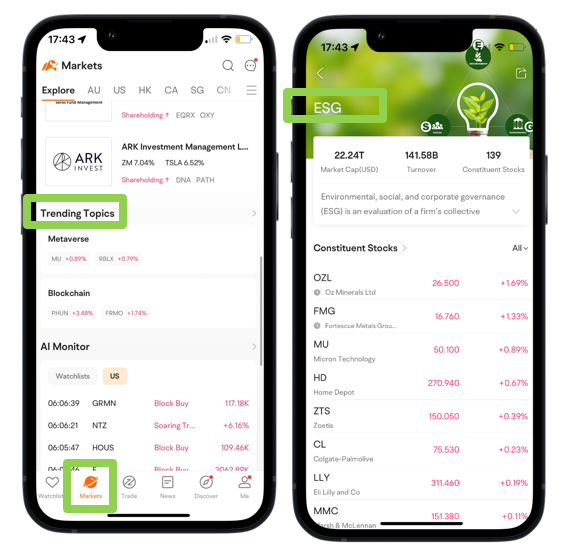
Images provided are not current and any securities are shown for illustrative purposes only.
This presentation is for informational and educational use only and is not a recommendation or endorsement of any particular investment or investment strategy. Investment information provided in this content is general in nature, strictly for illustrative purposes, and may not be appropriate for all investors. Read more
Recommend
How to Trade Volatility: Strategies & Tips for Success
How to File Taxes: 6 Steps for Beginners

Best AI Stock Trading Tools on moomoo Trading App

What is Algorithmic Trading | Benefits, Strategies & Future Trends
How to Diversify Your Portfolio: 6 Strategies to Consider
How to Invest in Dividend Stocks for Beginners
How to Invest in DeepSeek Stock: Easy Steps to Follow
How to Invest in Silver for Beginners
Meme Stocks: Definition, Examples, and Impact on the Market
What is an ACH Transfer: Definition, Types & Benefits
Stop-Limit Order: What it is in Stocks
How to Invest In OpenAI Stock in 2026
Fractional Shares: Definition & How to Buy
Cash Accounts: What Are They and How Do They Work
What Are International Stocks & American Stocks?
Margin Account vs Cash Account: Which is Right for You?
Volatility: Definition in Finance and How to Calculate
What is a Brokerage Account: Definition and How to Open
What Are Bitcoin ETFs and How to Trade
How to Transfer Stocks From One Broker to Another
New "T+1" Settlement Cycle | What You Need to Know
SEC Form 13F: Definition, Filling Requirements, and Examples
How to Choose a Good Online Brokerage for Stock Trading
Bitcoin Futures: What Are They and How to Invest
What Is 403(b) Plan? How Does It Work
Price Action Trading: A Guide to Understanding the Basics
Margin Trading: Strategies, Benefits, and Risks
How to Invest in Index Funds for Beginners
Pre-Market and After-Hours Trading: Definition & How It Works
What is the Stock Market: Key Concepts and Functions
Common Stock: Definition, Benefits, and vs. Preferred Stock
Stock Dividends vs. Capital Gains: What You Need to Know
What Is a Stock Split - Definitions, How It Works, & Examples
Institutional Investors: Definitions & How They Invest
How to Invest in the S&P 500 for Beginners
The Impacts of ChatGPT on the Stock Market
ETFs vs. Mutual Funds
How to Practice Trading Stocks with a Free Demo Account?
The Basics of Financial Literacy: Why You Should Care
Stocks vs. Bonds
Choosing the Best Trading Platform for You — moomoo vs. Webull vs. Robinhood
The Consumer Price Index (CPI) Explained For Investors
How to Use moomoo Paper Trading Online?
What Is the Price-to-Sales (P/S) Ratio?
What Is a Quarterly Report?
What Is the Price-to-Book (P/B) Ratio?
Margin Account Explained: Definition, Benefits, and How to Use It
What Is A 10-K?
What Is SEC Form 10-Q?
What Is Ethical Investing
What Is Earnings Season
What Is Socially Responsible Investment (SRI)?
What Is a Stop Order?
Reading the Annual Report
What Is Open Trade Equity (OTE)?
What Is Impact Investing
How to Use moomoo Paper Trading
What Is a Limit Order?
Margin Trading: How It Works, Risks and Benefits
What Is Initial Margin?
How to Invest in Stocks: From Basic to Advanced
Stock Market Courses that Seek to Empower Investment Goals
How Can You Calculate Margin Interest?
What is Intraday?
Retail Investors vs. Institutional Investors: What You Need to Know
What are Cyclical stocks?
How to Buy Stocks Online without A Broker
How to Trade Volatility: Strategies & Tips for Success
How to File Taxes: 6 Steps for Beginners
Best AI Stock Trading Tools on moomoo Trading App
What is Algorithmic Trading | Benefits, Strategies & Future Trends
How to Diversify Your Portfolio: 6 Strategies to Consider
How to Invest in Dividend Stocks for Beginners
How to Invest in DeepSeek Stock: Easy Steps to Follow
How to Invest in Silver for Beginners
Meme Stocks: Definition, Examples, and Impact on the Market
What is an ACH Transfer: Definition, Types & Benefits
Stop-Limit Order: What it is in Stocks
How to Invest In OpenAI Stock in 2026
Fractional Shares: Definition & How to Buy
Cash Accounts: What Are They and How Do They Work
What Are International Stocks & American Stocks?
Margin Account vs Cash Account: Which is Right for You?
Volatility: Definition in Finance and How to Calculate
What is a Brokerage Account: Definition and How to Open
What Are Bitcoin ETFs and How to Trade
How to Transfer Stocks From One Broker to Another
New "T+1" Settlement Cycle | What You Need to Know
SEC Form 13F: Definition, Filling Requirements, and Examples
How to Choose a Good Online Brokerage for Stock Trading
Bitcoin Futures: What Are They and How to Invest
What Is 403(b) Plan? How Does It Work
Price Action Trading: A Guide to Understanding the Basics
Margin Trading: Strategies, Benefits, and Risks
How to Invest in Index Funds for Beginners
Pre-Market and After-Hours Trading: Definition & How It Works
What is the Stock Market: Key Concepts and Functions
Common Stock: Definition, Benefits, and vs. Preferred Stock
Stock Dividends vs. Capital Gains: What You Need to Know
What Is a Stock Split - Definitions, How It Works, & Examples
Institutional Investors: Definitions & How They Invest
How to Invest in the S&P 500 for Beginners
The Impacts of ChatGPT on the Stock Market
ETFs vs. Mutual Funds
How to Practice Trading Stocks with a Free Demo Account?
The Basics of Financial Literacy: Why You Should Care
Stocks vs. Bonds
Choosing the Best Trading Platform for You — moomoo vs. Webull vs. Robinhood
The Consumer Price Index (CPI) Explained For Investors
How to Use moomoo Paper Trading Online?
What Is the Price-to-Sales (P/S) Ratio?
What Is a Quarterly Report?
What Is the Price-to-Book (P/B) Ratio?
Margin Account Explained: Definition, Benefits, and How to Use It
What Is A 10-K?
What Is SEC Form 10-Q?
What Is Ethical Investing
What Is Earnings Season
What Is Socially Responsible Investment (SRI)?
What Is a Stop Order?
Reading the Annual Report
What Is Open Trade Equity (OTE)?
What Is Impact Investing
How to Use moomoo Paper Trading
What Is a Limit Order?
Margin Trading: How It Works, Risks and Benefits
What Is Initial Margin?
How to Invest in Stocks: From Basic to Advanced
Stock Market Courses that Seek to Empower Investment Goals
How Can You Calculate Margin Interest?
What is Intraday?
Retail Investors vs. Institutional Investors: What You Need to Know
What are Cyclical stocks?
How to Buy Stocks Online without A Broker

