Price gaps analysis
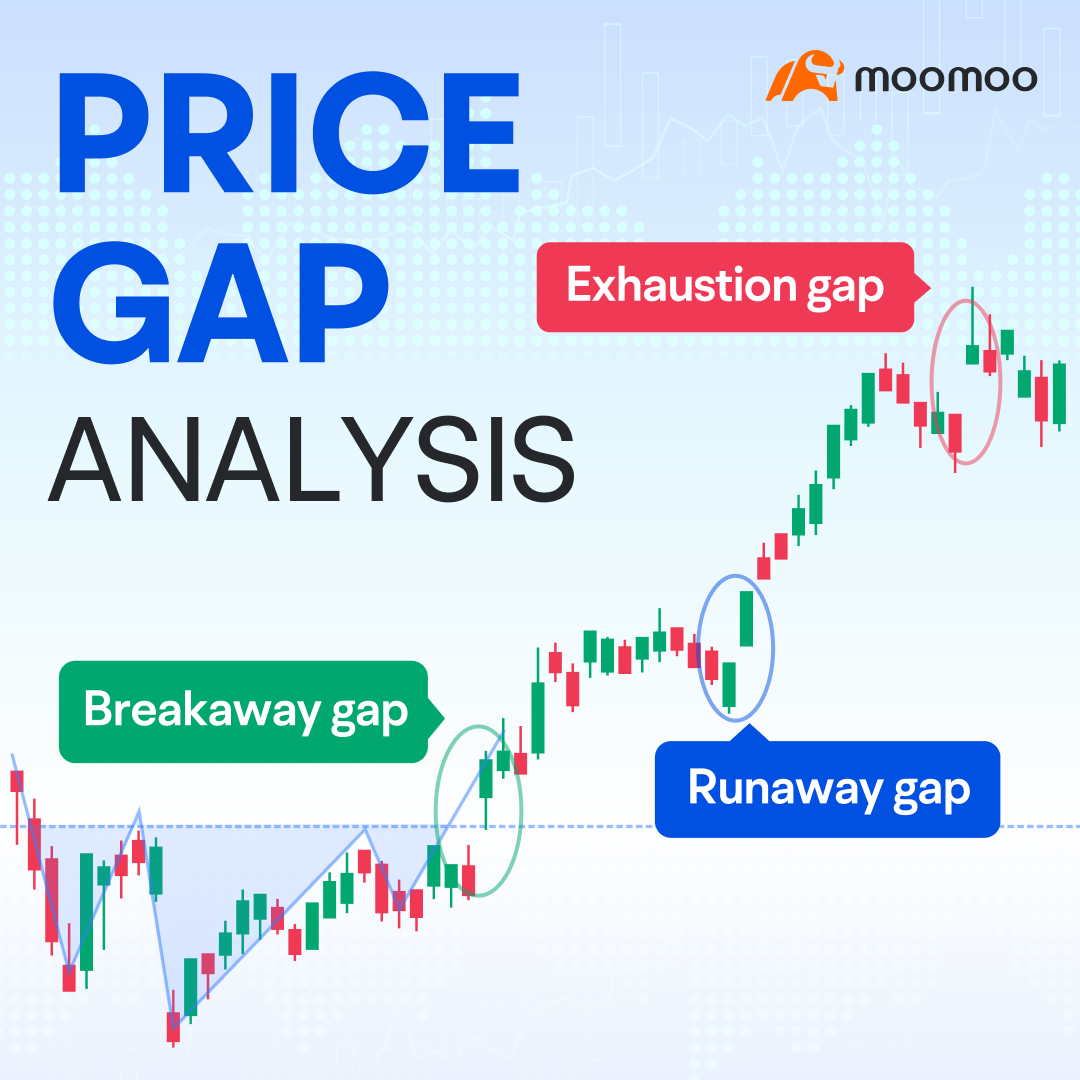
01 What are price gaps?
A price gap is a particular price range on a chart where no trading activities have taken place.
Gaps often occur when a strong shift in sentiment happens during the hours when markets are usually closed. This results in an imbalance between supply and demand.
Suppose a company announces a better-than-expected earnings result after the market closes. Its share price is likely to open the next day higher than the previous day's high, forming a gap up, as many investors may consider it undervalued.
“Gap fill” means the asset trades back to the pre-gap area. Some investors might have heard that “gaps are always filled.” This is not true. There can be gaps that are filled and others aren’t.
In technical analysis, there are four main types of price gaps.
02 What are common gaps?
As the name suggests, common gaps are commonly seen in the market. They occur on a more frequent basis than any other type of gap.
In general, there are no major events that precede common gaps. This type of gap is relatively small and tends to provide no analytical insight.
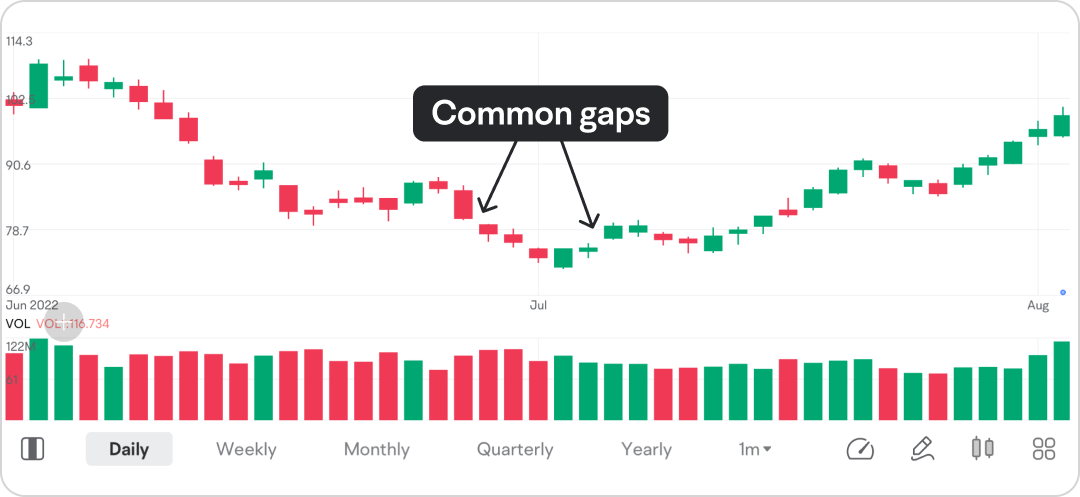
Common gaps are typically filled in a relatively quick manner. Therefore, they are typically closely watched by traders looking for potential gap fills.
For example, Stock A has a gap up opening at $100.1, higher than the previous high of $100. If the gap is considered uneventful, the price would likely trade back to the $100 level in the coming days or even intraday.
03 What are breakaway gaps?
Breakaway gaps could be exciting for many traders as the indication of the beginning of a potentially significant market move.
As its name implies, a breakaway gap occurs when the price action breaks out of a trading range, for example, at the completion of an important price pattern, and the breakout of an important trend line.
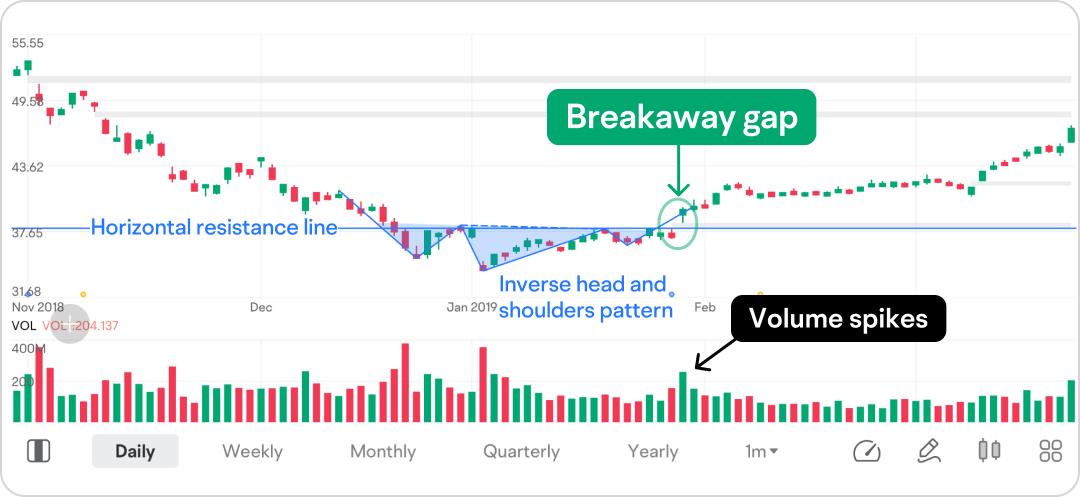
A breakaway gap typically occurs after major news events, such as an earnings release, and is often accompanied by a significant increase in trading volume. This uptick in volume is likely caused by increased market participation, including investors with positions that are now on the wrong side of the breakout rushing to buy or sell their positions. Such actions might further drive up trading activity and exacerbate the price movement.
Breakaway gaps tend not to get filled in the short term. However, traders should note that optimal breakaway gaps tend to close near the session high or low, suggesting an upside or downside momentum when the session ends. A poor close can hint that the gap may be prone to failure.
04 What are runaway gaps?
Runaway gaps are usually driven by increased interest in the market.
Technical traders have theorized that runaway gaps often occur after a stock has experienced a breakaway gap.
The psychology behind runaway gaps is that traders, who didn't get in during the initial move, suddenly decide not to wait for a retracement in price, but to catch up with the potentially trending market.
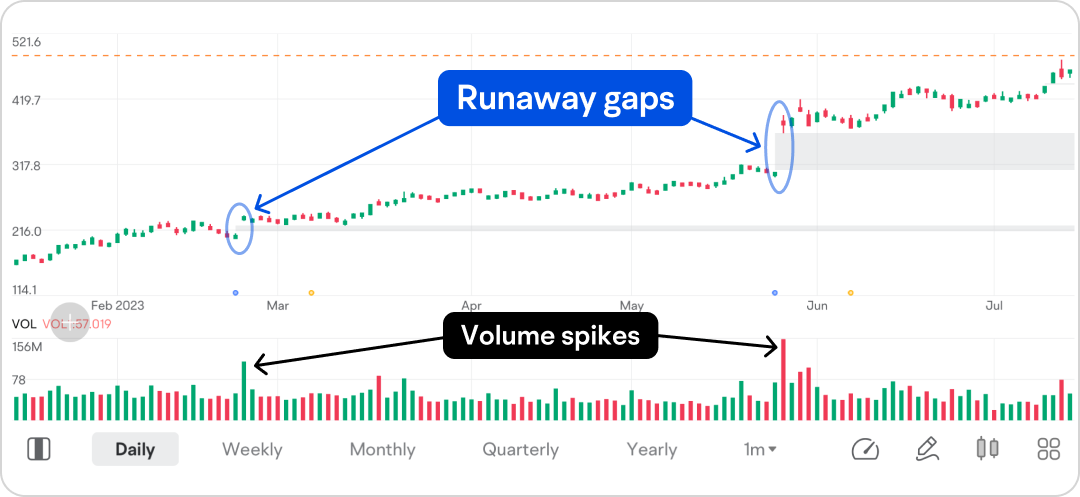
This sudden trading interest is usually catalyzed by an unexpected news announcement, including a new product release by the company, better-than-expected earnings, and an announcement of a potential acquisition.
In an uptrend, a runaway gap can be a sign of market strength; in a downtrend, it may indicate a sign of weakness.
A stock’s price may experience several runaway gaps during a strong trend, which can help strengthen the move.
Runaway gaps are often not filled in the short term. They are usually accompanied by high trading volumes, indicating investor’s confidence in the direction of the current trend.
05 What are exhaustion gaps?
Exhaustion gaps appear near the end of market trends. They can be the first signal of the potential end of the current trend.
An exhaustion gap typically comes with a huge volume. However, with great profit-taking and the demand drying up, the price trend might not last much longer.
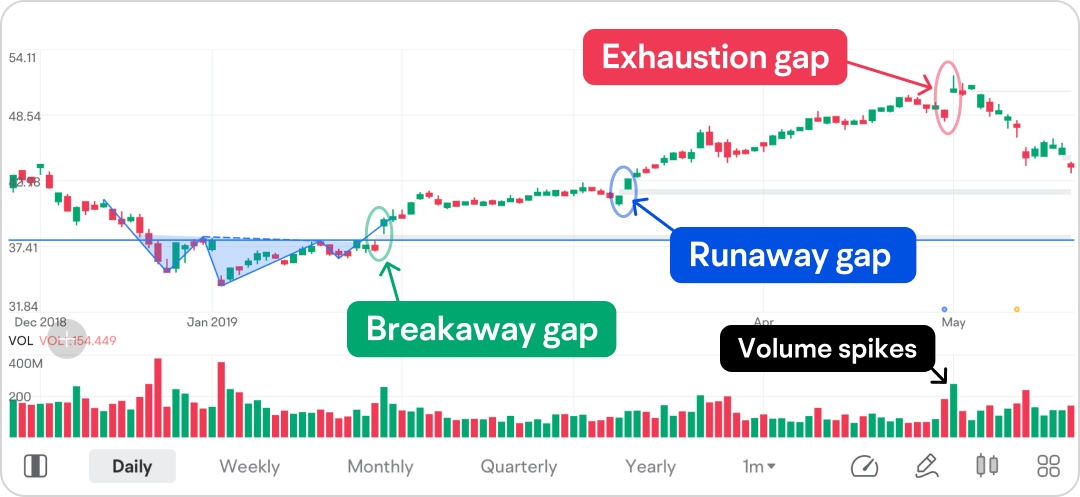
From a trader’s perspective, after the two types of gaps, the breakaway and runaway gaps, have been identified during a well-defined trend, they may begin to expect the potential exhaustion gap.
Exhaustion gaps can be easily mistaken for runaway gaps if traders overlook the exceptionally high volumes, which may indicate a wave of frenzied trading activity in the market.
Exhaustion gaps can be filled within a few days or a couple of weeks as the price may soon reverse the current trend.
To sum up, a gap may fill very shortly after it appears, may take a long time to fill or may never fill. It is also important to use other tools and indicators as well as gap analysis.
This presentation discusses technical analysis, other approaches, including fundamental analysis, may offer very different views. The examples provided are for illustrative purposes only and are not intended to be reflective of the results you can expect to achieve.
All investing involves risk, including the potential loss of principal, and there can be no guarantee that any investing strategy will be successful.
This presentation is for informational and educational use only and is not a recommendation or endorsement of any particular investment or investment strategy. Investment information provided in this content is general in nature, strictly for illustrative purposes, and may not be appropriate for all investors. Read more