The US$60 Billion Weight-Loss Drug Market: Who is Winning?
During the recent U.S. stock earnings season, the buzz surrounding 'GLP-1 weight-loss drugs' has even surpassed discussions about artificial intelligence (AI). These drugs have been hailed as potential game-changers in the pharmaceutical world, with many drug companies scrambling to develop similar products.
As competition for a slice of this promising market heats up, savvy investors are asking: How big is this market? Which companies are likely to benefit? What advantages do major players like Novo Nordisk and Eli Lilly have? And what risks should investors be aware of?
In this article, we'll provide some insights into these questions, helping investors better understand the opportunities and potential pitfalls of investing in weight loss drugs.
01 What are GLP-1 weight-loss drugs?
GLP-1 agonists are designed to manage blood sugar levels and curb hunger by reducing food intake. They were initially developed to treat type 2 diabetes. However, researchers soon noticed that these drugs had an interesting side-effect: they seemed to promote weight loss by decreasing appetite.
As a result, scientists began exploring the potential of GLP-1 agonists as weight-loss medications.
Denmark's Novo Nordisk (NYSE: NVO) was the first to give it a shot. In 2010, they introduced Liraglutide, branded as Victoza, primarily for diabetes treatment. However, after realizing its potential in promoting weight loss, they refined it into Saxenda, a drug specifically tailored for obesity management.
In 2017, Novo Nordisk launched another diabetes medication called Semaglutide, marketed as Ozempic. In mid-2021, they received FDA approval for a stronger version of this drug called Wegovy, designed to aid weight loss. This medication's popularity surged after receiving attention on social media platforms such as TikTok, and even Tesla CEO Elon Musk endorsed it, increasing the demand for GLP-1 weight-loss drugs.
Eli Lilly and Co. (NYSE: LLY), also entered the GLP-1 weight-loss drug market with products like Dulaglutide in 2014, marketed as Trulicity. Since then, it has become one of their top-selling drugs.
In May 2022, Lilly introduced Tirzepatide, also known as Mounjaro. Although FDA approved it only for adults with type 2 diabetes, studies have shown it to be more effective for weight loss than Novo Nordisk's Ozempic and Wegovy, which has caught a lot of attention.
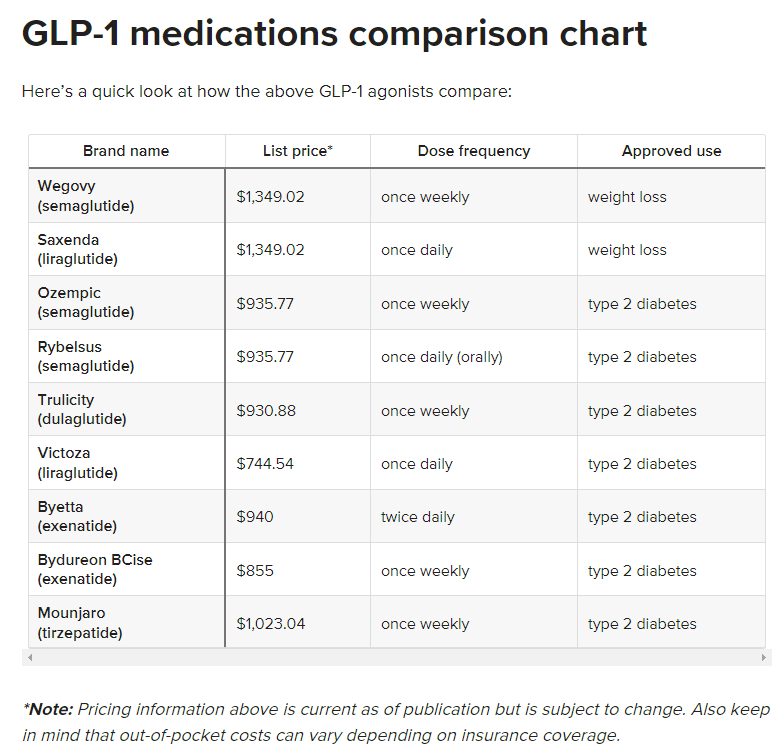
For your reference, we've compiled a table below that lists the available GLP-1 drugs, their prices, and how frequently they need to be taken. Currently, the only ones approved for weight loss are Novo Nordisk's Wegovy and Saxenda.
02 Weight-loss drug market outlook
As one of the leading causes of various severe health conditions, obesity is a growing concern worldwide. According to the World Health Organization, over 750 million people are suffering from obesity globally, resulting in 5% of all deaths.
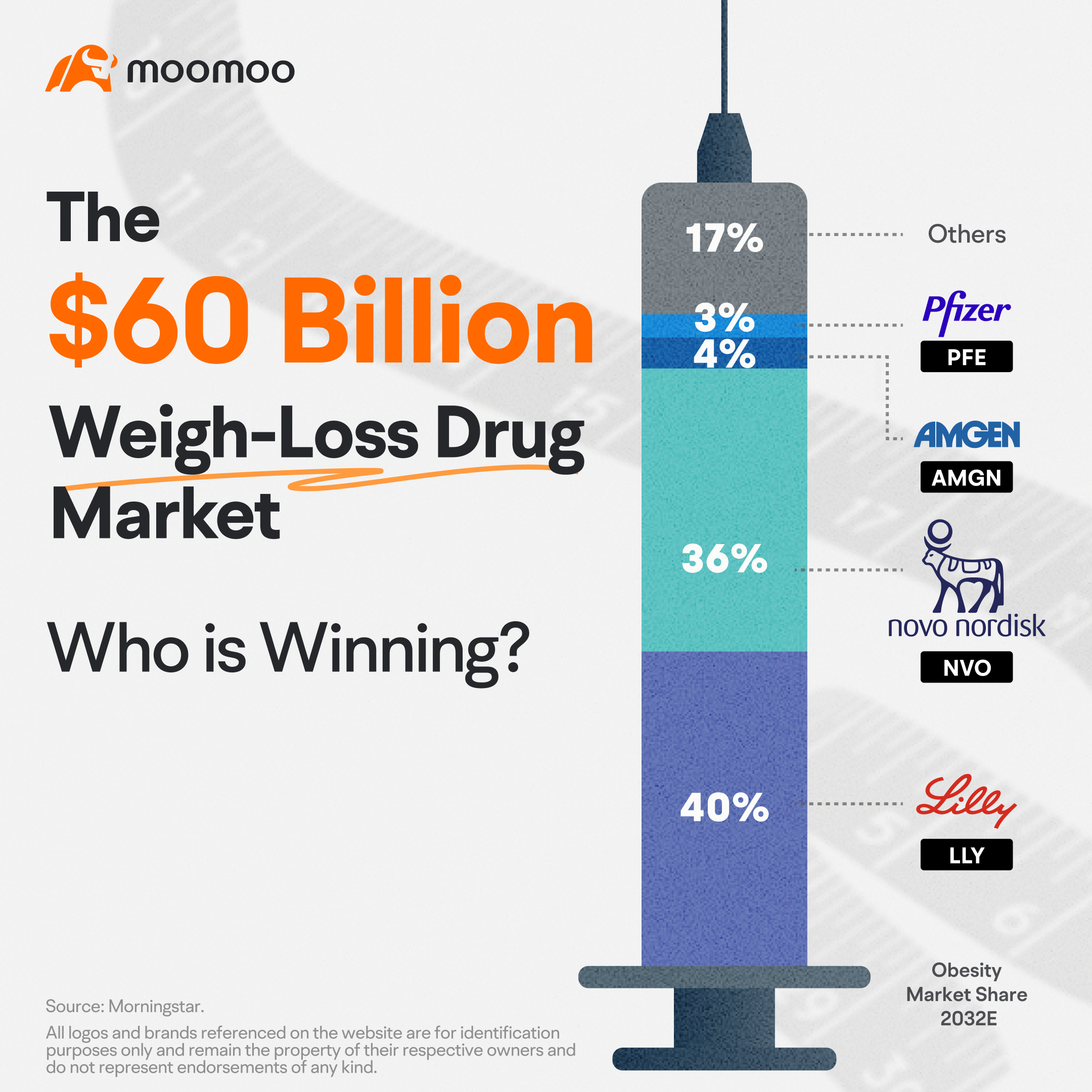
The emergence of GLP-1 weight-loss drugs has sparked a newfound hope for those struggling with obesity. Morningstar analysts predict that the global market for these drugs could reach US$60 billion in the next decade.
They expect that with Novo Nordisk and Eli Lilly introducing obesity treatment drugs, the average global price for GLP-1 obesity therapy could rise to around US$5,400 per year, but as competition grows, prices are expected to gradually decrease, reaching about US$2,800 by 2032. Their projections suggest that approximately 21 million people worldwide may opt for GLP-1 therapy for obesity by 2032.
Morgan Stanley holds even more optimistic views, forecasting that the global obesity market could surge from US$2.4 billion in 2022 to an impressive US$77 billion by 2030, surpassing their earlier estimate by 43%.
03 Which companies are likely to benefit?
Currently, Novo Nordisk and Eli Lilly are the two leading companies in the weight-loss drug market.
However, Morningstar analysts believe that two biopharmaceutical giants, Pfizer Inc (NYSE: PFE) and Amgen, Inc (NYSE: AMGN), also have the potential to make their mark in this field.
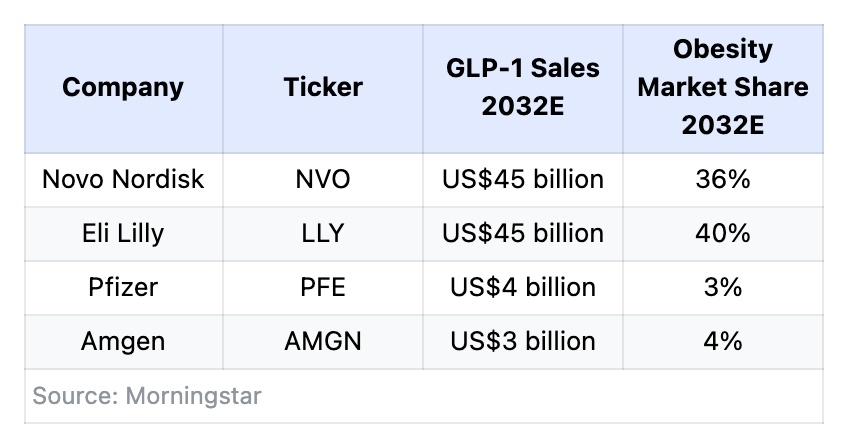
They project that by 2032, Pfizer and Amgen could capture market shares of 3% and 4%, respectively, in the GLP-1 weight-loss therapy market. However, these percentages are still significantly lower than Novo Nordisk's 36% and Eli Lilly's 40%.
Currently, Pfizer is choosing between two oral GLP-1 therapies, both expected to produce phase 2 clinical trial data by late 2023 or early 2024, paving the way for phase 3 clinical development by the end of 2024.
Amgen's approach stands out because it combines a GLP-1 booster with a GIP inhibitor. This sustained action and potential for better results could make it a strong contender. However, they'll have to wait for phase 2 clinical trial data in 2024, and the product is unlikely to hit the market before 2026.
04 Novo Nordisk vs. Eli Lilly
Investors are curious about the potential of Novo Nordisk and Eli Lilly, two leading companies in the weight-loss drug market. We can compare them in several key aspects:
Product Portfolio: According to research from The Motley Fool's analyst, Novo Nordisk stands out because the company has multiple GLP-1 drugs approved for weight loss, ensuring stable market growth. However, Novo Nordisk faces challenges in meeting market demand due to production limitations. On the other hand, Eli Lilly's new product, Mounjaro, boasts better efficacy, with clinical trials showing weight loss of up to 22.5%, while Novo Nordisk's Ozempic and Wegovy only claim to reduce weight by approximately 15%. But Mounjaro is currently only approved for diabetes treatment, with expected weight loss approval later this year.
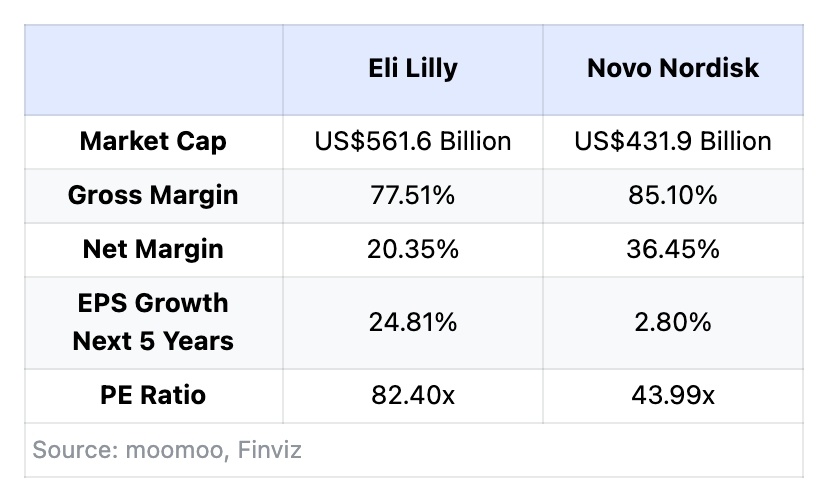
Profitability: Novo Nordisk boasts stronger profitability with gross and net profit margins of 85.1% and 36.45%, respectively, whereas Eli Lilly's margins are 77.51% and 20.35%, according to data from moomoo as of September 14, 2023.
Growth Prospects: Eli Lilly seems to have the upper hand over Novo Nordisk. Analysts predict an impressive 24.81% annual EPS growth rate for Eli Lilly over the next five years, compared to Novo Nordisk's forecasted 2.8%, according to data from Finviz as of September 14, 2023.
Valuation: When considering the price-to-earnings (PE) ratio, Eli Lilly appears relatively more expensive. As of September 14, 2023, Eli Lilly's PE (TTM) is 82.4x, while Novo Nordisk's PE (TTM) is 43.99x, according to data from moomoo.
In summary, Novo Nordisk has a diverse product portfolio and stronger profitability, while Eli Lilly excels in drug efficacy, offers higher growth potential, and carries a relatively higher valuation.
05 Risks in weight-loss drug investments
While the weight-loss drug market is likely to hold immense potential, investors must also recognize the potential risks associated with investing in weight-loss drug companies. Currently, weight-loss drug companies may face three major risks:
Intensifying Competition: Apart from giants like Eli Lilly and Novo Nordisk, other major pharmaceutical companies are also entering the competition for GLP-1 weight-loss drugs. Morningstar analysts predict that other pharmaceutical firms may introduce their weight-loss drugs as early as 2026. The entry of new competitors could impact product sales and further drive down drug prices. Additionally, in the long term, patents for some drugs may expire, creating opportunities for new entrants in the market.
High Drug Prices: Reuters reports that the high prices of weight-loss drugs could be a problem. For example, Wegovy costs as much as US$12,371 per year, which could be challenging for patients. Statistics indicate that only one-third of patients are still using popular weight-loss drugs like Wegovy after one year, and the high cost could be one of the reasons they discontinue treatment. Therefore, without insurance coverage, the high prices might discourage some patients seeking treatment for obesity.
High Expectations: Investors in weight-loss drug stocks must be aware of the potential risk posed by excessively high expectations. This year, as of the market close on September 18, Lilly's stock price has surged by 56.52%, while Novo Nordisk's has seen a gain of 36.25%. For investors considering purchasing shares in these companies, the challenge lies in the extremely high expectations surrounding these drugs. These expectations might already be reflected in stock prices, limiting the upside potential. Therefore, investors need to carefully assess these risks and make decisions based on their risk tolerance and investment strategies.
This presentation is for informational and educational use only and is not a recommendation or endorsement of any particular investment or investment strategy. Investment information provided in this content is general in nature, strictly for illustrative purposes, and may not be appropriate for all investors. Read more