When to Sell Stock: The 7%-8% Sell Rule
As an investor in the stock market, it's common to face the dilemma of what to do when the stocks you own start losing money. In this situation, there are two options available:
A. Hold on and wait for them to recover
B. Sell immediately to prevent further losses.
Legendary investor Warren Buffett once said, "The first rule of investing is to never lose money, and the second rule is to never forget the first rule." This means that to succeed in the stock market, you must learn how to protect the money you already have.
In this article, we'll teach you a simple yet effective strategy for minimizing losses: the 7%-8% sell rule. By following this rule, you can limit your potential losses and reduce your overall risk exposure in the market.
Why should we cut losses?
Cutting losses is one of the most important principles in stock trading. It involves setting a price point at which you sell to prevent bigger losses.
However, some investors find it challenging to cut their losses due to two main reasons.
1. Fear of Losing Money: People are often more afraid of losing money than they are excited about making profits. Selling at a loss can feel painful, almost like cutting off a piece of yourself.
2. Reluctance to Admit Mistakes: It can be hard for investors to admit when they've made a wrong decision, as selling at a loss means accepting that their initial judgment was not the best.
But here's the thing: if you don't cut your losses and keep waiting and hoping the stock will bounce back, you might end up in an even worse situation.
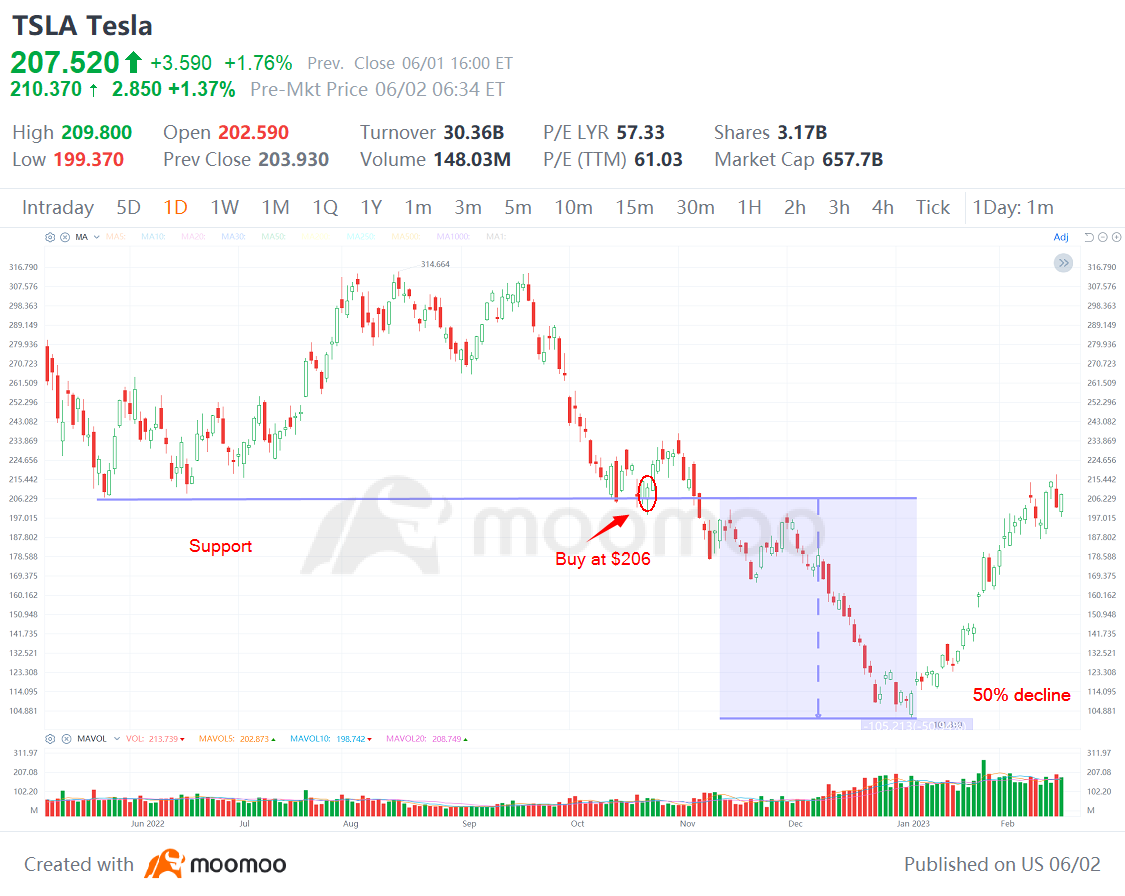
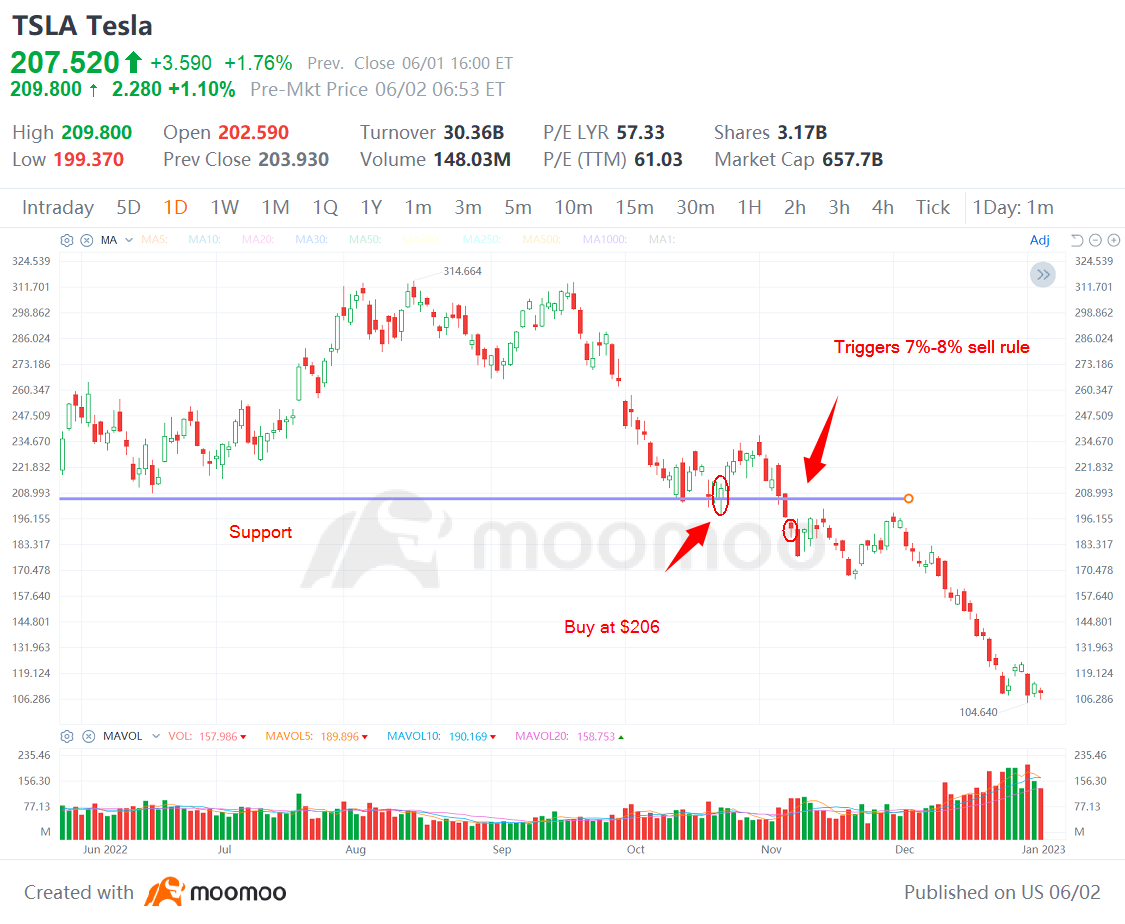
For instance, let's take the example of Coco, who believed in Tesla's potential and bought its stock at $206 per share. At first, the stock price went up, bringing him joy.
However, it suddenly dropped below his purchase price. Despite the losses, Coco held on, hoping it would recover. Sadly, Tesla's stock kept falling, and eventually, he had to sell at $102, losing nearly half of his initial investment.
This example illustrates the importance of having a stop-loss strategy in place before you start to trade. It helps protect your money and prevents significant losses.
7%-8% sell rule
One of the most common ways to cut losses is by setting a stop-loss at a specific percentage.
To implement this strategy, you set a specific percentage (like 5%, 10%, or 15%) as your stop-loss point. When your stock's losses reach that percentage, you sell it to limit your losses. The exact percentage depends on your comfort with risk.
According to IBD founder William O'Neil's 7%-8% sell rule in "How to Make Money in Stocks",
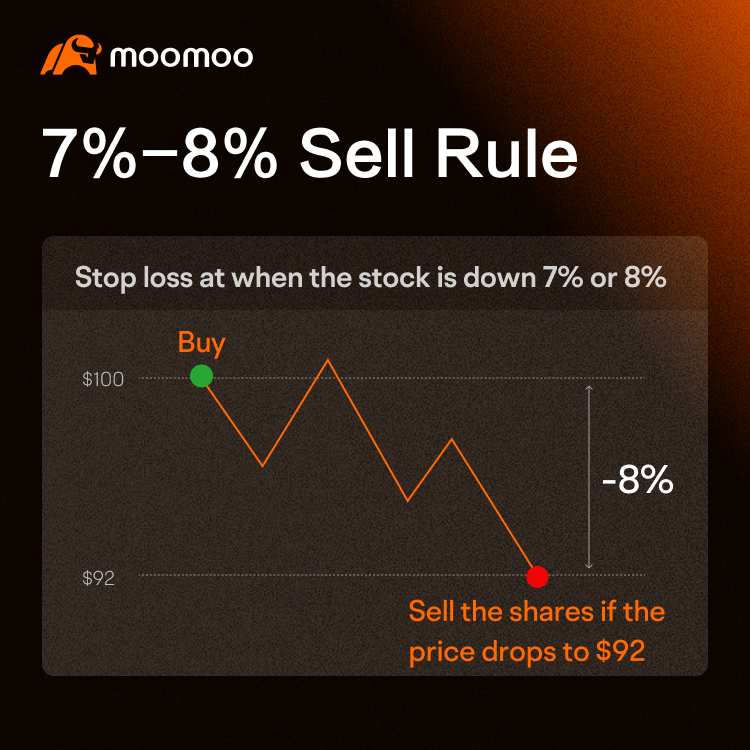
You should sell a stock when you are down 7% or 8% from your purchase price.
For example, let's say you bought Company A's stock at $100 per share. According to the 7%-8% sell rule, you should sell the shares if the price drops to $93 or $92.
There are several advantages to using this approach.
● Advantages: ease of use, reduced emotional decision-making, better control over overall investment risk, and prevention of larger losses.
● Disadvantages: It may result in frequent selling and potentially missing out on potential rebounds.
In a particularly weak or volatile stock market, you may also choose to cut your losses even quicker, say, at 3%-5%.
Why should we cut losses at a 7%-8% fall?
You might be curious as to why the stop loss is set at 7%-8% instead of 10% or 20%. The answer stems from research conducted by William O'Neil, who studied the US stock market history over the past 130 years.
Historical data has shown that if investors entered the market at an ideal buy point, the stock generally wouldn't go down by more than 8%. An over 8% decline seemed to indicate a wrong entry point chosen:
Either the stock you picked isn't doing well due to changes in the company or industry.
Or it's bad timing, with the overall market starting to decline.
As an individual investor, you may not know why a stock is falling or how far it will continue to drop.
That's why a stop loss strategy is crucial. It's a risk management measure to prevent bigger losses. With the 7%-8% sell rule, you limit your losses to 7% or 8%, ensuring that you do not suffer more significant setbacks.
How will stop loss be applied?
Let's look at these 2 scenarios:
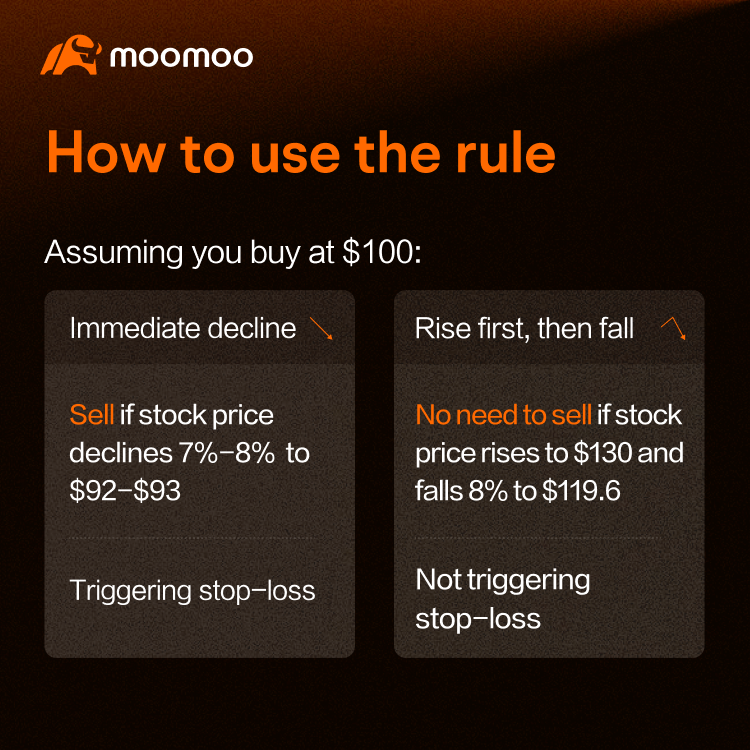
1. Immediate Decline after Buying: Let's say you bought a stock at $100, but its price quickly drops to $92 or $93. When it reaches this point, meaning the rule is triggered, it's time to sell the stock.
2. Initial Rise and Subsequent Decline: Imagine you bought a stock at $100, and it goes up to $130 before dropping by 8% to $119.6. In this case, the sell rule is not triggered since it is a winning position. The sell rule is triggered only when the stock price falls to $92-$93.
Now, let's go back to our example of Coco and Tesla:
Suppose Coco set a 7%-8% sell rule before trading, with an entry price of $206. His stop loss level would be between $189.5 and $191.5.
With this trading plan, Coco could have avoided losing nearly 50% of his investment if he sold the stock at the stop-loss level.
What to do if the stock you sell rebounds shortly after?
If a stock rebounds quickly after being sold with a stop loss, investors may feel regretful and think they've missed an opportunity.
However, consider this perspective: think of the stop loss as insurance, where the 7%-8% loss acts as the premium paid for that protection.
Market fluctuations are unpredictable, and a stock in a downtrend can experience significant declines. The purpose of a stop loss is to limit those losses.
You can always buy the stock back if it becomes fundamentally solid or technically sound.
Summary
Investing in the stock market carries risks, and it's essential for investors to protect themselves from potential losses.
One effective method is to set stop-loss levels and adhere to them.
The 7%-8% sell rule provides a practical approach, but there are other strategies available, and investors should choose the one that suits their circumstances. The key is to have a risk management plan in place that minimizes risks and lays the groundwork for a safer investment journey.
moomoo Learn's premium courses have a lot of advanced investment knowledge, which you are also welcome to explore.
This presentation is for informational and educational use only and is not a recommendation or endorsement of any particular investment or investment strategy. Investment information provided in this content is general in nature, strictly for illustrative purposes, and may not be appropriate for all investors. Read more