




Moomoo Insights
Jul 16 15:38
TSMC Earnings: AI Demand Is Stronger Than the Chip Selloff Suggests
Moomoo Insights
Sep 30 05:04
Live Take | Anthropic’s $518B Compute Bet: Who Wins From the AI Buildout?
This article contains 1,850 words and takes about 5 minutes to read.
The US debt ceiling once again became a topic of public concern in June 2023, as the world's largest economy was on the brink of a potential debt default crisis. However, the Senate managed to pass a debt ceiling agreement just in time, averting the crisis.
But what is the debt ceiling exactly, and why does it generate so much attention? More importantly, how does it fit into the wider discussion of fiscal policy, and what alternative instruments exist beyond debt financing? In this article, we offer answers to these pressing questions and explore the complexities of US fiscal policy.

● What are the goals and methods of fiscal policy?
● How does fiscal policy work?
● Fiscal policy vs. monetary policy
● How does fiscal policy impact financial markets?
● Challenges faced by fiscal policy: debt ceiling
● Summary
Fiscal policy is jointly formulated and implemented by the President, Treasury Secretary, and Congress. Its ultimate goal, similar to that of the Federal Reserve's monetary policy, is to try to achieve and maintain stability in domestic economic and financial operations.
To achieve its goals, fiscal policy primarily focuses on adjusting government revenue and expenditure. Revenue is vital to spending, and a significant portion of the country's fiscal funding comes from it.
1. Tax revenue: Taxes are a critical source of revenue, influencing various aspects of our daily lives such as sales taxes on purchases and income taxes on earnings. The Treasury Department manages tax revenue, with personal income and social security taxes currently being the main sources.
2. Debt financing: If there is insufficient tax revenue, the federal government can obtain funds through debt financing. This involves issuing debt instruments such as government bonds, notes, and Treasury Inflation-Protected Securities (TIPS).
1. Discretionary spending: The highest proportion of discretionary spending is on defense, followed by education, social services, and more.
2. Mandatory spending: This type of spending is primarily for social welfare benefits such as Social Security and Medicare. Mandatory spending accounts for the highest proportion of all expenditures, amounting to 72.9% as of 2021.
3. Net interest: Refers to principal and interest payments made by the Treasury Department for the issuance of securities.
Balancing fiscal revenue and expenditure is often challenging, and if government spending exceeds revenue in a given fiscal year, it results in a fiscal deficit.
The economy is known to follow four stages: Expansion, peak, contraction, trough. Fiscal policy aims to regulate economic expansion and contraction through government revenue and expenditure. As a result, fiscal policy can be categorized into two types: expansionary fiscal policy and contractionary fiscal policy.
During an economic slowdown, the government may take expansionary fiscal policy measures in an effort to stimulate demand and prevent further decline. The two primary tools used in expansionary fiscal policy are:
1. Tax cuts: Reducing direct and indirect tax rates can increase consumers' disposable income, boosting their purchasing power, creating employment opportunities, and stimulating economic growth.
2. Increase government spending: Increasing public investment in projects like highways can create more jobs, raise demand, and boost overall economic activity.
The government can use these methods separately or together depending on the situation. However, if both methods are used simultaneously, such as tax cuts and increased spending, it could lead to a fiscal deficit.
When the economy overheats, contractionary fiscal policy aims to reduce the total demand and consumer spending in the economy to help prevent high inflation and currency depreciation. The two primary tools used in contractionary fiscal policy are:
1. Tax hikes: The government imposes higher taxes on individuals or business products, services, and income to reduce consumer purchasing power, which can slow down the economy.
2. Decrease government spending: Cut public spending on subsidies and public welfare projects, which can decrease the employment rate and limit the amount of money available to consumers, reducing overall economic activity.
Throughout key moments in US history, fiscal policy has played an essential role in shaping economic outcomes.
The following image might help you better understand US fiscal policy:
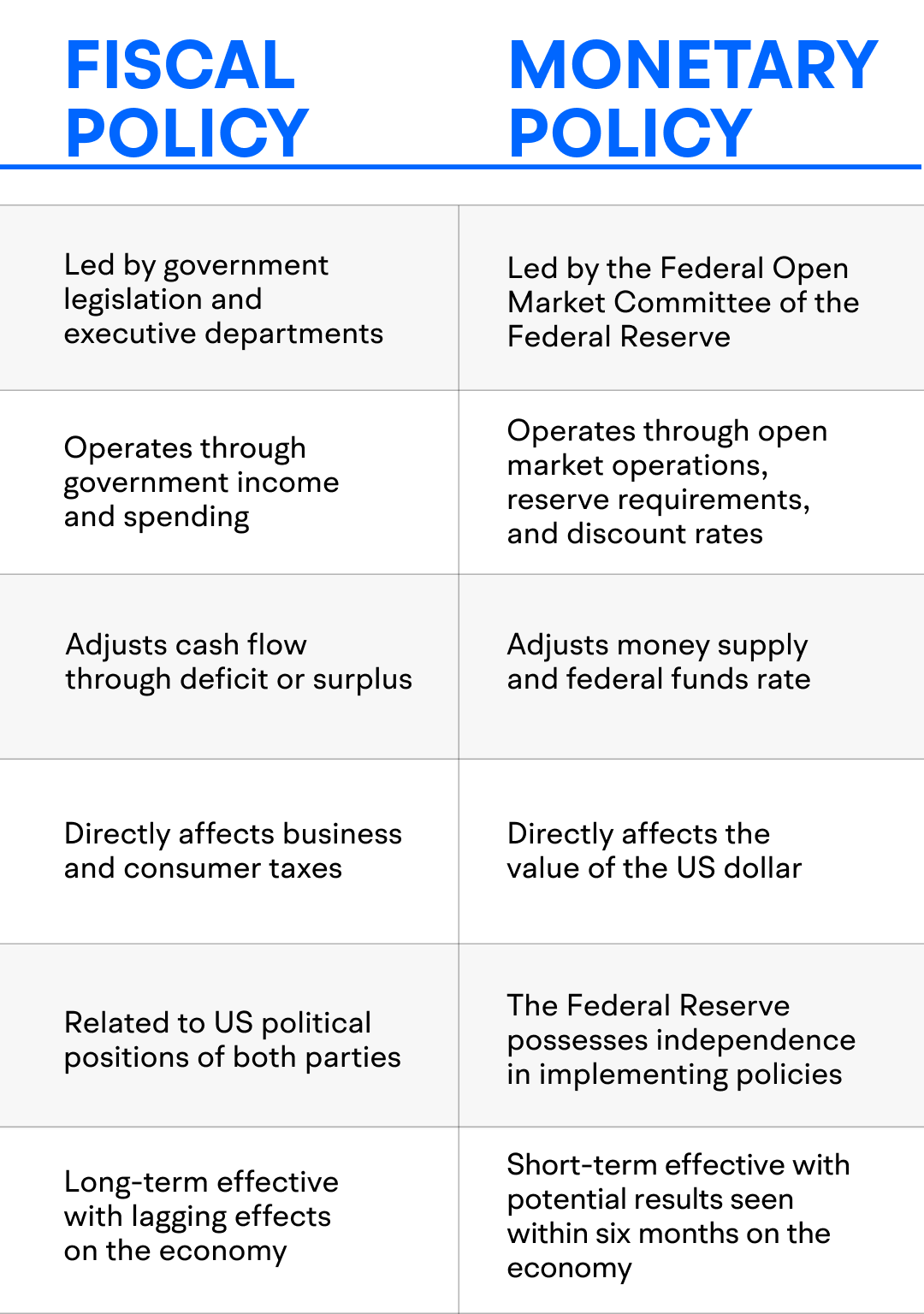
Fiscal policy and monetary policy are two different tools used to influence a country's economy, often used in conjunction with each other.
Monetary policy is managed by the Federal Reserve using open-market operations, reserve requirements, and discount rates, while fiscal policy is primarily the responsibility of the federal government, operating through government spending and taxation.
Combining both tools can produce the best results as they share the same goal of positively impacting the economy.
This combination was used to combat the 2008-2009 financial crisis:
Monetary policy: The Federal Reserve purchased large quantities of treasury bonds and mortgage-backed securities while decreasing bank reserve requirements. This provided the market with short-term liquidity, increased money supply, brought down long-term interest rates, and stimulated consumer and business spending.
Fiscal policy: The government also quickly implemented new plans, such as the Economic Stimulus Act, the Housing and Economic Recovery Act, and the Emergency Economic Stabilization Act, injecting billions of dollars into the economy. These measures aimed to prevent further crises and ease the overall financial situation.
Fiscal policy directly impacts businesses and financial markets, mainly affecting three areas:
1. Taxes: During expansionary fiscal policy, taxes typically decrease, reducing the tax burden on businesses and creating more investment opportunities. In contrast, during contractionary fiscal policy, business tax expenses increase, potentially slowing down business growth.
2. Employment: Decreasing taxes increases consumer purchasing power, potentially leading to greater demand for goods and services. To meet production demands, companies often create more job opportunities, usually lowering unemployment rates.
3. Market volatility: The existence of debt ceilings means that there is a risk of default for US debt. For example, at the beginning of June 2023, as the Treasury Department approached the expected "default day," global market volatility increased. Furthermore, in August 2023, the US sovereign credit rating was downgraded, resulting in negative market sentiment and causing global stock markets to decline.
To assess the goals and effects of US fiscal policy, it is beneficial to understand the current fiscal policy. The Treasury Department publishes three reports that are essential for this purpose:
1. Budget Request: Fiscal policies are typically tied to each year's federal budget, which is proposed by the president and approved by Congress, including estimated expenditures, tax levies, and projected deficits or surpluses. This budget provides an overview of what to expect in the upcoming fiscal year, which begins on October 1st.
2. Annual Performance Report: At the end of each fiscal year, the Treasury Department provides a detailed summary of the previous year's goals as described in the annual performance plan.
3. Strategic Plan: Every four years, the Treasury Department formulates long-term strategic goals for the next four years to guide internal resolutions.
Fiscal policy has a basic logic behind its operation, but it's important to understand that it is not a "cure-all" for the economy. Overuse of expansionary fiscal policy can cause lasting government deficits and may result in difficulties in servicing debt.
The US deficit problem mainly comes from continuous growth in expenditures like mandatory spending, which may be related to the aging population and welfare system. For example, subsidies for unemployed individuals during the COVID-19 pandemic have contributed to increased expenditure in this area.
To address the shortfall in government spending due to chronic deficits, the US has had to increase debt issuance.
Notable events like the Iraq War, the 2008 economic recession, and COVID-19 have caused a sharp surge in debt in the 21st century. From the 2019 fiscal year to the 2021 fiscal year, government spending increased by approximately 50%. Tax cuts, stimulus plans, increased government spending, and reduced tax revenue due to widespread unemployment are common reasons for this drastic increase in debt.
The debt-to-GDP ratio is used to measure a country's ability to pay off its debts, and during COVID-19, this indicator reached an unprecedented 128%.
The need for balanced fiscal policies that consider both short-term economic needs and long-term fiscal sustainability is highlighted by the US's escalating debt problem.
The debt ceiling is the maximum limit set by Congress to restrict outstanding federal debt. Once this limit is reached, the federal government cannot increase the amount of outstanding debt and loses the ability to pay bills and fund projects.
Reaching the debt ceiling has consequences.
When the debt ceiling is reached, the possibility of the US government defaulting on its debt arises, potentially leading to catastrophic consequences not only for the US but also for the global economy. Therefore, the US government will go to great lengths to avoid defaulting on its debt.
Although the debt ceiling has been reached multiple times, the US has never defaulted. How does the US manage to skirt the edge of default? It's simple: if there is a limit, just raise it!
The Treasury Department can use emergency measures approved by Congress to temporarily pause some types of government debt and allow for borrowing within a limited timeframe to fund projects or services. Since 1960, Congress has permanently raised, temporarily extended, or revised the definition of the debt limit 78 times.
As raising the debt ceiling usually requires bipartisan support, it is often used as a bargaining tool in the political game between the two major parties in the US.
The US's escalating debt problem causes instability in the capital market from time to time. With the downgrade of the US sovereign credit rating, the perception that "US Treasuries are a safe haven" may no longer be accurate. Therefore, investors should remain wary of potential risks in default-free government bonds.
● Fiscal policy refers to the expenditure and taxation decisions made by the US government to regulate the economy.
● The government typically implements expansionary policies during economic recessions and contractionary policies during economic prosperity.
● The ultimate goal of both fiscal and monetary policies is to try to achieve and maintain domestic economic and financial stability, but they differ in their approach to influencing the economy.
● Financial markets are directly affected by fiscal policy, which can be seen in market volatility, corporate taxes, and changes in the labor force.
● Investors can monitor the objectives and effectiveness of US fiscal policy through three reports released by the Treasury Department.
● The US debt problem is becoming increasingly severe, so investors should always be aware of risks associated with default-free government bonds.
Check out the macro analysis in the "Advanced" section to learn more about fiscal policy. Update yourself with the latest data and market trends to make more informed investment decisions!
This presentation is for informational and educational use only and is not a recommendation or endorsement of any particular investment or investment strategy. Investment information provided in this content is general in nature, strictly for illustrative purposes, and may not be appropriate for all investors. Read more
Recommend
Why does Warren Buffett say don't piggyback on his trades?

How does nonfarm payroll impact the global market?
Unveiling Inflation: Why is Your Wallet Shrinking?

Mastering the Dollar Cycle: How to invest in a changing economy
Gold vs. Gold Miners: A Comparison
Are U.S. Treasuries still a safe haven?
Meet Dr. Copper: Understanding the Copper Market
Do Oil Price Swings Rock the Stock Market?
How Tariffs Could Impact the Copper Landscape?
Why do oil ETFs lag behind oil prices in the long run?
Why is the US dollar so powerful worldwide, and how can we tell?
A look at employment: what other indicators are there?
GDP: The Barometer of National Prosperity
Understanding Treasury Auctions: A Step-by-Step Guide
Unpacking the U.S. Debt Issue
Why is Oil Called the "Mother of All Commodities"?
How Inflation Affects the Market
How to interpret the Fed dot plot?
How to Decode Inflation: CPI, PCE, and PPI
Understanding Bessent's Fiscal Blueprint
The Rise of the Fed: Can Trump Dismiss Powell?
What's in the Fed's Toolbox?
'Oracle of Omaha' Warren Buffett:ROE>20% is preferable
'Father of value investing' Benjamin Graham: Ten Stock Selection Criteria
Strong Consumer Spending Despite Economic Slowdown: Here's Why
Analyzing the manufacturing industry may help you grasp economic trends
What is the Debt Ceiling? A Deep Dive into US Fiscal Policy
How to Preserve Your Wealth in a High Inflation Environment
How to analyze the Federal Reserve's monetary policy?
Rapidly Rising US Housing Prices: Opportunity or Risk?
How Will the US Dollar Perform in 2024? A Closer Look into the US Dollar Index
Discussing the driving forces behind rises in gold prices
Investing and Labor Market Indicators
Discover the bond market: A quick and easy guide
The Underlying Conflicts Surrounding Crude Oil Prices
Understanding the relationship between the stock market and the bond market
Understanding the US Non-Farm Payroll Data
Understanding the Federal Reserve Interest Rate Decision
Understanding the CCI
Understanding the PPI
Understanding the Retail Sales
Understanding the US Crude Oil Inventories
Understanding the Durable Goods Orders
Listen to the Fed's speakers: Hawks or doves?
Open the Fed's monetary policy toolbox
The Fed Dot Plot explained: What it says about US interest rates
How does monetary policy steer our lives and investment
What the Federal Reserve does?
Understanding the GDP
A brief history lesson on the Fed and U.S. economy
08 Carl Icahn & Icahn Enterprises
09 Seth Klarman & Baupost Group
07 Howard Marks & Oaktree Capital
01 Using 13F filings to learn from big investors
03 How to Read Form 13F
02 Identify a fund's investment strategy
04 Warren Buffett & Berkshire Hathaway
06 Ray Dalio & Bridgewater Associates
05 Bill Ackerman & Pershing Square Capital
Why does Warren Buffett say don't piggyback on his trades?
How does nonfarm payroll impact the global market?
Unveiling Inflation: Why is Your Wallet Shrinking?
Mastering the Dollar Cycle: How to invest in a changing economy
Gold vs. Gold Miners: A Comparison
Are U.S. Treasuries still a safe haven?
Meet Dr. Copper: Understanding the Copper Market
Do Oil Price Swings Rock the Stock Market?
How Tariffs Could Impact the Copper Landscape?
Why do oil ETFs lag behind oil prices in the long run?
Why is the US dollar so powerful worldwide, and how can we tell?
A look at employment: what other indicators are there?
GDP: The Barometer of National Prosperity
Understanding Treasury Auctions: A Step-by-Step Guide
Unpacking the U.S. Debt Issue
Why is Oil Called the "Mother of All Commodities"?
How Inflation Affects the Market
How to interpret the Fed dot plot?
How to Decode Inflation: CPI, PCE, and PPI
Understanding Bessent's Fiscal Blueprint
The Rise of the Fed: Can Trump Dismiss Powell?
What's in the Fed's Toolbox?
'Oracle of Omaha' Warren Buffett:ROE>20% is preferable
'Father of value investing' Benjamin Graham: Ten Stock Selection Criteria
Strong Consumer Spending Despite Economic Slowdown: Here's Why
Analyzing the manufacturing industry may help you grasp economic trends
What is the Debt Ceiling? A Deep Dive into US Fiscal Policy
How to Preserve Your Wealth in a High Inflation Environment
How to analyze the Federal Reserve's monetary policy?
Rapidly Rising US Housing Prices: Opportunity or Risk?
How Will the US Dollar Perform in 2024? A Closer Look into the US Dollar Index
Discussing the driving forces behind rises in gold prices
Investing and Labor Market Indicators
Discover the bond market: A quick and easy guide
The Underlying Conflicts Surrounding Crude Oil Prices
Understanding the relationship between the stock market and the bond market
Understanding the US Non-Farm Payroll Data
Understanding the Federal Reserve Interest Rate Decision
Understanding the CCI
Understanding the PPI
Understanding the Retail Sales
Understanding the US Crude Oil Inventories
Understanding the Durable Goods Orders
Listen to the Fed's speakers: Hawks or doves?
Open the Fed's monetary policy toolbox
The Fed Dot Plot explained: What it says about US interest rates
How does monetary policy steer our lives and investment
What the Federal Reserve does?
Understanding the GDP
A brief history lesson on the Fed and U.S. economy
08 Carl Icahn & Icahn Enterprises
09 Seth Klarman & Baupost Group
07 Howard Marks & Oaktree Capital
01 Using 13F filings to learn from big investors
03 How to Read Form 13F
02 Identify a fund's investment strategy
04 Warren Buffett & Berkshire Hathaway
06 Ray Dalio & Bridgewater Associates
05 Bill Ackerman & Pershing Square Capital

