Why and how to invest in dividend shares
Earning from investments can come in two primary forms:
Capital gain: You make a capital gain when you sell an investment for more than you paid for it.
Dividend income: When a company shares its profits with you in the form of dividends, you’re receiving dividend income.
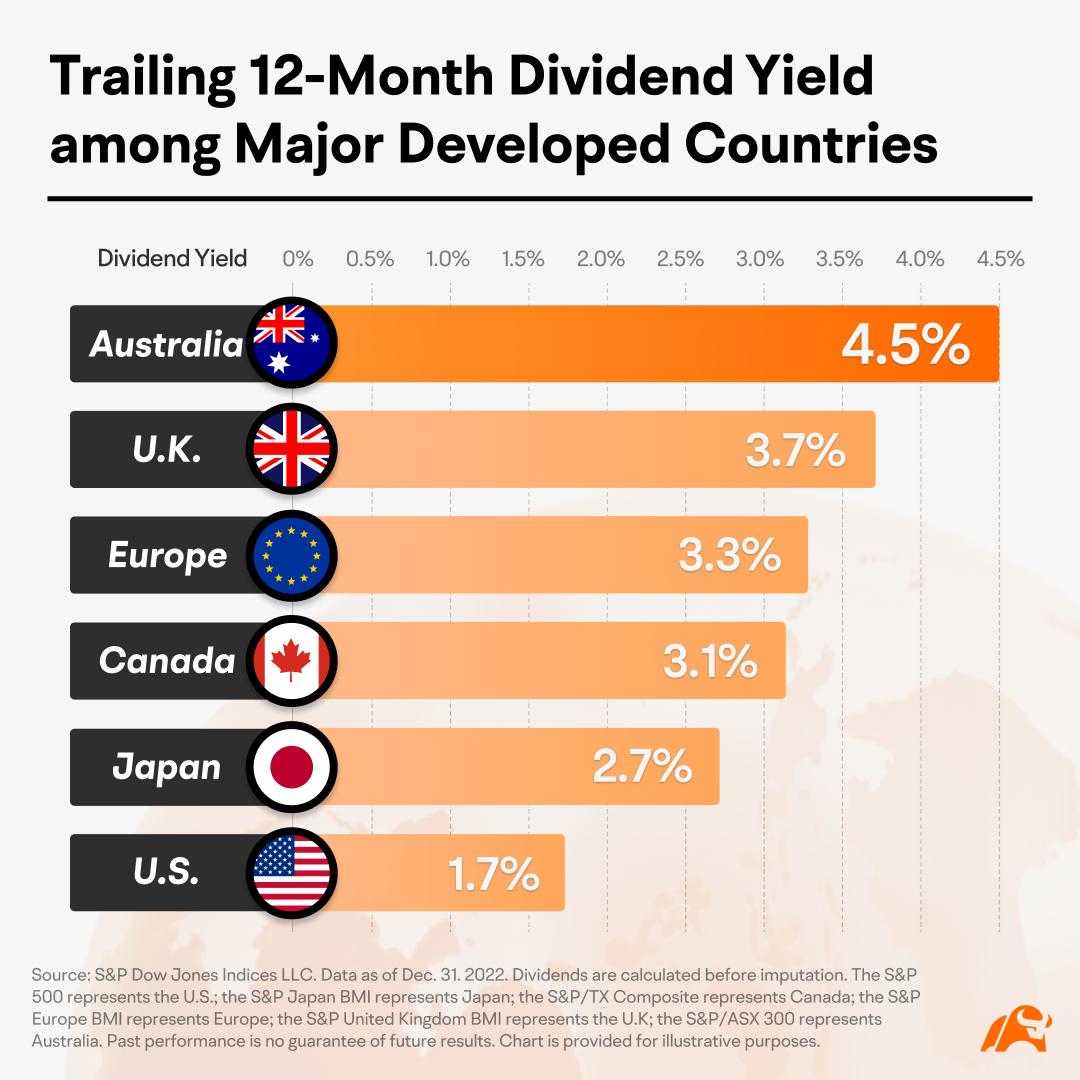
The Australian equity market is renowned for its high dividend yield and well-established dividend culture, offering the highest dividend returns among major developed markets.
What are dividend shares?
Dividend shares, also known as income stocks, are companies with a proven track record of paying dividends to their shareholders.
These entities are usually mature, profitable firms that prioritize returning value to their investors with regular dividend disbursements.
Investing in dividend shares can provide investors with a steady income stream, making them an essential component of a well-diversified investment portfolio.
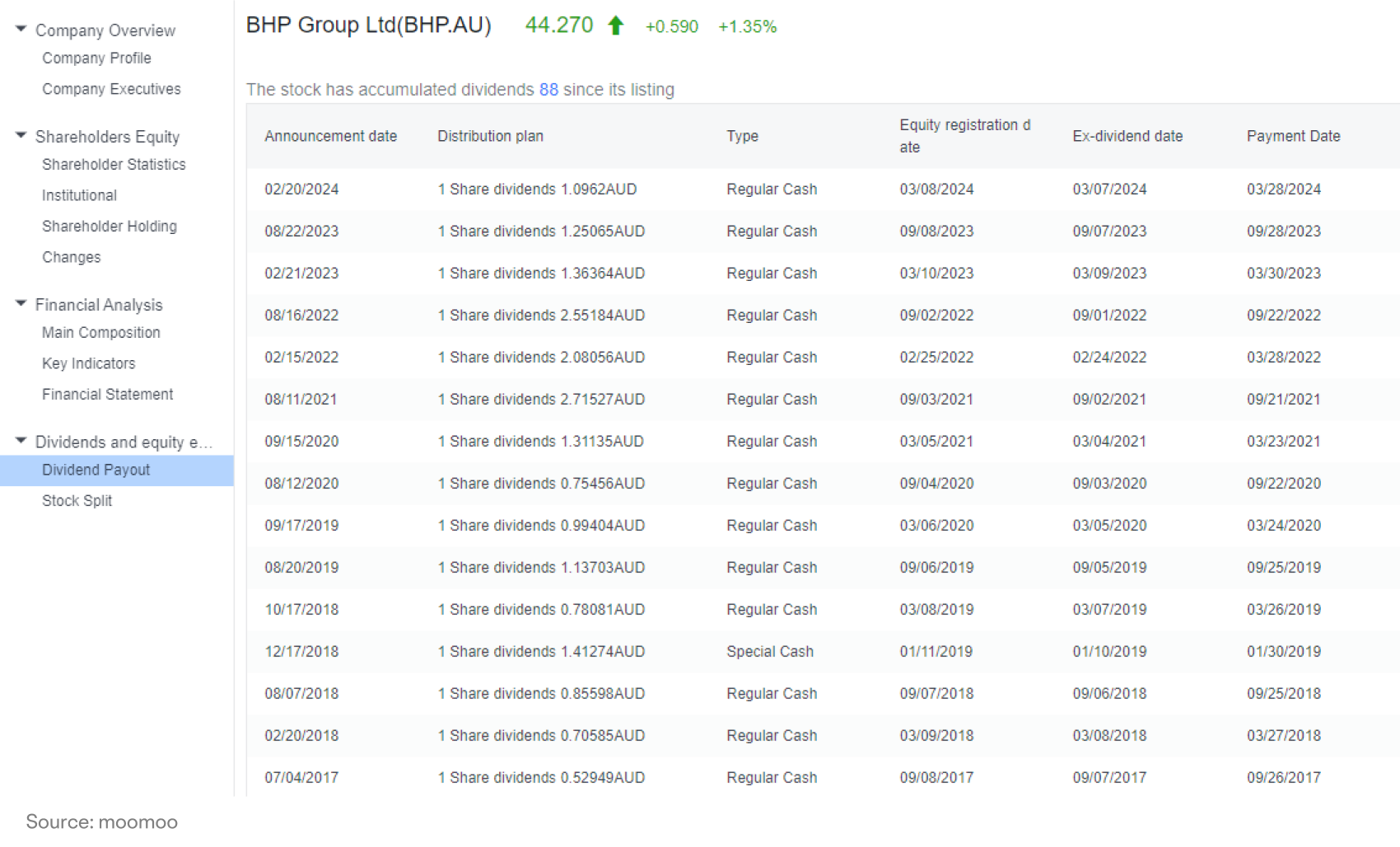
In Australia, most dividend-paying companies follow a semiannual dividend payment schedule. For instance, on 20 February 2024, the Board of BHP announced an interim dividend of 72 US cents per share for the half-year ending 31 December 2023. Typically, the company pays two dividends per year, and since its listing, it has paid more than 80 dividends.
Why invest in dividend shares?
Dividend shares can provide investors with a reliable and consistent income stream, offering regular returns over time.
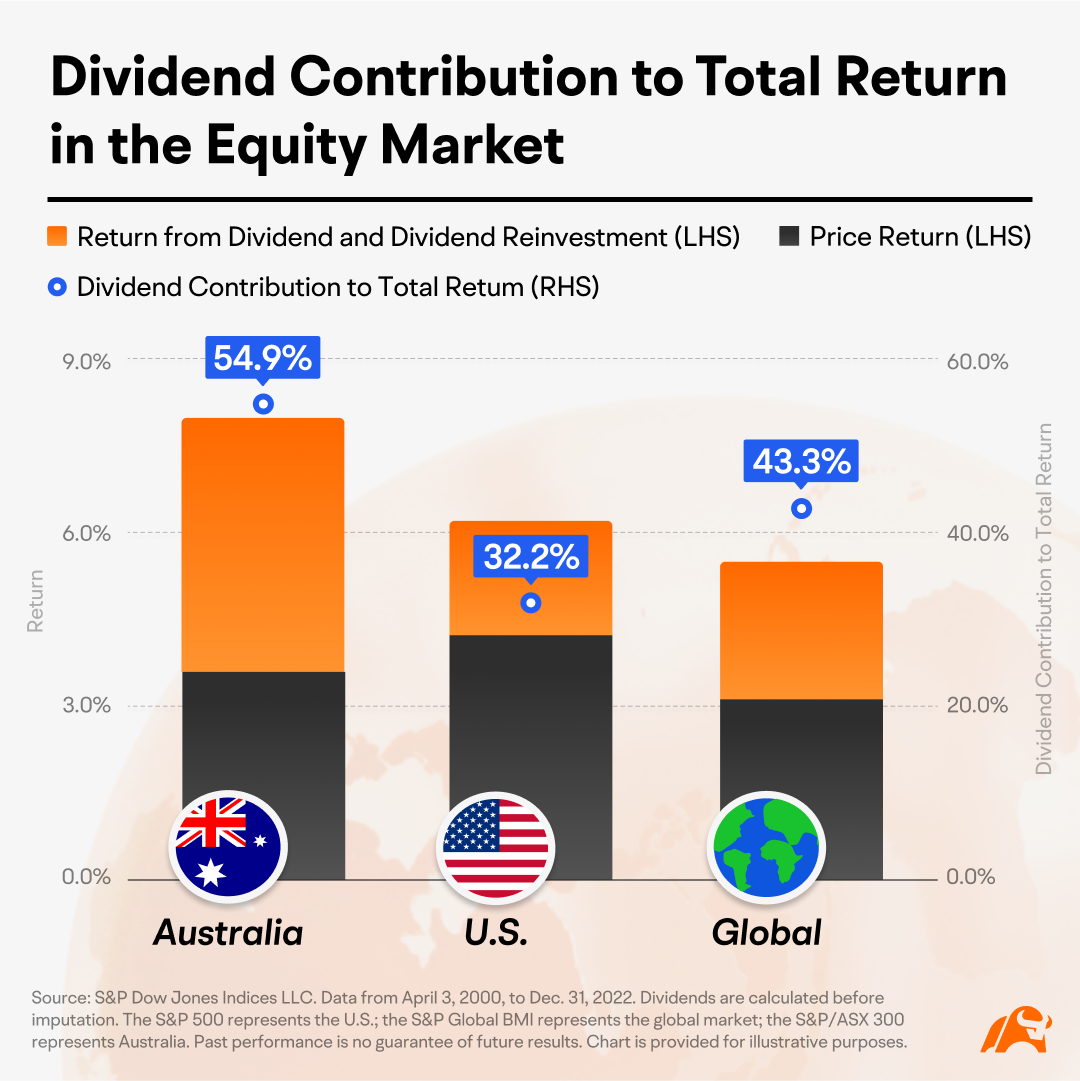
In the Australian share market, dividends are a significant source of total return. Since the year of 2000, dividends and dividend reinvestment in Australia have accounted for over half of the total return for the S&P/ASX 300, higher than 32% for the U.S. and 44% globally.
Companies that consistently pay dividends typically exhibit financial resilience, offering investors a degree of reassurance. Such firms often possess a defensive character, frequently outshining growth shares in times of economic volatility.
This resilience can be leveraged through investment strategies that focus on high-dividend-yielding stocks. One such approach is "The Dogs of the Dow," which involves buying the 10 stocks in the Dow Jones Industrial Average (DJIA) with the highest dividend yield and rebalancing annually. Michael O'Higgins found that over 26 years, this hypothetical high dividend yield portfolio generated a 17.9% annualized return, outperforming the 13% annualized return of the DJIA.
A similar strategy can be applied in the Australian market using the S&P/ASX 200 High Dividend Index, which measures the performance of 50 high-dividend-yielding companies within the S&P/ASX 200 with positive 12-month forecast dividend yields, excluding those classified as A-REITs.
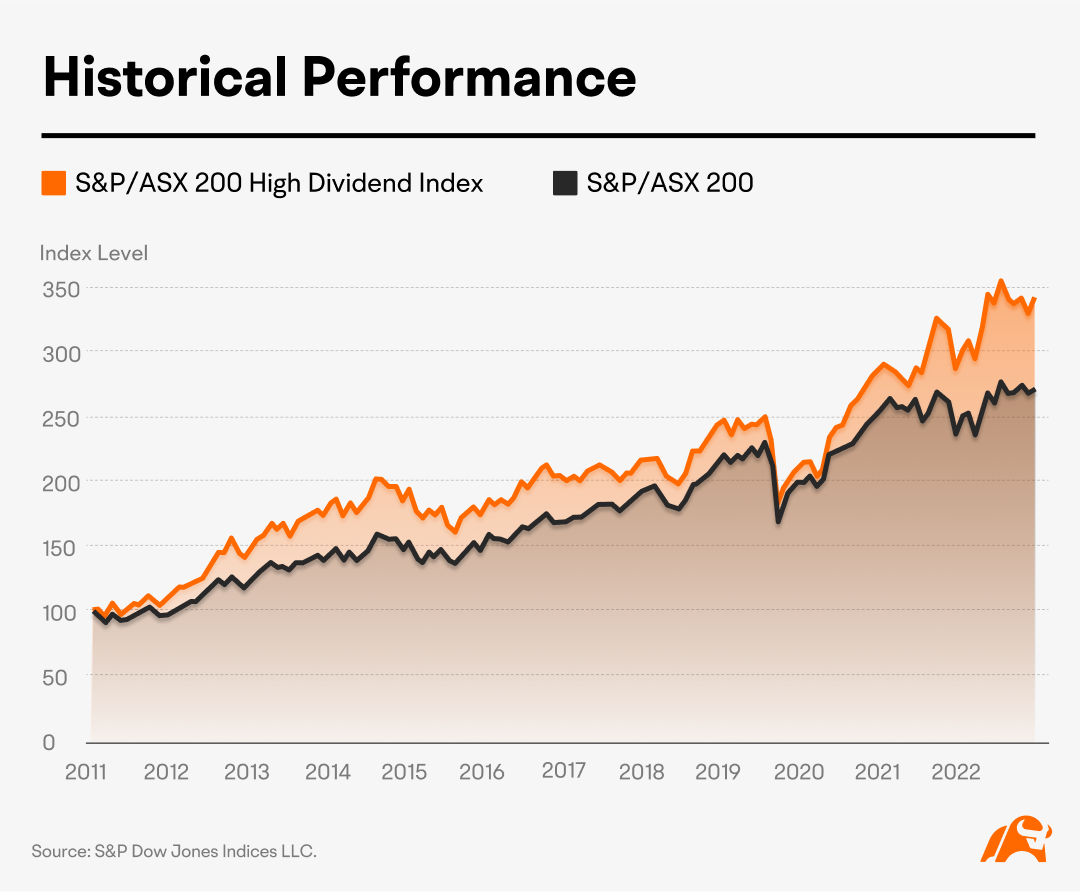
From 31 July 2021 to 30 June 2023, this index had a total annualized return of 10.83%, outperforming the benchmark ASX 200 index, which returned 8.73%.
Moreover, the tax advantages from franking credits make investing in dividend shares even more attractive for many people.
Understanding franking credits
Franking credits were introduced in Australia in 1987 to address the issue of ASX investors being taxed twice on dividends.
These credits are a reflection of tax already paid at the company level, and a franked dividend comes with franking credits that can be used to offset personal income tax liabilities.
The tax offset effect varies based on the marginal tax rate of each investor. The table below illustrates the tax effect for hypothetical investors with marginal tax rates of 15%, 30%, and 45%.
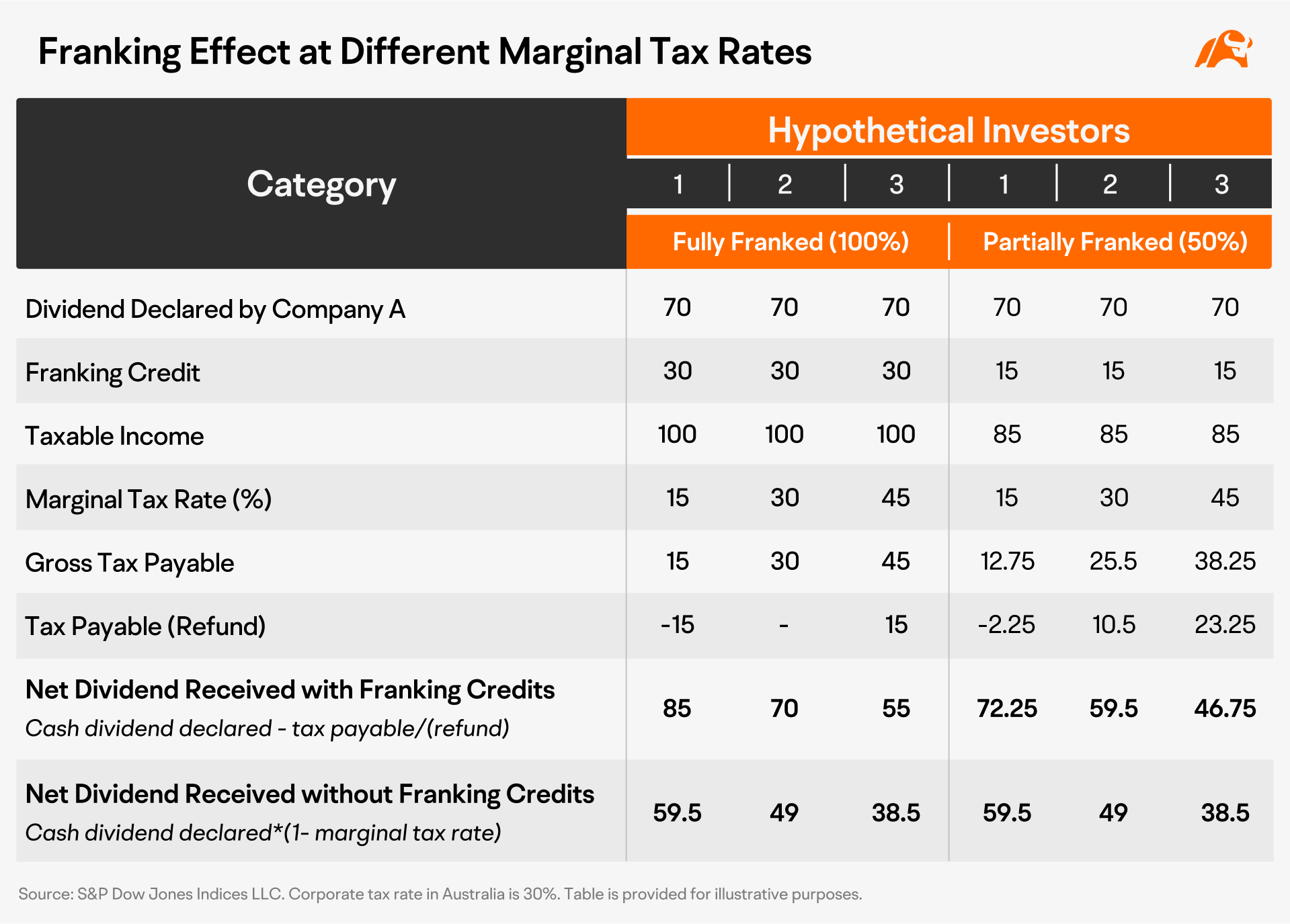
Franking credits offer a tax benefit in Australia, boosting after-tax income for shareholders who are taxed at a rate lower than the corporate rate. This can result in meaningful tax reductions or refunds.
The Australia dividend imputation system promotes dividend payouts with attached franking credits, helping shareholders avoid double taxation. In the US, lacking such a system, companies often opt for share buybacks over dividends to prevent their investors from being taxed twice on the same earnings.
How to track dividend shares?
Before investing in dividend-paying stocks, it's important to assess the company's financial stability, dividend payment history, and the likelihood of consistent earnings. Also, consider market trends and payout ratios to make well-informed decisions.
A key metric is the dividend yield, which measures the annual income investors receive from dividends for each dollar invested. It’s calculated as follows:
Dividend Yield = Dividends Per Share / Share Price
The ASX 200 index includes many blue-chip companies with a lengthy track record of reliable dividend payments. You can rank the constituent stocks by dividend yield on moomoo to identify potential investment opportunities.
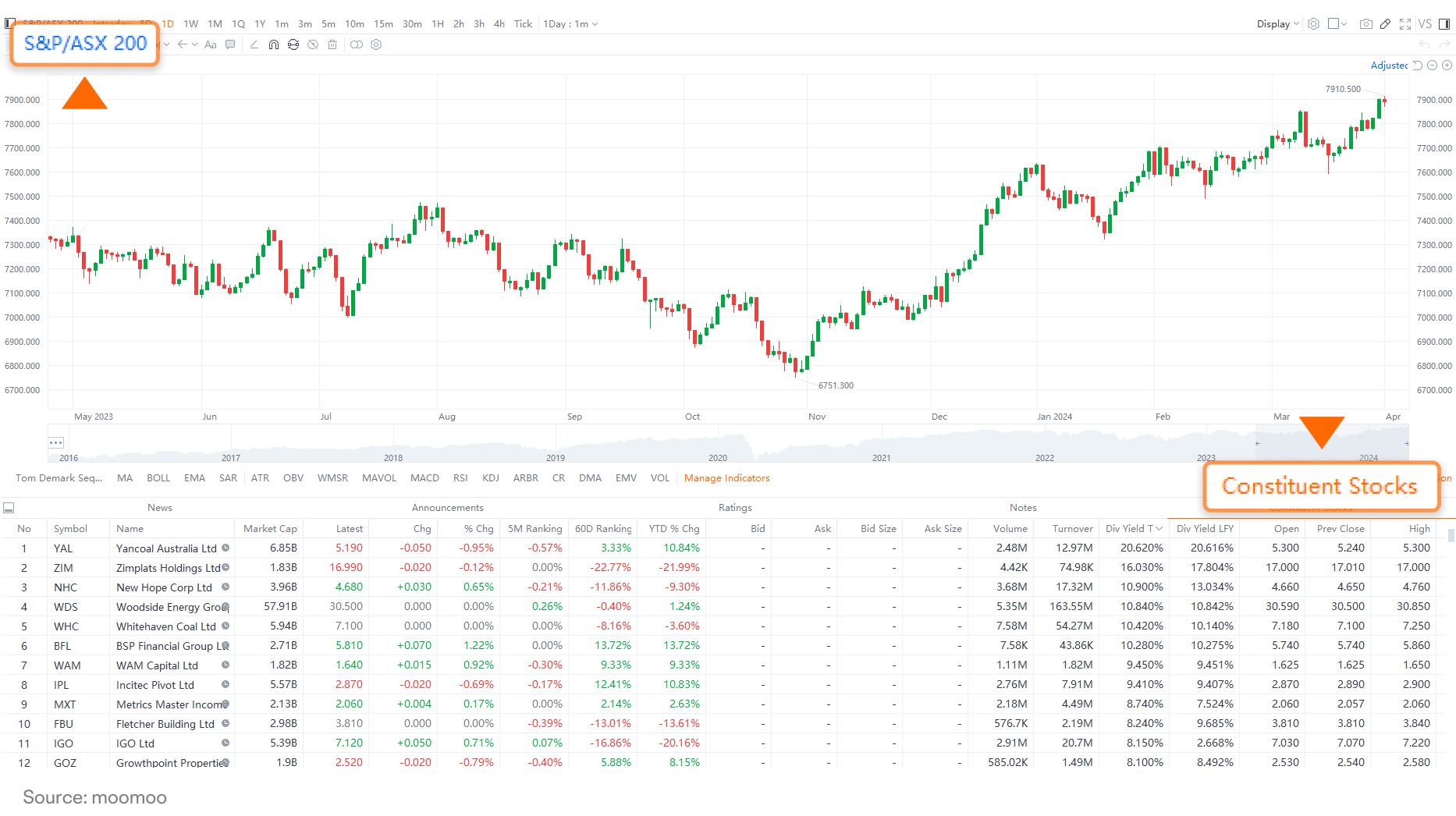
Remember, the yields presented are usually based on past dividends, and future yields may vary with changes in share price or company and economic developments. If dividends stay constant, the yield increases as share prices drop, and decreases when prices rise.
Looking out for “yield traps”
High yields might appeal to dividend-focused investors, but not all such stocks are wise choices—some carry significant risk.
“Yield traps” refer to stocks offering seemingly attractive yields due to falling share prices, yet they harbor poor business fundamentals, potentially leading to reduced earnings.
These companies may struggle financially and carry heavy debt loads, casting doubt on their ability to maintain dividend payouts.
Many investors fall for the siren's song of ultra-high-yield percentages without considering the whole picture. Although there's no foolproof method to detect a yield trap, investors can look for some red flags, such as exceptionally high yields, overwhelming debt, weak cash flow, and underlying business problems.
This presentation is for informational and educational use only and is not a recommendation or endorsement of any particular investment or investment strategy. Investment information provided in this content is general in nature, strictly for illustrative purposes, and may not be appropriate for all investors. Read more