Inverse ETFs: Is there potential profit in market downturns?
The sharemarket operates in a cyclical manner, characterised by fluctuations of highs and lows. Even in a bull market, there are moments when shares may encounter pullbacks, leading to temporary losses for many investors.
To potentially capitalise on, or safeguard against, market downturns, some sophisticated and proactive investors are turning to products that provide 'short' exposure to the sharemarket. Among various investment options, inverse exchange-traded funds (ETFs) are gaining popularity as effective instruments for managing market volatility.
What is an inverse ETF?
An inverse ETF, sometimes called a short ETF, is designed to move in the opposite direction of its underlying asset, seeking to capitalise on a decline in its value.
Inverse ETFs are often referred to as 'short' or 'bear' products, which typically reflect this in their names. They utilise various financial instruments like futures contracts and swaps to provide returns that are inversely correlated to their underlying asset, typically on a daily basis.
Many inverse ETFs are leveraged, aiming to generate returns that are two or three times greater than those of the underlying asset, making them highly speculative investments.
For example, the Australian Equities Strong Bear Hedge Fund (BBOZ), one of the most actively traded inverse ETFs on the ASX, aims to deliver amplified returns that are inversely correlated with the performance of the Australian sharemarket. A 1% decline in the S&P/ASX 200 index on any given day typically results in an increase of 2% to 2.75% in the value of the BBOZ. Conversely, if the S&P/ASX 200 rises, one can expect a corresponding decrease in the value of the BBOZ.
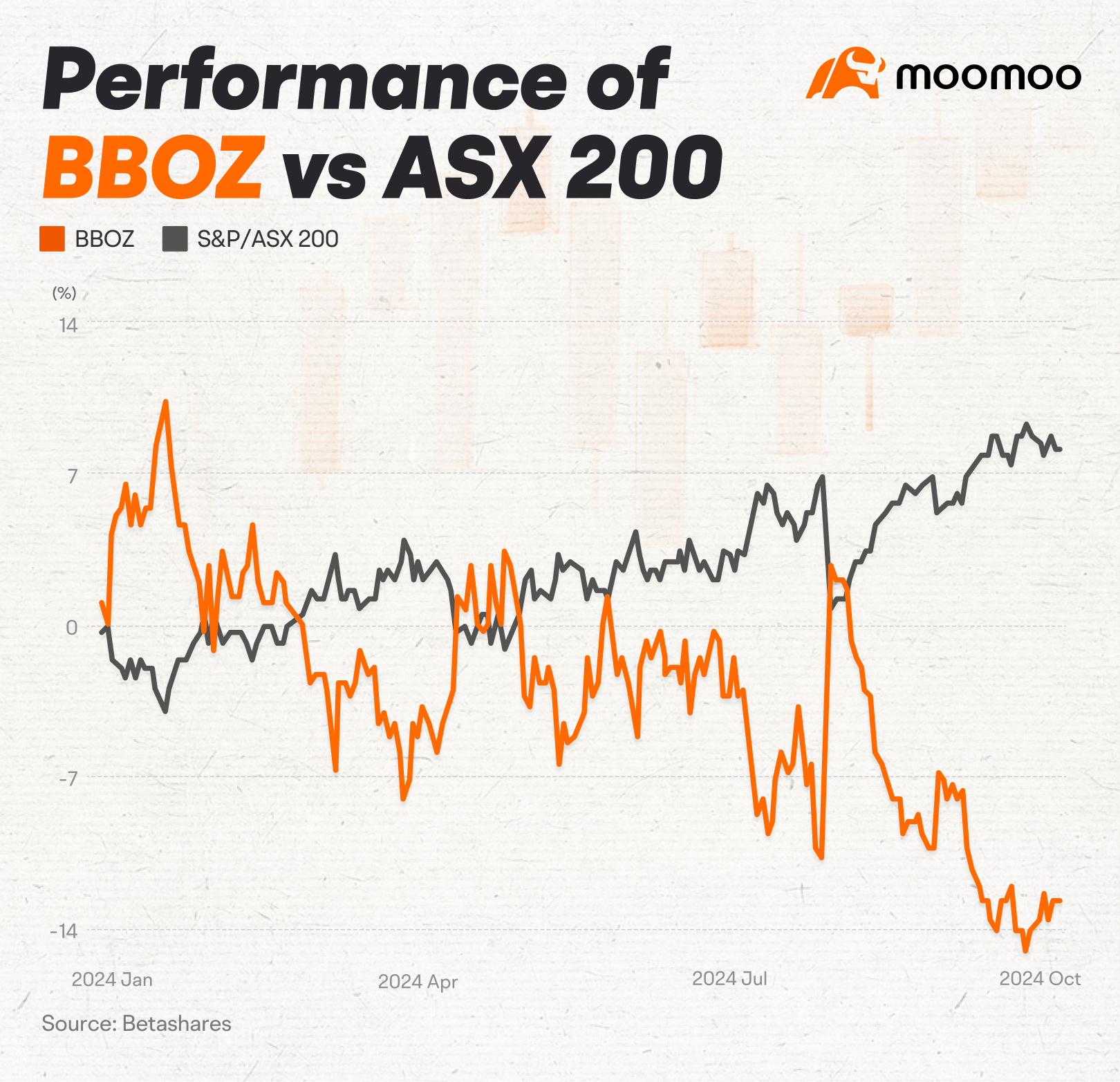
It's essential to recognise that the targeted returns of inverse ETFs are calculated on a daily basis. Their portfolio exposure is actively monitored and adjusted to stay within a targeted range on any given day. However, returns over periods longer than one day may differ in amount and possibly direction from the daily target return range. These characteristics render them unsuitable for long-term holding.
Advantages of inverse ETFs
● Hedging
Traders can use inverse ETFs as a hedging strategy to offset potential losses in their long positions, effectively reducing overall risk during market downturns without the need to sale their long holdings.
● Speculation
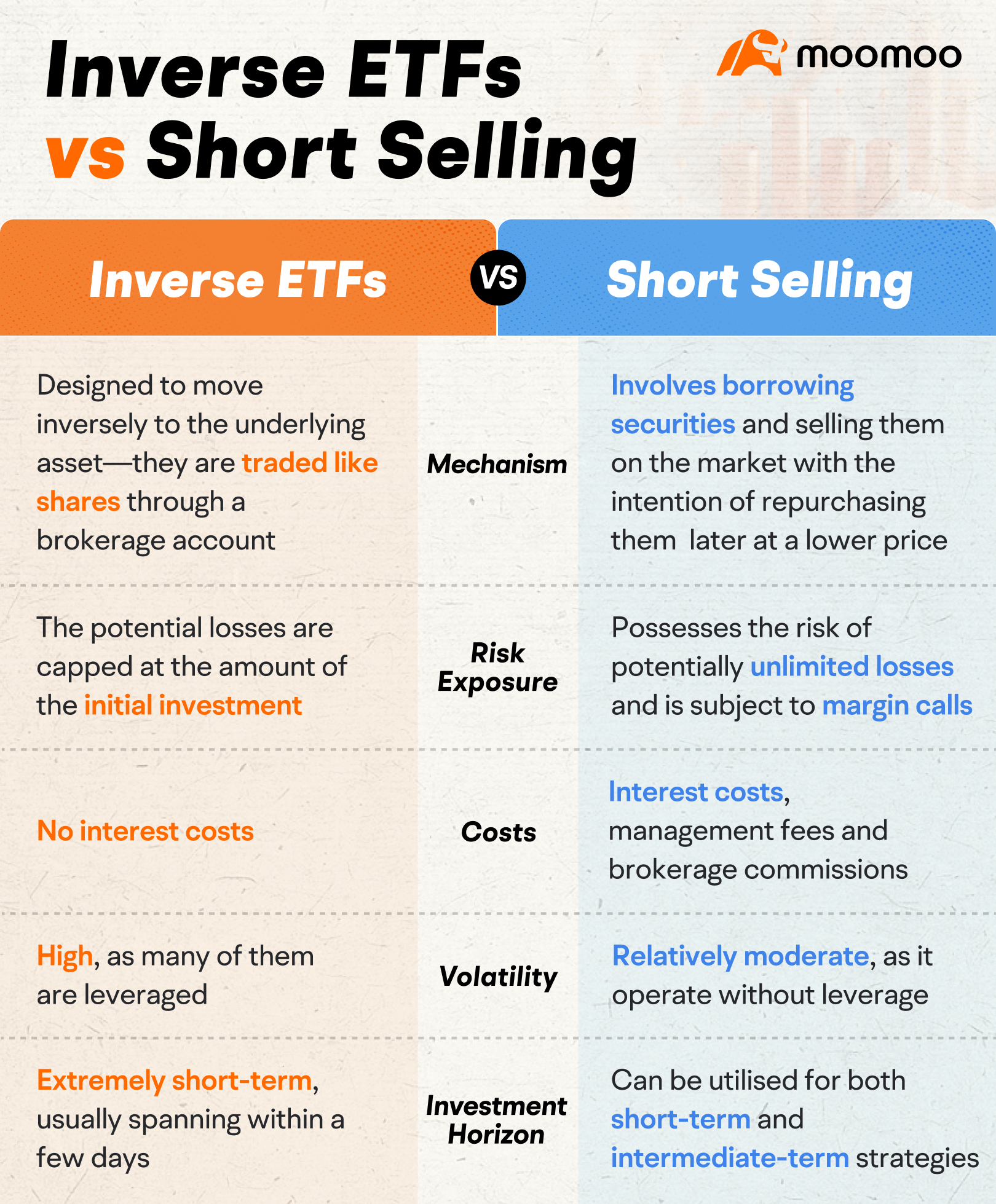
Traders anticipating a market downturn may use inverse ETFs to capitalise on short-term price declines without engaging in short selling, which entails interest costs, the risk of margin calls and the potential for unlimited losses.
● Leverage
Many inverse ETFs are designed to provide leveraged exposure, amplifying potential returns (or losses) in relation to both the underlying asset and the invested capital.
● Convenience
Inverse ETFs are accessible through brokerage accounts, making their trading as straightforward as buying and selling shares.
Drawbacks of inverse ETFs
Inverse ETFs possess distinct characteristics that set them apart from traditional ETFs. They are more complex and entail several disadvantages that investors should carefully consider:
● Volatility loss
Inverse ETFs are specifically designed to achieve their stated objectives on a daily basis. However, due to the compounding effects that arise from daily rebalancing, their performance over extended periods can diverge significantly from the inverse of the underlying asset, particularly in volatile market conditions.
For example, if an investor puts $100 into a -1x inverse ETF, and the value of the underlying asset drops to $80 on the first day, followed by a decline to $60 on the second day, the value of the inverse ETF position would theoretically increase by 20% (reflecting the asset’s 20% decrease from $100 to $80) and then by 25% (due to the asset’s 25% drop from $80 to $60). Consequently, the ETF's value would be calculated as $100 × 1.20 × 1.25 = $150.
However, if the underlying asset's value rebounds to $100 on the third day (a 67% increase from $60 to $100), the inverse ETF would incur a loss of $150 × 67% = $100, resulting in a decrease in its value to $50.
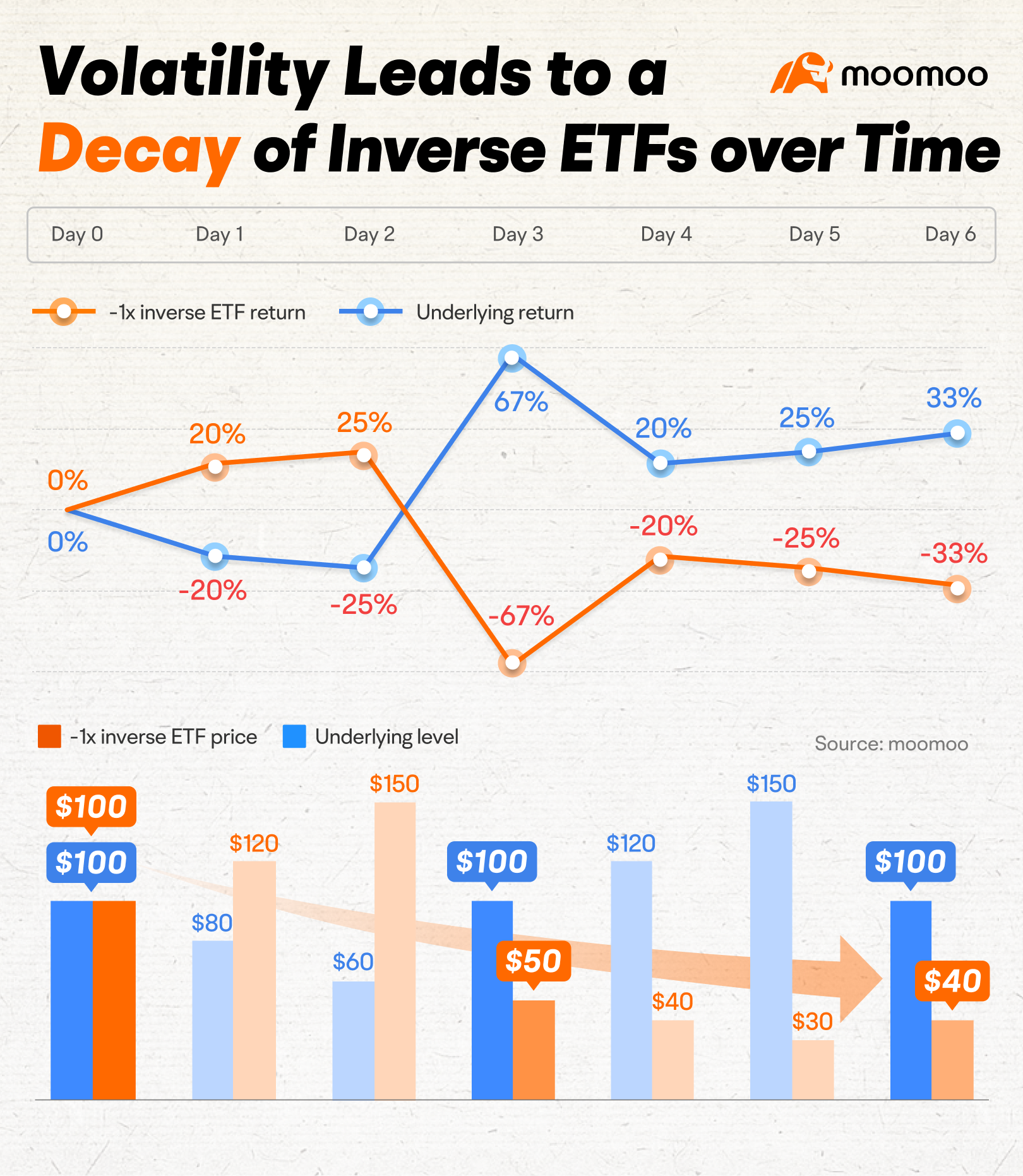
The chart above theoretically illustrates how an inverse ETF can experience volatility loss over time due to compounding effects. This effect on returns can be more pronounced with increased volatility of the underlying asset and the length of the investor's holding period.
● Short-term market timing
Unlike traditional ETFs that are generally used for long-term investment strategies, inverse ETFs are primarily favoured by traders seeking to profit from short-term market declines or to hedge against daily downturns. They operate on fundamentally different time horizons.
As a result, investors need to precisely time both their purchases and sales of inverse ETFs. Furthermore, traders need to closely monitor their portfolios because inverse ETFs are not suited for buy-and-hold strategies. This can lead to higher transaction costs and increased stress.
● Higher risks
Inverse ETFs utilise financial derivatives, such as swaps and futures contracts, to achieve their intended performance. However, these instruments carry heightened risks, as they are typically leveraged and require frequent rebalancing. This dynamic can exacerbate potential losses if the market moves against the investor.
Additionally, the performance of inverse ETFs over extended periods can significantly diverge from the inverse of the underlying asset due to compounding effects, particularly in turbulent market conditions.
● Liquidity concerns
Some inverse ETFs may have lower trading volumes, resulting in wider bid-ask spreads. This can increase the cost and complexity of entering and exiting positions.
How to find inverse ETFs?
There are several inverse ETFs available on the ASX, with the most actively traded products inversely tracking the performance of major Australian and US indices.
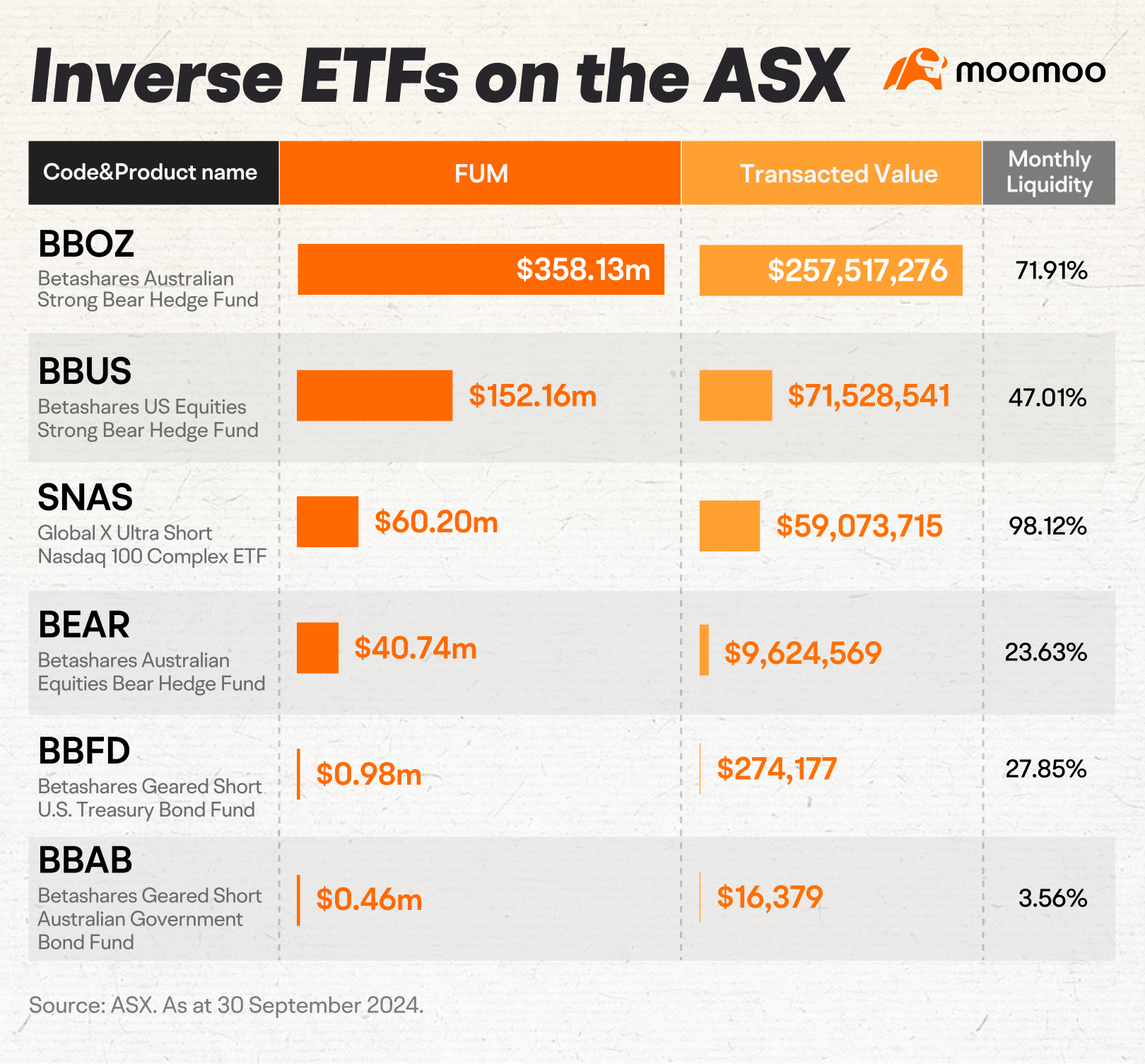
For instance, the Betashares Australian Strong Bear Hedge Fund (BBOZ) seeks to achieve a magnified daily return ranging from -2x to -2.75x in relation to the S&P/ASX 200 index. Similarly, the Betashares US Equities Strong Bear Hedge Fund (BBUS) targets a daily magnified return of -2x to -2.75x relative to the S&P 500 index. Additionally, the Global X Ultra Short Nasdaq 100 Complex ETF (SNAS) aims to deliver geared daily returns that are inversely correlated with the performance of the Nasdaq 100 index.
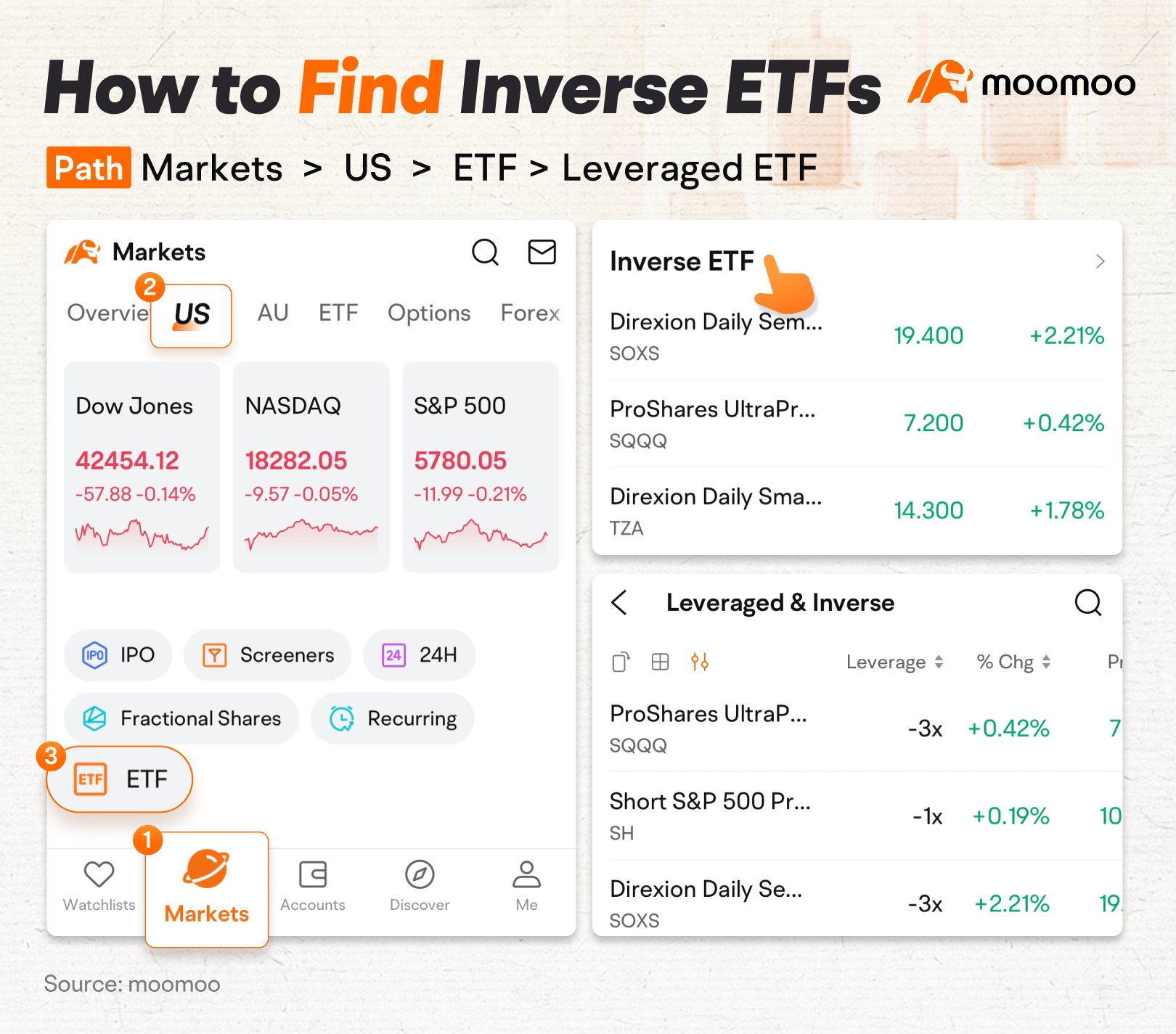
The US sharemarket offers investors a broader range of trading options. To find inverse ETFs on moomoo, simply navigate to Markets > US > ETF > Inverse ETF.
Before investing in inverse ETFs, investors should thoroughly review the prospectus to evaluate the products' investment objectives and the related risks.
The bottom line
Inverse ETFs are not suitable for all investors. They are more complex with a unique nature compared to traditional ETFs. They are typically used as a short-term instrument, not long-term buy-and-hold positions, for sophisticated and proactive investors who comprehend their specific performance characteristics and actively manage their portfolios.
Although inverse ETFs have stated objectives, typically on a daily basis, there can be a significant difference between the expected return and actual performance over the long term.
If you are a conservative investor who cannot endure significant short-term losses and cannot actively monitor your portfolio as frequently as daily to ensure that these products align with your investment objectives, then inverse ETFs are not suitable for you.
This presentation is for informational and educational use only and is not a recommendation or endorsement of any particular investment or investment strategy. Investment information provided in this content is general in nature, strictly for illustrative purposes, and may not be appropriate for all investors. Read more