Investing in US stocks in TFSA: 5 things you need to know
Tax-Free Savings Account (TFSA) is a popular way for Canadians to save and invest money without paying taxes on their profits. If you're thinking about buying US stocks in your TFSA, here are five important things to consider.
1. Can you buy US stocks in a TFSA?
Yes, you can! A TFSA allows you to invest in various assets, including US stocks. You can buy individual stocks or exchange-traded funds (ETFs) that are listed on US exchanges like Nasdaq or the NYSE. This gives you the chance to invest in global companies like $Microsoft (MSFT.US)$ , $Apple (AAPL.US)$ , $Amazon (AMZN.US)$ , and $NVIDIA (NVDA.US)$ .
However, to buy US stocks, you'll need to convert your Canadian dollars (CAD) into US dollars (USD) first. Be aware that this can involve currency conversion fees, which can affect your overall returns.
If you want to avoid dealing with currency conversions, you can invest in Canadian-listed ETFs that give you exposure to US stocks. These ETFs trade in CAD, making it easier to invest without worrying about currency exchange.
2. Do you have to pay taxes on US stocks in a TFSA?
This is an important question. While your TFSA is a tax-free account, any dividends you earn from US stocks may be subject to a 15% withholding tax imposed by the US government. Unfortunately, you can't reclaim this tax within a TFSA. However, any profits you make from selling US stocks (capital gains) are tax-free.
For example, if you buy 50 shares of $Coca-Cola (KO.US)$ at $60 each and the stock has a 2.65% dividend yield, the 15% withholding tax will reduce your effective dividend yield to about 2.25%.
If you later sell your shares for US$70 each, the capital gains will be US$20 per share and will not be taxed, allowing you to keep all your profits.
It's also important to know that the 15% withholding tax applies to US stocks as well as Canadian ETFs that hold US stocks, like VFV, which tracks the S&P 500 index.
3. Benefits of owning US stocks
Despite the withholding tax on dividends, investing in US stocks in TFSA offers three main benefits:
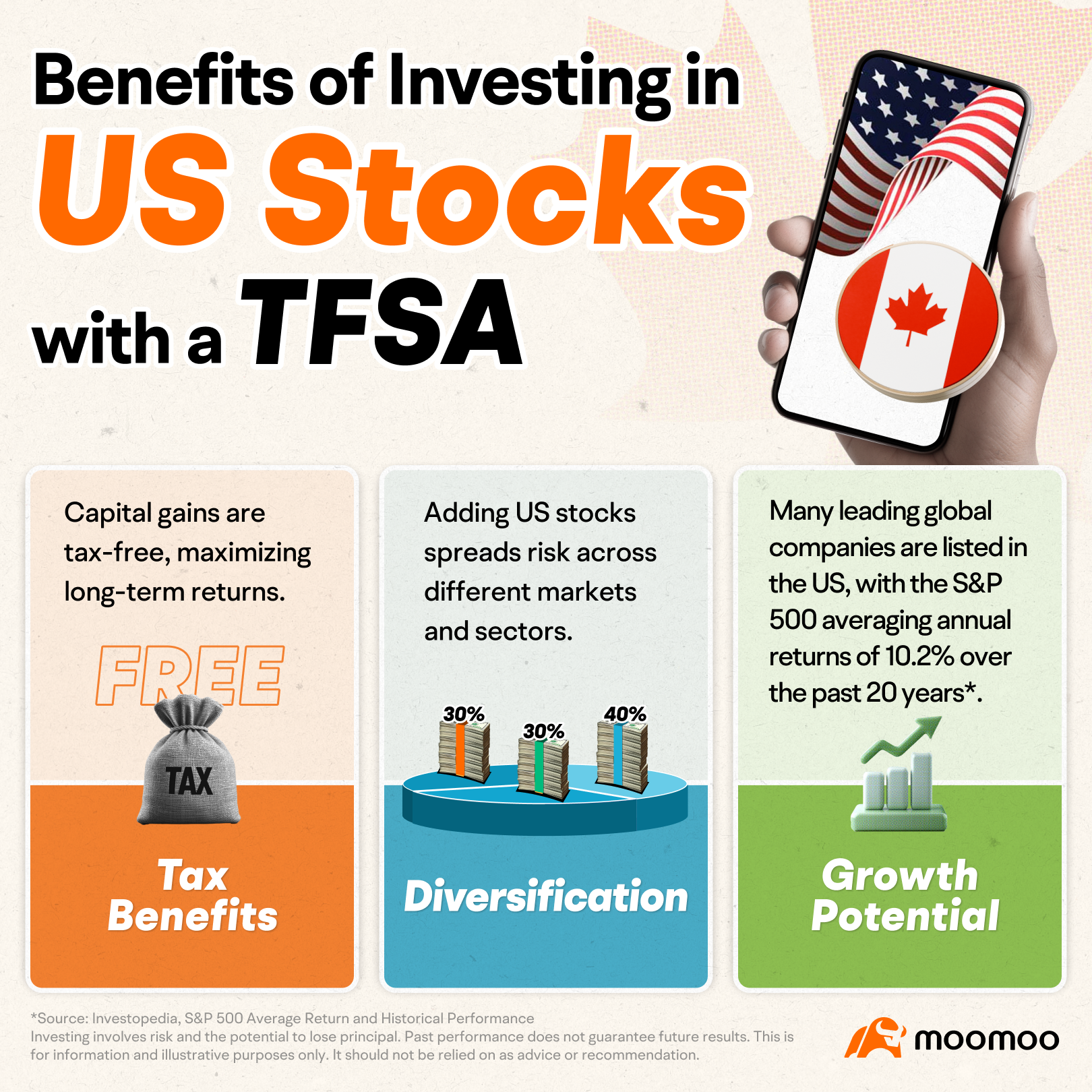
Tax Benefits: Capital gains are tax-free in a TFSA, allowing for long-term growth.
Diversification: Adding US stocks to your portfolio can help spread your risk across different markets and sectors.
Growth Potential: Many of the world’s leading companies are listed in the US stock market, which can offer growth opportunities. The S&P 500 index has averaged about 10.2% average annual returns over the past 20 years (excluding dividends)*.
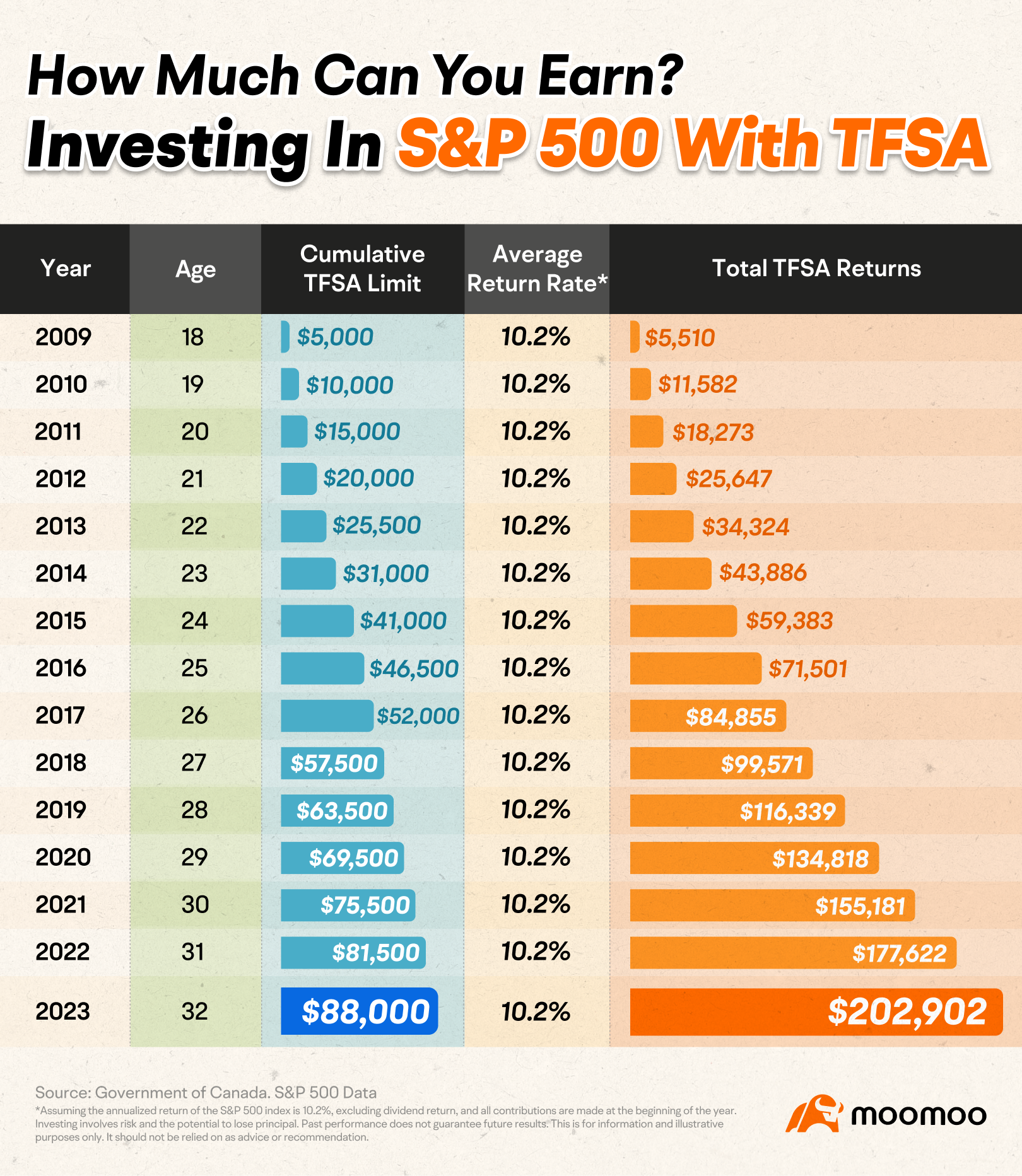
Let’s say you started putting money into your TFSA in 2009 and contributed the maximum amount each year by investing in an S&P 500 index ETF. After 15 years, how much money could you have made?
The chart below shows that your total contribution will be $88,000 from 2009 to 2023. Assuming annual returns to be 10.2%, your savings could grow to $202,902 after 15 years. That means you would have made about 1.3 times your original investment!
Keep in mind that the stock market can go up and down, and returns can vary from year to year. However, the overall trend has been upward. If you stay invested for the long term, a TFSA can potentially provide you with significant gains.
4. A simple way to hold US stocks in a TFSA
There are thousands of stocks in the US markets, making picking a stock a challenging task for many investors—almost like finding a needle in a haystack. If you're looking to invest in US stocks through your TFSA but don’t want to pick individual stocks, a simple way is to invest in an S&P 500 index ETF.
The S&P 500 index is a benchmark for the US stock market and includes the largest 500 companies listed on US exchanges. By investing in an S&P 500 ETF, you can easily gain exposure to a broad range of top-performing companies without the added hassle of researching each stock individually.
Here are two popular S&P 500 ETFs you might consider:
Vanguard S&P 500 Index ETF (TSX: VFV) This ETF trades in Canadian dollars (CAD).
Vanguard S&P 500 Index ETF (NYSE: VOO) This ETF trades in US dollars (USD).
Both VFV and VOO are managed by Vanguard and track the performance of the S&P 500 index. They hold the same underlying stocks.
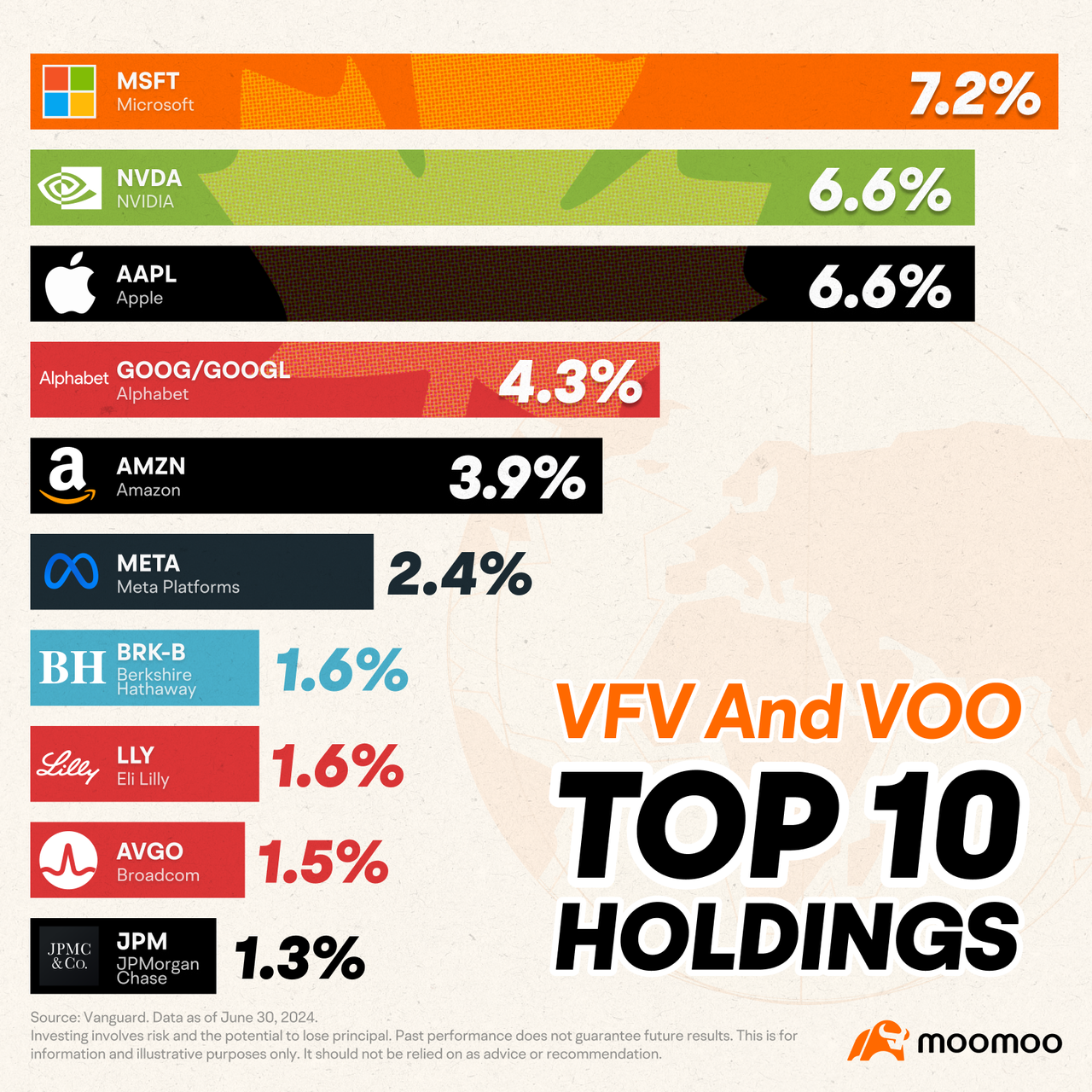
As of June 30, 2024, both ETFs have 504 stocks in their portfolios, with identical top 10 holdings, including $Microsoft (MSFT.US)$ (7.2%), $NVIDIA (NVDA.US)$ (6.6%), $Apple (AAPL.US)$ (6.6%), $Alphabet-C (GOOG.US)$ (4.3%), $Amazon (AMZN.US)$ (3.9%), $Meta Platforms (META.US)$ (2.4%), $Berkshire Hathaway-B (BRK.B.US)$ (1.6%), $Eli Lilly and Co (LLY.US)$ (1.6%), $Broadcom (AVGO.US)$ (1.5%), and $JPMorgan (JPM.US)$ (1.3%).
If you'd like to learn more about the differences between VFV and VOO, you can check out this article: Understanding S&P 500 ETFs for Canadian investors.
5. Risks of investing in US stocks
While there are many benefits, investing in US stocks also comes with risks:
Currency Fluctuations: Changes in currency value can impact your returns, especially if the Canadian dollar strengthens against the US dollar.
Market Volatility: US stocks can have significant price swings, which may affect your investment value.
Economic and Regulatory Factors: Keep an eye on the US economy and regulations, as they can influence stock performance.
Conclusion
Investing in US stocks through your TFSA can be a smart way to grow your savings without paying taxes on your gains. By understanding the tax implications, benefits, and risks, you can make informed choices that align with your financial goals.
This presentation is for informational and educational use only and is not a recommendation or endorsement of any particular investment or investment strategy. Investment information provided in this content is general in nature, strictly for illustrative purposes, and may not be appropriate for all investors. Read more